


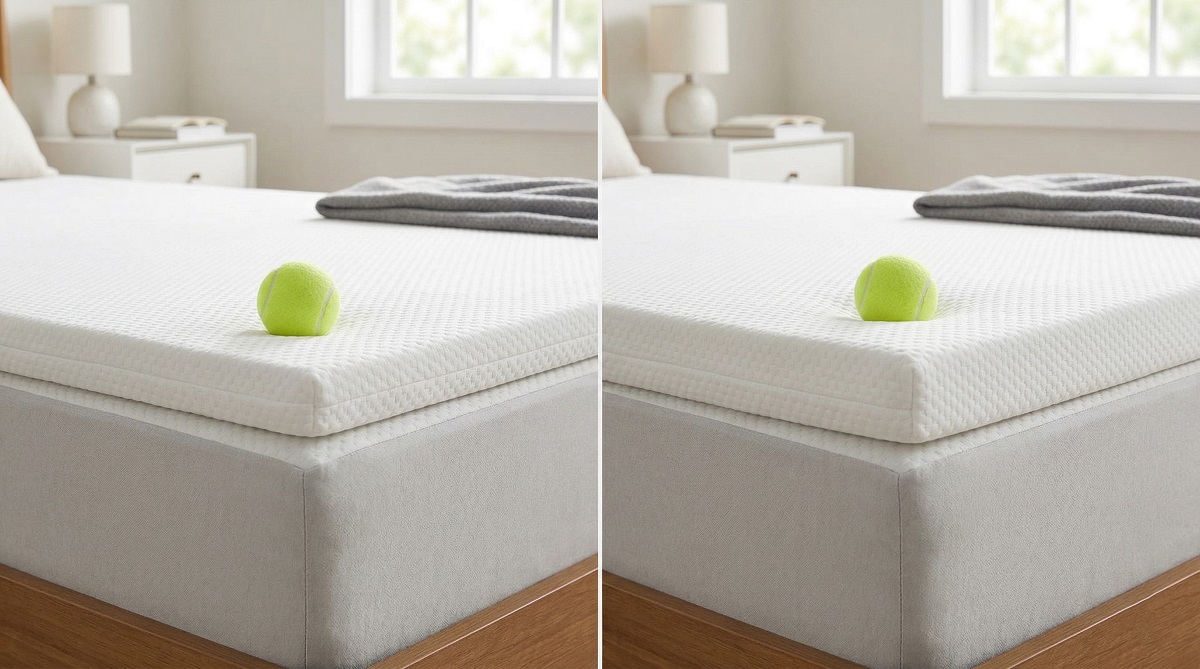
Here’s the short version: a 2-inch topper makes a subtle difference — it softens a decent mattress without dramatically changing the feel. A 3-inch topper actually transforms your sleep surface. If your mattress is firm, old, or causing shoulder or hip pain, the extra inch matters more than most people expect.
For most shoppers choosing their first topper, 3 inches is the safer bet. The price difference between 2-inch and 3-inch options from the same brand is usually under $40–$60, and the 3-inch version handles many more situations well. That said, stomach sleepers, very lightweight people, and hot sleepers often do better with 2 inches.
Read on for the full breakdown — sleep position, body weight, mattress condition, sheet compatibility, and a few things most guides skip entirely. If you’re still deciding whether you need a topper at all, our cover the broader question.
Who Should (and Shouldn’t) Go with Each Thickness
✅ Choose 2 Inches If You:
- Sleep primarily on your stomach and need to stay flat
- Weigh under 130 lbs and want a lighter comfort adjustment
- Sleep hot and want less foam between you and airflow
- Already have a supportive mattress in decent condition
- Have limited bed height left (worried about fitted sheets not reaching)
❌ Skip the 2-Inch (Go with 3) If You:
- Sleep on your side — you need more cushioning for hips and shoulders
- Weigh over 180–200 lbs
- Have chronic back, hip, or joint pain
- Have a firm or aging mattress you’re trying to refresh
- Want the topper to make a real, noticeable difference in how your bed feels
The One-Inch Difference That Actually Matters
One inch doesn’t sound like much until you’re lying on it. The gap between 2 inches and 3 inches of foam isn’t just about thickness — it changes how much your body sinks in, how well pressure points get cushioned, and how dramatically the feel of your existing mattress shifts.
What a 2-Inch Topper Does
A 2-inch layer adds a noticeable touch of softness without overhauling your sleep surface. You’ll feel a change, but your mattress still does most of the work. This makes it a solid choice when your bed is fundamentally sound but just a bit too firm for your liking. It’s also better for people who run warm at night — less foam means better airflow and less heat buildup. Adding a 2-inch topper brings your bed up by about 2 inches in total height, which matters if your existing mattress is already deep. Standard fitted sheets (which typically cap out around 12–14 inches) may still work for many setups.
What a 3-Inch Topper Does
Three inches produces a genuinely different sleep surface. Bodies sink deeper into the foam, and pressure points — particularly at the hips and shoulders — get real relief rather than a modest nudge. For someone sleeping on a rock-hard hotel mattress or a firm years-old bed, a 3-inch topper can feel like a full upgrade. The trade-off: it retains more heat than a 2-inch version, and it adds roughly 3 inches to your total bed height. If your mattress is already 12 inches or deeper, you’ll likely need (18-inch pocket depth or more) to get a proper fit. According to bedding depth guides, standard sheets fit mattresses up to about 14 inches deep, while deep-pocket sheets accommodate up to 17 inches, and extra-deep up to 25 inches.
Which Thickness Is Right for Your Sleep Position
Sleep position is the single most reliable predictor of which topper thickness you’ll prefer. Here’s how the math works:
Side Sleepers → 3 Inches (Almost Always)
Side sleeping concentrates your body weight on two narrow contact points: the shoulder and the hip. A 2-inch topper often doesn’t provide enough material to redistribute that pressure effectively, especially for anyone over 130 lbs. Three inches lets the foam contour around those curves without the underlying mattress pushing back too hard. If you regularly wake with shoulder or hip soreness, your topper likely isn’t thick enough — or isn’t thick enough yet.
Back Sleepers → 2 or 3 Inches Depending on Mattress
Back sleepers don’t put quite as much concentrated stress on individual joints, which means there’s more flexibility here. On a mattress that’s already supportive, 2 inches works fine — it softens things without letting the hips sink too far. If your mattress leans firm or is starting to feel like lying on a gym floor, go with 3 inches. The extra cushion supports the lower back curve without throwing spinal alignment off.
Stomach Sleepers → 2 Inches (or Less)
This is the one position where more isn’t better. Too much loft causes the pelvis to sink below the spine, which puts strain on the lower back. Stomach sleepers generally want the thinnest topper that still adds some softness — meaning 2 inches is typically the ceiling. Some strict stomach sleepers find even 2 inches too much and prefer a 1-inch option or no topper at all.
Combination Sleepers → 3 Inches
If you rotate between positions throughout the night, 3 inches handles the full range better. It cushions your shoulder and hip during side-sleeping stretches and still gives back sleepers adequate support when you roll. The extra inch provides flexibility that a thinner topper simply can’t match.
Body Weight Changes the Equation
The same depth of foam feels different depending on how much you weigh, because heavier bodies compress foam more deeply. Here’s a quick guide — and if you want a deeper dive into how body weight affects , we have that covered too:
- Under 130 lbs: A 2-inch topper generally provides adequate cushioning. You don’t compress foam as deeply, so you don’t need as much of it to reach the same effective comfort level.
- 130–200 lbs: This is where 3 inches becomes clearly preferable for side sleepers, and 2 inches becomes marginal. For back sleepers in this range, either works depending on the mattress condition.
- Over 200 lbs: A 3-inch topper (or thicker) is the right call for most sleep positions. Heavier frames compress foam more quickly, which means a 2-inch topper may flatten out and lose effectiveness faster. Denser foam (look for 3+ lbs per cubic foot) also holds up longer under more weight.
Foam density matters as much as thickness here. A 3-inch topper made from low-density foam (under 2 lbs/cu ft) will compress down faster than a 2-inch topper made from high-density material. Look for CertiPUR-US certified foam with a density rating of 3+ lbs per cubic foot for the best durability.
2-Inch vs 3-Inch: Head-to-Head Comparison
| Feature | 2-Inch Topper | 3-Inch Topper |
|---|---|---|
| Comfort change | Subtle adjustment | Noticeable transformation |
| Best sleep position | Stomach, back (light) | Side, combination, back (firm mattress) |
| Best body weight | Under 150 lbs | Any weight; especially 150+ lbs |
| Heat retention | Lower | Higher (more foam material) |
| Added bed height | ~2 inches | ~3 inches |
| Typical price range (queen) | ~$60–$150 | ~$80–$200 |
| Sheet pocket depth needed | Standard often works | Deep pocket (18″+) recommended |
| Mattress condition it helps | Minor firmness issues | Moderate firmness or mild aging |
Material Matters as Much as Thickness
Thickness and material work together. A 3-inch topper made of cheap, low-density foam may underperform a well-made 2-inch option. Here’s how the main materials stack up across both thicknesses:
Memory Foam
The most popular choice for a reason — memory foam contours closely to your body and provides solid pressure point relief. CertiPUR-US certified foam means it’s been tested for harmful chemicals and emissions. At 3 inches, memory foam offers substantial cradling and is great for pain relief. At 2 inches, it still contours but with less dramatic effect. One downside: memory foam traps heat more than other materials. If you sleep warm, look for gel-infused or open-cell memory foam, which handles heat better. for side-by-side cooling comparisons.
Latex
Latex is more responsive than memory foam — it pushes back against your body rather than slowly conforming. This means less of a “stuck” feeling and better temperature regulation. A 3-inch latex topper is roughly comparable in support to a 4-inch memory foam topper, thanks to latex’s higher density. If you want organic materials, look for GOLS-certified latex (Dunlop) or FSC-certified Talalay latex. Dunlop runs firmer and denser; Talalay is softer and more consistent throughout the layer.
Cooling Gel Foam
Gel-infused memory foam addresses the heat problem. The gel beads or infusion pulls warmth away from the surface. At 2 inches, cooling gel foam is a solid pick for hot sleepers who want some softness without a heat trap. At 3 inches, gel infusion becomes even more important — otherwise, you’re adding more material that retains warmth.
Practical Things Most Guides Skip
Your Fitted Sheets Might Not Fit Anymore
This is one of the more annoying surprises for first-time topper buyers. Before you order, measure the depth of your current mattress from top to bottom. Add the topper thickness to that number. If your mattress is 10 inches deep and you add a 3-inch topper, you’re at 13 inches total — standard sheets (which typically work up to 12–14 inches) might still fit, but just barely. A 12-inch mattress plus a 3-inch topper puts you at 15 inches, which needs deep-pocket sheets. A 14-inch mattress plus a 3-inch topper at 17 inches needs extra-deep-pocket sheets to reliably stay on. Save yourself a frustrating middle-of-the-night fight with your fitted sheet and check the math before you buy.
A Topper Can’t Fix a Structurally Broken Mattress
If your mattress has developed a visible sag — a dip where you sleep — a topper will conform to that depression rather than flatten it out. Industry guidance suggests that once sag exceeds about 1.5 inches, you’re looking at a mattress replacement rather than a topper fix. A 3-inch topper can mask minor sagging temporarily, but it won’t restore even, flat support. Use a topper to extend a mostly-good mattress or to adjust firmness on a new one — not to rescue a mattress that’s already given up.
Weight and Portability
This matters more than people think, especially for college students or anyone who needs to move the topper periodically. The ViscoSoft Select High Density 3-inch queen topper, for example, weighs around 30 lbs, according to ViscoSoft’s product page. A 2-inch version of the same model is meaningfully lighter. If you’re outfitting a dorm Twin XL or plan to store the topper seasonally, that weight difference is worth factoring in.
A Few Options Worth Considering
Rather than a full roundup, here are three well-reviewed options that give you a practical sense of the price range for both thicknesses as of March 2026 (check current pricing before buying — these fluctuate):
- ViscoSoft Select High Density (2″ and 3″) — Named the top memory-foam topper pick by NY Times Wirecutter for 2025–2026. Uses 3+ lbs/cu ft CertiPUR-US certified foam. The 3-inch queen was priced around $119–$205 on the ViscoSoft website (sale prices vary). Available in Twin XL for college dorms. 90-day return window. Check current price on Amazon.
- Casper Mattress Topper (2″ and 3″) — The 3-inch version was listed at $155 sale price for queen as of March 2026. Casper uses Breathe Flex Foam designed for responsiveness and airflow. Check current price on Casper.com.
- Lucid 3-Inch Gel Memory Foam Topper — The most budget-friendly option of the three. The queen typically runs $79–$99.99 on Amazon. Gel-infused for cooling; CertiPUR-US certified. Good for sleepers on a tight budget who still want meaningful pressure relief. Check current price on Amazon.
For organic material options, for latex topper breakdowns from brands like Avocado Green Mattress.
Frequently Asked Questions
Which is better: a 2-inch or 3-inch mattress topper?
For most people, 3 inches is the stronger pick. It handles more sleep positions, does more for pain and stress points, and provides a meaningful upgrade on a firm mattress. A 2-inch option makes sense primarily for stomach sleepers, very lightweight people, or hot sleepers who want minimal added foam. See for a broader comparison if you’re still weighing options.
Does a 2-inch mattress topper make a noticeable difference?
Yes — but the effect is subtle compared to 3 inches. You’ll feel softer than your bare mattress, but the underlying support character of your bed stays largely intact. Think of it as fine-tuning rather than overhauling.
Can a 3-inch topper be too thick?
For stomach sleepers, often yes. Too much loft lets the pelvis drop below the spine, straining the lower back. If you sleep mostly on your stomach, 1–2 inches is the safer range. For all other positions, 3 inches is rarely too much.
Does a thicker topper trap more heat?
In general, yes — more foam means more heat retention, especially with traditional memory foam. If you run hot, look for gel-infused or latex options in either thickness. Latex naturally sleeps cooler than memory foam at the same depth.
Will a 3-inch topper fix my sagging mattress?
Only partially, and temporarily. A topper conforms to the shape of your mattress — it doesn’t restore flat, even support. Once sag exceeds about 1.5 inches, a topper becomes a temporary mask rather than a real fix. That’s generally when it’s time to replace the mattress.
What sheets do I need for a 3-inch topper?
Add your mattress depth to 3 inches. If the total is under 14 inches, standard sheets might work. Between 14–17 inches, go with deep-pocket sheets. Over 17 inches, look for extra-deep-pocket sheets (18″+ depth). Deep-pocket sheets are widely available and not significantly more expensive than standard ones.
How long does a 2 or 3 inch topper last?
Typically 3–5 years with regular use. Foam density is the main longevity factor — high-density foam (3+ lbs per cubic foot) holds up significantly longer than cheaper, lighter alternatives. A 3-inch high-density topper will often outlast a 2-inch low-density one.
Is a 3-inch topper better for back pain?
For most side and back sleepers dealing with back pain, yes. The extra cushioning at the hips and shoulders reduces pressure that can otherwise contribute to lower back discomfort. That said, material matters too — a medium-firm latex or memory foam topper typically outperforms a very soft plush option for pain relief, regardless of thickness. Browse for tested options across both categories.
Prices and availability on mattress toppers shift regularly. For the most current options, check 3-inch toppers on Amazon or 2-inch toppers on Amazon to compare current deals across brands.
