


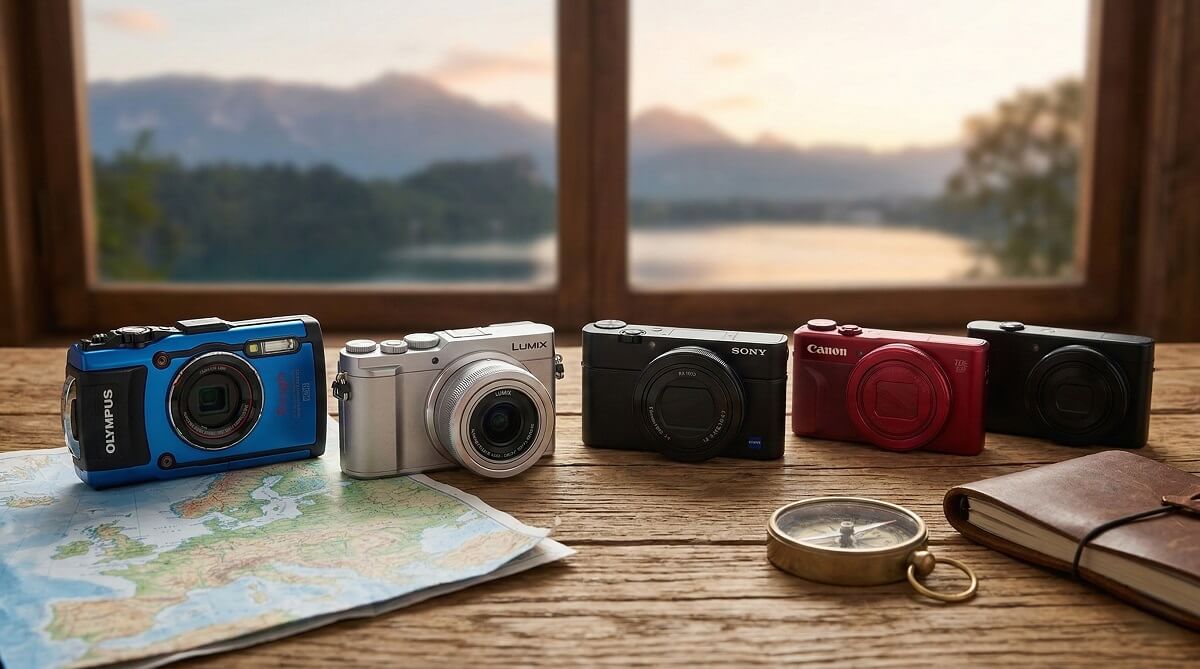
Let’s be honest: finding a quality point-and-shoot camera under $500 is harder than it was five years ago. The market has contracted significantly as smartphones have gotten better, and many popular models from 2015-2020 are either discontinued or now cost well over $500. That said, there are still solid options if you know where to look and what trade-offs to accept.
Your best choice depends on what you need most. If durability matters, the OM System Tough TG-7 ($550, slightly over budget) is waterproof to 50 feet and nearly indestructible. For vlogging on a budget, the Canon PowerShot V10 ($399) offers good video quality despite some overheating issues. Need serious zoom? The Canon PowerShot SX740 HS delivers 40x optical zoom. And if image quality is your priority, consider the used market—a Sony RX100 III from 2014-2016 still produces excellent photos and costs under $400 used.
This guide covers what’s actually available right now, with verified pricing and honest assessments of where these cameras win against and where they don’t. We’ll also explain when you might be better off with your phone or stepping up to a mirrorless camera instead.
Who Should (and Shouldn’t) Buy a Point-and-Shoot Camera in 2026
✅ Consider a Point-and-Shoot Camera Under $500 If:
- You want better optical zoom than your smartphone (10x or more)
- You need a compact backup camera for travel alongside your main gear
- You’re shopping for someone who finds smartphones frustrating to use as cameras
- You need a camera that can survive harsh conditions (water, cold, drops)
- You want manual controls in a pocketable size
- You’re upgrading from a camera that’s 10+ years old
❌ Skip This Category If:
- Your smartphone is from 2023 or newer and you’re happy with its photos
- You primarily shoot in low light without a tripod (phones often do better here)
- You want the absolute best image quality ()
- You need advanced video features like high frame rates or LOG profiles
- You don’t want to carry a separate device
- You expect a major improvement over your phone without any compromises
The Point-and-Shoot Market in 2026: What’s Changed
Here’s what you need to know about the current state of compact cameras under $500. The once-thriving point-and-shoot market has shrunk dramatically. Popular models like the Sony RX100 VII now cost $1,699—more than triple our budget. The Canon PowerShot G7 X Mark III, a former favorite, runs around $1,300 for the limited edition announced in early 2026. Many cameras recommended in articles from just a few years ago are no longer made.
Why the change? with computational photography have gotten remarkably good. Modern phones like the Samsung Galaxy S23 Ultra feature a 1/1.3-inch main sensor—not far off from some compact cameras. They combine multiple exposures instantly, handle HDR automatically, and deliver photos that look great on screens and social media.
But dedicated cameras still have advantages. Optical zoom beats digital zoom every time. A 1-inch sensor provides better background blur and low-light performance than most phones. Physical controls make manual shooting easier. And a camera won’t buzz with notifications while you’re trying to compose a shot.
The cameras that remain under $500 tend to specialize: rugged models for extreme conditions, superzoom cameras for telephoto reach, or budget options that make specific compromises. There’s no perfect all-rounder at this price point in 2026—you’ll need to choose what matters most to you.
Top Point-and-Shoot Cameras Under (or Near) $500
1. Canon PowerShot SX740 HS — Best for Zoom
Price: Approximately $300-$350 (check current pricing at Best Buy or Amazon)
The SX740 HS packs a 40x optical zoom (24-960mm equivalent) into a body you can slip into a jacket pocket. That zoom range is the big draw here—you can shoot everything from wide landscapes to distant wildlife or sports action. The camera also shoots 4K video, though only at 30fps.
Key Strengths:
- 40x optical zoom range—impossible to match with a smartphone
- 20.3-megapixel sensor produces decent images in good light
- Compact size despite the zoom lens
- Built-in WiFi for transferring photos to your phone
- Affordable price point
Limitations:
- 1/2.3-inch sensor is small—not much better than a phone in low light
- No viewfinder (LCD screen only)
- Image quality drops at maximum zoom
- Battery life is modest
Best for: Travel photographers who need zoom reach, parents shooting kids’ sports or school events, wildlife watchers, anyone prioritizing telephoto capability over ultimate image quality.
2. Canon PowerShot V10 — Best Budget Vlogging Camera
Price: $399 (Canon direct)
The V10 isn’t a traditional point-and-shoot—it’s designed specifically for vlogging and social media content. It features a 1-inch sensor, built-in stand, stereo microphones with background noise filtering, and a flip screen. The camera shoots 4K video and handles face tracking well.
Key Strengths:
- 1-inch sensor provides good image quality for the price
- Excellent audio with stereo mics and noise filtering
- Face tracking works reliably for vlog-style shooting
- Compact and lightweight (210g)
- Built-in stand is genuinely useful
- 14 built-in color filters for quick creative looks
Limitations:
- Overheating issues during extended 4K recording
- Poor battery life—plan to buy spares
- Not weather-sealed
- Fixed 19mm wide-angle lens (no zoom)
- Struggles in low light despite the larger sensor
Best for: Content creators, vloggers, social media users who want better quality than a phone, anyone making talking-head videos or .
3. OM System Tough TG-7 — Best Rugged Camera
Price: $550 (OM System | B&H Photo)
Yes, this is $50 over our budget, but there’s no real competition in the rugged camera category under $500. The TG-7 is waterproof to 50 feet, freezeproof to 14°F, shockproof to 7-foot drops, and crushproof to 220 pounds. It’s the camera you take snorkeling, skiing, or anywhere you wouldn’t dare bring your phone.
Key Strengths:
- Exceptional durability—survives conditions that would destroy other cameras
- Waterproof without needing a separate case
- Macro mode is surprisingly good (4x microscope mode)
- RAW support added in this version (big improvement over TG-6)
- GPS, compass, and temperature sensor built-in
- Fast f/2.0 lens at wide end
Limitations:
- Small 1/2.3-inch sensor limits image quality
- Only 12 megapixels (fine for most uses, but lower than competitors)
- 4x zoom is modest compared to superzooms
- Largely unchanged from previous TG-6 model
- Over budget at $550
Best for: Outdoor enthusiasts, scuba divers and snorkelers, travelers in harsh climates, parents with young kids (drops happen), anyone who needs a that won’t quit.
4. Panasonic Lumix ZS100/TZ100 — Best Travel Zoom (Used)
Price: Around $400-$450 used (KEH | MPB | eBay)
This 2016 model remains one of the best travel cameras ever made. It combines a 1-inch sensor with a 10x zoom (25-250mm equivalent) in a truly pocketable body. The ZS100 includes an electronic viewfinder, RAW support, and 4K video. While it’s no longer produced new, quality used examples are readily available.
Key Strengths:
- 1-inch sensor delivers significantly better image quality than superzooms
- 10x zoom covers most travel photography needs
- Built-in electronic viewfinder (rare at this price)
- Leica-branded lens is sharp across the zoom range
- Genuine pocket camera despite the zoom and sensor
- Touchscreen LCD is responsive
Limitations:
- Discontinued—must buy used
- Battery life is adequate but not exceptional
- Autofocus is slower than newer cameras
- No weather sealing
- Small EVF (but having one at all is valuable)
Best for: Travelers who want both zoom and image quality, street photographers who value a viewfinder, anyone willing to buy used for better performance.
5. Sony RX100 III — Best Image Quality (Used)
Price: Under $400 used (KEH | MPB | eBay)
The RX100 series set the standard for premium compact cameras. The Mark III (2014) remains relevant in 2026 thanks to its 1-inch sensor, fast f/1.8-2.8 lens, pop-up electronic viewfinder, and excellent build quality. Newer RX100 models offer improvements but cost $1,000+ even used. The III hits the sweet spot of capability and value.
Key Strengths:
- Outstanding image quality from 1-inch sensor
- Fast lens (f/1.8-2.8) enables good low-light shooting
- Pop-up OLED viewfinder
- Manual controls and RAW support
- Excellent build quality—feels like a premium device
- Tilting LCD for flexible composition
Limitations:
- Modest 2.9x zoom (24-70mm equivalent)
- Discontinued—used market only
- No 4K video (1080p only)
- Autofocus is good but not cutting-edge
- Battery life requires planning (carry spares)
Best for: Photography enthusiasts who prioritize image quality, street photographers, anyone who wants a “real camera” experience in a compact size, travelers who don’t need long zoom.
Point-and-Shoot Camera Comparison
| Model | Price | Sensor Size | Megapixels | Zoom Range | Viewfinder | Video | Best For |
|---|---|---|---|---|---|---|---|
| Canon SX740 HS | ~$350 | 1/2.3″ | 20.3 MP | 40x (24-960mm) | No | 4K/30p | Zoom reach |
| Canon PowerShot V10 | $399 | 1″ | 15.2 MP | Fixed 19mm | No | 4K/30p | Vlogging |
| OM System TG-7 | $550 | 1/2.3″ | 12 MP | 4x (25-100mm) | No | 4K/30p | Durability |
| Panasonic ZS100 (used) | ~$450 | 1″ | 20 MP | 10x (25-250mm) | Yes (EVF) | 4K/30p | Travel |
| Sony RX100 III (used) | ~$400 | 1″ | 20 MP | 2.9x (24-70mm) | Yes (EVF) | 1080p | Image quality |
Prices as of February 2026. Check retailers for current availability and deals.
What to Look for in a Point-and-Shoot Camera
Sensor Size Matters More Than Megapixels
Don’t get caught up in the megapixel race. A 12-megapixel camera with a 1-inch sensor will produce better images than a 20-megapixel camera with a 1/2.3-inch sensor. Larger sensors capture more light, deliver better background blur, and perform better in dim conditions.
For reference, high-end now use 1/1.3-inch main sensors. To get a meaningful improvement over your phone, look for cameras with 1-inch sensors. The 1/2.3-inch sensors in budget and superzoom cameras won’t wow you in direct comparisons, but they enable features phones can’t match—like 40x optical zoom.
Zoom Range vs. Image Quality Trade-Off
Physics is unforgiving: you can’t have a huge zoom range and excellent image quality in a pocketable camera at this price. Superzoom cameras like the Canon SX740 HS sacrifice sensor size to fit that 40x lens. Cameras with 1-inch sensors typically max out around 10x zoom.
Think about what you actually shoot. If you’re photographing buildings, food, and people within 10 feet, you don’t need 40x zoom. If you’re watching birds or shooting sports from the stands, zoom matters more than ultimate image quality.
Viewfinder or Not?
A viewfinder makes a real difference in bright sunlight when LCD screens wash out. Electronic viewfinders (EVFs) also help you hold the camera steadier—pressing it against your face creates a third point of contact. The Panasonic ZS100 and Sony RX100 III both include EVFs. Budget models skip them to save cost.
Features Worth Paying For
- RAW format support: Gives you more control in post-processing
- Manual controls: Aperture, shutter speed, and ISO adjustment
- WiFi/Bluetooth: Easy photo transfer to your phone
- Image stabilization: Helps with handheld shots at slower shutter speeds
Features You Can Skip
- GPS tagging: Your phone does this better and doesn’t drain camera battery
- Built-in filters: Easier to apply in editing software
- Touchscreens: Nice to have but not essential for most shooting
- More than 20 megapixels: Diminishing returns unless you print very large
Point-and-Shoot vs. Smartphone: The Honest Truth
Where Dedicated Cameras Still Win
Optical zoom is the clearest advantage. A 10x optical zoom on a compact camera delivers far better results than cropping a smartphone photo or using digital zoom. The Canon SX740 HS’s 40x zoom is simply impossible on a phone.
Larger sensors in 1-inch compact cameras provide better background blur (bokeh) than phones can achieve naturally. While phone portrait modes fake this effect with software, they often make mistakes around hair and complex edges. A real lens at f/1.8 or f/2.0 gives you authentic depth of field.
Physical controls make manual shooting much easier. Changing shutter speed or aperture with a dial beats fumbling through touchscreen menus. A proper camera also won’t interrupt your shot with notifications, texts, or low battery warnings from other apps.
Where Smartphones Have Caught Up
Computational photography has gotten remarkably sophisticated. Night modes on modern phones combine multiple exposures to produce bright, clean shots in conditions that would challenge budget cameras. HDR processing happens automatically and usually looks natural.
Convenience is huge. You always have your with you. Photos automatically back up to the cloud. You can edit and share images instantly. There’s no memory card to worry about or extra device to charge.
For video, phones often match or beat budget cameras. Features like cinematic mode, action mode stabilization, and easy vertical video recording are standard on smartphones but rare on point-and-shoots under $500.
The Verdict
If you have a smartphone from 2023 or newer, a point-and-shoot camera under $500 won’t dramatically improve your photos in all situations. The improvement is specific: better zoom, better manual controls, better ergonomics, or better durability. If none of those matters to you, your phone might be enough.
But if you’re upgrading from an old camera, need serious zoom, or want dedicated controls, these compact cameras still make sense. They’re tools for specific jobs, not universal upgrades over modern phones.
New vs. Used: Where to Find These Cameras
Buying New
The Canon PowerShot SX740 HS, Canon PowerShot V10, and OM System TG-7 are all current production models. You can buy them from major with full warranties. Check pricing at:
- Best Buy: Often has open-box deals and allows in-store pickup
- Amazon: Wide selection, fast shipping, easy returns
- B&H Photo Video: Knowledgeable staff, no sales tax in most states
- Manufacturer direct: Sometimes offers bundles with accessories
Buying Used or Refurbished
The used market is where you’ll find the best value, particularly for discontinued premium models like the Sony RX100 III and Panasonic ZS100. These cameras were built to last and often come from enthusiasts who took good care of them.
Trusted used camera sources:
- KEH Camera: Grades condition conservatively, offers warranties, excellent return policy
- MPB: Similar to KEH, global marketplace, transparent grading
- eBay: Widest selection, buyer protection through eBay Money Back Guarantee, read seller ratings carefully
- Local camera shops: Can inspect before buying, build relationships for future gear
What to check when buying used:
- Sensor condition—look for dust or marks (minor dust on lens is normal)
- Shutter count if available (though compacts don’t always report this)
- Battery health—may need to buy a replacement
- LCD scratches or cracks
- All buttons and dials function properly
- Lens extends and retracts smoothly without grinding sounds
Used cameras typically cost 40-60% less than original retail prices. A Sony RX100 III that sold for $800 new in 2014 now runs under $400 used, yet delivers image quality that holds up today.
Models to Avoid
Skip cameras with 1/2.3-inch sensors and no zoom advantage—they won’t beat your smartphone. Avoid cameras older than 2012 unless you’re deliberately going vintage. And be wary of “too good to be true” deals on eBay for high-end models—verify the seller’s reputation and return policy.
Which Camera for Your Needs
For Casual Travelers
Get the Panasonic Lumix ZS100/TZ100 (used). The 10x zoom covers most travel situations, the 1-inch sensor delivers quality photos worth printing, and it fits in a pocket. The viewfinder is a lifesaver for framing shots in bright Mediterranean sun or Asian midday heat.
For Outdoor Enthusiasts
The OM System Tough TG-7 is the obvious choice despite the $550 price. Take it snorkeling without a case, shoot in the snow without worry, or hand it to kids without holding your breath. The waterproof capability alone justifies the price for anyone who does water sports.
For Content Creators
The Canon PowerShot V10 was designed for . The built-in stand, good audio, and face tracking make solo recording straightforward. Just be aware of the overheating limits if you plan long takes.
For Wildlife and Sports
Choose the Canon PowerShot SX740 HS. That 40x zoom lets you capture distant subjects that would be tiny dots with other cameras. Image quality won’t match 1-inch sensor cameras, but you’ll actually get the shot instead of having nothing.
For Learning Photography
Look for a used Sony RX100 III or Canon PowerShot G7 X Mark II (if you find one under $500 used). Both offer full manual controls, RAW shooting, and image quality that rewards careful technique. You’ll learn composition and exposure without the bulk of a .
Frequently Asked Questions
Are point-and-shoot cameras still worth buying in 2026?
It depends on your needs. Point-and-shoot cameras remain valuable if you want optical zoom beyond what smartphones offer, need a rugged camera for harsh conditions, or prefer dedicated camera controls. However, if you have a recent smartphone and primarily shoot in good light without needing zoom, your phone may be sufficient. The market has shifted toward specialized cameras (rugged, superzoom, vlogging) rather than general-purpose models.
What’s the minimum sensor size worth considering?
Look for 1-inch sensors if you want meaningfully better image quality than smartphones. Modern flagship phones use 1/1.3-inch main sensors, so cameras with smaller 1/2.3-inch sensors won’t deliver much improvement in image quality. The trade-off: 1-inch sensor cameras typically cost more or have less zoom range than cameras with smaller sensors. The exception is superzoom cameras—their long zoom lenses are worth accepting a smaller sensor.
Can I get a good camera for under $300?
Options are limited. The Canon PowerShot SX740 HS typically falls in the $300-$350 range and offers excellent zoom, though image quality won’t dramatically beat a modern smartphone. Under $300, you’re mostly looking at older used models or cameras with very small sensors. Consider saving up to the $400-$500 range or checking the used market for better options like discontinued premium compacts.
Should I buy new or used?
Used cameras offer better value, especially for discontinued premium models like the Sony RX100 series and Panasonic Lumix ZS100. These cameras were built well and often deliver better performance than current budget models. Buy new if you want a warranty, the latest features, or a camera still in production (like the Canon SX740 HS or OM System TG-7). Buy from reputable used dealers like KEH or MPB for graded condition and return policies.
What’s the best point-and-shoot for video?
The Canon PowerShot V10 ($399) was designed specifically for video and vlogging, with good audio, face tracking, and a built-in stand. However, it has overheating issues during extended 4K recording. For more reliable video, consider the Panasonic Lumix ZS100 (used), which shoots 4K without overheating problems, or step up to a mirrorless camera like the Sony a6100 if video is your primary focus.
Do I need a viewfinder?
A viewfinder helps in bright sunlight when LCD screens wash out, and it steadies the camera by creating a third contact point against your face. The Panasonic ZS100 and Sony RX100 III both include electronic viewfinders. That said, many photographers shoot perfectly well with just an LCD screen. If you frequently shoot outdoors in bright conditions or want better stability for handheld shots, a viewfinder is worth prioritizing.
How does zoom quality compare to my smartphone?
Optical zoom on dedicated cameras is vastly superior to smartphone digital zoom. A 10x optical zoom captures real detail at distance, while cropping a smartphone photo results in blurry, pixelated images. Even a modest 10x zoom on the Panasonic ZS100 provides reach your phone can’t match. Superzoom cameras like the Canon SX740 HS with 40x zoom open up entirely new photographic possibilities—wildlife, sports, or architectural details—that are impossible with phone cameras.
What accessories do I need?
At minimum, buy extra batteries. Most compact cameras get 200-300 shots per charge, and you’ll want spares for full-day shooting. Also get a fast SD card (UHS-I or UHS-II) for 4K video. Optional include a wrist strap (included with most cameras), a small camera case for protection, and a screen protector if you’re rough on gear. Skip expensive manufacturer accessories—third-party batteries and chargers work fine and cost less.
How long will a point-and-shoot camera last?
Compact cameras typically last 5-10 years with normal use. The Sony RX100 III from 2014 still takes excellent photos in 2026. Potential failure points include the extending zoom lens mechanism, LCD screen, and battery life degradation. Used cameras from 2014-2019 can still serve you well for several more years, especially if you’re okay with 1080p video instead of 4K. The limiting factor is often software (slower autofocus, no modern features) rather than catastrophic failure.
Can I use these cameras for professional work?
It depends on the work. These cameras can handle product photography for e-commerce, event candids, real estate exteriors (with the superzoom), or social media content creation. They’re not suitable for professional portraits requiring shallow depth of field, low-light event photography (like weddings), or anything requiring advanced controls and reliability under pressure. Think of them as capable backup cameras or specialized tools rather than primary professional bodies.
Final Recommendations
The best point-and-shoot camera under $500 depends entirely on how you’ll use it. There’s no perfect all-rounder at this price in 2026—you’re choosing between different strengths.
For most people: Consider the used market first. A Panasonic Lumix ZS100 or Sony RX100 III around $400 delivers better image quality than current budget models and costs less than mid-range options.
If you need zoom: The Canon PowerShot SX740 HS offers 40x reach at an affordable price. Accept that image quality will be modest.
If you need durability: Stretch your budget to $550 for the OM System TG-7. Nothing else comes close for underwater and extreme conditions.
If you’re creating video content: The Canon PowerShot V10 at $399 is purpose-built for vlogging, though overheating is an issue for long recordings.
How to Make Your Decision
Start by honestly assessing what you need. Look at your phone’s recent photos—what situations did it struggle with? If you rarely zoom beyond 3x, don’t pay for superzoom. If you never shoot in harsh conditions, skip the rugged camera. If you’re happy with your phone for everything except wildlife photography, get the superzoom.
Then set a realistic budget. The sweet spot for used premium compacts is $350-$450. New cameras with real advantages over phones typically start around $400. Don’t expect miracles from $200 cameras—at that price, your phone probably does better.
Finally, remember these are tools for specific jobs. A point-and-shoot camera in 2026 isn’t trying to do everything—it’s filling gaps smartphones can’t. Choose the camera that fills your specific gap, accept the trade-offs, and you’ll be happy with your purchase.
Check current prices and availability at Amazon, Best Buy, or B&H Photo Video. For used cameras, browse KEH Camera, MPB, and eBay.
