


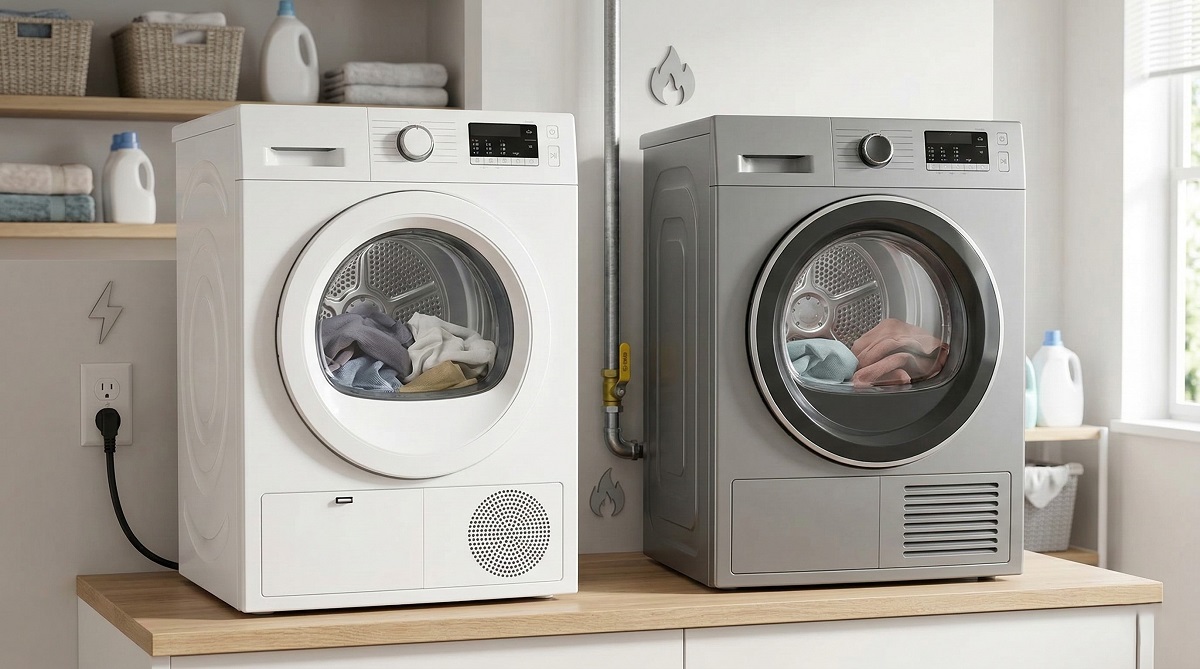
For most homeowners, choosing between an electric dryer and a gas dryer comes down to whether you already have a gas line. If you do, gas dryers save money long-term despite higher upfront costs—typically $50 to $75 per year in operating expenses. If you don’t have a gas line, electric dryers make more sense unless you’re willing to invest $350 to $2,000 in gas line installation.
The key difference: gas dryers heat clothes faster and cost less per load to run (15-25 cents vs 30-40 cents), but they require a natural gas hookup and professional installation. Electric dryers plug into a 240-volt outlet, cost less upfront ($400-$600 vs $500-$750 for mid-range models), and work anywhere—but they have slower dry times and higher electricity bills.
For families doing five or more loads weekly, gas dryers typically pay for themselves within 5-8 years through lower operating costs. For light users or renters, electric models offer better value. Heat pump dryers (a newer electric technology) use 50% less energy than traditional electric dryers and compete with gas efficiency, though they come with higher purchase prices. for more appliance comparisons.
Quick Decision Guide
| Choose Gas Dryer If… | Choose Electric Dryer If… |
|---|---|
| ✅ You already have a gas line | ✅ You don’t have a gas line |
| ✅ You do 5+ loads per week | ✅ You do fewer than 4 loads weekly |
| ✅ You own your home | ✅ You rent or plan to move soon |
| ✅ Natural gas is cheap in your area | ✅ You have access to renewable electricity |
| ✅ You want faster drying times | ✅ You prioritize simple maintenance |
Understanding How Each Type Works
How Gas Dryers Work
Gas dryers use a natural gas or propane burner to generate heat. An electric motor spins the drum while a fan circulates the hot air to dry your clothes. Because the burner produces instant, high-temperature heat, gas dryers typically dry loads in 30-40 minutes.
These units require both a gas line connection and a standard 120-volt outlet for the motor and controls. They also need proper venting to exhaust combustion byproducts safely outdoors. An ignition system lights the burner when needed, similar to how a gas furnace operates.
How Electric Dryers Work
Electric dryers use metal heating coils to convert electricity into heat. The same basic principle applies—an electric motor spins the drum and a fan circulates warm air—but the heating method differs. Instead of a gas flame, electric resistance coils warm up like the elements in a toaster.
These models require a dedicated 240-volt outlet, which delivers higher voltage than standard household outlets (120V). Most electric dryers remove moisture through condensation or venting. The lower heat output compared to gas means longer dry times, typically 45-60 minutes per load.
On average, electric dryers use 3-5 kilowatt-hours (kWh) per load, while gas dryers consume about 0.2-0.25 therms of natural gas per load. This difference in fuel type and efficiency is what drives the cost variations between the two options.
Cost Comparison: Upfront vs Long-Term
Purchase Price
Electric dryers typically cost $400 to $600 for mid-range models, while comparable gas dryers run $500 to $750—about 10-20% more upfront. High-end models of both types range from $1,200 to $1,600, with some premium units reaching $2,300.
You can find budget options for less: some electric models start around $300, and we’ve seen well-rated gas dryers for as low as $340. The price difference has been narrowing in recent years as manufacturers streamline production for both fuel types.
Installation Costs
Installation expenses vary significantly based on your home’s existing setup:
For electric dryers: If you already have a 240-volt outlet in your laundry area, installation costs just $50-$200 for basic hookup. If you need a new 240V outlet installed, expect to pay an electrician $300-$800. In some cases, you might need an electrical panel upgrade, which can add $1,300-$4,000 to your costs.
For gas dryers: With an existing gas line nearby, hookup runs $100-$300, including professional installation and safety inspection. If you need a new gas line installed, costs jump to $350-$2,000 depending on the distance from your gas meter and complexity of the installation. Gas valve installation adds another $200-$500.
Professional installation is recommended for both types. Gas dryers require it for safety (and often to maintain warranty coverage), while electric dryers benefit from proper grounding and circuit protection.
Operating Costs Per Load
Here’s where gas dryers pull ahead. Based on current 2026 national average utility rates:
- Gas dryers: 15-25 cents per load
- Electric dryers: 30-40 cents per load
The exact cost depends on your local electricity rates (national average: 18.05 cents per kWh) and natural gas rates (national average: $14.87 per thousand cubic feet). According to Bob Vila’s analysis, gas dryers operate at roughly half the energy expense of electric alternatives in most regions.
Annual Operating Costs
For an average household doing about 283 loads per year (5.4 loads per week), here’s what you can expect:
- Gas dryer: $60-$85 per year
- Electric dryer: $120-$130 per year
- Annual savings with gas: $50-$75
If you do laundry less frequently—say three loads per week—the annual savings shrink to $25-$40. The break-even point where gas dryers pay for their higher upfront cost typically falls between 5-8 years for average users. your specific break-even point based on your usage.
Maintenance and Repair Costs
Electric dryers average $100-$300 per repair and are often DIY-friendly. Many repairs involve replacing heating elements, thermostats, or door switches—components you can order online and install yourself if you’re handy.
Gas dryers average $150-$400 per repair and typically require a qualified technician due to gas safety concerns. Parts may cost slightly more, and you’ll pay for professional labor. Both types last 10-15 years with proper maintenance.
The most important maintenance task for both types: clean your lint filter after every load and have your vent ducts cleaned annually. Clogged filters can make dryers use up to 30% more energy and create fire hazards. to keep your appliances running efficiently.
Energy Efficiency Showdown
Which Uses Less Energy?
Gas dryers are more energy-efficient overall, with a Combined Energy Factor (CEF) rating of 3.48 pounds per kWh or higher. Electric dryers rate at 3.93 CEF for standard models. Higher numbers indicate better efficiency—the CEF measures how many pounds of laundry can be dried per unit of energy consumed.
Gas dryers dry faster (30-40 minutes typical) compared to electric models (45-60 minutes). This shorter cycle time means less wear on your clothes and lower energy use per load. However, the environmental picture is more complex than simple efficiency numbers suggest.
Heat Pump Dryers: The Electric Alternative
Heat pump dryers represent a newer technology that uses 50% less electricity than traditional electric dryers. Instead of generating heat through resistance coils, they work like a refrigerator in reverse—extracting heat from surrounding air and concentrating it to dry clothes.
These models cost more upfront ($1,000-$2,000 versus $400-$600 for standard electric), but they rival gas dryers for efficiency. They’re also gentler on fabrics, require no venting, and qualify for federal rebates up to $840. The main downside: longer dry times of 1.5-2 hours per load.
If you’re committed to electric but want gas-level efficiency, heat pump dryers are worth considering. They typically pay for themselves within 3-5 years through energy savings of $50-$100 annually. of the latest energy-efficient appliances.
Environmental Impact
Gas dryers use fewer kilowatt-hours of electricity, but they burn fossil fuel directly and release carbon dioxide. Electric dryers consume more energy overall, but they can run on renewable grid power if your utility offers solar, wind, or hydroelectric options.
Your electricity source matters. If your local grid relies heavily on coal, a gas dryer might have a smaller carbon footprint. If you have access to renewable energy plans or live in regions with clean electricity (like the Pacific Northwest’s hydropower), an electric dryer powered by renewables is the greener choice.
to reduce your household’s environmental impact.
Head-to-Head Comparison
| Feature | Gas Dryer | Electric Dryer |
|---|---|---|
| Upfront Cost (mid-range) | $500-$750 | $400-$600 |
| Installation Requirements | Gas line + 120V outlet + vent | 240V outlet (vent optional) |
| Installation Cost | $100-$300 (existing line) $350-$2,000 (new line) |
$50-$200 (existing outlet) $300-$800 (new outlet) |
| Operating Cost/Year | $60-$85 | $120-$130 |
| Cost Per Load | 15-25 cents | 30-40 cents |
| Dry Time | 30-40 minutes | 45-60 minutes |
| Energy Factor (CEF) | ~3.48 lbs/kWh | ~3.93 lbs/kWh |
| Lifespan | 13 years average | 14 years average |
| Maintenance | Professional required | Often DIY-friendly |
| Repair Costs | $150-$400 average | $100-$300 average |
| Portability | Fixed to gas line location | More flexible placement |
| Safety Concerns | Gas leak risk, CO emissions | Electrical fire risk |
| Best For | High-volume users, existing gas homes | Renters, low-volume users, renewable energy |
Installation Requirements Explained
What You Need for Gas Dryer Installation
Gas dryers require several specific elements:
- Natural gas or propane line within 6 feet of the dryer location
- 120-volt grounded outlet for motor and controls
- Exterior vent (4-inch diameter) to exhaust combustion byproducts
- Professional installation (strongly recommended)
- Gas line pressure test to ensure safe operation
- Carbon monoxide detector in or near laundry area
Building codes in most areas require gas dryer vents to terminate outdoors. Condo and apartment dwellers may not be able to install gas dryers unless the building already has appropriate venting infrastructure or a common HVAC system.
What You Need for Electric Dryer Installation
Electric dryers have simpler requirements:
- Dedicated 240-volt outlet (NEMA 10-30 or 14-30 plug type)
- 30-amp circuit breaker on your electrical panel
- Ventilation recommended (some models are ventless)
- Can be DIY if outlet exists; hire an electrician otherwise
Standard household outlets provide 120 volts, so most homes need an electrician to install the higher-voltage outlet electric dryers require. Once installed, however, electric dryers are plug-and-play. Ventless and heat pump models offer even more installation flexibility for apartments and condos.
Pros and Cons Breakdown
Gas Dryer Advantages
- Lower operating costs: 30-50% less per load saves $50-$75 annually
- Faster drying: Higher heat output shortens cycles to 30-40 minutes
- Less wear on clothes: Shorter exposure to heat preserves fabric quality
- Better in cold climates: Performance not affected by ambient temperature
- Long-term savings: Pays for higher upfront cost within 5-8 years
Gas Dryer Disadvantages
- Higher purchase price: 10-20% more than comparable electric models
- Complex installation: Gas line installation may cost $350-$2,000
- Professional maintenance required: More expensive repairs
- Safety concerns: Gas leak and carbon monoxide risks require proper installation
- Venting mandatory: Must exhaust outdoors per building codes
- Not portable: Fixed to gas line location
Electric Dryer Advantages
- Lower upfront cost: $400-$600 for quality mid-range models
- Easier installation: Just needs a 240V outlet
- Widely available: Works anywhere with electricity
- Simpler maintenance: Often allows DIY repairs
- Flexible placement: Ventless models available for apartments
- Renewable energy compatible: Can run on solar or wind power
Electric Dryer Disadvantages
- Higher operating costs: Nearly double gas in most regions
- Slower drying: Lower heat output extends cycles to 45-60 minutes
- 240V outlet required: May need electrician to upgrade wiring
- Power outage vulnerability: No backup option during outages
- Higher long-term costs: Extra $50-$100 per year adds up over time
Special Considerations
Regional Energy Costs Matter
Natural gas is cheapest in Texas, Louisiana, Oklahoma, and Pennsylvania—states with abundant natural gas production. Electricity is most affordable in the Pacific Northwest (thanks to hydroelectric power) and some Midwest states.
Gas savings are strongest in the Northeast and Midwest, where natural gas is plentiful but electricity rates run high. Use your local utility rates to calculate your actual costs. The national averages (18.05 cents per kWh for electricity, $14.87 per thousand cubic feet for gas) provide a baseline, but your specific rates may vary significantly.
Rebates and Incentives
Federal rebates are available for energy-efficient heat pump dryers—up to $840 through the Home Electrification and Appliance Rebate program. Standard electric and gas dryers don’t qualify for federal tax credits as of 2026.
State and utility programs vary by location. Several utilities offer rebates for ENERGY STAR certified models:
- Puget Sound Energy: $50-$100 for standard dryers, $350-$400 for heat pump models (through 12/31/2026)
- DTE Energy: Rebates for qualified clothes dryers (applications due by 12/31/2026)
- Pennsylvania (FirstEnergy): Rebates for qualified products purchased through 5/31/2026)
Check the ENERGY STAR Rebate Finder to search available programs in your area by zip code. for more money-saving tips on home appliances.
For Renters
If you rent, stick with electric dryers. Installing a gas line requires landlord permission and is rarely cost-effective if you plan to move within a few years. Electric dryers offer the flexibility renters need.
Some compact electric models run on standard 120V outlets, though these have much smaller capacity (typically under 4.4 cubic feet). They work well for singles or couples doing small loads. Consider the used market if you’re in temporary housing—you can often find solid electric dryers for $100-$200. for more appliance shopping advice.
For New Home Builders
Install both a gas line and 240V outlet in your laundry room during construction. This provides maximum flexibility for future owners and costs much less during the build phase ($300-$500 for gas line installation) than retrofitting later ($500-$2,000).
This dual setup can improve resale value, especially in regions where gas dryers are popular. Buyers appreciate having options.
Making Your Decision
Calculate Your Break-Even Point
Use this formula to determine when gas dryers pay for themselves:
(Gas dryer cost – Electric dryer cost + Installation difference) ÷ Annual savings = Years to break even
Example scenario: You’re choosing between a $600 electric dryer and a $700 gas dryer. You already have a gas line, so installation costs are similar. Based on your laundry habits (6 loads per week), you calculate $65 in annual savings with gas.
Break-even calculation: ($700 – $600) ÷ $65 = 1.5 years
In this case, the gas dryer makes financial sense if you’ll own the home for more than two years. If you needed to install a new gas line for $1,000, the calculation changes: ($700 – $600 + $1,000) ÷ $65 = 16.9 years. Now the electric dryer is clearly the better choice.
Who Should Choose Gas
- Homeowners planning to stay 7+ years
- Homes with existing gas lines
- High laundry volume (5+ loads per week)
- Areas where natural gas is already used for heating or cooking
- Regions with cheap natural gas rates
Who Should Choose Electric
- Renters or people who move frequently
- Homes without existing gas lines (where installation cost is prohibitive)
- Low laundry volume (1-3 loads per week)
- Anyone prioritizing simple installation and maintenance
- People who want to use renewable electricity sources
When to Consider Heat Pump (Electric)
- You want maximum energy efficiency
- You’re willing to pay $1,000-$2,000 upfront for long-term savings
- Longer dry times (1.5-2 hours) don’t bother you
- You have no venting option in your space
- Environmental impact is a priority
- You qualify for federal or state rebates
Frequently Asked Questions
How much does a gas dryer save per year?
Gas dryers typically save $50-$75 per year compared to electric dryers, based on national average utility rates and typical usage (5-6 loads per week). Households doing more laundry see greater savings—up to $100 annually for very high-volume users. The exact savings depend on your local electricity and natural gas rates.
Can I convert an electric dryer hookup to gas?
Yes, but it requires professional installation of a gas line, which costs $350-$2,000 depending on the distance from your gas meter and complexity of the installation. You’ll also need to purchase a gas dryer. This conversion only makes financial sense if you plan to stay in your home for 7-10+ years and do frequent laundry.
Are gas dryers dangerous?
Modern gas dryers are safe when properly installed and maintained. Key safety measures include professional installation, annual inspection of gas connections, a carbon monoxide detector installed nearby, and keeping the vent clear of lint buildup. Gas leak risk is minimal with proper setup, and today’s models have multiple safety shutoffs built in.
Do electric dryers really take longer?
Yes, electric dryers typically take 45-60 minutes for a standard load versus 30-40 minutes for gas. The lower heat output of electric resistance coils (compared to a gas flame) means longer drying cycles. Heat pump dryers take even longer—1.5 to 2 hours—but use significantly less energy.
Which lasts longer: gas or electric dryer?
Both types last about the same length of time. Electric dryers average 14 years, while gas dryers average 13 years. Lifespan depends more on brand quality, how frequently you use it, and whether you maintain it properly (cleaning lint filters and vents) than on the fuel type.
Can I use a regular outlet for an electric dryer?
No, electric dryers require a 240-volt outlet, not the standard 120-volt outlets used for most household appliances. If your laundry area doesn’t have a 240V outlet, an electrician can install one for $300-$800. Some small-capacity portable models use 120V outlets, but these are limited to 3-4 pound loads and are quite rare.
What’s cheaper to run: gas or electric dryer?
Gas dryers are typically 30-50% cheaper to operate per load. Annual operating costs average $60-$85 for gas versus $120-$130 for electric, based on typical household usage. However, gas dryers cost more upfront and may require expensive installation if you don’t have a gas line.
Do I need a vent for an electric dryer?
Most electric dryers need venting to exhaust hot, moist air outdoors. However, ventless condensation models are available—these capture moisture in a reservoir you empty manually. Heat pump dryers (a type of electric dryer) are always ventless. Ventless models cost more but work well in apartments, condos, and other spaces where outdoor venting isn’t possible.
Which is better for the environment?
It depends on your electricity source. If your power comes from renewables (solar, wind, hydroelectric), an electric dryer is greener. If your electricity comes from coal or natural gas power plants, a gas dryer may have a smaller carbon footprint despite burning fossil fuel directly. Heat pump dryers offer the best environmental option overall, using half the energy of standard electric models.
Should I buy ENERGY STAR rated?
ENERGY STAR doesn’t certify standard gas or electric dryers because they all have similar efficiency within each type (unlike refrigerators or washing machines, which vary widely). Instead, look for moisture sensors and auto-shutoff features—these prevent over-drying and save energy. Heat pump dryers do qualify for ENERGY STAR certification and federal rebates. to reduce your utility bills.
Final Recommendations
The choice between gas and electric dryers depends on your specific situation—existing hookups, how often you do laundry, how long you’ll own your home, and local utility rates. There’s no universal “best” choice that works for everyone.
If you already have a gas line and do frequent laundry, gas dryers deliver real savings that add up over the years. If you’re starting from scratch or do light laundry, electric dryers offer better value when you factor in installation costs. And if you want the highest efficiency regardless of fuel type, heat pump dryers are worth the premium price—especially with available rebates.
Calculate your specific break-even point using local utility rates and your actual laundry volume. This simple math will show you which option makes the most financial sense for your household.
Ready to shop? Compare current prices and customer reviews for top-rated dryers on Amazon, or visit your local Home Depot or Lowe’s to see models in person and ask questions.
