


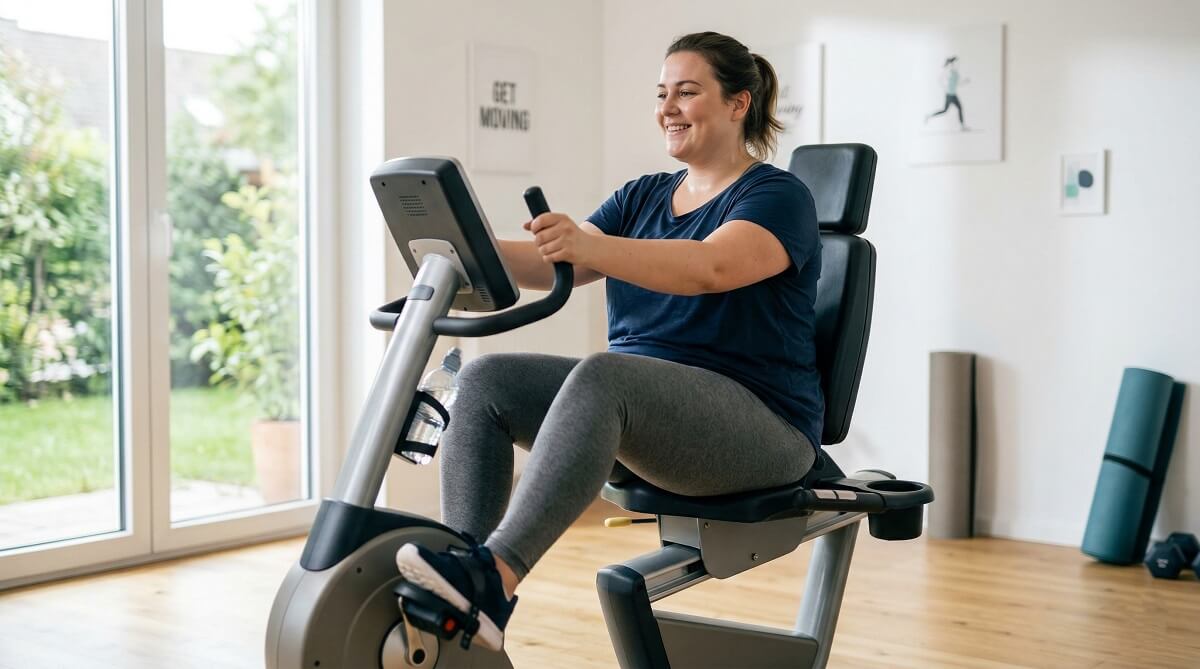
If you’re carrying extra weight and thinking about getting an exercise bike, here’s the honest version: most standard exercise bikes top out at 250–300 lbs. If you’re above that, riding a bike past its weight limit isn’t just uncomfortable — it can be a genuine safety hazard. The good news is that heavy-duty options rated for 350–400 lbs are widely available, and they don’t have to cost a fortune.
For most overweight beginners, a recumbent bike is the better starting point. explain that the reclined seating position with built-in back support makes it far easier to maintain proper form when your core strength isn’t there yet. According to Healthline (medically reviewed by Mia Armstrong, MD), recumbent bikes are “less stressful on the lower spine” and specifically recommended for people with obesity who may struggle to sit upright on a standard bike seat.
The CDC recommends at least 150 minutes of moderate-intensity activity per week for adults — but if you’re just starting out, that number is a goal, not a day-one requirement. Starting with three 10-minute sessions per day is a practical way in, and research published in the European Journal of Applied Physiology found that three shorter bouts produce similar cardiovascular benefits as one continuous 30-minute session.
Who Should (and Shouldn’t) Use an Exercise Bike
✅ Best For
- Overweight adults who need a low-impact, joint-friendly cardio option
- People with knee pain, bad hips, or arthritis who can’t handle running or jumping
- Anyone who wants to exercise at home without a gym membership
- Beginners who want something they can actually stick with
- People weighing up to 300 lbs (standard bikes) or up to 400 lbs (heavy-duty models)
❌ Skip If
- You want a full-body workout — bikes are primarily lower body cardio
- You have severe lower back issues (consult your doctor before starting)
- You’re looking for something portable and compact — heavy-duty bikes are bulky
- You get bored easily without group classes or outdoor scenery (a smart bike with app connectivity helps here)
What to Look for in an Exercise Bike if You’re a Heavier Rider
Weight Capacity: Don’t Skip This Step
This is the single most important spec to check before buying. Standard consumer exercise bikes typically support 250–300 lbs. Riding a bike that’s at or over its weight limit puts stress on the frame, pedals, and seat hardware — all of which can fail unexpectedly.
If you’re over 250 lbs, aim for a bike rated for at least 50 lbs more than your current weight. That buffer matters. Heavy-duty exercise bikes rated for 350–400 lbs exist at multiple price points, from budget options around $300–$500 to commercial-grade machines over $1,000.
Seat Size and Comfort
Narrow saddles are designed for cyclists who shift their weight constantly. When you’re new to exercise biking and sitting for longer periods, a narrow saddle causes real pain — fast. Look for wide, padded seats with adjustable positioning. Recumbent bikes solve this problem almost entirely: their chairs are broader, cushioned, and include lumbar back support. The HARISON Pro recumbent bike, for example, features an 11.4″ × 15.7″ high-density foam seat — considerably larger than what you’d find on a standard upright.
Stability and Frame Build
Heavy steel frames with a wide base are what you want. Lightweight aluminum frames work fine for lighter riders but can flex or wobble under additional weight. Check the flywheel weight too — heavier flywheels (20+ lbs) create smoother pedaling motion and reduce mechanical strain, which matters more the heavier the rider.
Resistance and Display Features
Magnetic resistance is quieter and smoother than friction-based systems, and it requires less maintenance. For beginners, look for at least 8 resistance levels so you have room to progress over weeks and months without maxing out the machine. A basic display showing time, distance, speed, and calories is enough to start — heart rate monitoring is a nice addition if you want to track intensity.
Upright vs. Recumbent vs. Spin Bike: Which Type Fits You?
Most overweight beginners land in one of two camps: upright or recumbent. Spin bikes are generally not the right first choice — here’s why.
| Type | Seat Style | Typical Weight Limit | Best For | Think Twice If |
|---|---|---|---|---|
| Upright | Narrow-to-wide padded saddle | 250–300 lbs (standard) 350–400 lbs (heavy-duty) |
More compact footprint; similar feel to outdoor cycling | You have lower back weakness or poor core strength |
| Recumbent | Wide chair seat with back support | 300–400 lbs | Absolute beginners; joint pain; back issues; long sessions | Space is tight — recumbent bikes have a larger footprint |
| Spin / Indoor Cycling | Narrow racing saddle | 250–300 lbs | High-intensity training once you’re past the beginner stage | You’re just starting out — saddles and riding position are punishing for beginners |
The seated, reclined position of a recumbent bike means your back is supported throughout the workout. For someone who hasn’t exercised in a while — or who has joint sensitivities — that support makes the difference between lasting five minutes and lasting thirty. If you’re also weighing other low-impact options, covers alternatives like rowing and elliptical machines.
Top Exercise Bikes for Overweight Beginners (2026)
All prices listed are approximate as of March 2026. Check current pricing before purchasing — exercise equipment prices shift frequently. on ChubbytIps.
Best Budget Recumbent Bike — Schwinn 230
Weight Capacity: 300 lbs
Price: ~$449–$500 (check current pricing on Amazon)
Resistance: 16 levels magnetic
Warranty: 10-year frame, 2-year mechanical, 1-year electronics
The Schwinn 230 is a solid entry-level recumbent at an accessible price. It connects with Zwift and Explore the World apps via Bluetooth, which helps with motivation if riding in place bores you. The ventilated seat and backrest reduce discomfort on longer sessions. The 300 lb weight limit means it works for many — but not all — heavier riders. If you’re approaching or over 250 lbs, consider stepping up to one of the higher-capacity options below.
Best for: Beginners under 280 lbs who want a budget-friendly start and app connectivity.
Skip if: You’re over 300 lbs — this bike isn’t rated for that weight.
Best Mid-Range for Heavier Riders — Sunny Health & Fitness SF-RB424002
Weight Capacity: 350 lbs
Price: $499.99 (as of March 2026, Sunny Health & Fitness website)
Resistance: Magnetic (smart app integration)
Connectivity: SunnyFit app compatible
Sunny Health & Fitness makes solid, no-frills fitness equipment that punches above its price point. The SF-RB424002 bumps the weight ceiling to 350 lbs and adds a reinforced heavy-duty frame while keeping the price under $500. The SunnyFit app gives you workout tracking and guided sessions, which helps when you’re figuring out how hard to push.
Best for: Riders between 275–350 lbs who want solid construction at a mid-range price.
Skip if: You need more than 350 lbs of capacity — see the HARISON below.
Best for Higher Weight Capacity — HARISON Pro Recumbent Bike (HR-B8)
Weight Capacity: 400 lbs
Price: Check current pricing on Amazon or Best Buy
Resistance: 14 levels magnetic, 28 lb flywheel
Seat: 11.4″ × 15.7″ high-density foam padded
Height Range: 4’8″ to 6’4″
Connectivity: Bluetooth smart app
The HARISON Pro is purpose-built for heavier riders. Its 400 lb capacity, wide padded seat, and heavy-duty stainless steel frame make it one of the more capable home recumbent bikes at its price point. The 28 lb flywheel creates a smooth, stable pedaling feel — you’ll notice the difference compared to lighter-flywheel budget models. It accommodates a wide range of heights with its sliding seat rail system.
Best for: Riders up to 380–400 lbs who need high capacity and seat comfort.
Skip if: You want a premium connected experience with guided coaching — the HARISON’s display is functional but basic.
Best Premium Option — NordicTrack Commercial VR25
Weight Capacity: 350 lbs
Price: $1,499 retail (frequently on sale around $999; check current pricing at Best Buy)
Resistance: 26 levels (SMR Silent Magnetic)
Display: 7″ HD touchscreen
Built-in Workouts: 35
Design: Step-Thru (easy to mount and dismount)
Warranty: 10-year frame, 2-year parts, 1-year labor
If you want the best recumbent biking experience for home use, the NordicTrack VR25 delivers. The Step-Thru frame design is a genuine quality-of-life improvement — getting on and off a standard bike frame when you’re carrying extra weight is awkward. The 26 resistance levels give you a long runway of progression, and the 35 built-in workouts mean you’re not staring at a blank screen trying to figure out what to do. At its sale price, it’s competitive. At full MSRP, wait for a deal.
Best for: Serious buyers who want a long-term machine and don’t mind spending more for quality.
Skip if: Budget is tight — the Sunny or HARISON options deliver good value for less.
Side-by-Side Comparison
| Model | Weight Capacity | Price (approx.) | Resistance Levels | Best Feature |
|---|---|---|---|---|
| Schwinn 230 | 300 lbs | ~$449–$500 | 16 | App connectivity, trusted brand |
| Sunny SF-RB424002 | 350 lbs | ~$499 | Magnetic (smart) | 350 lb capacity under $500 |
| HARISON Pro HR-B8 | 400 lbs | Check current | 14 | Highest weight capacity, wide seat |
| NordicTrack VR25 | 350 lbs | $999–$1,499 | 26 | Step-Thru design, 7″ touchscreen, 35 workouts |
How to Start: A 4-Week Beginner Plan
The most common mistake new exercisers make is starting too hard and getting sidelined by soreness, fatigue, or burnout in the first week. The goal early on isn’t to push hard — it’s to build the habit and let your body adapt.
for more fitness beginner resources.
Week 1: Build the Habit
- Sessions: 3 per week
- Duration: 10–15 minutes per session
- Resistance: Level 1–2 (comfortable pace, you can hold a conversation)
- Goal: Consistency over intensity — show up three times this week
Week 2: Add Time
- Sessions: 3–4 per week
- Duration: 15–20 minutes per session
- Resistance: Level 2–3
- Goal: Finish each session feeling pleasantly tired, not wiped out
Week 3: Find Your Pace
- Sessions: 4 per week
- Duration: 20–25 minutes per session
- Resistance: Level 3–4
- Goal: Try 2 minutes at a harder pace, then ease back — basic interval work
Week 4: Build Toward 30 Minutes
- Sessions: 4–5 per week
- Duration: 25–30 minutes per session
- Resistance: Level 3–5
- Goal: Complete at least 150 minutes of moderate activity this week (the CDC weekly target)
Key rule: If you can’t talk while riding, you’re going too hard. Moderate intensity means breathing heavier but still able to carry on a conversation.
What to Actually Expect from Regular Riding
Let’s keep this honest. Exercise alone rarely produces dramatic weight loss without dietary changes — but consistent cycling delivers real health improvements that go beyond the scale.
Calorie Burn on a Stationary Bike
According to Harvard Health Publishing, a 30-minute stationary bike session at moderate intensity burns approximately:
- 155 lbs: ~252 calories
- 185 lbs: ~294 calories
- 200+ lbs: Proportionally more — likely 330–400+ calories at moderate pace
At vigorous intensity, those numbers jump to 378–441+ calories for the same duration. Heavier riders burn more calories for the same workout because moving more body weight takes more energy.
Longer-Term Health Gains
Government health authorities cite research showing that people who cycle regularly for 30+ minutes per day can reduce their risk of type 2 diabetes significantly. A large Finnish study found a 40% lower diabetes risk among people who cycled more than 30 minutes daily. A separate Danish study following 30,000 people over 14 years found that regular cycling protected against heart disease.
Cycling is listed as a qualifying moderate-intensity activity by both the CDC and the NHS, meaning your stationary bike sessions count toward the recommended 150 minutes per week.
Joint-Friendly by Design
Unlike running, which generates impact forces several times your body weight with each stride, cycling is a non-impact exercise. Your weight is supported by the seat throughout the workout. This makes it one of the few high-calorie-burn activities that’s genuinely accessible to people with knee pain, hip discomfort, or arthritis.
Common Mistakes to Avoid
Buying a Bike Below Your Weight Limit
Always verify the rated weight capacity before purchasing. A bike rated for 250 lbs used by a 270 lb rider isn’t just uncomfortable — it puts stress on the frame welds, pedal axles, and seat hardware. Some bikes fail gradually; others fail suddenly. Check the spec sheet every time.
Starting Too Hard
Going all-out in week one leads to extreme soreness and usually a 2-week break while you recover. Your cardiovascular system adapts faster than your muscles and tendons. Start easy, and let the adaptation happen over time.
Skipping the Seat Height Adjustment
Most knee discomfort on a stationary bike comes from the wrong seat height. Your leg should be almost fully extended at the bottom of each pedal stroke — a slight bend at the knee, not a deep bend. Take 5 minutes to dial this in before your first real session.
Ignoring Diet
A 30-minute moderate bike ride burns 250–300 calories for a 155 lb person. A single fast-food meal can add 700–1,200 calories. Exercise alone rarely produces significant weight loss without some attention to eating habits. The bike is one part of the picture, not the whole solution.
No Rest Days
Daily exercise without recovery leads to overuse injuries and burnout. Especially in the first month, build rest days into your schedule. Three to five days per week is plenty to make real progress.
Frequently Asked Questions
Can I use an exercise bike if I weigh 300 lbs?
Yes, but pay attention to weight limits. Many standard bikes max out at 300 lbs, so look for models rated for at least 350 lbs to give yourself a safety buffer. The Sunny Health & Fitness SF-RB424002 (350 lbs) and HARISON Pro HR-B8 (400 lbs) are designed for heavier riders.
What exercise bike has the highest weight limit?
Home exercise bikes typically top out at 400 lbs. The HARISON Pro HR-B8 recumbent bike is rated for 400 lbs, which is among the highest available for home use. Commercial gym bikes sometimes go higher, but they’re not designed for home purchase.
How many calories does a 250 lb person burn on an exercise bike?
Based on Harvard Health data extrapolated proportionally, a 250 lb person cycling at moderate intensity for 30 minutes burns approximately 380–420 calories. At vigorous intensity, that figure climbs higher. Body weight is one of the primary drivers of calorie burn — heavier riders expend more energy for the same workout.
Is a recumbent or upright bike better for bad knees?
Both are low-impact and generally safe for knee issues, but recumbent bikes take pressure off the knee joint by allowing a more natural leg extension. If your knees are a particular concern, a recumbent bike is the safer starting point. Adjust seat distance so your leg reaches near-full extension at the bottom of each pedal stroke — this reduces knee strain on both bike types.
How long should I ride an exercise bike as a beginner?
Start with 10–15 minutes per session, three times a week. Research indicates that three shorter sessions (10 minutes each) throughout the day produce similar cardiovascular benefits to one continuous 30-minute session. Build toward 30-minute sessions over 4–6 weeks as your fitness improves.
Do I need to change my diet to lose weight on an exercise bike?
For significant weight loss, yes. A 30-minute moderate bike ride burns 250–300 calories for a mid-weight person — meaningful, but easy to outpace with food choices. The bike provides real health benefits (cardiovascular, metabolic, mood) regardless of weight loss, but diet changes are necessary for consistent fat reduction.
Is it safe to use an exercise bike every day?
In the early weeks, daily riding increases your injury risk from overuse. Aim for 3–5 days per week with rest days in between. Once you’ve built a baseline of fitness over 4–6 weeks, daily low-intensity sessions become safer — but listen to your body. For more on building a sustainable routine, .
How do I know if an exercise bike is sturdy enough for me?
Check three things: the manufacturer’s rated weight capacity (aim for 50+ lbs above your current weight), the frame material (look for steel, not aluminum, in heavy-duty models), and the flywheel weight (heavier is more stable). If a product listing doesn’t clearly state the weight limit, that’s a red flag — pass on it.
Ready to Start?
The right exercise bike is one that fits your body safely and that you’ll actually use. For most overweight beginners, a recumbent model with an appropriate weight capacity is the practical choice. Check current prices and availability at Amazon or Best Buy — prices change regularly, so verify before you commit.
on ChubbytIps for fitness equipment, home gym gear, and more.
