


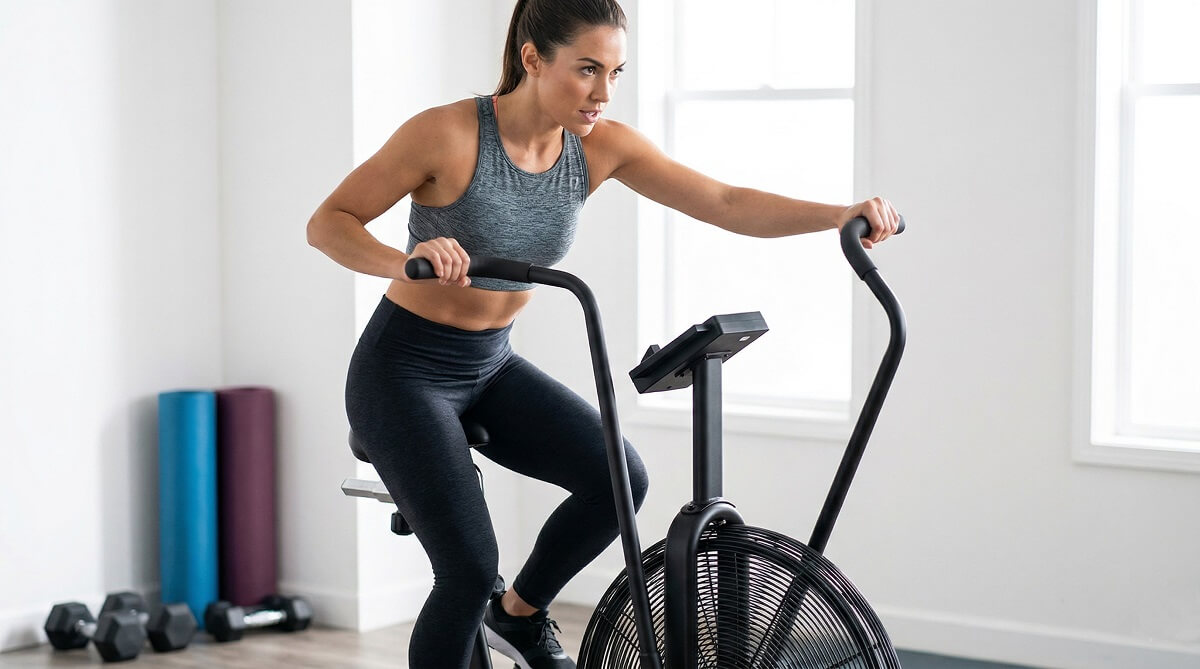
There are two completely different machines that go by “exercise bike with moving arms.” One is a recumbent bike with push-pull arm handles or resistance bands — a low-impact option designed for seniors, rehab patients, and anyone with joint limitations. The other is a fan air bike where the handlebars connect directly to the resistance mechanism — more intense, better for HIIT-style training. Most buyers discover this distinction after they’ve already ordered. If you’re in a hurry: go recumbent if you want gentle, daily cardio; go air bike if you want a challenging, full-body workout that scales with your effort.
On the question of whether moving your arms actually helps — the honest answer is yes, but with caveats. Your legs will always do more of the cardiovascular work. Arm cycling achieves roughly 70% of the VO2 output that leg cycling produces, according to a meta-analysis of 41 studies. But combined arm-and-leg motion does increase total calorie burn compared to either alone, and for users who can’t sustain hard leg-only cardio, adding arm movement is a genuine benefit. Just don’t expect your biceps to torch calories like your quads do.
This guide covers both machine types, top models with verified March 2026 pricing, a side-by-side comparison table, and a straight answer on who should and shouldn’t buy one.
Two Very Different Machines — What “Moving Arms” Actually Means
The term covers two distinct categories, and mixing them up leads to disappointment either way.
Type 1: Recumbent Bikes with Arm Handles or Resistance Bands
These are the machines you’ll see most often in this category. You sit in a reclined seat with back support, pedal with your legs, and simultaneously push and pull a set of arm handles — or, in some models, use resistance bands attached to the frame to work your arms independently while you ride.
The arm motion on handle-based models moves like a cross between a rowing stroke and an elliptical stride. It’s smooth, low-impact, and easy to maintain even for users who haven’t exercised in years. The resistance is usually magnetic, which keeps noise levels extremely low — under 10–15 decibels on most models, quieter than a normal conversation.
Representative models: Vanswe RB408, Vanswe RB505, MERACH S23.
Type 2: Fan Air Bikes with Moving Handlebars
Fan air bikes — sometimes called assault bikes or Airdyne-style bikes — look different. You sit upright, and the handlebars are mechanically linked to a large fan-blade wheel. When you push the handles forward and backward while pedaling, the fan spins faster. The resistance increases the harder you work. There’s no preset resistance level; it’s all self-generated.
This makes air bikes genuinely scalable — a beginner can use one at low effort, and a competitive athlete can push one to near-maximum exertion. The trade-off is noise (the fan is loud at higher speeds) and intensity (these machines are not gentle on the joints at moderate-to-high effort).
Representative models: Schwinn Airdyne AD7, Assault AirBike Classic.
Which Type Should You Choose?
- ✅ Recumbent with arm handles — knee/hip/back issues, adults 60+, low-impact daily cardio, apartment use, post-injury recovery
- ✅ Fan air bike — HIIT training, healthy joints, CrossFit-style home cardio, users who want progressive unlimited resistance
- ❌ Recumbent bikes are not designed for high-intensity interval work; the resistance tops out at preset levels
- ❌ Air bikes are not appropriate for users with significant joint limitations at moderate-to-high effort
Do the Moving Arms Actually Help? What the Research Says
The Honest Calorie Burn Math
Arm muscles are smaller than leg muscles and burn fewer calories for equivalent effort. A systematic review and meta-analysis of 41 studies found that arm cycling achieves roughly 70% of the maximum oxygen uptake (VO2max) that leg cycling produces — meaning arms-only cardio is meaningfully less efficient than legs-only cardio at the same perceived effort, according to research published in the National Library of Medicine.
The 2024 Compendium of Physical Activities — the gold-standard reference for MET values used by the CDC and ACSM — puts arm ergometer exercise at roughly 2.0–4.3 MET depending on intensity. Stationary biking with legs lands between 5.5 and 7.0 MET for moderate effort. That’s a meaningful difference.
However — and this matters for most buyers — combined arm-and-leg cycling does produce higher cardiovascular output than either mode alone. A 2025 meta-analysis found that arm-plus-leg cycling elicits significantly greater VO2 peak, heart rate, and power output compared to isolated limb exercise. For a fan air bike pushed to vigorous effort, estimated MET values can reach 12–14 — higher than most gym equipment options.
Upper Body Muscles Engaged
Handle-based recumbent bikes work your chest, shoulders, and triceps on the push stroke, and your biceps, upper back, and rear shoulders on the pull stroke. The degree of engagement depends on how hard you drive the handles — a casual push-pull at low resistance is more of a light warm-up than a strength stimulus.
Resistance band models (like the MERACH S23) let you work arms independently from pedaling, which gives you more flexibility to target specific movements — curls, rows, overhead presses — while your legs maintain a steady pedal cadence. The trade-off is that it requires more conscious effort to use the bands consistently.
Fan air bikes give the most direct upper-body engagement because the handlebars link directly to the fan resistance. The harder you push and pull, the more resistance you feel.
Benefits Beyond Calorie Burn
For older adults, adding arm movement to daily cardio offers specific advantages: shoulder mobility, bilateral coordination, and better overall circulation. Users recovering from sedentary periods or limited-mobility situations often find that the coordinated arm-leg motion feels more engaging than leg-only cycling — and engagement matters for consistency.
Core stabilization is active throughout both machine types, particularly during the push-pull motion on air bikes where balance shifts with each stroke.
Top Picks: Best Exercise Bikes with Moving Arms in 2026
Best for Seniors and Low-Impact Daily Cardio: Vanswe RB408
The RB408 hits the right balance of capacity, quietness, and accessibility for older adults or anyone with joint sensitivity. It supports up to 400 lbs, runs under 10 decibels (quieter than most recumbent bikes in this category), and the step-through open frame means you don’t have to swing a leg over anything to get on.
The dual-action arm handles move in a push-pull motion synchronized with the pedals. Eight magnetic resistance levels give enough range for a genuine workout without overwhelming beginners. Most users report setup taking 30–45 minutes; the bike ships roughly 90% pre-assembled. Dimensions: 57″L × 20″W × 47″H.
Price as of March 2026: approximately $449.99 (sale price; regular $499). Check current availability on Amazon (ASIN: B0DK1VD293). Note: the Vanswe site listed RB408 as back-ordered in March 2026, with shipping expected the same month.
Best for Larger Users: Vanswe RB505
The RB505 is Vanswe’s upgraded version — bumping weight capacity to 450 lbs, adding a wider mesh-back seat with lumbar support, and extending the inseam range to 29.5″–38.5″. If the RB408 fits most adults, the RB505 fits nearly everyone. Noise stays under 15 dB. Footprint is slightly larger at 59″L × 25″W.
It connects to Kinomap and Zwift for app-based guided workouts. Sale pricing as of March 2026 was approximately $399–$439 on the Vanswe website. No confirmed Amazon ASIN was available at time of writing — check Vanswe’s official site for current stock and pricing.
Best Budget Option: MERACH S23
At $269.99, the MERACH S23 is the most accessible price point in this category with full-featured connectivity. Rather than push-pull handles, it uses integrated resistance bands for upper-body work — which gives more flexibility in how you use them, but requires you to actively engage them during a ride rather than being linked to your pedaling motion.
Eight magnetic resistance levels, Bluetooth connectivity to the Merach app, and a 2-year warranty are solid specs for under $300. Weight capacity is 350 lbs. Check current price and availability: MERACH S23 on Amazon (ASIN: B0DL5P59Q7).
Best Fan Air Bike: Assault AirBike Classic
If you want a genuine high-intensity machine, the Assault AirBike Classic is the standard reference point. At $699, it’s a serious piece of equipment — 20 sealed bearings, 7 on-board programs, and fan resistance that scales infinitely with your output. Weight capacity is 300 lbs.
The push-pull handlebars engage your chest, shoulders, and arms directly and intensely. This isn’t a low-impact machine at any meaningful effort level. Buy it if you want CrossFit-style conditioning at home. See current availability on Amazon (ASIN: B00F74RX40).
Best Premium Fan Bike: Schwinn Airdyne AD7
The Schwinn AD7 is the premium upright fan bike — a well-established design with years of track record behind it. At approximately $1,299, it carries a 350 lb weight capacity and a standout warranty: 10 years on the frame, 2 years on parts, 1 year on electronics, and 6 months labor. That warranty is uncommon at any price point and worth factoring in for buyers who want long-term reliability from a major brand. Check current pricing: Schwinn AD7 on Amazon (ASIN: B072Q63BDD).
Side-by-Side Comparison
| Model | Type | Price (Mar 2026) | Weight Cap. | Resistance | Noise | Best For |
|---|---|---|---|---|---|---|
| Vanswe RB408 | Recumbent + push-pull arms | ~$449.99 | 400 lbs | 8-level magnetic | <10 dB | Seniors, joint issues, daily cardio |
| Vanswe RB505 | Recumbent + push-pull arms | ~$399–$439 | 450 lbs | 8-level magnetic | <15 dB | Larger users, families, seniors |
| MERACH S23 | Recumbent + resistance bands | $269.99 | 350 lbs | 8-level magnetic | Quiet | Budget buyers, beginners, app users |
| Assault AirBike Classic | Fan air bike | $699 | 300 lbs | Fan (unlimited) | Louder | HIIT, CrossFit-style training |
| Schwinn Airdyne AD7 | Fan air bike | ~$1,299 | 350 lbs | Fan (unlimited) | Louder | Premium HIIT, long-term durability |
Prices as of March 2026. Check current pricing before purchasing — sale prices and availability change frequently.
What to Check Before You Buy
Arm Movement Type: Synchronized Handles vs. Independent Bands
Synchronized dual-action handles (Vanswe, Assault, Schwinn) engage your arms automatically as you ride — you don’t have to think about it. Resistance bands (MERACH) require you to actively use them and allow for more varied movements, but they’re easier to ignore during a ride. If your goal is consistent upper-body engagement with no extra effort, handles work better. If you want the flexibility to do curls, rows, or overhead work, bands give you that.
Weight Capacity — Build In a Buffer
The general rule: pick a bike rated at least 50 lbs above your current body weight. This accounts for dynamic loading during exercise (your actual impact on the frame is higher than your static weight) and extends the machine’s lifespan. For users at or above 300 lbs, the Vanswe RB408 (400 lb cap) or RB505 (450 lb cap) are the standout options in the recumbent category.
Resistance Type: Magnetic vs. Fan
Magnetic resistance (recumbent bikes) uses a preset number of levels — typically 8 to 16. It’s quiet, smooth, and consistent. Fan resistance (air bikes) has no preset levels; the tension increases automatically as you pedal and drive the handles harder. Fan bikes are louder and more aggressive, which suits high-intensity users and frustrates everyone else.
Floor Space and Setup
The Vanswe RB408 requires about 57″ × 20″ of floor space. The RB505 needs 59″ × 25″. Assembly on most of these machines takes 30–45 minutes; models marketed as “90% pre-assembled” are faster. Fan air bikes tend to be more compact footprint-wise but require stable flooring — a rubber mat under any air bike is a good idea to absorb vibration and protect floors.
Console and Connectivity
All models reviewed here display time, speed, distance, calories, and pulse. The MERACH S23 and Vanswe models add Bluetooth connectivity to apps (Merach App, Kinomap, Zwift). If app-based guided workouts matter to you, confirm compatibility before purchasing. The Assault AirBike Classic has 7 built-in programs but no Bluetooth streaming to third-party apps.
Who Should Buy an Exercise Bike with Moving Arms (and Who Shouldn’t)
✅ Good Fit If You:
- Are 60 or older and want safe, joint-friendly daily cardio
- Have knee, hip, or lower-back issues that limit other exercise options
- Want to add light upper-body movement to your cardio without separate equipment
- Are returning to exercise after a break and need a stable, accessible machine
- Live in an apartment and need something quiet (magnetic recumbent models)
- Want high-intensity combined cardio and have healthy joints (air bike)
❌ Probably Not the Right Buy If You:
- Want to build meaningful arm muscle mass — free weights and cable machines are more effective for hypertrophy
- Are a trained cyclist focused on leg power development — standard road or spin bikes deliver a more specific training stimulus
- Have joint limitations but are interested in air bikes — the fan resistance at any real effort level is not gentle
- Are on a tight budget and primarily want maximum calorie burn — a basic recumbent bike without arm handles costs significantly less and burns comparable calories if you push hard
Frequently Asked Questions
What muscles does an exercise bike with moving arms work?
The specific muscles depend on the machine type. Push-pull arm handles engage your chest, shoulders, and triceps on the push, and your biceps, upper back, and rear deltoids on the pull. Both machine types work your quadriceps, hamstrings, glutes, and calves during pedaling. Your core provides stabilization throughout. Resistance band models let you target additional movements like curls and overhead presses.
Is an exercise bike with moving arms better than an elliptical?
They’re different rather than one being better. An elliptical is weight-bearing (you stand) and typically provides more direct lower-body engagement in a standing position. A recumbent bike with arm handles is fully seated and lower-impact — better for users with significant joint issues or limited mobility. If you can use both comfortably, ellipticals generally produce higher calorie burn per session for healthy users. If standing for 30 minutes is difficult, the recumbent bike wins on practicality.
Can I lose weight using an exercise bike with moving arms?
Yes, as part of a consistent routine with appropriate diet. Any sustained cardio contributes to calorie expenditure. A 165 lb person pedaling moderately on a recumbent bike burns roughly 145–185 calories per 30 minutes (MET 5.5–7.0). Adding arm movement increases that modestly. Consistency matters more than any single session’s calorie count.
How loud are exercise bikes with moving arms?
Magnetic recumbent bikes run extremely quietly — the Vanswe RB408 specs under 10 dB, which is near-silent. The RB505 and MERACH S23 are also quiet. Fan air bikes (Assault, Schwinn Airdyne) are noticeably louder at higher effort levels due to the fan mechanism. If noise is a concern, stick with magnetic recumbent models.
What weight capacity do I need?
Choose a machine rated at least 50 lbs above your body weight for safety and frame longevity. The MERACH S23 supports 350 lbs, the Vanswe RB408 supports 400 lbs, and the RB505 tops out at 450 lbs. For most adults, the 350 lb rating is sufficient; for larger users, the Vanswe models are the better choice in this category.
How long does assembly take?
Most recumbent bikes with arm handles take 30–45 minutes to assemble. Models marketed as “90% pre-assembled” fall on the faster end; others may take up to an hour. All the models listed here include a manual and basic tools. If assembly sounds unappealing, some retailers offer white-glove delivery and setup for an additional fee.
Are recumbent bikes with arm handles good for back pain?
Often yes. The reclined position distributes spinal load differently than upright cycling, reducing lower-back pressure. The wide padded seat and backrest on models like the Vanswe RB408 provide lumbar support during the ride. That said, if you have a specific spinal condition, consult your doctor or physical therapist before starting any new exercise routine.
Can I use a recumbent arm bike for rehabilitation?
Recumbent bikes with moving arms are commonly used in physical therapy and home rehabilitation because the motion is low-impact, supported, and controllable. The ability to adjust resistance from very light to moderate makes them appropriate for gradual recovery. Users recovering from knee surgery, hip replacement, or stroke rehabilitation report using these machines — but always follow guidance from your healthcare provider on appropriate intensity and duration.
Check current prices and availability for the top picks above: Vanswe RB408 on Amazon, MERACH S23 on Amazon, and Assault AirBike Classic on Amazon. Prices and stock change frequently — always verify before purchasing.
