


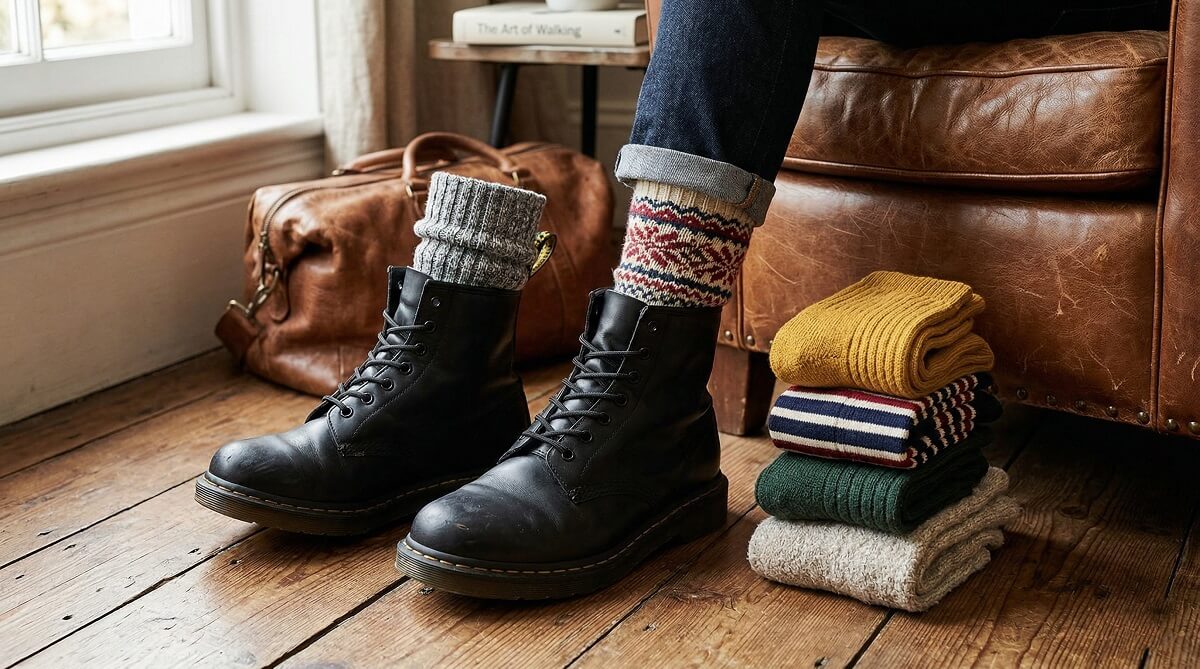
Most people assume Doc Martens hurt because the leather is stiff — and that’s true. But the real culprit behind most blisters is friction between the leather heel counter and a sock that slides, bunches, or just isn’t padded enough where the boot hits hardest. for more on breaking in leather footwear.
The socks that work with Docs share a few specific traits: a padded heel cushion to absorb friction, a secure cuff band that won’t slip inside the boot, and enough height to protect the ankle bone. You don’t need to spend a lot — but you do need to pick the right style for what you’re dealing with. According to Dr. Martens’ own break-in guide, “the top of the heel is often the spot that gives people the most trouble.” They specifically recommend purpose-made padded socks as one of three main ways to get through the break-in period without wrecking your heels.
Below are the sock types, materials, and specific picks that have actually worked — organized by what you’re dealing with: breaking in a new pair, everyday comfort, or staying low-profile under rolled jeans.
Which Sock Style Do You Actually Need?
✅ Get padded crew socks if:
- You’re breaking in a new pair of Doc Martens
- You get heel blisters or ankle rubbing on any boot
- You’re wearing Docs all day on hard floors or pavement
- You’ve already tried “regular” socks and still got blisters
✅ Get ankle or quarter socks if:
- Your Docs are already fully broken in and soft
- You want a lower-profile look under rolled jeans or cropped pants
- You’re wearing a Chelsea boot or low-collar style
❌ Skip no-show liner socks if:
- Your Docs are still stiff — no padding means blisters guaranteed
- You’re walking more than a few blocks
- You have the 1460 eight-eye boot with a high leather collar
Why the Right Sock Makes Such a Difference
Doc Martens boots are made from thick, unlined leather — especially the classic 1460. That leather heel counter is rigid until it’s been worn and softened. Until then, every step grinds it against the same two spots: the back of your heel and your ankle bone. cover what to look for in footwear for long-term comfort.
A padded sock acts as a buffer between your skin and the leather, absorbing some of that friction. But padding alone isn’t enough — if the sock slips inside the boot, the bunched fabric creates its own friction point. That’s why sock height and cuff elasticity matter as much as cushioning.
Dr. Martens acknowledges the break-in process takes time. Their official guidance recommends wearing new Docs every other day (not every day back-to-back), leaving the top two eyelets loose on your first few outings, and applying their Balsam leather conditioner to soften the inside. Socks are one piece of the puzzle — not the whole solution.
The 5 Sock Types That Work With Doc Martens
1. Padded Crew Socks — Best for Break-In
These are the go-to choice when your Docs are still stiff. A crew sock hits mid-calf, which means it sits well above the boot collar and protects your ankle bone on both sides. The key feature to look for is double foam or extra padding at the heel and ankle — not just a slightly thicker fabric across the whole sock.
Shezza Padded Crew Socks ($23.99/pair, shezza.com) are built specifically for this use case — the brand exists almost entirely because founder Tiffany suffered her own Doc Marten blisters and engineered a fix. The double foam barrier at the heel is thicker than what you’ll find on most general-purpose socks. They have 4.6/5 stars from 846+ customer reviews as of early 2026, including dozens of verified buyers who mention Doc Martens specifically.
Dr. Martens Double Doc Cotton Blend Socks are the obvious official answer. Made with roughly 79% cotton, 20% nylon, and 1% elastane, they have extra padding built into the heel and ankle zones and extra arch support. A single pair runs around $16.00; the 3-pack is a better deal at around $19.99 (check current pricing at drmartens.com). They’re not the thickest padded sock you can find, but they’re engineered for the exact friction points of their own boots.
2. Thick Cotton Quarter Socks — Everyday Workhorse
Once your Docs have softened up, a thick cotton quarter sock is often all you need. Quarter socks sit just above the ankle — enough height to cover the ankle bone without the bulk of a full crew. Look for ones with a reinforced heel and tight cuff. Hanes, Fruit of the Loom, and Gold Toe all make thick boot-height cotton socks in multipacks that run under $15 on Amazon and hold up well through repeated washing.
The trade-off: cotton absorbs sweat and can stay damp. If you’re walking all day or in humid weather, this matters. For shorter outings on already-soft Docs, it’s a non-issue.
3. Merino Wool Crew Socks — Best All-Day Comfort
Merino wool is where you end up if you wear Docs seriously. It regulates temperature (warmer when cold, cooler when warm), wicks moisture away from skin instead of holding it like cotton does, and resists odor naturally. Multiple independent sources single out merino as the best material for boot socks across the board.
Darn Tough boot socks ($28–$30 at darntough.com, around $27 on Amazon (ASIN B000XIEAH8)) are 68% merino wool, 30% nylon, and 2% Lycra. They come with a lifetime guarantee — if they wear out or develop holes, Darn Tough replaces them. In an independent head-to-head comparison by Stridewise, they took the “Most Comfortable” category over Smartwool and CHUP. They run slightly thick, which makes them good for the break-in phase too.
Smartwool crew socks (~$22/pair at smartwool.com or Amazon (ASIN B0B2XNJ5ML)) are 53% merino wool, 43% nylon, with targeted arch support and a nearly seamless toe. Stridewise rated them “Best Fitting” in the same test. If Darn Tough runs a hair too bulky for your taste, Smartwool gives you a slightly slimmer profile with similar merino benefits.
4. No-Show Socks With a Heel Tab — For Already-Soft Docs in Warm Weather
Let’s be clear: no-show socks are not for breaking in Doc Martens. Two separate independent reviewers covering this topic specifically warn against them for unbroken-in Docs, since the leather will chafe the exposed ankle and heel with nothing there to absorb it.
That said, once your Docs are soft — or if you’re wearing a low-collar style like the 1461 Oxford — a no-show sock with a heel tab is a reasonable summer option. The heel tab keeps the sock from sliding into the shoe. Feetures High Performance Max Cushion ankle socks (Amazon ASIN B06VZ3Y1XW) are a solid pick here — targeted compression, moisture-wicking, and the heel tab actually holds position.
5. Dr. Martens Official Socks — For the Purists
If you want the officially endorsed option, the Double Doc socks are it. They’re not the thickest padded sock on the market, but they’re designed around Doc Martens’ own knowledge of where their boots rub. The 3-pack at ~$19.99 works out to under $7/pair, which is hard to argue with. Available in Black, White, Charcoal, and a few seasonal colors.
The main trade-off against the merino options above: they’re a cotton blend, which means less odor resistance and more moisture retention over a long day. For break-in purposes or moderate daily wear, they do the job well.
Sock Material Guide at a Glance
Materials affect how your socks perform over a full day — not just during the first hour. Here’s how the main options stack up for Doc Marten use:
| Material | Moisture Control | Odor Resistance | Cushioning | Price Range | Best For |
|---|---|---|---|---|---|
| Cotton | Absorbs (stays damp) | Low | Good if thick | $<15/6-pack | Casual, short wear, cold weather |
| Cotton-Nylon Blend | Moderate | Moderate | Good | $7–$24/pair | Everyday use (Dr. Martens Double Doc) |
| Merino Wool | Wicks away | High (natural) | Very good | $22–$30/pair | All-day, all-season, odor-sensitive |
| Synthetic (polyester/nylon) | Wicks away | Low–moderate | Varies | $10–$20/pair | Athletic use, warm weather |
When Socks Keep Falling Into Your Doc Martens
Slippage is a separate problem from blisters — and it has a separate fix. Socks slide into shoes for three main reasons: the boots are slightly too large, the sock’s cuff elastic is weak, or the sock height is too short for the boot collar.
The fix is simple: look for socks with a tighter ribbed cuff and more elastane content. Running socks tend to outperform casual socks here — they’re engineered to stay put during movement. Nike running socks and Happy Socks have both been called out by reviewers for unusually strong elastic bands that hold position even in slightly oversized shoes.
One practical trick: wash new socks in a hot cycle before wearing them. This tightens the cuff elastic and reduces that “loose from the pack” slackness that new socks often have.
Which Sock Height Works Best by Doc Marten Style
Not all Docs have the same collar height. The sock that works for an 8-eye 1460 is overkill for a Chelsea boot, and the no-show that’s fine for an Oxford can end badly in a platform Jadon.
| Doc Marten Style | Best Sock Height | Notes |
|---|---|---|
| 1460 Boot (8-eye) | Crew (mid-calf) | High leather collar — ankle bone protection is non-negotiable |
| 1461 Oxford shoe | Ankle or quarter | Low collar; crew length can poke out awkwardly |
| Chelsea Boot | Ankle with padded heel tab | Slippage is a real risk; elastic-sided design can pull socks down |
| Jadon Platform Boot | Crew (can show or stay hidden) | Higher collar than the 1460; crew length essential for ankle coverage |
| Mary Jane / Sandal | No sock or liner only | Personal preference; no structural need |
Top Sock Picks Compared
| Sock | Type | Material | Padding | Price | Best For |
|---|---|---|---|---|---|
| Dr. Martens Double Doc (3-pack) | Crew | 79% Cotton / 20% Nylon | Heel + ankle | ~$20/3-pack | Break-in, value |
| Shezza Padded Crew | Crew | Not disclosed | Double foam heel | $23.99/pair | Break-in, blister-prone |
| Darn Tough Hiker Boot | Crew | 68% Merino / 30% Nylon | Full cushion option | $28–$30/pair | All-day, all-season |
| Smartwool Crew | Crew | 53% Merino / 43% Nylon | Targeted arch | ~$22/pair | Slim fit, all-season |
| Feetures HP Max Cushion (heel tab) | Ankle no-show | Synthetic blend | Max cushion + heel tab | ~$15–$18/pair | Broken-in Docs, warm weather |
Prices as of March 2026 — check current pricing before purchasing.
Frequently Asked Questions
What socks do you wear with Doc Martens?
During the break-in period, padded crew socks are the most reliable choice — they protect the heel and ankle from the stiff leather collar. Once your Docs have softened, you can scale back to ankle or quarter socks depending on the boot style and how low-profile you want to go.
How do I stop blisters when breaking in Doc Martens?
Dr. Martens’ official advice is to wear Docs every other day during break-in (not daily marathons), leave the top two eyelets loose at first, apply their Balsam leather conditioner to the interior, and wear thick padded socks or Double Doc socks. Heel pads inside the boot add another layer of protection at the back of the heel — the highest-friction zone.
Are thick socks better for Doc Martens?
For breaking in, yes — thickness helps absorb friction and speeds up the softening process. Once the leather has been conditioned by wear, you don’t need maximum thickness anymore. A moderately padded crew or quarter sock is usually enough.
Do no-show socks work with Doc Martens?
Not with stiff, unbroken-in boots. The leather collar will chew up your ankle with nothing to protect it. If your Docs are already broken in and soft — or if you’re wearing a very low-collar style like the 1461 Oxford — a no-show sock with a heel tab (like Feetures) can work. Just don’t try it on day one.
What sock height looks best with Doc Marten boots?
For the classic 1460 eight-eye boot, crew socks that hit mid-calf look good either hidden inside or slightly visible with rolled jeans. For Chelsea boots, ankle or quarter socks work better since the elastic sides of the boot tend to pull taller socks down. For the 1461 Oxford, ankle socks are ideal.
Are Dr. Martens own socks worth buying?
The Double Doc socks are a reliable pick — they’re specifically engineered around the boot’s friction points, and the 3-pack at around $20 makes them hard to beat on value. They’re a cotton blend, so they’re not as odor-resistant or moisture-wicking as merino wool options. For occasional wear, they’re great. For heavy daily use, a merino option like Darn Tough holds up better long-term.
How do I stop my socks from falling into my Doc Martens?
Choose socks with a tighter ribbed cuff and higher elastane content — running socks tend to stay put better than casual styles. Washing new socks in hot water before first wear tightens the cuff elastic. If the problem persists, your boots may be slightly too large, and heel pads can help reduce interior volume.
What material socks work best for Doc Martens in summer?
Merino wool is counterintuitively good in summer — it’s temperature-regulating and moisture-wicking, so your feet stay drier and cooler than with cotton. If merino feels too warm, look for thin crew or ankle socks with a nylon-polyester blend and mesh ventilation zones. Avoid 100% cotton in summer since it retains moisture and can create friction as it gets wet.
Check current pricing on Darn Tough boot socks on Amazon, or visit Dr. Martens’ official sock lineup for their branded Double Doc option. Prices and availability change; the links above reflect what’s in stock as of March 2026. Looking for other footwear and comfort gear?
