


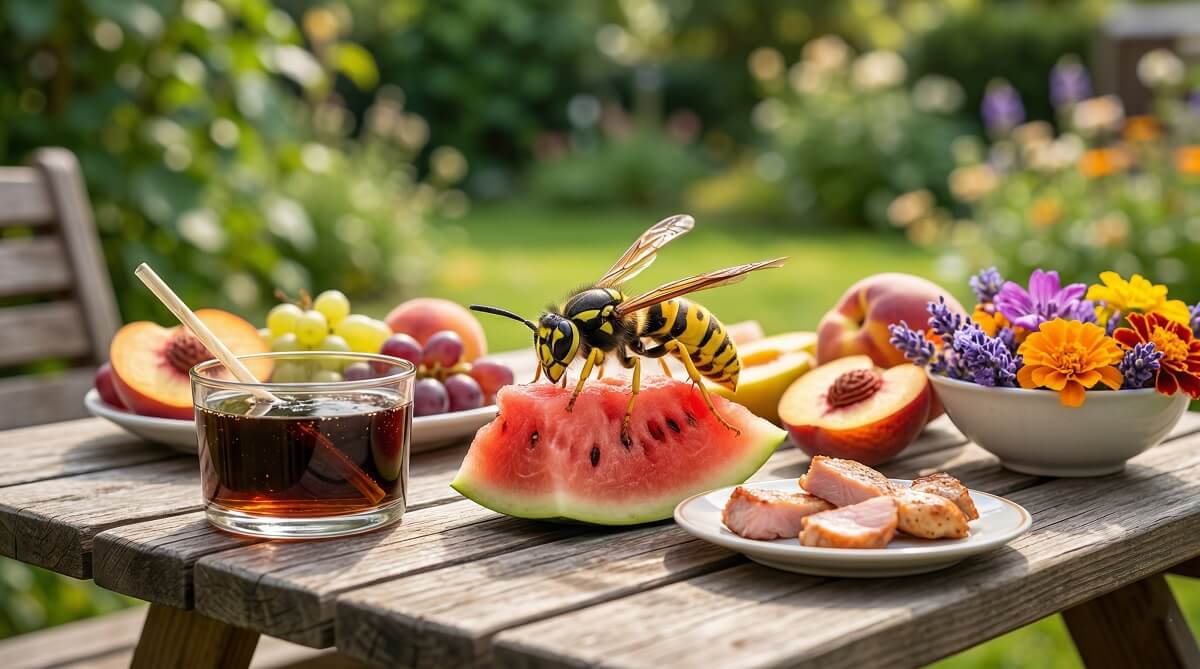
If wasps keep showing up at your cookouts, hovering around your trash cans, or building nests under your eaves every spring, something nearby is sending them a signal. These stinging insects are drawn by food (sugar and protein), certain fragrances, nesting opportunities, bright colors, and even outdoor lighting at night. The tricky part: what pulls them in shifts with the season. Spring and summer workers are mostly hunting protein to feed growing larvae. By late summer and fall, those same foragers are desperate for sugar — which is when they start dive-bombing your lemonade.
This article covers the seven main triggers, breaks down which wasp species respond to which cues, and gives you specific steps to reduce activity around your home. If you’ve already got an active colony in a wall void or underground, — the nest removal part is not a DIY job.
Quick Guide: Why Wasps Are Likely in Your Yard
✅ Common Reasons They’re Showing Up
- Open or loosely covered trash cans with food waste
- Sugary drinks, ripe fruit, or food scraps left outside
- Gaps under eaves, roof soffits, or cracks in siding
- Floral perfume or scented lotion worn outdoors
- Meat or pet food left out during grilling season
❌ Skip DIY Removal If:
- The nest is inside a wall void, attic, or underground
- You or anyone nearby has a known sting allergy
- The colony is large (signs: heavy wasp traffic to one spot, loud buzzing from walls)
Why Wasps Come Foraging in the First Place
Wasps are social insects that live in colonies lasting a single year. A queen founds a new nest each spring, and by late summer the colony can hold anywhere from a handful of workers to thousands, depending on the species. Worker wasps — the ones you see flying around — have two jobs: find food and defend the nest.
Adult wasps run almost entirely on liquid carbohydrates. According to University of Maryland Extension (updated February 2026), adults feed on flower nectar, fruit juice, tree sap, and honeydew excreted by aphids. They also collect protein — insects, spiders, and meat scraps — but that food goes straight to the larvae at the nest. Adult wasps can only swallow liquids themselves.
This is why wasps are most active mid-day on warm, clear days — generally 12 pm to 6 pm, per Science Friday’s research feature with Prof. Seirian Sumner of University College London. They’re foraging. And if your yard or patio consistently has what they need, they’ll keep returning.
The 7 Main Things That Attract Wasps
1. Sugar and Sweet Foods
Sweet liquids are the primary fuel for adult wasps. Anything with sugar — open soda cans, juice, beer, ripe or fallen fruit, honey, jam, even the residue inside a recycling bin — registers as a foraging target. This is especially pronounced in late summer and early fall.
Here’s why the season matters: during spring and summer, worker wasps get much of their sugar from a biological exchange with the larvae. The larvae eat solid protein (insects, meat), digest it, and produce a sugary secretion that workers lap up. This process, called trophallaxis, keeps adult wasps fed through the colony’s growth phase. Once the queen stops laying eggs in late summer, larval production drops, those secretions stop, and workers suddenly have to find sugar on their own. That’s when a half-empty soda can or a bowl of cut watermelon on your patio becomes irresistible.
Wasps respond more to sweet odors than sweetness alone. An open can left outdoors can draw foragers from a surprisingly long distance.
2. Protein and Meat
Grilled hamburgers, pet food bowls, fish scraps, and garbage containing meat draw workers because they collect protein pellets to bring back as larval food. This is primarily a spring and summer issue, when the colony is actively expanding and larvae need a steady supply.
Yellowjackets are the main culprits here — they scavenge at picnic areas, around garbage cans, and anywhere meat is being cooked or handled. Paper wasps hunt live caterpillars and insects rather than scavenging, so they’re considerably less likely to crash your cookout.
3. Scented Personal Products
Floral perfume, cologne, scented hair spray, fruity body lotion, and even scented sunscreen can pull in foraging wasps. These fragrances mimic the scent cues wasps use to locate nectar-bearing flowers. Oklahoma State University Extension specifically advises against “sweet-smelling colognes, perfumes, and hair sprays” in areas where these stinging insects are common.
This is one attractant that’s easy to miss. The same body spray that’s fine indoors becomes a problem at a late-summer outdoor gathering when wasp colonies are at their largest and workers are actively hunting carbohydrates.
4. Flowers and Garden Plants
Wasps are pollinators, not just predators. They visit flowers for nectar just as bees do, and certain plants are particularly effective at drawing them in. Fennel is the standout: a study cited by University of Wisconsin Extension found that fennel alone drew 48 species of ichneumonid wasps and 8 predatory wasp species in a single Massachusetts organic garden. Yarrow, goldenrod, purple tansy, and buckwheat are similarly effective.
This doesn’t mean you need to tear out your garden — wasps visiting flowers are unlikely to sting unless provoked. But if you want to reduce activity in a specific outdoor seating area, planting spearmint, thyme, or citronella nearby may help deter them.
5. Shelter and Nesting Opportunities
Each spring, newly-mated queens emerge from overwintering and scout for a protected spot to start a nest. Gaps under roof soffits, crevices in siding, voids behind wall panels, hollow trees, and old rodent burrows are all candidates. The queen isn’t selective about aesthetics — she needs something sheltered, enclosed, and shielded from direct weather.
Wood factors in too. Wasps chew weathered wood — fence boards, deck rails, tree bark — to produce the paper pulp used in nest construction. Old wood structures near the house provide both building materials and potential nest sites in one location.
Mud dauber wasps specifically need moist soil or clay for their tube-shaped nests. Consistently damp garden beds, standing water near the foundation, or soil around a dripping outdoor faucet will draw them in.
6. Bright Colors (Especially Yellow, Orange, and Blue)
Wasps have trichromatic vision with photoreceptors tuned to UV light (~340 nm), blue (~440 nm), and green (~530 nm), according to research on insect color vision evolution. They detect ultraviolet wavelengths that humans can’t see — the same range many flowers use to guide pollinators. Bright yellows, oranges, and blues fall within or near the band wasps associate with nectar-producing plants.
This is why OSU Extension recommends tan, khaki, and dark-colored clothing in wasp-heavy areas, and avoiding bright floral patterns at outdoor events. A bright yellow shirt at a late-summer picnic reads like a large flower to a hungry forager.
7. Outdoor Lights at Night
Most common wasp species aren’t particularly drawn to light. European hornets are the exception. They’re nocturnal hunters, and like other night-active insects, they navigate toward artificial light sources. According to University of Maryland Extension (updated February 2, 2026), European hornets are pulled toward porch lights, landscape lighting, and even light leaking through window blinds — and they may collide with windows as a result.
Switching to motion-activated lights helps. If you keep lights running, UMD Extension notes that LED bulbs with a warmer color temperature (amber/yellow-toned) attract fewer insects overall compared to standard bluish-white LEDs.
How Wasp Attractants Change by Season
Most pest guides treat wasp attraction as one fixed behavior. The reality: what draws them in May is different from what pulls them in September. Understanding that calendar lets you anticipate problems rather than react to them.
| Season | Primary Attractants | Why |
|---|---|---|
| Spring | Shelter, weathered wood, soft soil, insects | Queen founding new colony; needs nesting site and building materials |
| Summer | Protein (meat, insects, pet food), caterpillars | Workers feeding rapidly growing larvae |
| Late Summer / Fall | Sugar (fruit, soda, sweet drinks, overripe garbage) | Larval secretions stop; workers lose primary sugar source and seek alternatives |
| Fall (late) | Warm indoor shelter (attics, wall voids) | Mated queens searching for overwintering sites before first frost |
Wasp Attractants by Species
Lumping all wasps together leads to prevention advice that misses the mark. Different species have different priorities. Here’s a breakdown of the main species found across the USA:
| Species | Primary Attractants | Typical Nest Location | Peak Problem Season |
|---|---|---|---|
| Yellowjackets | Sweet drinks, meat scraps, garbage, fallen fruit | Underground, wall voids | Late summer – fall |
| Paper Wasps | Sheltered eaves/overhangs, caterpillars, insects | Under eaves, door frames, shrubs | Spring – summer |
| European Hornets | Outdoor lights (at night), tree sap, other insects | Tree cavities, hollow walls, attics | Late summer – fall |
| Mud Daubers | Moist soil/clay, spiders | Porches, carports, garage walls (mud nests) | Spring – summer |
| Baldfaced Hornets | Insects, sweet materials, protein near nest | Aerial (trees, building overhangs) | Summer – fall |
How to Make Your Property Less Attractive to Wasps
Reducing wasp presence is mostly about removing the unintentional signals your yard is broadcasting. Here are the practical steps, sorted by impact:
Food and Trash
- Use trash cans with secure, locking lids — not just flip-top covers. Bungee cords work as a backup if the lid doesn’t seal properly.
- Rinse soda cans and bottles before tossing them in recycling. The sugar residue inside a can is a reliable draw for foragers.
- Bring outdoor pet food dishes inside after meals, especially during late summer when wasps are most sugar-desperate.
- Pick up fallen fruit promptly. A single rotten apple on the ground can hold foragers’ attention for days.
- Cover food at cookouts and keep drinks in closed containers. Check your soda can before drinking if it’s been sitting out unattended.
Home and Property
- Inspect and seal gaps around soffits, fascia boards, utility entry points, and window frames. Early spring (before queens become active) and late fall (after colonies die off) are the best windows for this.
- Replace or treat weathered wood on fences, decks, and garden structures — workers chew it for nest-building pulp.
- Fix dripping outdoor faucets and eliminate standing water near the foundation, which draws mud daubers looking for clay.
- Switch porch and landscape lights to motion-activated fixtures, or replace bulbs with warm amber LEDs if European hornets are active in your region.
Outdoor Habits
- Skip floral perfume, cologne, and heavily scented lotion for outdoor events in late summer — unscented options are a smarter call during peak wasp season.
- Wear khaki, olive, or dark clothing at outdoor gatherings; avoid bright yellows and oranges, especially at late-summer picnics.
- Stay calm if a wasp approaches and move away slowly. Swatting triggers a defensive response and can release alarm pheromones that recruit more colony members.
- Avoid mowing directly under a known nest or running trimmers close to one — vibrations near the colony are a reliable trigger for defensive stinging.
Natural Deterrents
A 2013 study published in Pest Management Science found peppermint oil to be among the most effective spatial repellents for social wasps — 17 of 21 essential oils tested showed significant deterrent effects on vespid workers. Diluting peppermint oil in water and applying it around entry points or nesting-prone overhangs may discourage nest building, though it won’t eliminate an established colony.
Plants with strong, non-floral scents — spearmint, thyme, citronella, and eucalyptus — are commonly cited as natural deterrents. The science on whole-plant repellency is thinner than the evidence for concentrated essential oils, but they’re a low-risk addition if you’re already managing other attractants.
Frequently Asked Questions
Why are wasps so aggressive in the fall?
By late summer, the queen stops laying eggs, which cuts off the sugary secretions that larvae produce for adult workers. Hungry and without their usual fuel source, workers become persistent around any available sugar — soda, fruit, sweet drinks. The colony is also at its largest at this point, so more foragers are active at once. They’re not angrier — they’re just more desperate.
Do wasps like the smell of perfume?
Yes. Floral and fruity fragrances in perfumes, colognes, and hair products mimic the scent signals wasps use to find nectar-producing flowers. This is most noticeable in late summer when foraging pressure peaks. Unscented or lightly scented products are a smarter option for outdoor events during wasp season.
What color clothing attracts wasps?
Bright yellow, orange, and blue are the most problematic. Wasps see into the UV spectrum and associate these colors with flowers. Oklahoma State University Extension recommends tan, khaki, and dark clothing when spending time in wasp-heavy areas. Light floral patterns also tend to register as visual cues to foraging workers.
Are wasps attracted to light?
Most species — yellowjackets, paper wasps — are not strongly drawn to light. European hornets are the notable exception. They’re nocturnal hunters and will navigate toward bright outdoor lights, sometimes in noticeable numbers. Switching to warm-color (amber/yellow) LEDs or motion-activated lights reduces this issue considerably.
What attracts wasps to my house specifically?
Two main factors: nesting opportunities and nearby food. Gaps under soffits, in fascia boards, and around utility entries are prime sites for paper wasps. Yellowjackets favor wall voids and underground burrows. If you notice consistent activity near one point on your home, there’s likely an active or forming colony close by.
Does standing water attract wasps?
Mud daubers — the slender, metallic-blue or black wasps that build tube-shaped mud nests — actively seek moist soil for building material. They’re regularly spotted near outdoor faucets, pond edges, and consistently damp garden areas. Other social wasps don’t specifically target water, though they do need it occasionally and may visit bird baths or gutters in dry conditions.
What smells do wasps hate?
A 2013 study in Pest Management Science found 17 essential oils effectively repelled social wasps, with peppermint, clove, lemongrass, spearmint, and geranium among the strongest performers. Peppermint oil diluted in water and applied around potential nesting areas is the most practical DIY option backed by peer-reviewed research.
How many wasps means there’s a nest nearby?
Seeing 10 or more wasps consistently around your property is a reliable sign of a nearby colony. A paper wasp nest typically holds 20–75 workers; yellowjacket colonies range from 200 to as many as 5,000 workers, according to Oklahoma State University Extension. If you see wasps consistently flying to or from one spot on the ground or on your home, that’s the entrance.
Cutting down on wasp activity is mostly about removing the signals you’re unintentionally sending — cover your food and trash, seal potential nesting spots in early spring or late fall, and consider swapping porch bulbs to warm amber LEDs if European hornets are an issue in your area. If you’ve handled those factors and still have a significant colony — especially one inside a wall or underground — a licensed pest control professional is the safest option. Avoid flooding or burning a nest; these approaches tend to provoke rather than solve the problem.
