


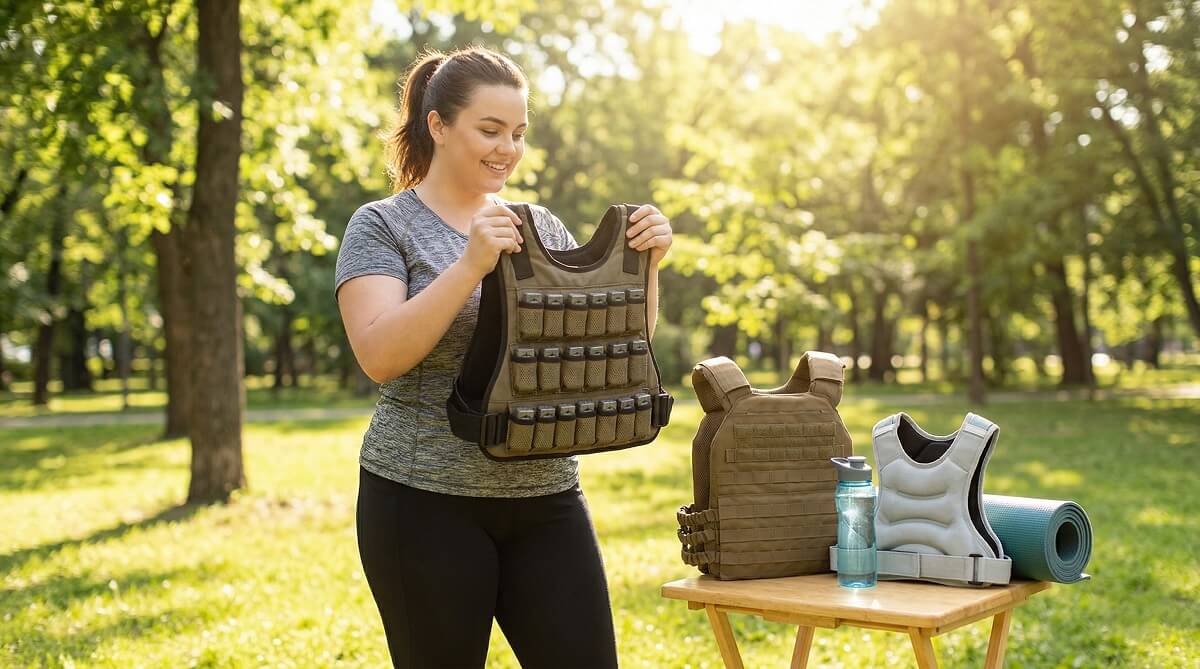
The short answer: most beginners should start with a vest that weighs about 5% of their body weight. For a 150-pound person, that’s roughly 7–8 lbs. If you already have a solid fitness base, starting at 8–10% is reasonable too. Either way, the vest should feel challenging but not heavy enough to throw off your posture or shorten your stride.
The other thing that matters just as much as the starting weight: buy an adjustable vest. You’ll outgrow a fixed-weight option within a few weeks, and a vest you can add to over time is far more practical than buying two or three different ones. A good beginner adjustable vest runs anywhere from $25 to $50 on Amazon — you don’t need to spend much to get started.
Below, you’ll find a starting weight table based on body weight, exercise-specific guidance (walking vs. pull-ups vs. squats), what to look for when buying, and a few solid entry-level options worth considering.
Who Should (and Shouldn’t) Start With a Weighted Vest
✅ A Good Fit If You:
- Already do regular walking, hiking, or bodyweight workouts
- Want to burn more calories or add resistance without buying weights
- Are focused on bone health, muscle endurance, or improving cardiovascular fitness
- Prefer keeping your hands free during cardio
❌ Hold Off If You:
- Are brand new to consistent exercise — build a few weeks of base fitness first
- Have an existing back, neck, or joint injury (consult your doctor first)
- Can’t maintain upright posture during a normal 20-minute walk
How Much Should Your First Weighted Vest Weigh?
The 5% Body Weight Rule
The 5% guideline exists for a practical reason: your body needs time to adapt to carrying extra load, and starting too heavy puts stress on your joints and spine before your muscles are ready to support it. As physical therapist Meg Darmofal, DPT, of Michigan State University explains, “If it is too heavy to start, the user could compensate with poor posture and potentially cause further injury to their spine.” Starting light lets you dial in your form before adding load.
Use the table below to find your starting range:
| Your Body Weight | 5% Starting Load | 10% (After Acclimation) | 20% Absolute Max |
|---|---|---|---|
| 120 lbs | 6 lbs | 12 lbs | 24 lbs |
| 150 lbs | 7.5 lbs | 15 lbs | 30 lbs |
| 175 lbs | ~9 lbs | ~18 lbs | 35 lbs |
| 200 lbs | 10 lbs | 20 lbs | 40 lbs |
| 225 lbs | ~11 lbs | ~22 lbs | 45 lbs |
Note: “20% max” is the upper limit most fitness professionals cite for any user, regardless of experience level. According to TRX Training, exceeding 20% of body weight “can cause poor posture, muscle strain, and joint stress, especially during more intense exercises.”
Does Your Goal Change the Starting Weight?
In most cases, stick with 5% regardless of your goal. Where it gets a little more nuanced:
- Weight loss / everyday walking: 5–8% is the sweet spot. Research from the American Council on Exercise found that wearing a vest at 15% of body weight increased energy expenditure by approximately 12% — even modest loads add up over long walks.
- Bone density support: 5–10% works well for bone loading. A 5-year study in the Journal of Gerontology (Snow et al., 2000) found that women who used weighted vests in exercise lost less than 1% of total hip bone mass, compared to 3.8% loss in those who didn’t. The exercise group actually gained over 1.5% femoral neck bone density during the study period.
- Strength training (squats, push-ups): You can tolerate slightly more load because larger muscle groups are involved. Still start at 5–10% for your first few sessions to check form.
Starting Weights by Exercise Type
The right starting weight also depends on what you’re doing with the vest. Different movements put different demands on your joints and stabilizing muscles.
Weighted Vest for Walking
Walking is the most forgiving place to start. A vest at 5–10% of your body weight is appropriate from day one. For a 150-pound person, that’s 7.5–15 lbs to begin with — stay at the lower end if this is new territory.
Pay attention to your stride: it should stay normal and relaxed. If you notice yourself shuffling or leaning forward, the vest is too heavy or you’ve been wearing it too long. Sharon Hame, MD, a sports medicine orthopedic surgeon at UCLA Health, recommends starting with just one loop around the block rather than your usual full route.
Weighted Vest for Running
Running creates more joint impact per stride, so go lighter than you would for walking — 5–8% to start. More importantly: don’t jump straight to running. Establish 2–3 weeks of comfortable weighted walks before adding a vest to any running session. Form breaks down fast once fatigue sets in at a harder pace.
Weighted Vest for Bodyweight Exercises
The appropriate load depends on which exercises you’re adding the vest to. Here’s a practical breakdown, based on guidance from Bells of Steel:
| Exercise | Beginner Starting Weight | Why |
|---|---|---|
| Pull-ups / Dips | 5–10 lbs | Smaller stabilizing muscles; too much load compromises form fast |
| Push-ups | 10–15 lbs | More muscle groups involved; handles moderate load well |
| Squats / Lunges | 15–20 lbs | Large muscle groups (quads, glutes) can tolerate higher load |
Use the same vest weight across all your exercises when starting out — there’s no need to swap weights for each movement. Only adjust if one specific exercise clearly feels too easy or too hard.
What to Look for in a Beginner Weighted Vest
Adjustable Weight vs. Fixed Weight
An adjustable vest — one where you can add or remove individual weight bars or plates — is almost always the better buy. You’ll start at 6–10 lbs and progress from there over several months. A fixed-weight vest locks you into one load, meaning you’d need to buy again once you’ve adapted.
Look for vests that let you add weight in small increments (1–2.5 lbs at a time). Finer progression means you can stay in the right challenge zone longer without jumping too far ahead.
Fit, Straps, and Weight Distribution
The vest should sit snugly on your torso without bouncing side-to-side or shifting during movement. Key things to check:
- Adjustable straps: Front and/or back straps to customize the fit to your torso
- Even front-to-back weight distribution: Weight spread across the chest and back, not concentrated on the shoulders
- No excess movement: Lift your arms, do a squat, then jog in place — the vest should stay in position throughout
A poorly fitting vest shifts your center of gravity, increases joint stress, and makes everything feel harder than it should.
Materials and Breathability
Nylon and polyester hold up well, breathe reasonably, and are easier to clean than neoprene. Neoprene is fine for shorter sessions but traps heat during anything over 20–30 minutes.
If you walk outdoors early or late in the day, reflective trim is a practical bonus — several entry-level vests include it.
Beginner Weighted Vest Options Worth Considering
These are widely available, have solid reviews, and cover the beginner-to-intermediate range. Prices fluctuate, so check current listings before buying.
| Model | Weight Range | Approx. Price | Adjustable? | Best For |
|---|---|---|---|---|
| CAP Barbell 20 lb Adjustable Vest | Up to 20 lbs (removable 2.5 lb packets) | ~$22–40 | Yes | Walking, cardio, home gym use |
| ZELUS Weighted Vest | 6 lbs to 23+ lbs | ~$29–50 | Yes | Walking, running, general fitness |
| RitFit Weighted Vest | 4 lb, 8 lb, 10 lb, 12 lb, 15 lb, 20 lb options | ~$35–44 | Fixed weight per purchase | Fixed-weight training, running |
| Omorpho G-Vest (Premium) | 10 lbs (expandable to 20 lbs) | ~$299 | Yes (with add-on) | Running, long walks, comfort-focused users |
The CAP Barbell and ZELUS are the most practical entry points. Both are adjustable, affordable, and work fine for walking and basic bodyweight training. The RitFit is a solid pick if you want a specific fixed weight and prefer a slimmer neoprene profile. The Omorpho is a premium option if comfort is the priority — it’s specifically designed to minimize chafing and stay put during longer sessions.
Check current prices on Amazon weighted vests or see individual listings: CAP Barbell on Amazon | ZELUS on Amazon | RitFit on Amazon
How to Progress After You Start
A Simple First 8 Weeks
There’s no need to overthink the progression. The general guideline — backed by studies used in the Journal of Gerontology research — is to increase load by about 1–2% of your body weight every two weeks, as long as your form stays clean. For a 150-pound person, that’s roughly 1.5 lbs every two weeks.
A practical starting framework:
- Weeks 1–2: 5% of body weight, 10–20 minute sessions only. Let your body adapt to the load before extending duration.
- Weeks 3–4: Keep the same weight, but extend duration or add a few bodyweight exercises.
- Weeks 5–6: Add 2–3 lbs if your posture and breathing feel normal throughout the full session.
- Weeks 7–8: Reassess and repeat the process.
Signs You’re Adding Weight Too Fast
Pull back if you notice any of these:
- Lower back discomfort after sessions that wasn’t there before
- Your stride shortens noticeably compared to unweighted walking
- Breathing feels labored at a pace that normally feels easy
- Slouching or forward lean to compensate for the weight
- Any sharp or persistent joint pain — stop and remove the vest immediately
Why a Weighted Vest Actually Works
A weighted vest increases the load your body has to move with every step. That extra demand raises your heart rate, engages more muscle fibers, and increases the number of calories burned — even at a walking pace. Research from the American Council on Exercise found roughly a 12% increase in energy expenditure when wearing a vest at 15% of body weight. Even lower loads make a meaningful difference accumulated over time.
The bone health angle is particularly well-supported by research. A 5-year study published in the Journal of Gerontology (Snow et al., 2000) found that postmenopausal women who exercised with weighted vests lost less than 1% of hip bone mass over five years — while the non-exercising control group lost 3.8%. The exercise group even gained over 1.5% bone density at the femoral neck. Weight-bearing exercise stimulates bone remodeling, and a vest adds that load-bearing signal without requiring high-impact activity.
For cardiovascular fitness, a 2024 study in Medicine & Science in Sports & Exercise confirmed that even modest vest loads measurably increase the metabolic cost of walking. A University of New Mexico study also found VO2 max improvements in women who used a weighted vest during slow treadmill walking.
Who Should Be Extra Cautious
A weighted vest is safe for most healthy adults, but a few situations call for extra care or a conversation with your doctor first:
- Existing back or neck injury: The additional load increases spinal stress. Dr. Hame at UCLA Health specifically flags this group.
- Arthritis in hips, knees, or ankles: Added weight amplifies joint load; start at 3–5% or skip it until cleared by a physician.
- Complete fitness beginners: Walk without the vest for 4–6 weeks first. Your connective tissue needs time to adapt.
- Over age 55 or deconditioned: Start at 3–5% and progress more slowly — every 3–4 weeks rather than 2.
Frequently Asked Questions
What is a good starter weight for a weighted vest?
About 5% of your body weight — around 7–10 lbs for most adults. If you already exercise regularly, you can start at 8–10%. The key is that the vest shouldn’t change your posture, shorten your stride, or make breathing feel labored at your normal pace.
Can I use the same vest weight for all exercises?
Yes, especially when starting out. There’s no need to swap weights between walking and bodyweight movements in your early weeks. Once you’ve been using the vest for a month or two, you might find you want a lighter load for running and a heavier one for squats — but one vest weight for everything works fine to begin.
Is it okay to wear a weighted vest every day?
Short sessions — under 30 minutes — are generally fine daily if you feel good. For longer training sessions, 4–5 days a week with at least one rest day is more sustainable and reduces overuse risk. Wearing it all day is not recommended; fatigue accumulates faster than you might expect.
What’s the maximum weight I should ever use in a weighted vest?
Most fitness professionals cap general users at 20% of body weight. Going heavier increases injury risk and tends to degrade form and joint health more than it adds benefit. For everyday fitness use, most people never need to go beyond 10–15%.
Does a weighted vest help with weight loss?
It helps by raising calorie expenditure without requiring you to increase intensity in other ways. Research from the ACE found roughly a 12% bump in energy expenditure with a vest at 15% body weight during walking. That’s not dramatic on its own, but consistent use over time adds up. Nutrition still does most of the work for weight loss.
Is a weighted vest safe for people with osteoporosis?
Carefully managed vest use can actually support bone health — the Snow et al. study showed significant benefits for postmenopausal women. However, anyone with a diagnosed osteoporosis condition should consult their physician before starting, since the vest adds load to already-compromised bone. A doctor can advise on appropriate starting weight and exercise type.
How do I know if my vest is too heavy?
The main signals: your posture changes (you slouch or lean forward), your stride shortens, breathing becomes noticeably labored, or you experience any joint discomfort — particularly in the lower back, knees, or hips. If any of these show up, reduce the load. Your form should feel roughly the same with the vest as without it.
What’s the difference between a weighted vest and rucking?
Both add load to your body during movement, but the weight distribution differs. A weighted vest spreads load evenly across your front and back torso. A rucksack (backpack) puts all the weight on your back, shifting your center of gravity rearward. For people concerned about balance or back stability, a vest is generally the safer option. If you already use a rucksack and like it, there’s no need to switch — the benefits are comparable.
Ready to get started? Check current prices and options for beginner-friendly adjustable training vests on Amazon. Prices change frequently, so confirm before purchasing.
