


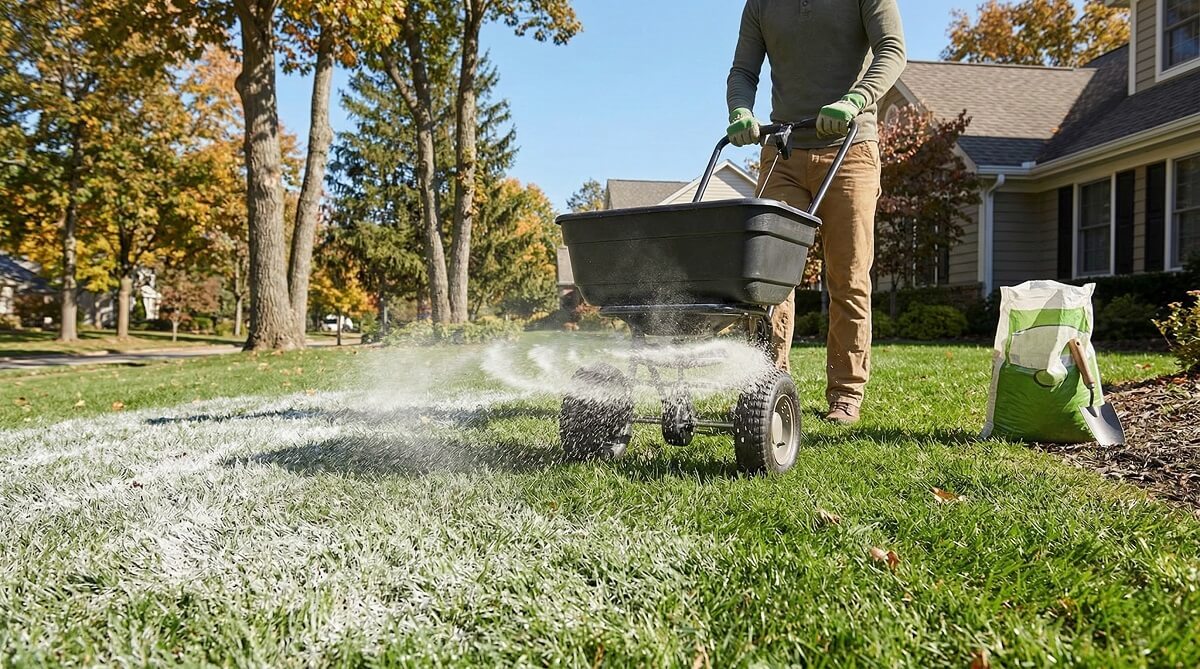
Fall—specifically September through November—is the best time to put lime on your lawn for most of the United States. The combination of cooler temperatures, increased rainfall, and natural freeze-thaw cycles helps lime break down and penetrate the soil over winter, preparing your lawn for optimal spring growth. Early spring (March through April) works as a backup if you miss the fall window.
Before applying lime at any time, . Only lawns with a pH below 6.0 actually need lime—applying it to soil that doesn’t need it can harm your grass by making conditions too alkaline. A professional soil test through your local extension office costs $11-30 and will tell you not only whether you need lime, but exactly how much to apply based on your specific soil type.
Avoid liming during summer heat or winter dormancy. Hot, dry conditions prevent proper absorption, while frozen or snow-covered ground stops the chemical process entirely. Your lawn shouldn’t be stressed, wilted, or actively dormant when you apply lime.
Quick Lime Application Checklist
✅ Apply lime now if:
- Soil test shows pH below 6.0
- Grass is green and actively growing (not stressed)
- It’s September-November (fall) or March-April (early spring)
- Weather forecast shows dry conditions for 24-48 hours
- You’ve aerated or plan to aerate within the same week
❌ Wait or skip lime if:
- You haven’t tested soil pH (don’t guess)
- Soil pH is already 6.0-7.0 (no lime needed)
- It’s summer (too hot) or winter (too cold)
- Rain forecast within 24 hours of application
- You fertilized within the past 2 weeks
- Grass is brown, dormant, or drought-stressed
Best Times to Apply Lime to Your Lawn
Fall Application (September-November) — The Optimal Window
Fall stands out as the ideal time to lime your lawn because natural conditions work in your favor. When you apply lime in fall, freeze-thaw cycles throughout winter help break down the lime particles, allowing them to penetrate deeper into the soil. Abundant rainfall during fall and winter months assists this process, gradually adjusting your soil pH over several months.
By spring, when your grass enters its most active growth period, the pH adjustment is complete and your lawn can take full advantage of improved nutrient availability. The Scotts lawn care team confirms this advantage: “The benefit of adding lime to your soil in fall is that both the freeze-thaw cycles and the abundant rain and snow common during the fall and winter months will help break down the lime and start raising the soil’s pH.”
Apply lime after for better soil penetration. Core aeration opens channels in the soil, allowing lime particles to settle deeper rather than sitting on the surface. This combination—aerating in fall followed by lime application—gives you the best results for most cool-season grasses.
Spring Application (March-April) — The Secondary Option
Early spring serves as your backup window if you missed fall application. Apply lime in March or April, before your grass enters peak growth mode. This gives the lime at least a few months to begin adjusting pH before summer stress arrives.
Early spring timing beats late spring for one simple reason: more time for the lime to work. If you apply lime in May or June, summer heat arrives before the pH adjustment really takes hold, reducing effectiveness. Spring application works well when combined with spring aeration, particularly for warm-season grasses that shouldn’t be aerated in fall.
The downside? Spring application gives lime less time to work before your lawn faces summer stress. Fall remains the better choice whenever possible.
When NOT to Apply Lime (Critical Timing Mistakes)
Poor timing wastes money and can stress your lawn. Avoid these windows:
Summer (June-August): Heat and drought stress prevent proper absorption. Lime needs moisture to break down and move into soil. During summer, lawns often struggle with water stress, and adding lime can create additional stress. Scotts explicitly warns: “Lime should never be applied to a lawn that is stressed or dormant, so don’t apply lime during summer.”
Winter (December-February): Frozen soil and dormant grass mean lime won’t break down effectively. The chemical reactions that adjust pH essentially stop in frozen conditions. Wait until early spring when soil thaws and grass begins active growth.
On wet or soggy lawns: Applying lime to wet grass causes clumping and uneven distribution. Your spreader won’t work properly, leaving some areas under-limed and others over-limed.
On stressed or wilted grass: Any pH change creates some stress for grass plants. Don’t compound existing stress from drought, disease, or other issues.
Within 2 weeks of fertilizing: that contain ammonium nitrate or urea react with lime to form ammonia gas through a process called ammonia volatilization. This reaction causes nutrient loss and reduces the effectiveness of both products. Wait at least 1-2 weeks between applying fertilizer and lime.
Regional Timing Guide for Applying Lime
Your location determines the optimal timing windows for lime application. Match your USDA hardiness zone to these recommendations:
Northern States (USDA Zones 3-5)
In northern climates—Minnesota, Wisconsin, Michigan, northern New York, and similar regions—apply lime in late September through mid-October for fall applications. This window gives lime time to begin working before the ground freezes solid. For spring applications, wait until late April or early May when soil has thawed and grass shows active growth.
Common grass types in these zones include Kentucky bluegrass, perennial ryegrass, and fine fescue. Kentucky bluegrass prefers a pH between 6.5 and 7.2, making it one of the grasses most likely to benefit from lime in acidic soils.
Mid-Atlantic & Midwest (USDA Zones 6-7)
For states like Ohio, Pennsylvania, Virginia, Maryland, and similar mid-latitude regions, October through mid-November works well for fall lime application. Spring applications should happen between mid-March and mid-April.
Tall fescue dominates this region, along with Kentucky bluegrass and perennial ryegrass. Tall fescue grows best when soil pH sits between 5.5 and 6.5, making it slightly more tolerant of acidic conditions than bluegrass.
Southern States (USDA Zones 8-10)
In Texas, Florida, Georgia, and other southern states, you can apply lime as late as November or even early December for fall timing. Spring applications work best in February through March, before warm-season grasses enter peak growth.
Bermudagrass, Zoysiagrass, and St. Augustine grass thrive in southern climates. These warm-season grasses prefer a pH of 6.0-6.5 and generally tolerate lower pH better than cool-season grasses. You may need lime less frequently in southern regions, but soil testing remains the only reliable way to know.
Step-by-Step Lime Application Timeline
4-6 Weeks Before: Test Your Soil
Start with a professional soil test. Your local university extension laboratory provides the most reliable results at reasonable cost. As of 2026, pricing typically runs $11-30 per sample. The University of Minnesota charges $22, Maryland Extension runs $11-30, and Vermont Extension charges $17 for a basic test.
Collect your soil sample by taking small amounts from 10-15 spots across your lawn, mixing them together in a clean bucket, and submitting about one cup of this mixed soil. Take samples from the top 4-6 inches of soil. Avoid contaminated areas near driveways, pet areas, or recent construction.
The test results tell you your current pH and provide a specific recommendation for lime in pounds per 1,000 square feet. This recommendation factors in your soil type—clay, loam, or sand—which affects how much lime you need to change pH.
2-4 Weeks Before: Aerate Your Lawn (Recommended)
Aeration helps lime penetrate deeper into your soil. Use a core aerator, which pulls small plugs of soil out of the ground, rather than a spike aerator that simply pokes holes. Core aeration creates larger openings that allow lime particles to settle into the soil profile.
According to Ohio State University Extension, “If coring is carried out prior to the lime application, it will help the lime incorporate into the soil.” Aerate 1-2 weeks before liming for the best results. Professional aeration costs vary by region and lawn size, while aerator rental typically runs $50-80 per day.
Application Day: Spread the Lime
Apply lime on a dry day with no rain forecast for at least 24 hours. Wet grass causes clumping and uneven distribution. You’ll need either a drop spreader or broadcast spreader. The ($59.97 at Home Depot) covers up to 5,000 square feet, while the EdgeGuard DLX ($99.97) handles up to 15,000 square feet.
Apply lime in a criss-cross pattern—one pass in one direction, then a perpendicular pass. This ensures even coverage and prevents striping. Never apply more than 50 pounds per 1,000 square feet in a single application. According to University of Arkansas Extension guidelines cited by Scotts: “Never add more than 50 pounds of lime per 1,000 square feet in a single application.”
After spreading, water your lawn lightly to rinse lime off grass blades and help it reach the soil. This prevents potential leaf burn from lime sitting directly on foliage.
6-12 Months After: Retest and Monitor
Lime takes time to work. You’ll notice initial pH changes within 3-6 months, but full adjustment takes up to 2-3 years according to Michigan State University Extension. Pelletized lime applied in May, for example, reaches maximum pH by August at the earliest—about three months.
Retest your soil in the opposite season from when you applied lime. If you limed in fall, test the following spring. Watch for improvement signs: greener grass, reduced moss growth, and better response to fertilizer applications. If pH remains too low, you may need a second application the following year.
How Much Lime to Apply (And When to Split Applications)
Understanding Lime Recommendations
Your soil test provides a recommendation in pounds of calcium carbonate per 1,000 square feet. However, lime products vary in their Calcium Carbonate Equivalent (CCE)—the measure of how much actual calcium carbonate they contain compared to pure limestone.
Pennington Fast Acting Lime, one of the most popular products, has a CCE of 90-94.6%. If your soil test recommends 50 pounds of pure calcium carbonate per 1,000 square feet and you’re using Pennington Fast Acting Lime with a 90% CCE, you’d calculate: 50 pounds ÷ 0.90 = 55.5 pounds of actual product needed.
Check the CCE percentage on your lime product bag and adjust accordingly. Products with higher CCE require less material to achieve the same pH change.
Single vs Split Applications
The total amount needed determines how you divide your lime application:
Under 50 lbs per 1,000 sq ft: Apply all at once, either in fall or early spring. Most lawns fall into this category when lime is needed.
50-100 lbs needed: Split into two applications. Apply 50 pounds in fall, then the remainder the following spring. This prevents over-application at one time.
Over 100 lbs needed: Apply 50 pounds in fall, another 50 pounds in spring, retest soil, and continue the following year if still needed. Severely acidic soils require patience—you can’t fix years of pH decline in one application.
Types of Lime and Application Timing
| Lime Type | Characteristics | Best Timing | Cost per 40 lb Bag |
|---|---|---|---|
| Pelletized Lime | Easy to spread, minimal dust, moderate speed | Fall or early spring | $8-12 |
| Powdered/Pulverized Lime | Faster acting, very dusty, harder to apply | Fall (more settling time) | $5-8 |
| Liquid Lime | Fastest acting, professional application | Any season (proper conditions) | $150-300 per acre (professional service) |
Pelletized Lime (Easiest to Apply)
Most homeowners choose pelletized lime because it’s easy to handle and spread. The pellets produce minimal dust compared to powdered lime, and they work through standard broadcast or drop spreaders without clogging. Pennington Fast Acting Lime covers 5,000 square feet per 30-pound bag and breaks down at a moderate pace—faster than traditional agricultural lime, but slower than liquid treatments.
Apply pelletized lime in fall or early spring for best results. The pellets gradually break down over several months, providing steady pH adjustment.
Powdered/Pulverized Lime (Fastest Acting)
Finely ground lime changes pH faster than pelletized products because the smaller particles have more surface area. However, the dust makes application messy and difficult. Even light wind can blow powdered lime off target, and achieving even coverage with a spreader becomes challenging.
If you choose powdered lime, fall application gives the dust more time to settle and prevents the mess from interfering with summer lawn activities. Powdered lime typically costs less than pelletized options—$5-8 per 40-pound bag versus $8-12.
Liquid Lime (Professional Option)
Liquid lime treatments work the fastest, adjusting pH within weeks rather than months. However, these products typically require professional application and cost significantly more than granular options. Expect to pay $150-300 per acre for professional liquid lime service.
The advantage of liquid lime is flexibility—professionals can apply it during any season as long as conditions allow (not frozen, not drought-stressed). For most homeowners, the cost doesn’t justify the speed advantage.
Grass-Specific Timing Considerations
Cool-Season Grasses (Bluegrass, Fescue, Ryegrass)
Cool-season grasses——prefer slightly higher pH, typically 6.5-7.0 according to Penn State Extension. These grasses grow most actively in fall and spring, making fall the ideal time to lime.
Apply lime in September or October during active growth. Cool-season grasses can handle fall aeration and fall lime application in the same season, making this an efficient approach. If you miss the fall window, early spring (March-April) works as your backup timing.
Warm-Season Grasses (Bermuda, Zoysia, St. Augustine)
Bermudagrass, Zoysiagrass, and St. Augustine grass tolerate slightly lower pH—6.0-6.5—and often need lime less frequently than cool-season grasses. These grasses enter dormancy in fall and shouldn’t be aerated during dormancy.
For warm-season grasses, you have two good timing options: late spring (April-May) when grass is actively growing, or fall (September-October). If you plan to aerate, do it in late spring when warm-season grass is growing vigorously, and apply lime at the same time. Alternatively, aerate in late spring and lime in fall, giving you two separate treatment windows.
Combining Lime with Other Lawn Care Tasks
Lime + Aeration Timing
Aerate first, then apply lime within the same week. Lime particles settle into aeration holes, improving contact with the soil profile. Penn State Extension notes that limestone works best when mixed with the top 5 inches of soil, and aeration helps achieve this penetration.
For cool-season grass: Aerate and lime both in fall. This is the ideal combination for Kentucky bluegrass, tall fescue, and ryegrass lawns.
For warm-season grass: Aerate in late spring when grass is growing strongly. You can lime immediately after aerating, or wait until fall to lime. Both approaches work.
Lime + Fertilizer Timing
Never apply lime and fertilizer together. These products can interact chemically, reducing the effectiveness of both. Wait at least 1-2 weeks between applications, with lime going down first.
Alternatively, separate these treatments seasonally: fertilize in early spring, then lime in fall. This approach eliminates any concern about timing conflicts.
Lime + Overseeding Timing
You can overseed immediately after liming. In fact, lime helps new grass establish by improving nutrient availability. A common fall renovation sequence combines multiple tasks: aerate, apply lime, overseed, and water thoroughly.
The improved pH from lime helps young seedlings access nutrients more efficiently, leading to better establishment and density.
Cost Breakdown: When to DIY vs Hire a Pro
DIY Lime Application Costs
For a typical 5,000 square foot lawn needing lime (2026 costs):
- Soil test: $22 (University of Minnesota) or $11-30 (typical range)
- Pelletized lime: $10-12 per 30 lb bag × 3-4 bags = $30-48
- Spreader rental: $25-35 per day (if you don’t own one)
- Total DIY cost: $77-115
If you already own a spreader and skip the soil test (not recommended), you’re looking at just the lime cost—$30-48 for 5,000 square feet.
Professional Lime Application Costs
Professional lawn care companies typically charge around $24 per 1,000 square feet for lime application, according to lawn care professionals. For a 5,000 square foot lawn, expect to pay approximately $120-150 for professional service.
Professional service includes the lime product, spreading, and cleanup. Some companies include soil testing in their service packages, while others charge separately. The advantage is convenience and even application—professionals use commercial spreaders that provide better coverage than consumer equipment.
Cost-Benefit Analysis by Lawn Size
Under 3,000 sq ft: DIY almost always makes sense. Professional charges still include minimum service fees, making small lawns relatively expensive per square foot.
3,000-8,000 sq ft: DIY saves money but requires time and physical effort. Professional service costs 1.5-2× more than DIY but eliminates several hours of work.
Over 8,000 sq ft: Professional application becomes more attractive. Large lawns require multiple bags of lime, repeated spreader passes, and significant physical effort. The cost difference narrows on a per-square-foot basis for large properties.
Signs You Timed Your Lime Application Correctly
Proper timing and correct application amounts produce these improvements within 3-6 months:
- Greener, thicker grass: Improved pH allows better nutrient uptake, leading to more vigorous growth and deeper green color
- Moss decline: Moss thrives in acidic conditions. As pH rises, moss struggles to compete with healthy grass
- Reduced weeds: Certain weeds prefer acidic soil. Better pH creates conditions that favor grass over these weeds
- Better fertilizer response: At proper pH, grass absorbs nitrogen, phosphorus, and potassium more efficiently, making your fertilizer more effective
- Soil test confirms improvement: Retest after 6 months to verify pH has moved closer to the ideal range
- No grass burn or yellowing: These problems indicate over-application or failure to water after spreading. Correct timing plus proper application technique avoids these issues
Common Lime Timing Mistakes to Avoid
Learn from these frequent errors:
1. Applying without testing soil first: This is the single biggest mistake. You might not need lime at all—or you might need far more or less than you assume. The soil test costs $22 and eliminates guesswork.
2. Liming in summer heat: Hot, dry conditions prevent absorption and can stress grass. You’ll waste money and possibly harm your lawn.
3. Applying to frozen or snow-covered ground: Frozen soil means no chemical activity. The lime sits on the surface until spring thaw, when it may wash away or distribute unevenly.
4. Liming too close to fertilizing: Wait at least 1-2 weeks between these applications. Chemical reactions between certain fertilizers and lime reduce effectiveness and waste nutrients.
5. Expecting immediate results: Lime requires 3-6 months minimum to significantly change pH. Avoid reapplying prematurely because you don’t see instant greening.
6. Applying too much at once: The 50 pounds per 1,000 square feet maximum exists for good reason. Excessive lime can swing pH too high, creating new nutrient problems.
7. Not watering after application: Lime particles stuck on grass blades can cause burn spots. A light watering rinses lime into the soil where it belongs.
8. Liming when soil is already neutral or alkaline: If your pH is 7.0 or higher, lime creates problems rather than solving them. Test first, lime only when needed.
Frequently Asked Questions
What is the best time of year to put lime on my lawn?
Fall—September through November—is the best time to put lime on your lawn for most of the United States. The freeze-thaw cycles and abundant moisture during fall and winter help break down lime and raise soil pH gradually. Early spring (March-April) works as a secondary option if you miss the fall window. Both seasons provide enough time for lime to adjust pH before your grass faces summer stress.
Can I apply lime to my lawn in summer?
No, avoid summer application. Hot, dry conditions prevent proper lime absorption and can stress your grass further. Lime needs moisture to break down and move into the soil. During summer, most lawns struggle with heat and water stress. Adding lime during this period compounds the stress and wastes money on ineffective treatment. Wait until fall or early spring when temperatures moderate and moisture increases.
Can I put lime on my lawn in winter?
Winter application is not recommended. Frozen soil and dormant grass mean lime won’t break down effectively. The chemical reactions that adjust pH require soil temperatures above freezing and some level of grass activity. Lime applied to frozen ground simply sits on the surface until spring thaw, when it may wash away unevenly or concentrate in low spots. Wait until early spring when soil thaws and grass begins active growth.
How long does lime take to work?
Lime takes 3-6 months for initial pH changes and up to 2-3 years for full effect according to Michigan State University Extension. If you apply pelletized lime in May, for example, maximum pH change occurs by August at the earliest—about three months. Factors affecting speed include particle size (smaller works faster), soil temperature (warmer speeds reactions), moisture levels (adequate water required), and how well lime mixes with soil. Patience is necessary—avoid expecting overnight results.
Can I apply lime and fertilizer at the same time?
No, separate these applications by at least 1-2 weeks. Fertilizers containing ammonium nitrate or urea react with lime to form ammonia gas through ammonia volatilization. This chemical reaction causes nutrient loss and reduces effectiveness of both products. Apply lime first, wait 1-2 weeks, then fertilize. Alternatively, fertilize in early spring and lime in fall, completely separating the treatments seasonally.
How often should I put lime on my lawn?
Most lawns need lime every 2-3 years, but test your soil every 2-3 years to confirm actual need. Frequency depends on several factors: soil type (sandy soils need more frequent liming), rainfall amount (high-rainfall areas leach calcium faster), fertilizer use (certain fertilizers increase acidity), and grass type (cool-season grasses prefer higher pH). Never apply lime based on a schedule—always test first to determine whether your specific lawn needs it.
What happens if I apply lime at the wrong time?
Summer application stresses grass and wastes money due to poor absorption. Winter application is simply ineffective—no chemical activity occurs in frozen soil. Poor timing means you spend money on lime that doesn’t accomplish the intended pH adjustment. In extreme cases, lime applied during summer heat can burn grass if not watered immediately. Always aim for fall or early spring application when conditions support proper lime breakdown and soil penetration.
Should I aerate before or after applying lime?
Aerate first, then apply lime within the same week. Lime settles into aeration holes for better soil contact and deeper penetration. Penn State Extension notes that limestone works most effectively when mixed with the top 5 inches of soil, and aeration helps achieve this depth. The holes created by core aeration provide direct pathways for lime to reach deeper soil layers rather than sitting primarily on the surface.
Can I apply lime to wet grass?
No, lime clumps on wet grass and distributes unevenly. Your spreader won’t function properly on wet turf, leading to inconsistent application. Some areas receive too much lime while others get too little. Apply lime to dry grass with no rain forecasted for 24 hours. After spreading, water lightly to rinse lime off grass blades and help it reach the soil—but start with dry grass for proper distribution.
Do I need to water after applying lime?
Yes, water lightly after spreading lime to rinse particles off grass blades and help lime reach the soil. This prevents potential leaf burn from lime sitting directly on foliage. A light watering—about 10-15 minutes with a sprinkler—is sufficient. You don’t need heavy watering; just enough to wash lime down to soil level where it can begin working. This step is particularly important if you accidentally applied lime to slightly damp grass or if humidity is high.
Final Timing Recommendations
Late September through October offers the sweet spot for lime application across much of the United States. This window takes advantage of natural seasonal conditions and gives lime maximum time to adjust pH before spring growth.
Your action plan: through your local extension office 4-6 weeks before you plan to apply lime. If results show pH below 6.0, schedule lime application for mid to late fall. Aerate your lawn first if possible, spread lime on a dry day, water lightly afterward, and retest the following spring to confirm improvement.
If you miss the fall window, don’t panic. Early spring still works—just apply in March or April before summer heat arrives. The key is testing first and timing application during moderate temperatures with adequate moisture.
Ready to improve your lawn’s pH? Check current prices on pelletized lime at or . Find your for professional soil testing services.
