


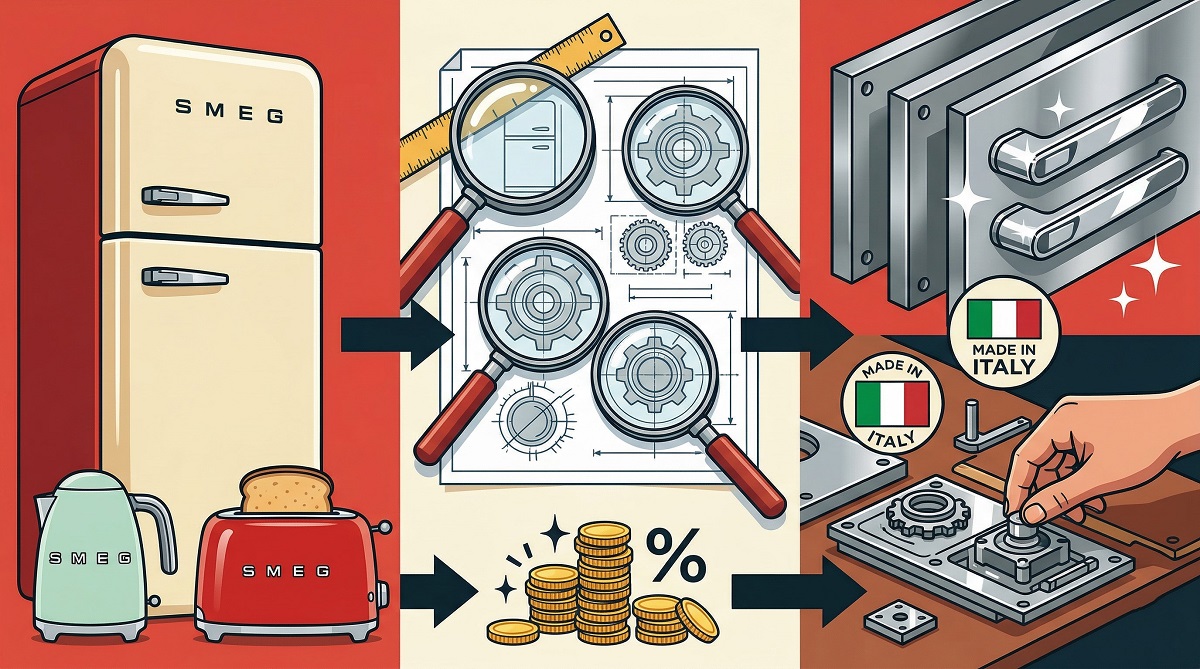
Smeg appliances cost more than most people expect—sometimes two to five times what a comparable machine runs from a brand like Cuisinart or Hamilton Beach. The short answer is that you’re paying for four things simultaneously: Italian manufacturing heritage, distinctive industrial design that’s stayed essentially unchanged since the 1990s, premium materials, and the brand’s deliberate positioning as a lifestyle product rather than just a kitchen tool. A Smeg toaster isn’t really competing with other toasters. It’s competing with other statement pieces.
That said, design dollars don’t automatically mean better performance. Independent testing paints a mixed picture: Smeg’s small appliances—especially toasters, hand mixers, and espresso machines—earn solid marks from reviewers. But their kettles and refrigerators have underperformed in rigorous lab testing, sometimes placing near the bottom of comparative rankings. Knowing which Smeg products are actually worth the premium, and which ones you’re better off skipping, is the whole point of this piece.
Below, we break down what drives the price, where Smeg earns it, where it doesn’t, and what your money buys when you go with a cheaper alternative instead.
Who Should (and Shouldn’t) Buy Smeg
✅ Smeg Makes Sense If You:
- Want appliances that stay on permanent display—not hidden in a cabinet
- Care about kitchen aesthetics and want a cohesive countertop look across multiple pieces
- Are buying a small appliance (toaster, hand blender, espresso machine) rather than a large one
- Can catch a sale—seasonal deals often knock 15–25% off the price
- Have already budgeted for a premium purchase and won’t regret it
❌ Skip Smeg If You:
- Prioritize performance-per-dollar above everything else
- Need a refrigerator or range—the value case weakens significantly at large-appliance scale
- Require a long warranty; Smeg’s US small-appliance coverage is just one year standard
- Are on a tight budget—comparable function exists for 40–60% less from KitchenAid, Breville, and De’Longhi
What Your Money Actually Pays For
Smeg was founded in 1948 by Vittorio Bertazzoni Sr. in Guastalla, Italy. The name is an acronym: Smalterie Metallurgiche Emiliane Guastalla—which translates roughly to “Emilian Metallurgical Enameling Works of Guastalla,” according to Smeg’s official brand history. The company started as a metalworks and enameling operation before shifting into home appliances, launching its first branded cooker in 1956 and its now-iconic FAB refrigerator line in 1997.
That history matters because Smeg has never tried to be a budget brand. From day one, the strategy was to make appliances that belonged in well-designed kitchens—not just efficient ones. Here are the four forces that actually drive the price tag.
1. Italian Manufacturing (At Least for Major Appliances)
Smeg’s major appliances—ovens, ranges, refrigerators, dishwashers—are still manufactured in Italy across multiple facilities including Guastalla, Bonferraro, Chieti, and San Giuliano Milanese. Italian labor and material costs are substantially higher than production in lower-cost regions, and that’s reflected in the sticker price.
For small appliances (toasters, kettles, coffee makers), manufacturing locations vary by product. If you’re paying a premium specifically for Italian-made goods, it’s worth checking the packaging on the specific model you’re considering. The large appliances carry that heritage most directly.
2. Award-Winning Industrial Design
Smeg employs serious industrial designers and has a track record of winning respected awards. In 2025, the Chicago Athenaeum Museum of Architecture and Design gave Smeg the Good Design Award for its Electric Barbecue and Sparkling Water Maker—recognizing both “aesthetic, functionality, iconic identity, and innovative impact,” according to Smeg’s official announcement.
The FAB line’s rounded silhouette, chrome accents, and vintage color palette have been consistent since 1997. That kind of sustained design identity costs money—both to develop and to maintain as a brand differentiator over nearly three decades. You’re not just getting a product; you’re getting one that’s been visually refined and coordinated across an entire product ecosystem.
3. Premium Materials and Build Quality
Pick up a Smeg toaster and set it next to a $30 alternative. The difference in weight is immediate. Smeg appliances use stainless steel, die-cast aluminum housing, and high-grade polymer components rather than the thin plastic shells common in budget appliances. The levers feel solid. The bases don’t wobble. The chrome doesn’t peel.
One Taste of Home tester who used the Smeg 2-slice toaster for a month described it this way: “Every piece on it feels sturdy and solid. The chrome and weight of it remind me of 1950s appliances that are durable and last forever.” That tactile quality doesn’t happen accidentally—and it’s priced into every unit.
4. Brand Positioning as a Lifestyle Product
Smeg occupies the same psychological market territory as Le Creuset, KitchenAid’s Artisan line, and Vitamix. The price isn’t just about production costs—it’s also a positioning signal. Smeg has partnered with Dolce & Gabbana (the “Sicily Is My Love” collection), Porsche, Fiat, and Disney precisely because those collaborations reinforce the brand as something aspirational, not just functional.
Reviewed.com’s Senior Manager of Lab Operations put it plainly: Smeg’s steep prices “have very little to do with build quality, and everything to do with appearance.” That’s a blunt take, but it captures something real. You’re buying a brand identity alongside the appliance—and whether that’s a reasonable spend depends entirely on how much you care about what’s sitting on your counter.
What Smeg Actually Costs Right Now
Smeg’s US pricing is set by the official Smeg store (smegstore.us), though Amazon, Williams Sonoma, Best Buy, and other retailers often list them at similar or slightly lower prices. Here’s what you’re looking at for the most popular small appliances as of March 2026:
| Smeg Product | Smeg MSRP (US) | Comparable Alternative | Alt. Price (Approx.) |
|---|---|---|---|
| 2-Slice Toaster (TSF01) | $275 | KitchenAid 2-Slice Toaster | ~$80–$130 |
| Electric Kettle (KLF03, 7-cup) | $200+ | De’Longhi Icona Vintage Kettle | ~$90–$115 |
| Drip Coffee Maker (DCF02) | ~$300 | Cuisinart DCC-3200 (14-cup) | ~$80–$100 |
| Retro Stand Mixer (5qt, 600W) | $540 | KitchenAid Artisan (5qt) | ~$400–$500 |
| Milk Frother (MFF01) | ~$230–$250 | Breville Milk Café | ~$80–$130 |
Prices were current as of March 2026—check Amazon or the official Smeg US store for real-time pricing, as they shift with promotions and color availability.
The pattern here is consistent: Smeg runs two to three times the price of functional alternatives in every category. That premium is partially explained by the factors above—and partially by the fact that Smeg knows its buyers are making an aesthetic decision, not a purely rational one.
Performance Reality: What Independent Tests Found
The price story is only half the picture. The more useful question is: do Smeg appliances actually work as well as they cost? The answer varies sharply by product category.
Where Smeg Holds Up Well
Toasters: This is Smeg’s strongest category. Taste of Home’s product testing team evaluated more than a dozen toasters and voted the Smeg 2-slice model the “most stylish” pick. More importantly, they praised its performance—even browning across all six settings, reliable bagel and defrost functions, and consistent results in month-long real-world use. Reviewed.com includes the Smeg toaster among their top pop-up toasters, and the model has accumulated over 200 five-star reviews on Amazon.
Hand mixer: Homes & Gardens tested the Smeg Retro 50s Hand Mixer ($180) against more than a dozen competitors. It took second place, outperformed only by KitchenAid’s iconic model. Nine speeds, multiple attachments (dough hooks, wire whisks, beaters), and a digital timer put it near the top of any buying guide for hand mixers.
Espresso machines: BBC Good Food’s test kitchen rated the ECF02 espresso machine 4.5 out of 5 stars, noting it “produces great espresso—dark and rich with silky crema.” The step-up EGF03 model (with a built-in burr grinder) earned equal praise and is considered mid-range pricing versus other premium coffee machines at its performance level.
Immersion blender: The Smeg hand blender with attachments handles immersion blending, whisking, chopping, and mashing in a single unit. The Homes & Gardens editor bought one personally and uses it daily—it made it into their guide as a top-five immersion blender despite its $135–$190 price range.
Where Smeg Falls Short
Kettles: This is the clearest performance disappointment. Consumer NZ, an independent non-profit consumer testing organization, evaluated 44 electric kettles. The Smeg Variable Temperature Kettle KLF04 landed second-from-last in their rankings. Testers cited excessive noise, difficulty seeing the water level (obscured by the handle), and wrist strain when pouring. For a $200+ kettle, that’s a hard case to make. if you’re still undecided. If 50s-style is your goal for a kettle, the De’Longhi Icona Vintage is worth comparing—Reviewed.com calls it “a higher-performing dupe” at roughly half the price.
Refrigerators: Smeg’s FAB line fridges are among the most photographed appliances on the internet, and among the most criticized by actual owners. Reviewed.com notes widespread complaints about poor temperature regulation, flimsy plastic interior parts, high repair costs, and the fact that the freezer requires manual defrosting—a feature most modern fridges eliminated decades ago. The FAB32 offers roughly 18.8 cubic feet of storage at prices starting around $2,000+, while competitors at similar prices offer significantly more space and better energy ratings.
Drip coffee makers: Real-world owner experience here is mixed. One owner who used a Smeg drip coffee maker for over two years praised the coffee quality but cited persistent frustrations: a loud startup/shutdown beep, an awkward water fill design requiring a high pour angle, and a 20-minute auto-shutoff that required constant manual restarts. When the machine failed just past the one-year warranty window, Smeg’s customer support offered no resolution. That kind of experience is worth factoring into your decision.
Smeg vs. The Competition
Smeg vs. KitchenAid
For stand mixers, KitchenAid’s Artisan (5qt) costs $400–$500—less than Smeg’s $540—and outperforms it in most head-to-head tests. Homes & Gardens found the KitchenAid “better by pretty much any metric,” including being “more authentically 50s” since the Artisan’s silhouette is largely unchanged from the original 1950s design. The Smeg mixer is a reasonable pick only if you’re building a matching Smeg collection and can find it discounted by $100 or more.
Smeg vs. De’Longhi Icona Vintage
For buyers who want retro aesthetics without Smeg’s price, De’Longhi’s Icona Vintage line offers kettles and coffee makers in similar pastel colorways at significantly lower price points. Reviewed.com specifically recommended the De’Longhi Icona kettle as “a more affordable and higher-performing dupe” of Smeg’s equivalent. It typically runs $90–$115 on Amazon versus Smeg’s $200.
Smeg vs. Breville (Coffee and Milk)
Breville’s Barista Pro and Bambino espresso machines offer performance that’s difficult for Smeg to match at their price tiers. Breville’s Milk Café frother runs $80–$130 versus Smeg’s $230–$250 milk frother—with comparable froth quality in independent tests. For pure coffee performance, Breville typically wins on function; Smeg wins on how it looks while doing it.
Smeg vs. Big Chill / Elmira (Retro Fridges)
If a retro-style refrigerator is what you actually need—not just want—Big Chill and Elmira Northstar are worth comparing. Both offer American-made retro aesthetics with modern internals (no-frost freezers, better energy ratings, larger capacities). Pricing is comparable or higher, but the functional reputation is considerably stronger than Smeg’s FAB line.
When to Buy Smeg — and When to Walk Away
Buy Smeg When:
- You’ve identified a model in a strong-performing category (toaster, hand mixer, espresso machine) and found it on sale
- The aesthetic is a genuine priority—you’ll see this appliance every single day and care what it looks like
- You’re building a coordinated kitchen aesthetic across multiple appliances and want the matching set
- Black Friday, seasonal events, or direct Smeg store promotions knock the price down 15–25%
Skip Smeg (or Look Elsewhere) When:
- You’re buying a refrigerator—the value case is weak, and reliability concerns are documented
- You need the absolute best performance at a given budget; competing brands almost always win on pure function
- Warranty security matters to you—the standard small-appliance warranty in the US is just one year, unless you buy directly from the Smeg store (which extends it to two)
- The price gap feels painful; it should feel like a splurge you’re comfortable with, not a compromise you’ll regret
Frequently Asked Questions
What does SMEG stand for?
SMEG is an acronym for Smalterie Metallurgiche Emiliane Guastalla—the Italian phrase for “Emilian Metallurgical Enameling Works of Guastalla,” reflecting the company’s origins as an industrial enameling and metalworks operation in northern Italy.
Is Smeg made in Italy?
Smeg’s major appliances (ovens, ranges, refrigerators, dishwashers) are manufactured in Italy across multiple production facilities. Small appliances may be produced elsewhere depending on the product line—check individual product packaging if Italian manufacturing is important to you.
How long is Smeg’s warranty in the US?
Small appliances come with a one-year warranty in the US. If you purchase directly from the Smeg official online store, that extends to two years. Major appliances (fridges, ranges, dishwashers, built-in coffee systems) carry a standard two-year warranty. This is worth knowing before purchase, especially for products in the $200–$300 range.
Are Smeg toasters worth it?
For most buyers, yes—at least for the 2-slice toaster. Independent testing by Taste of Home, Reviewed.com, and others consistently places the Smeg toaster in the top tier for both design and performance. Even browning, solid build quality, and reliable settings make it one of the few Smeg products where the price feels justified. If you can find it on sale below $225, it’s a solid call.
Are Smeg fridges reliable?
Less so than competitors at comparable prices. Reviewed.com and multiple user review platforms document recurring issues with Smeg FAB refrigerators: inconsistent temperature regulation, flimsy internal plastic parts, the need to manually defrost the freezer, and high repair costs. For a $2,000–$4,000 purchase, those are meaningful concerns. If you want the retro fridge look, investigate Big Chill or Elmira Northstar before committing to Smeg.
Is Smeg better than KitchenAid?
Depends on the product. For stand mixers, KitchenAid wins on performance and value at full price. For toasters, they’re competitive—Smeg wins on aesthetics, KitchenAid offers marginally more bread-specific settings. For hand mixers, Smeg is a strong second place. Neither brand is universally better; it comes down to what you’re buying.
What are the best alternatives to Smeg for less money?
For retro kettle and coffee aesthetics: De’Longhi Icona Vintage (roughly half the price, strong performance reviews). For stand mixers: KitchenAid Artisan. For espresso and coffee: Breville. For toasters that are similarly designed: KitchenAid’s Artisan toaster is the closest direct comparison. None of these will give you the Smeg colorway range, but they’ll perform equally or better at a lower price.
Does Smeg go on sale?
Yes, regularly. Black Friday is the most reliable window for Smeg discounts, though seasonal sales, Amazon promotions, and Williams Sonoma sale events can cut 15–25% off list price. Homes & Gardens reviewers who cover the brand specifically advise waiting for sales before buying at full price—several noted they personally bought their own Smeg appliances that way. Set a price alert on Amazon or check the Smeg store’s promotions page before paying full retail.
Check current prices and available colors for Smeg small appliances on Amazon or at the official Smeg US store. If you’re looking for retro-style alternatives, compare De’Longhi Icona Vintage or KitchenAid’s Artisan line before committing.
