


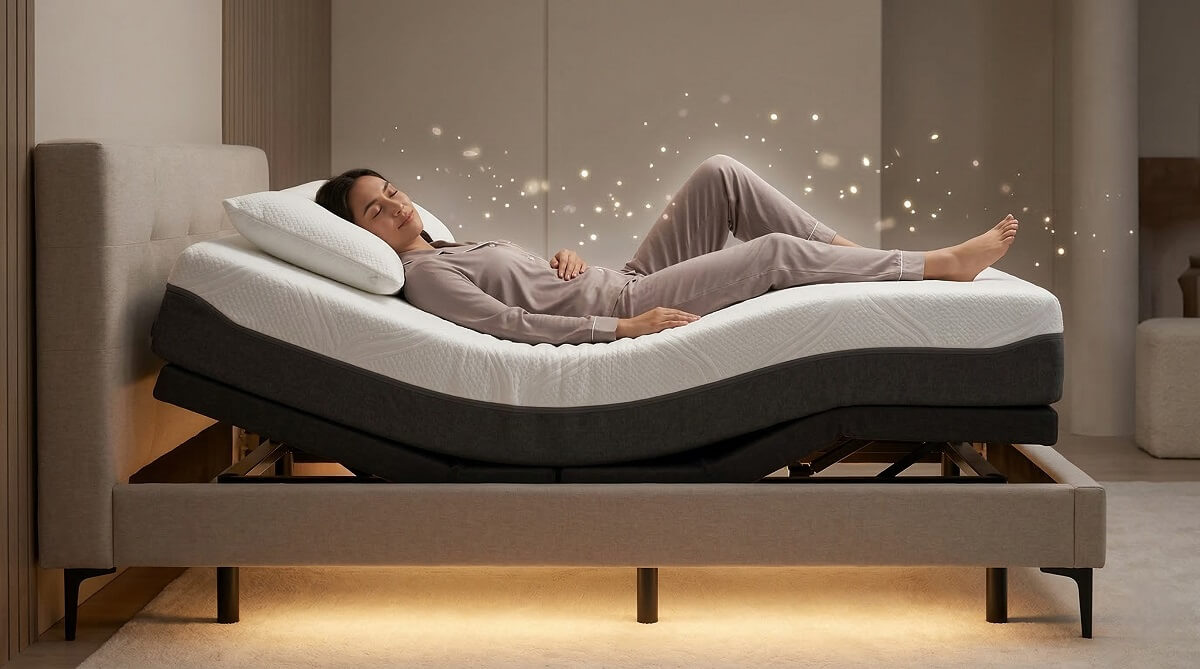
A zero gravity bed is an adjustable bed frame that elevates your head and legs to create a neutral body position, originally developed by NASA for astronauts during launches. This position relieves pressure on your spine, improves circulation, and can reduce snoring, back pain, and acid reflux. For people dealing with chronic pain, sleep apnea, or mobility issues, zero gravity beds offer meaningful health benefits beyond simple comfort.
Prices range from around $300 for basic adjustable bases to over $3,000 for smart models with massage, app control, and anti-snore sensors. As of February 2026, the sweet spot for most buyers is $900-$1,500 for a queen-size base with essential features like preset positions, wireless remote, and USB ports. The Casper adjustable base, for example, starts at around $937 for queen size.
Whether a zero gravity bed is worth the investment depends on your specific sleep challenges. If you snore regularly, have lower back issues, or struggle with heartburn at night, the benefits can be substantial. But if you sleep well on a traditional flat mattress without pain or breathing issues, the added cost might not be justified. is often the first step before considering adjustable bases.
Who Should (and Shouldn’t) Buy a Zero Gravity Bed
✅ Consider a Zero Gravity Bed If You:
- Experience chronic lower back or neck pain — Elevation relieves spinal pressure and can reduce morning stiffness
- Snore or have mild sleep apnea — and reduces soft tissue obstruction
- Deal with acid reflux or GERD at night — Medical studies show 20-28 cm elevation reduces esophageal acid exposure
- Have circulation issues or leg swelling — Leg elevation helps reduce edema and improves blood flow
- Spend time reading or working from bed — Adjustable positioning prevents neck strain while using devices
- Want customizable sleeping positions — Dual motors allow independent head and foot adjustment
❌ Probably Skip If You:
- Sleep perfectly fine on a flat mattress — No pain or breathing issues means limited benefit for the cost
- Are on a tight budget (under $500 total) — Quality adjustable bases start around $900; cheaper models may disappoint
- Prefer a minimalist, low-profile bed setup — Adjustable bases add height and mechanical complexity
- Don’t have mobility issues or pain — The health benefits are most significant for specific conditions
- Want something completely maintenance-free — Motors and mechanisms require occasional troubleshooting
What Is a Zero Gravity Bed? (And Why “Zero Gravity”?)
When you hear “zero gravity,” you probably picture astronauts floating in space. But in the context of sleep, a zero gravity bed is simply an adjustable bed frame that positions your body in a way that minimizes pressure on your spine and joints.
The term comes from NASA, which developed this neutral body position for astronauts during rocket launches. When leaving Earth’s atmosphere, astronauts experience rapid changes in gravitational force. The zero gravity position — with the head and legs elevated above the heart — helps distribute that force evenly across the body rather than concentrating stress on the spine.
Now, adjustable bed manufacturers use the same positioning concept to help regular sleepers reduce pressure, improve circulation, and address common sleep issues like back pain and snoring. You won’t actually float, but you can experience similar pressure relief that NASA engineers discovered decades ago.
How Zero Gravity Beds Actually Work
The Position Explained
The zero gravity position creates approximately a 120-degree angle at your hips, with your head and legs elevated above your heart. Based on manufacturer specifications, most adjustable beds elevate the head by about 8-12 degrees and the legs by 30-45 degrees (commonly around 40 degrees).
This specific angle matters because it aligns your spine in a neutral position where your vertebrae aren’t compressed. When you lie completely flat, gravity pulls your body weight into the mattress unevenly, creating pressure points in your lower back and shoulders. The elevated position distributes your weight more evenly, reducing strain on your spinal column.
Key Features to Know
Most zero gravity beds include these standard features:
- Dual motors — Allow independent head and foot elevation (0-65° for head, 0-45° for foot). Single motor models exist in the budget range but only move together, limiting customization.
- Wireless remote with presets — One-touch buttons for Zero Gravity, Anti-Snore, Flat, and TV/Lounge positions. Mid-range models ($900+) include programmable memory for 1-4 favorite positions.
- App control — Premium models ($1,500+) add Bluetooth smartphone control for convenience. Budget models stick with wireless remotes.
- Additional comfort features — Massage (3 intensity levels typical), USB charging ports (2-4 ports), under-bed LED lighting for nighttime navigation.
- Weight capacity — Standard models support 650-850 lbs; heavy-duty versions with reinforced frames handle up to 1,000 lbs (important for couples).
7 Real Benefits of Zero Gravity Beds (Backed by Science)
1. Reduces Lower Back and Neck Pain
Cleveland Clinic sleep experts note that back sleeping is optimal for reducing spinal pressure, and adding knee elevation further reduces lower back strain. Dr. Andrew Bang, DC, states: “Want to put the least amount of pressure on your spine? Sleeping on your back is the way to go.”
The zero gravity position takes this a step further by elevating both your head and legs, creating alignment with your spine’s natural curve. This helps if you wake up with stiffness or aching, especially in the lumbar region. People with tight hamstrings particularly benefit from the knee elevation, which prevents excessive lower back arching. plays a crucial role in spinal health.
2. Minimizes Snoring and Sleep Apnea Symptoms
According to Sleep Foundation research, elevating your head while sleeping can limit how much gravity pulls the tongue and other tissues into positions where they block the airway. For back sleepers with mild sleep apnea, a 60-degree angle helps maintain open airways.
Clinical studies on positional therapy show that head-of-bed elevation reduces snoring by increasing airway cross-sectional area and decreasing closing pressure. While this doesn’t replace CPAP therapy for diagnosed sleep apnea, it can help with positional snoring (snoring that mainly occurs when lying flat on your back).
Patient tolerance is also better — while CPAP machines are more effective, many people struggle with adherence. Positional therapy through an adjustable bed offers a more comfortable alternative for mild cases.
3. Eases Acid Reflux and Heartburn
Medical research shows clear benefits for GERD (gastroesophageal reflux disease) sufferers. A systematic review published in PMC found that elevating the head of the bed by 20-28 cm (approximately 20-22 degrees) reduces esophageal acid exposure compared to flat sleeping.
Four out of five clinical trials showed positive results. In one high-quality study, participants using head elevation were 2.1 times more likely to report meaningful symptom improvement compared to flat sleeping. About 60-63% of participants preferred the elevated position after trying it.
A Johns Hopkins review of 100 independent studies on lifestyle changes for reflux found that only head-elevated sleeping and weight loss showed clear benefits in well-designed research. The elevation works by using gravity to keep stomach acids down where they belong, rather than allowing them to travel up the esophagus while you sleep.
4. Improves Blood Circulation
Elevating your legs so they’re roughly level with your heart reduces the work your cardiovascular system must do to circulate blood. When you lie flat, your heart pumps against gravity to move blood through your extremities. Leg elevation makes this process more efficient.
This is particularly helpful for people with edema (swelling), varicose veins, or who spend long periods standing during the day. The improved circulation can reduce swelling in hands and feet and may lower the risk of blood clots for people with circulatory issues.
5. Enhances Breathing for Respiratory Issues
An upright sleeping position reduces pressure on your lungs and opens nasal passages. If you deal with allergies, asthma, or seasonal congestion, the elevated position can make breathing more comfortable throughout the night.
The mechanism is straightforward: gravity helps drain sinuses when your head is elevated, and the expanded chest cavity allows your lungs to operate more efficiently. This won’t cure respiratory conditions, but it can provide symptom relief that leads to better sleep quality.
6. Supports Pregnancy Comfort
Pregnant women, especially in the second and third trimesters, often struggle to find comfortable sleeping positions. Side sleeping (particularly on the left side) is recommended by OB-GYNs, and adding slight elevation can reduce back strain and leg swelling that commonly occur during pregnancy.
The zero gravity position helps with common pregnancy complaints like heartburn, shortness of breath, and lower back pain. However, pregnant women should consult their healthcare provider before making significant changes to their sleep setup.
7. Adds Convenience for Daily Activities
Beyond sleep, an adjustable bed makes activities like reading, watching TV, or working on a laptop more comfortable. The elevated position prevents neck strain from propping yourself up with pillows, and it’s easier on your back than sitting upright in bed.
For seniors or people recovering from surgery or injury, the adjustable height also makes getting in and out of bed easier, reducing fall risk and strain.
What to Look for When Buying a Zero Gravity Bed
Motor Quality and Warranty
Motor type is one of the most important factors. Dual motors allow you to independently control head and foot sections — essential for finding your ideal position. Single motor models save money but move the head and foot together, limiting customization.
Most manufacturers claim “whisper-quiet” operation, but noise levels vary. Look for reviews mentioning specific operation sounds. As for warranty, most adjustable bases include 1-3 years of coverage, with some extending to 10 years. Check what’s covered — motor replacement is important, as are electronic components.
Remote and Control Options
Wireless remotes are standard on models above the budget tier. Look for backlit buttons (helpful at night), programmable memory positions (1-4 favorites), and battery backup. Premium models add smartphone app control via Bluetooth, though the practical benefit is minimal since you’ll have the remote on your nightstand anyway.
Weight Capacity
Standard adjustable bases support 650-850 lbs total. Heavy-duty models with reinforced steel frames can handle up to 1,000 lbs (static weight). If you’re a couple who both use the bed, or if either partner is over 250 lbs, opt for higher capacity models.
Weight capacity isn’t just about structural safety — it also affects motor performance and longevity. Underpowered motors working near their limit will wear out faster.
Mattress Compatibility
Zero gravity beds require flexible mattresses that can bend without damage. include:
- Memory foam — Best choice; flexes easily with adjustments
- Latex — Naturally flexible and durable
- Hybrid — Memory foam or latex top with coils; most work fine but check manufacturer guidelines
Traditional innerspring mattresses with box springs do NOT work. The box spring can’t flex with the bed’s adjustments and will void your warranty. Most bases accommodate 8-14 inch thick mattresses. For Split King setups, you’ll need two Twin XL mattresses.
Assembly and Installation
Manufacturers claim “tool-free assembly,” but the reality varies. Most bases arrive in 2-3 boxes and take 30-60 minutes to assemble with two people. The main tasks are attaching legs, connecting head and foot sections, and plugging in electrical components.
White glove delivery is available from most brands for $100-$200 extra. The delivery team unpacks, assembles, and removes packaging — worth considering if you don’t want to deal with heavy boxes.
Zero Gravity Bed Price Guide (2026)
Budget Range ($300-$700)
At this price point, expect basic functionality with compromises. You’ll get:
- Single motor operation (head and foot move together)
- Wired remote (not wireless)
- No massage or extra features
- Shorter warranty (1 year typical)
- Lower weight capacity (around 650 lbs)
These can work fine for one person with simple needs, but they lack the customization that makes zero gravity beds worthwhile for most buyers.
Mid-Range ($900-$1,500)
This is where most buyers find the best value. As of February 2026, popular options include:
- Casper Adjustable Base (Queen) — Starting around $937, includes wireless remote, zero gravity preset, USB ports
- Multiple Amazon options in the $1,000-$1,200 range with dual motors, massage, LED lighting, and wireless remotes
Mid-range models typically offer:
- Dual independent motors
- Wireless remote with 2-4 memory positions
- Massage function (3 intensity levels)
- USB charging ports (2-4 ports)
- Under-bed LED lighting
- Zero gravity and anti-snore presets
- 3-5 year warranty
- Weight capacity: 750-850 lbs
Premium Range ($1,500-$3,000+)
High-end models add smart features and premium build quality:
- App control with Bluetooth connectivity
- Advanced massage (wave patterns, targeted zones)
- Anti-snore sensors (automatically adjusts when snoring detected)
- Voice control compatibility (Alexa, Google Home)
- Superior motors (quieter, more durable)
- 10-25 year warranties
- Weight capacity up to 1,000 lbs
- Premium upholstery and materials
GhostBed, Tempur-Pedic, and other premium brands occupy this space. Whether the extra features justify the cost depends on your budget and how much you value convenience features like smartphone control.
Hidden Costs to Consider
Don’t forget these additional expenses:
- Mattress replacement/purchase — If your current mattress isn’t compatible, add $500-$2,000
- Electricity usage — Minimal but measurable. Adjustable beds draw 100-200 watts during adjustment (brief periods) and less than 1 watt on standby. Based on 10 minutes of daily adjustments, expect about 3 kWh per month, costing roughly $0.30-$0.45 monthly at average U.S. electricity rates. That’s less than your refrigerator uses.
- Extended warranty — Optional coverage beyond manufacturer warranty runs $100-$300
- White glove delivery — Assembly service costs $100-$200 if you want professionals to set it up
Top Zero Gravity Bed Comparison (2026)
Here’s a side-by-side look at popular models across different price tiers, based on current availability and specifications as of February 2026:
| Brand/Model | Queen Price | Motors | Key Features | Weight Capacity | Best For |
|---|---|---|---|---|---|
| Casper Adjustable Base | ~$937 | Dual | Wireless remote, zero-G preset, USB ports, massage | Not specified | Mid-range buyers wanting brand reliability |
| Budget Amazon Models | $500-$800 | Single or Dual | Basic wireless remote, limited presets | 650-750 lbs | Budget-conscious singles with simple needs |
| Mid-Range Amazon/Wayfair | $900-$1,300 | Dual | Wireless remote, massage (3 levels), USB ports, LED lighting, zero-G/anti-snore presets | 750-850 lbs | Best value for most buyers; full features without premium price |
| Heavy-Duty Models | $1,200-$1,800 | Dual | Reinforced steel frame, massage, full preset suite, programmable memory | 1,000 lbs | Couples or individuals needing higher weight capacity |
| GhostBed Adjustable Base | $1,500-$2,000 | Dual | 15 massage modes, app control, USB ports, LED lighting, premium build | 750-850 lbs | Premium features and brand warranty support |
| Tempur-Pedic Smart Base | $2,000-$3,000+ | Dual | Auto-snore detection, app control, voice command, premium massage, 10-year warranty | 650 lbs per base | Buyers wanting cutting-edge smart features and longest warranty |
Note: Prices are approximate as of February 2026 and may vary based on sales, promotions, and retailer. Weight capacities apply to queen and larger sizes; smaller sizes may have lower limits. Check current specifications before purchasing.
Who Should Buy a Zero Gravity Bed?
Ideal Candidates
People with chronic back/neck pain: If you wake up stiff every morning, or if sitting/standing all day leaves your lower back aching, the spinal decompression from zero gravity positioning can provide real relief. The Cleveland Clinic specifically recommends back sleeping with knee elevation for reducing spinal pressure, and adjustable beds make this easy to maintain all night.
Snorers and partners of snorers: If your partner complains about your snoring, or if you wake yourself up with loud snoring, positional therapy through head elevation can help. Research shows it’s particularly effective for “positional snorers” — people who mainly snore when flat on their backs. One partner complained less, better sleep for both.
GERD and acid reflux sufferers: If you experience heartburn at night or wake up with a sour taste in your mouth, the 20-22 degree elevation recommended by medical studies can make a significant difference. This is backed by systematic reviews showing reduced esophageal acid exposure and improved symptoms.
Seniors with mobility challenges: As we age, getting in and out of bed becomes harder. Adjustable bases can raise to a height that makes transfers easier and safer, reducing fall risk. The ability to read or watch TV without stacking pillows is also convenient.
Pregnant women (second/third trimester): Pregnancy brings heartburn, swelling, and back pain. The combination of elevation and side-sleeping support can address multiple discomforts. Always check with your OB-GYN first.
People recovering from surgery or injury: Post-operative recovery often requires specific positioning. An adjustable bed makes it easier to follow medical recommendations for elevation and support.
Who Can Skip It
Young, healthy sleepers with no pain issues: If you sleep fine on a regular mattress, wake up refreshed, and don’t have back pain or breathing problems, you probably don’t need the added expense and complexity of an adjustable base. The benefits are most significant when addressing specific health issues.
Strict budget limitations (under $500 total): Quality adjustable bases with useful features start around $900. Budget models under $500 often have limited functionality and may not deliver the benefits you’re hoping for. If cost is a concern, you might be better off investing in a quality mattress and supportive pillows first.
Minimalist bedroom aesthetic preferences: Adjustable bases add height to your bed setup and include visible mechanical components. If you prefer a low-profile, minimalist look, a traditional platform bed might suit your style better.
People who move frequently: Adjustable bases are heavy (100-150+ lbs for queen size) and require disassembly for moving. If you relocate often, the hassle might outweigh the benefits.
Frequently Asked Questions
Do zero gravity beds really help with back pain?
Yes, for many people. Cleveland Clinic research shows that back sleeping with knee elevation reduces pressure on the spine by aligning with its natural curve. The zero gravity position takes this further by elevating both head and legs. However, results vary by individual and the specific cause of back pain. If your back pain is from herniated discs, arthritis, or other structural issues, consult a doctor before investing in an adjustable bed.
Can I use my existing mattress on a zero gravity bed?
It depends on the mattress type. typically work well because they flex with the bed’s adjustments. Traditional innerspring mattresses, especially those designed to work with box springs, generally don’t work — they can’t bend properly and may void your warranty. Check your mattress manufacturer’s specifications or contact the adjustable base company for compatibility guidance.
How much electricity does a zero gravity bed use?
Very little. During adjustment, motors draw 100-200 watts, but this only lasts for brief periods (seconds to minutes). On standby, power consumption is less than 1 watt. Based on typical usage (about 10 minutes of adjustment daily), expect approximately 3 kWh per month, costing around $0.30-$0.45 at average U.S. electricity rates. That’s significantly less than your refrigerator or dishwasher.
Are zero gravity beds loud when adjusting?
Most modern adjustable beds are relatively quiet. Manufacturers describe them as “whisper-quiet,” though actual noise levels vary by brand and model. The sound is typically a low hum during movement, similar to an electric recliner. User reviews are your best source for real-world noise assessments — some budget models can be louder than advertised. Premium models with better motors tend to be quieter.
What’s the difference between zero gravity and just propping up pillows?
The key difference is consistent, ergonomic support throughout the night. Pillows shift, flatten, and create gaps that leave parts of your body unsupported. An adjustable bed maintains the exact angle (typically 8-12 degrees for head, 30-45 degrees for legs) consistently. This even distribution of support is what provides the spinal decompression and circulation benefits. Pillows also tend to create awkward neck angles, while adjustable beds keep your head aligned with your spine.
Do zero gravity beds work with regular bed frames?
Yes, most zero gravity adjustable bases are designed for “zero clearance,” meaning they can fit inside standard bed frames or sit directly on the floor. However, measure your frame’s interior dimensions first — antique or non-standard frames might not accommodate the base. The adjustable base replaces your box spring, not your bed frame. If you use it with a frame, ensure the frame has adequate center support.
How long do zero gravity beds last?
Quality adjustable beds typically last 10-15 years with normal use. Heavy-duty models with reinforced components can exceed this, with some rated for 15,000 lift cycles or more. Lifespan depends on frequency of use, weight load, and maintenance. Motors are usually the first component to need replacement. Warranty coverage varies from 1-25 years depending on brand and model, with mid-range options typically offering 3-10 years.
Can you sleep on your side in a zero gravity position?
The zero gravity position works best for back sleeping, as it’s designed to align the spine when you’re supine. However, you can still sleep on your side with the bed in this position — you’ll just experience less of the specific ergonomic benefits. Some people switch between positions during the night, using zero gravity for reading/relaxing and then adjusting to a flatter position for side sleeping. Dual motor bases let you customize angles to find what works for you.
Are there any downsides to zero gravity beds?
Yes, a few considerations:
- Cost: Quality models start around $900, plus potential mattress replacement costs
- Space and aesthetics: Adjustable bases add height and have a more industrial look than traditional setups
- Mechanical complexity: Motors can fail, remotes can malfunction, and troubleshooting isn’t always straightforward
- Partner coordination: Couples need either a Split King (two separate bases and mattresses) or must compromise on a single position
- Moving hassle: Heavy and bulky when it’s time to relocate
Do I need a special mattress for a zero gravity bed?
You need a flexible mattress that can bend with the base’s adjustments without damage. Memory foam and latex mattresses are ideal. Hybrid mattresses (foam or latex top with coils) usually work fine, but check with the manufacturer. Avoid traditional innerspring mattresses designed for box springs. Most adjustable bases accommodate mattresses 8-14 inches thick. If you’re buying a Split King setup, you’ll need two Twin XL mattresses rather than one king mattress.
Final Thoughts: Is a Zero Gravity Bed Worth It?
A zero gravity bed makes sense if you have specific health issues it can address — chronic back pain, regular snoring, acid reflux, or circulation problems. The medical research supporting these benefits is solid, and the cost ($900-$1,500 for most buyers) can be justified if it meaningfully improves your sleep quality and reduces pain.
However, if you sleep fine on a traditional mattress, the investment might not deliver proportional benefits. In that case, spending the same money on a high-quality regular mattress or addressing other sleep hygiene factors (room temperature, light blocking, consistent sleep schedule) might serve you better.
The sweet spot for value is the mid-range category: dual motors, wireless remote with memory positions, basic massage, and USB ports. You don’t need smartphone app control or anti-snore sensors to get the core benefits of zero gravity positioning. Focus on solid construction, a good warranty, and the features that directly address your sleep issues.
If you’re on the fence, consider these prioritization steps:
- First, ensure your current mattress is appropriate for your needs and not past its lifespan (typically 7-10 years)
- Address basic sleep hygiene: dark room, cool temperature (60-67°F), consistent schedule
- Try simpler solutions for specific issues (wedge pillow for acid reflux, positional devices for snoring)
- If problems persist and you’ve confirmed they’re position-related, then invest in an adjustable base
For people with the health conditions these beds help most — that’s a worthwhile investment in better sleep and reduced pain.
Where to Buy Zero Gravity Beds
Zero gravity adjustable beds are available from several retailers:
- Amazon — Widest selection across all price ranges, customer reviews, Prime shipping for many models
- Direct from manufacturers — Casper, GhostBed, Tempur-Pedic, DreamCloud offer trial periods and direct customer support
- Wayfair — Good mid-range selection with frequent sales
- Mattress retailers — Local stores let you test positions in person before buying
When shopping, pay attention to trial period policies. Many manufacturers offer 90-120 night trials, allowing you to return the base if it doesn’t work for you. This removes much of the purchase risk.
Compare current prices and check for seasonal sales (Presidents’ Day, Memorial Day, Labor Day, Black Friday typically see significant discounts). Delivery options matter too — white glove setup service is worth considering for the assembly convenience.
