


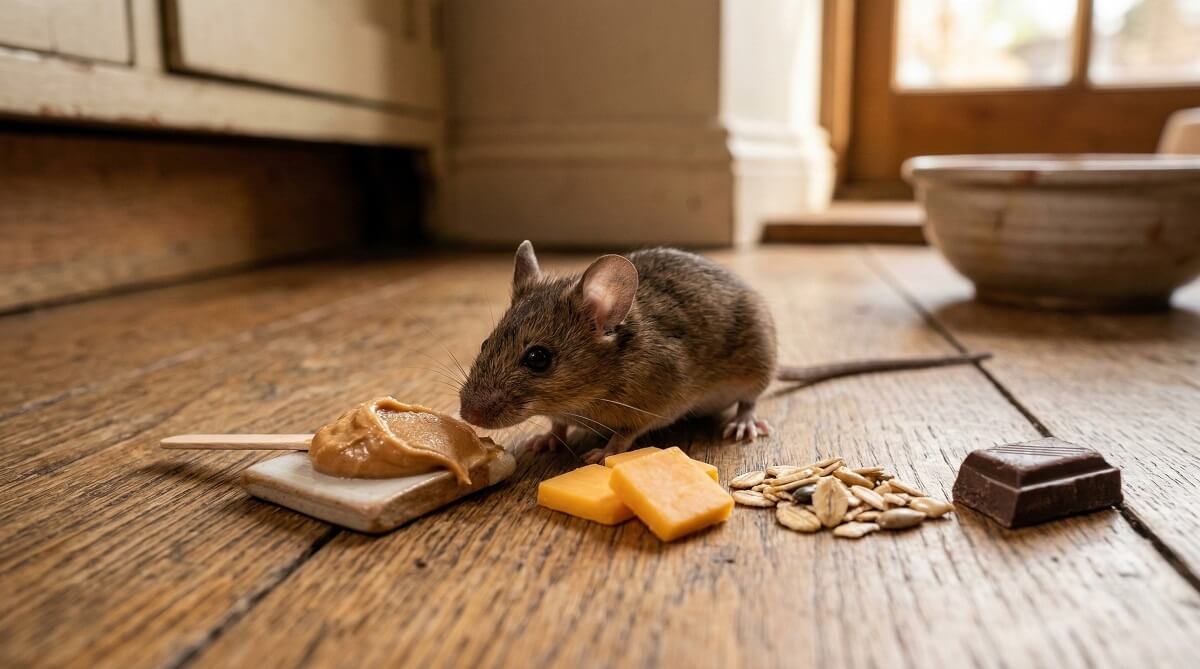
Peanut butter remains the most reliable mouse trap bait according to pest control professionals and university extension programs. Its strong aroma attracts mice from across a room, while its sticky texture prevents them from stealing the bait without triggering the trap. For optimal results, use a pea-sized amount of creamy peanut butter directly on the trap trigger.
If peanut butter isn’t available or you’re dealing with trap-shy mice, , candy bars like Snickers, and nesting materials (cotton balls, dental floss) serve as excellent alternatives. The key is matching the bait to the season—food works best in spring and summer when mice are actively foraging, while nesting materials attract mice in fall and winter when they’re building nests.
Forget what cartoons taught you about cheese. Mice prefer high-calorie foods rich in sugar and fat. Hard cheese can be stolen without triggering traps, and soft cheese spoils quickly. Other baits have higher success rates and better practical performance.
At-a-Glance Bait Guide
✅ Use Peanut Butter If:
- You want the highest success rate (recommended by Penn State Extension and pest control professionals)
- You’re using snap traps (sticky texture prevents theft)
- You need affordable, readily available bait
- You’re dealing with multiple mice
✅ Use Nesting Materials If:
- It’s fall or winter (breeding season)
- You’ve seen pregnant females (enlarged belly)
- Food baits aren’t working
- You want to avoid attracting ants or other pests
✅ Use Chocolate or Sweets If:
- Peanut butter has been tried and mice ignore it
- You want strong scent appeal
- You can secure it firmly to the trap
❌ Avoid Cheese Because:
- Mice don’t prefer it naturally (high-fat, low-sugar)
- Hard cheese can be stolen without triggering trap
- Soft cheese spoils quickly
- Other baits have higher success rates
Why Cheese Doesn’t Work (Debunking the Myth)
The idea that mice love cheese comes from cartoons, not science. In reality, mice prefer foods rich in carbohydrates and sugars. According to pest control professionals, mice naturally gravitate toward grains, seeds, and high-calorie foods—their wild diet consists largely of these items, along with occasional fruits or insects.
Cheese, while fatty, lacks the high sugar content mice instinctively seek. Hard cheese can be grabbed and carried away without triggering the trap. Soft cheese might stick better, but it spoils quickly and becomes less appealing. .
What Mice Actually Prefer
Mice have high metabolisms and are constantly foraging for energy-rich foods. They’re drawn to:
- High-calorie foods: Sugar and fat provide quick energy
- Strong scents: Mice have excellent sense of smell and locate food by aroma
- Natural diet items: Seeds, grains, nuts align with their instincts
- Moisture content: Some moisture makes food more appealing than dry, hard options
This is why peanut butter works so well. It combines high fat content, strong nutty aroma, sticky texture, and enough moisture to be attractive. It checks all the boxes for what mice naturally seek.
Top 7 Mouse Trap Baits (Ranked by Effectiveness)
#1: Peanut Butter
Why it works: Peanut butter has a powerful, nutty aroma that attracts mice from a distance. The sticky texture makes it nearly impossible for mice to snatch without triggering the trap. High fat and protein content appeals to their dietary needs.
How to use: Apply a pea-sized amount (about the size of a pencil eraser) directly on the trap trigger. Too much allows mice to eat without setting off the trap. They can nibble from the edges, get their fill, and leave. Creamy works better than chunky for most trap triggers.
Best for: Snap traps, all seasons, multiple mice. This is the go-to recommendation from Penn State Extension’s Integrated Pest Management program.
Cost: Peanut butter typically costs $3-6 per jar, making it one of the most affordable options. A single jar can bait dozens of traps.
#2: Chocolate
Why it works: High sugar and fat content delivers the energy mice crave. The strong scent attracts them effectively. Dark chocolate has a more potent aroma than milk chocolate.
How to use: Use a small piece (about the size of a pea) and partially melt it onto the trap trigger. You can warm chocolate in your pocket until it’s soft, then mold it firmly onto the trap. Once it hardens, mice have to work at it, increasing the chance of triggering the mechanism.
Best for: Mice that ignore peanut butter, situations where you want a solid bait option.
Pet safety warning: According to the Merck Veterinary Manual, chocolate contains theobromine, which is toxic to dogs and cats. Mild toxicity signs in dogs occur at 20 mg/kg, with cardiac effects at 40-50 mg/kg. Dark chocolate contains 5.3-5.6 mg/g of theobromine, while milk chocolate contains 2.3 mg/g. For a 10-pound dog, even small amounts of dark chocolate can be dangerous. .
#3: Snickers Bars or Candy Bars
Why it works: Snickers combines three things mice love: peanuts, caramel, and chocolate. The sticky caramel acts as a natural adhesive, preventing bait theft. High sugar and fat content makes it irresistible.
How to use: Cut a small slice with plenty of caramel. Warm it slightly in your pocket to make the caramel soft and sticky, then mold it firmly onto the trap trigger. The caramel hardens as it cools, creating a secure attachment.
Best for: Stubborn mice, situations where bait theft has been a problem.
#4: Nesting Materials (Cotton Balls, Dental Floss)
Why it works: During fall and winter, mice actively seek nesting materials to create warm habitats. This taps into a fundamental instinct, especially during breeding season. Pregnant females are particularly drawn to nesting materials.
How to use: Fluff up cotton balls to make them look inviting. Tie dental floss, yarn, or string securely to the trap trigger. You can add a tiny dab of peanut butter to the material to increase effectiveness.
Best for: , pregnant females, avoiding food-attracted pests like ants.
Non-toxic advantage: Nesting materials pose no risk to pets or children, making them a safer option for households with safety concerns.
#5: Hazelnut Spread (Nutella)
Why it works: Even sweeter than regular peanut butter, hazelnut spread combines sugar, fat, and strong aroma. The sticky texture works just like peanut butter.
How to use: Thin layer on trigger, same application method as peanut butter.
Best for: Discriminating mice in homes with other food sources available, when you want maximum sweet appeal.
Cost consideration: More expensive than peanut butter (typically $5-8 per jar), but equally effective.
#6: Bacon or Lunch Meat
Why it works: High protein and savory scent appeal to mice seeking protein. Some mice prefer savory over sweet options.
How to use: Small piece (size of a pea) pressed firmly onto trap trigger. The soft texture allows it to mold around the mechanism.
Best for: Mice that ignore sweet options, providing variety in bait rotation.
Limitation: Spoils quickly, especially in warm weather. Check and replace daily.
#7: Gummy Candy or Marshmallows
Why it works: High sugar content and chewable texture. The sweet aroma travels well.
How to use: Secure firmly to trap. For marshmallows, you can slightly melt them onto the trigger using a lighter for better adhesion.
Best for: Budget option with long shelf life, traps that will be left for several days.
Tip: Avoid large pieces that can be carried off. Secure them well or use smaller portions.
Bait Comparison Table
Here’s how different bait types compare in cost, longevity, and practical use:
| Bait Type | Cost Per Trap | Longevity | Best Season | Trap Compatibility | Key Advantage |
|---|---|---|---|---|---|
| Peanut Butter | $0.05-0.10 | 3-5 days | All year | Snap, Live | Sticky texture prevents theft |
| Chocolate | $0.15-0.25 | 5-7 days | All year | Snap, Live | Strong scent appeal |
| Snickers | $0.25-0.35 | 5-7 days | All year | Snap | Caramel prevents theft |
| Nesting Material | $0.05-0.10 | 7-14 days | Fall/Winter | All types | Pet-safe, non-food |
| Nutella | $0.20-0.30 | 3-5 days | All year | Snap, Live | Sweeter than PB |
| Bacon | $0.15-0.20 | 1-2 days | Spring/Summer | Snap | Savory alternative |
| Gummy Candy | $0.10-0.15 | 7-10 days | All year | Snap, Live | Long-lasting |
Costs are estimates based on typical retail prices. Check current pricing at your local store.
Commercial vs. DIY Baits: What’s Worth Buying?
Store-Bought Bait Products
Commercial mouse baits come in several forms: gel attractants, scented blocks, and pre-formulated pellets. Brands like Victor and Tomcat offer specialty rodent attractants designed for use in traps and bait stations.
Pros: Convenient, long-lasting, formulated specifically for rodents
Cons: More expensive (typically 10-20 times the cost of peanut butter), not necessarily more effective
For most homeowners, commercial baits aren’t worth the extra cost. Peanut butter from your pantry works as well or better than specialty baits. Save commercial options for severe infestations or when working with professionals.
DIY Bait Recipes That Work
You can create reliable bait combinations from common household items:
- Peanut butter + oatmeal mixture: Provides texture and bulk while maintaining scent appeal
- Birdseed blend: A 2019 agricultural study found birdseed yielded 2.1 to 2.4 times higher captures than other baits on the first trapping night. Mix sunflower, pumpkin, and hemp seeds
- Bacon grease on bread: Combines carbs with savory fat appeal
- Peanut butter with chocolate chips: Combines two proven attractants
These DIY options cost pennies per trap while providing successful attraction. The savings add up, especially when setting multiple traps.
How to Apply Bait Correctly (5 Essential Tips)
Tip #1: Use Less Than You Think
Pea-sized amounts work best for most baits. Too much allows mice to eat without triggering the trap. They can nibble from the edges, get their fill, and leave. A small amount forces them to interact with the trigger mechanism.
Exception: Nesting materials can be more generous. Use enough to look inviting—fluffed-up cotton balls or several strands of dental floss.
Tip #2: Secure Bait to the Trigger
Sticky baits like peanut butter and Nutella naturally adhere to snap trap triggers. For solid baits:
- Tie nuts, bacon, or candy with dental floss directly to the trigger
- Melt chocolate or candy bars onto the metal trigger using a long-reach lighter
- Warm Snickers bars in your pocket until caramel softens, then mold onto trap
Secured bait prevents mice from stealing food without consequences.
Tip #3: Wear Gloves When Handling
Mice detect human scent on traps, and they associate it with danger. Their sense of smell is sensitive enough to recognize unfamiliar odors. Wear disposable gloves or use sandwich bags as makeshift gloves when setting traps and applying bait.
This is especially important when placing traps in new locations or when mice have become trap-shy.
Tip #4: Replace Bait Every 2-3 Days
Fresh bait has stronger scent attraction. Stale or moldy bait repels mice rather than attracting them. Mark your calendar for replacement schedules:
- Peanut butter: 3-5 days
- Chocolate: 5-7 days
- Bacon: 1-2 days (daily in warm weather)
- Nesting materials: 7-14 days
Check traps daily regardless. Dead mice should be removed promptly for hygiene and to avoid scaring other mice away from working traps.
Tip #5: Match Bait to Trap Type
Different traps work better with different baits:
- Snap traps: Sticky baits (peanut butter, Nutella, caramel) prevent theft and force trigger interaction
- Live traps: Solid foods (chocolate, nuts, candy, birdseed) work well since cleaning is easier
- Glue traps: Place bait in center, away from edges where mice might grab without stepping on adhesive
- Bait stations: Use commercial blocks or gels designed for enclosed spaces
Strategic Trap Placement (Matters More Than Bait)
Even the leading bait won’t work if your traps are in the wrong location. According to Penn State Extension, mice travel along walls and edges rather than through open spaces. .
Where to Place Baited Traps
- Along walls: Mice naturally follow edges for safety. Place traps perpendicular to walls with the trigger end facing the wall
- Near signs of activity: Look for droppings, gnaw marks, or grease smudges. These indicate regular travel routes
- Behind appliances: Refrigerators, stoves, washers, and dryers provide cover. Mice feel safe in these hidden areas
- In dark corners: Mice are nocturnal and prefer undisturbed, shadowy spaces
- Near entry points: Check for gaps, cracks, pipe openings, and utility line entrances. Mice can fit through openings as small as a dime
How Many Traps to Set
According to pest control professionals, you catch the most mice on the first night. After that, remaining mice become wary. Multiple traps increase your odds substantially.
Rule of thumb: Set 2-3 traps for every mouse you’ve seen. If you’ve spotted one mouse, there are likely others you haven’t noticed.
Space traps 5-10 feet apart along walls and near activity areas. Don’t cluster them together—spread coverage across the problem area.
Proper Trap Orientation
Position snap traps perpendicular to walls with the trigger end facing the wall. When mice travel along the edge, they encounter the trap head-on. This increases the chance they’ll investigate the bait and trigger the mechanism.
Placing traps parallel to walls or in the middle of rooms dramatically reduces effectiveness. Mice won’t naturally encounter them during normal travel patterns.
Troubleshooting: When Bait Isn’t Working
Problem #1: Bait Disappears but No Mouse Caught
Cause: Trap sensitivity is too low, or mice are skilled at bait theft.
Solutions:
- Switch to stickier bait like peanut butter that can’t be easily removed
- Upgrade to traps with sensitive triggers designed for lightweight mice
- Test the trap mechanism before setting—make sure it releases with light pressure
- Apply bait to both the top and underside of the trigger so mice must work harder
Problem #2: Mice Ignore the Bait Completely
Cause: Competing food sources are more appealing than trap bait.
Solutions:
- Remove access to pet food, birdseed, pantry items, and food crumbs
- Clean up thoroughly so trap bait becomes the most attractive option
- Try a different bait type—rotate between sweet and savory options
- Move traps to areas with higher activity (more droppings)
Problem #3: Trap Shyness (Mice Avoid Traps)
Cause: Mice recognize traps as unfamiliar objects and perceive them as threats.
Solution: Pre-baiting strategy
- Place baited traps without setting them for 2-3 days
- Let mice feed safely from the traps during this period
- After mice are comfortable approaching the traps, set all traps simultaneously
- Check traps the next morning—you’ll likely catch multiple mice
This method overcomes wariness by letting mice build false confidence. Once they’re in the habit of visiting the “safe” food source, you spring the traps all at once.
Problem #4: Catching Babies but Not Adults
Cause: Baby mice are lighter and don’t trigger standard snap traps.
Solutions:
- Use electronic traps with sensitive sensors that detect lightweight mice
- Switch to live traps that don’t require trigger weight
- Purchase snap traps specifically designed with sensitive mechanisms
Problem #5: Attracting Ants or Roaches with Bait
Cause: Food baits attract other pests.
Solutions:
- Switch to nesting materials instead of food (cotton balls, dental floss)
- Use bait stations with entry holes too small for insects
- Clean up any spills or crumbs around traps
- Check traps more frequently and remove caught mice promptly
- Consider non-food commercial attractants designed for enclosed stations
Seasonal Bait Strategy Guide
Mouse behavior changes with seasons. .
Spring/Summer (March-August)
Mouse behavior: Actively foraging for food, higher metabolism, seeking calories
Best baits: High-calorie food options—peanut butter, chocolate, bacon, candy
Tips:
- Replace bait more frequently in heat (spoils faster)
- Focus on food baits over nesting materials
- Check traps daily in warm weather
Fall/Winter (September-February)
Mouse behavior: Seeking shelter and nesting sites, breeding season begins, building winter homes
Best baits: Nesting materials (cotton balls, dental floss, shredded paper) plus food baits
Tips:
- Pregnant females are particularly drawn to nesting materials
- Food baits still work but nesting materials become equally important
- Combine strategies—add small amount of peanut butter to cotton balls
- Mice move indoors seeking warmth, so indoor trapping becomes more critical
Safety Considerations
Pet Safety
Chocolate is toxic to dogs and cats. According to the Merck Veterinary Manual:
- Dogs: Mild toxicity at 20 mg/kg, cardiac effects at 40-50 mg/kg, seizures at ≥60 mg/kg
- Dark chocolate: 5.3-5.6 mg/g theobromine
- Milk chocolate: 2.3 mg/g theobromine
- Baker’s chocolate: 15.5 mg/g theobromine (most dangerous)
For a 10-pound dog: Even small amounts of chocolate on traps can be dangerous if the pet finds the trap. Use snap traps in locations inaccessible to pets, or choose pet-safe baits like peanut butter and nesting materials.
Snap trap dangers: Pets can get injured by snap traps. Place traps behind appliances, inside cabinets, or in areas where pets cannot reach. .
Child Safety
- Small bait pieces can be choking hazards
- Place traps in areas children cannot access—behind furniture, inside cabinets, in attics
- Use tamper-resistant bait stations if traps must be in accessible areas
- Never use poison baits if children are present in the home
- Teach children not to touch traps or “the mouse game” adults are setting up
Food Hygiene and Disease Prevention
The CDC emphasizes that rodent droppings, urine, and saliva can spread disease through air or contaminated food. :
- Wear gloves: Use disposable gloves when handling traps or dead mice
- Don’t reuse containers: Never use food containers that held bait for regular food storage
- Wash hands thoroughly: Clean hands with soap and water after handling traps
- Proper disposal: Place dead mice in sealed plastic bags before trash disposal
- Disinfect trap areas: Spray areas with 10% bleach solution, let sit 30 minutes before cleaning
- Don’t vacuum droppings: This can make viruses airborne; spray with disinfectant first, then wipe up with paper towels
Diseases transmitted by mice include Hantavirus, Lymphocytic Choriomeningitis Virus (LCMV), Salmonella, and others. Taking precautions protects your household.
Who should avoid handling rodents: According to health authorities, pregnant women, children under 5, and immunocompromised individuals should not handle rodents or clean cages directly. Have someone else manage trapping and disposal if you’re in these categories.
When to Call Professional Pest Control
DIY trapping works for small infestations, but sometimes you need professional help. :
- You’ve caught 5+ mice but they keep coming back
- Evidence of large infestation (extensive droppings, significant damage, multiple daily sightings)
- You can’t locate entry points despite thorough inspection
- Mice are in walls or inaccessible areas
- Recurring infestations despite your efforts
- Health concerns (immunocompromised household members, pregnancy)
- Commercial property requiring documentation and compliance
What professionals offer:
- Comprehensive property inspection
- Entry point identification and sealing (exclusion)
- Commercial-grade traps and monitoring
- Follow-up visits and ongoing monitoring
- Warranty or guarantee on services
Average costs (2026 USA): , professional mice extermination costs between $150 and $550, with most homeowners paying around $350 for a typical infestation. Services include:
- Inspection alone: $75-$125
- Trap installation: $150-$475
- Poison/bait stations with monitoring: $300-$550
- Full service (inspection + treatment + exclusion): $200-$600
- Fumigation for severe infestations: $2,000-$5,000
Professional exclusion work (sealing entry points) is the only permanent solution. Trapping without exclusion means mice will keep returning.
Frequently Asked Questions
What is the #1 best bait for catching mice?
Peanut butter is the most reliable mouse trap bait according to pest control professionals and university extension programs like Penn State. Its strong smell, sticky texture, and high fat content make it ideal for attracting mice while preventing bait theft.
Why doesn’t cheese work well as mouse bait?
Cheese lacks the high sugar content mice naturally seek. Hard cheese can be stolen without triggering traps, and soft cheese spoils quickly. . The cheese myth comes from cartoons, not actual mouse behavior.
How much bait should I use on a mouse trap?
Use a pea-sized amount (about the size of a pencil eraser) for food baits. Too much allows mice to eat without triggering the trap. Less is more—you want them to work at getting the food, which increases the chance of setting off the mechanism.
How often should I change mouse trap bait?
Replace bait every 2-3 days for most food options, or immediately if it looks dried out, moldy, or has been disturbed. Fresh bait has stronger scent attraction. Bacon should be replaced daily in warm weather, while nesting materials can last 7-14 days.
Can I use nesting materials instead of food as bait?
Yes, especially during fall and winter when mice are building nests. Cotton balls, dental floss, and shredded paper work well and won’t attract other pests like ants. This is particularly successful for pregnant females. You can add a small dab of peanut butter to nesting material for extra attraction.
What’s the best bait for live catch-and-release traps?
Solid foods work best for live traps: chocolate pieces, nuts, small candy bars, or birdseed. Avoid sticky baits like peanut butter that make cleaning difficult. A 2019 study found birdseed particularly effective, yielding 2.1 to 2.4 times higher captures than other baits.
Does the type of peanut butter matter?
Creamy works better than chunky for trap triggers because it spreads smoothly and adheres well. Fresh peanut butter (not expired) has stronger aroma. Store brands work just as well as name brands—mice don’t care about brand names. Natural or regular both work fine.
Are commercial mouse baits worth the money?
For most homeowners, no. Peanut butter from your pantry works as well or better than specialty baits costing 10-20 times more. Save commercial baits for severe infestations or when working with professional pest control services. Your money is better spent on more traps or exclusion materials.
What bait works for mice that ignore peanut butter?
Try chocolate, Snickers bars, hazelnut spread (Nutella), or nesting materials. . If food baits consistently fail, mice may have access to better food sources—eliminate competing food before trying different bait types.
Is it true that mice prefer certain baits in different seasons?
Yes. Mice seek high-calorie foods in spring and summer when they’re actively foraging. In fall and winter, they prioritize nesting materials during breeding season. Adjust your strategy accordingly—use food baits in warm months and add nesting materials in cold months for better results.
Ready to Solve Your Mouse Problem?
Start with peanut butter on well-placed snap traps along walls and near signs of activity. Set multiple traps simultaneously, check them daily, and replace bait every few days. Most homeowners see results within 24-48 hours using this approach.
If you’ve caught multiple mice but they keep returning, you likely have entry points that need sealing. The CDC recommends removing food sources and regular inspection to prevent infestations. .
According to the National Pest Management Association, about 21 million American households report rodent infestations every year. You’re not alone in dealing with this problem, and with the right bait and trap placement strategy, you can solve it effectively.
