


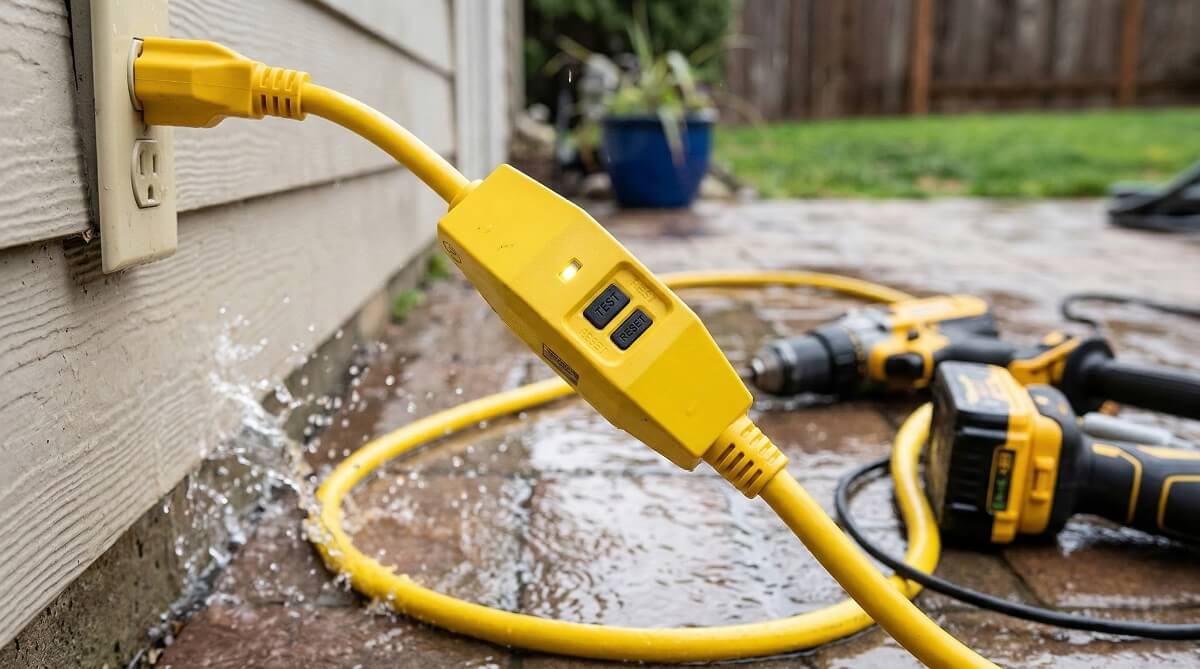
A GFCI extension cord can save your life. These cords detect dangerous current leaks as small as 5 milliamps and shut off power in roughly 1/40th of a second—fast enough to prevent electrocution. If you work with power tools outdoors, on construction sites, or anywhere moisture might be present, this protection isn’t optional.
GFCI extension cords typically range from $10 to $50 depending on length and wire gauge. For most homeowners and DIY enthusiasts, a 12-gauge, 3-foot to 25-foot auto-reset model offers the best balance of safety and convenience. Construction professionals need manual-reset versions to comply with OSHA requirements. Check current prices at retailers, as availability and deals change frequently.
The difference between a standard extension cord and a GFCI model comes down to personal protection. Regular cords depend on your circuit breaker, which trips at 15-20 amps—enough current to kill you. GFCI protection works at just 0.005 amps, cutting power before serious harm occurs.
Who Should (and Shouldn’t) Buy a GFCI Extension Cord
✅ You Need One If You:
- Use power tools outdoors or near water sources
- Work on construction sites (OSHA requires GFCI protection)
- Operate equipment in wet or damp environments—basements, garages, outdoor work areas
- Need temporary power in locations without permanent GFCI outlets
- Run pressure washers, pool equipment, or outdoor holiday lights
❌ Skip It If:
- You’re only powering low-voltage devices indoors in dry areas
- Your outlets already have GFCI protection and you won’t move equipment around
- You need very long cord runs over 100 feet (a GFCI breaker at the panel works better)
- You only use battery-powered tools
What Is a GFCI Extension Cord and How Does It Work?
A ground fault circuit interrupter extension cord builds a safety device directly into the cord itself. The GFCI constantly monitors the electrical current flowing through the cord. When it detects a difference between the current going out and coming back—even as little as 4-6 milliamps—it trips the circuit.
That tiny imbalance means current is leaking somewhere, possibly through you. A person can suffer serious injury or death from just 10-30 milliamps. By tripping at 5 milliamps, GFCIs shut off power before the current reaches dangerous levels. The response time is approximately 25-30 milliseconds.
Regular extension cords rely on the circuit breaker at your electrical panel. Those breakers protect your house wiring from overheating and fires by tripping at 15 or 20 amps. That’s thousands of times more current than it takes to stop your heart. GFCIs fill the gap by protecting people, not just wiring.
Types of GFCI Extension Cords
Indoor vs Outdoor GFCI Extension Cords
Indoor GFCI extension cords typically use lighter-duty 16 AWG or 14 AWG wire and come in shorter lengths. They work fine for workshop tools, basement equipment, and other protected environments.
Outdoor models feature heavy-duty 12 AWG wire and weather-resistant SJTW or SJOOW jacket material. These cords handle moisture, temperature swings, and rougher treatment. Look for “outdoor rated” or “weather resistant” on the packaging. Don’t use indoor cords outside—the jacket material breaks down from UV exposure and moisture.
Manual Reset vs Auto-Reset GFCI
Manual-reset GFCIs stay off until you press the reset button after a trip. This prevents the cord from automatically re-energizing, which could surprise someone working on equipment or restart a faulty tool.
Auto-reset models restore power on their own once the fault clears. They’re convenient for home use but not allowed in many commercial settings.
OSHA requires manual-reset GFCIs on construction sites. According to OSHA interpretation letters, automatic reset creates a safety hazard because power can return unexpectedly while workers are troubleshooting equipment or believe circuits are de-energized.
Inline GFCI vs Built-in Outlet Models
Inline GFCI cords have the protection module built into the middle of the cord, usually with a test and reset button. These typically end in a single outlet.
Built-in outlet models place the GFCI module at the receptacle end and often include multiple outlets—called a “triple tap” when there are three. These give you more plug-in options but can encourage overloading if you’re not careful about total amperage.
Both types provide the same level of protection. Choose based on whether you need multiple outlets or prefer a simpler single-outlet setup.
How to Choose the Right GFCI Extension Cord
Wire Gauge Guide: 14 AWG vs 12 AWG vs 10 AWG
Wire gauge determines how much current your extension cord can safely handle. The gauge number works backwards—lower numbers mean thicker wire that carries more power.
| Wire Gauge | Max Amps | Best Uses | Recommended Length |
|---|---|---|---|
| 14 AWG | Up to 15A | TVs, microwaves, light-duty power tools | 50-100 feet |
| 12 AWG | Up to 20A | Heavy-duty tools, air compressors, power washers | 50-100 feet |
| 10 AWG | Up to 30A | Industrial equipment, welders, large machinery | 50+ feet |
For most homeowner and contractor applications, 12 AWG hits the sweet spot. It handles serious tools without voltage drop issues and costs only slightly more than 14 AWG.
Length Considerations
Longer cords lose voltage over distance, which reduces the safe current capacity. A 25-foot 14 AWG extension cord handles 1,650 watts and up to 15 amps. Stretch that same 14 AWG wire to 150 feet and capacity drops to just 770 watts and 7 amps.
This voltage drop is why you need thicker wire for longer runs. If you’re regularly working more than 50 feet from your power source, step up to 12 AWG or consider multiple shorter cords instead of one long one.
Amperage Ratings and Load Capacity
Check your tool’s nameplate or manual for its amp draw. Add up the amps for any tools you might run simultaneously. Your extension cord’s rating needs to exceed that total.
A quick formula: watts divided by volts equals amps. For 120-volt AC power in the US, a 1,800-watt heater draws 15 amps (1,800 ÷ 120 = 15). That maxes out a 15-amp cord, leaving no safety margin. Use a 20-amp cord instead.
Overloading causes the cord to heat up. You’ll notice the jacket feels warm or even hot to touch. That’s dangerous—it damages the wire insulation and creates fire risk. If your GFCI cord keeps tripping, you might be overloading it. Check the amp draw and consider a heavier gauge cord.
Top GFCI Extension Cord Options for 2026
Based on specifications and early 2026 availability, here are common GFCI extension cord configurations:
| Brand/Type | Length | Gauge | Amps | Reset Type | Price Range |
|---|---|---|---|---|---|
| DEWENWILS Auto-Reset | 3 ft | 12/3 | 15A | Automatic | $20-$30 |
| DEWENWILS Manual | 3 ft | 12/3 | 15A | Manual | $20-$30 |
| Woods/Electriduct | 6 ft | 12/3 | 15A | Auto or Manual | $25-$35 |
| Tower Manufacturing | 25 ft | 12/3 | 20A | Manual | $40-$50 |
| Basic 14 AWG Models | 3-6 ft | 14/3 | 15A | Varies | $10-$20 |
Prices vary by retailer and change frequently. Check Amazon, Home Depot, and Lowe’s for current deals. Look for UL Listed or ETL Listed certification—these independent testing labs verify the GFCI actually works as advertised.
Popular brands include DEWENWILS, Tower Manufacturing, Woods, Electriduct, and IRON FORGE CABLE. All make reliable products when properly certified. The differences usually come down to cord length, outlet configuration (single vs triple tap), and whether you need manual or auto reset.
When and Where to Use GFCI Extension Cords
OSHA Requirements for Construction Sites
If you work in construction, OSHA regulation 29 CFR 1926.404(b)(1) requires ground fault protection for all 120-volt, single-phase, 15- and 20-ampere receptacle outlets on construction sites that aren’t part of the building’s permanent wiring.
You have two options: equip every cord and tool with GFCI protection, or implement an “assured equipment grounding conductor program” that requires regular testing of all electrical equipment. Most contractors choose GFCI cords because the testing paperwork is a headache.
Here’s the catch: OSHA interpretation letters clarify that if you mix GFCI-protected and non-protected equipment, you must test everything—even the cords that already have GFCIs. Going all-in on GFCI protection eliminates that requirement.
OSHA also requires testing GFCI equipment before first use, after any repair, after any incident that might have damaged it, and at intervals not exceeding 3 months. That means quarterly testing at minimum for regularly-used cords.
Home Use Applications
You don’t need GFCI extension cords for everything, but they make sense in these situations:
- Outdoor power equipment: Lawn mowers, leaf blowers, hedge trimmers, and pressure washers should all run through GFCI protection
- Workshop and garage work where permanent GFCI outlets aren’t installed
- Pool and spa equipment—critical for safety around water
- Holiday and outdoor lighting in wet conditions
- Any temporary setup in damp basements or crawl spaces
Outdoor and Wet Locations
Any outdoor electrical work carries moisture risk—morning dew, rain, snow, or wet grass. GFCI protection becomes essential, not optional. The National Electrical Code and OSHA both require it for outdoor temporary power.
Keep the GFCI module itself out of standing water and rain when possible. While the outlet end and plug are weather-resistant, prolonged exposure to moisture can still cause problems. Some contractors keep the GFCI portion inside a weatherproof box or under an overhang.
Safety Tips and Best Practices
How to Test Your GFCI Extension Cord
Every GFCI cord has a test button. Press it. Power should cut off immediately. Press the reset button to restore power. If the test button doesn’t trip the GFCI, or if it trips but power doesn’t actually cut off, replace the cord—it’s defective.
Test before first use, after dropping or damaging the cord, and every three months for cords in regular service. This isn’t optional if you’re working under OSHA jurisdiction. Keep testing logs if compliance matters for your work.
Common Problems and Troubleshooting
If your GFCI keeps tripping during normal use, check these issues:
Nuisance tripping from tool startup: Large motors can create brief current spikes when starting. This is usually fine—the GFCI is doing its job detecting small imbalances. If it happens constantly, you might need a different tool or to check for actual ground faults.
Won’t reset: This usually means you have an active ground fault—current is still leaking somewhere. Unplug everything and try resetting. If it works, plug tools back in one at a time to find the problem. If it won’t reset with nothing plugged in, the GFCI or cord is damaged.
Cord gets hot: You’re overloading the cord. Calculate your total amp draw and either reduce the load or use a heavier gauge cord. Heat damages insulation and creates fire risk.
Additional safety rules:
- Never daisy-chain GFCI extension cords together
- Don’t bypass GFCI protection by cutting it out of the circuit
- Inspect cords before each use for damage to the jacket
- Replace any cord with cuts, exposed wires, or damaged plugs
- Store cords indoors when not in use to prevent weather damage
Do You Really Need a GFCI Extension Cord?
If you’re working outdoors, in construction, or anywhere water and electricity might meet, yes. The question shifts from “do I need one” to “which one do I need.”
For most home use, a 12 AWG, 3- to 6-foot auto-reset GFCI extension cord covers outdoor tools, garage work, and temporary power needs. Spend $20-$30 and you’re protected.
Construction professionals should buy manual-reset versions to stay OSHA-compliant and prevent unexpected re-energization. If you’re running a job site, equipping every cord with GFCI protection beats managing an assured grounding program’s testing requirements.
You can skip GFCI extension cords if you only work indoors in dry locations with tools that don’t see moisture. But if there’s any doubt, GFCI protection is cheap insurance against a lethal shock.
Frequently Asked Questions
Can you plug a regular extension cord into a GFCI extension cord?
Yes, but only if the combined length and gauge support your tool’s power needs. The GFCI protects everything downstream from it, including any regular extension cords you plug into it. Just watch your total amp draw and make sure the weakest cord in the chain can handle the load.
What’s the difference between a GFCI and a surge protector extension cord?
GFCIs protect you from electric shock by detecting current leakage. Surge protectors shield your electronics from voltage spikes. They do completely different jobs. Some extension cords combine both features, but most GFCI cords don’t include surge protection.
How long do GFCI extension cords last?
With proper care, several years. The GFCI mechanism can wear out or become less sensitive over time. Regular testing (quarterly minimum) helps catch problems before the protection fails. Replace any cord that won’t trip during testing, has damaged insulation, or has been in a serious short circuit or shock event.
Will a GFCI extension cord work with my generator?
Yes. GFCI protection works with generator power just like it does with your house electrical system. This is especially important for portable generators at job sites or during emergencies, where temporary wiring and wet conditions increase shock risk.
Do I need GFCI if my circuit breaker is already GFCI?
If your GFCI breaker protects the circuit and you’re plugging directly into a GFCI outlet, you have coverage. But a GFCI extension cord adds portability—you can use it at other locations or at different properties where GFCI outlets might not exist. Redundant protection doesn’t hurt.
What does UL Listed mean for GFCI extension cords?
UL (Underwriters Laboratories) is an independent testing organization that verifies products meet safety standards. UL Listed means the cord has been tested and meets requirements for electrical safety, including GFCI trip speed and accuracy. ETL (Intertek) and CSA (Canadian Standards Association) provide similar certification. Look for one of these marks before buying.
Can GFCI extension cords be used in series?
Technically you can plug one GFCI cord into another, but it’s poor practice. Each connection point adds resistance and potential failure points. More importantly, the added length might exceed safe voltage drop limits. Use a single cord long enough for your needs, or go with a heavier gauge if you need to reach farther.
Why does my GFCI extension cord keep tripping?
Either you have a real ground fault (current leaking somewhere), you’re overloading the cord, or the GFCI is overly sensitive or defective. Start by unplugging everything and testing with no load. If it still trips, replace the cord. If it works fine with no load, plug in one tool at a time to find the problem. Older tools can develop ground faults as insulation breaks down.
Where to Buy
GFCI extension cords are widely available. Check current prices and availability at Amazon, Home Depot, or Lowe’s for competitive pricing and in-store pickup options.
Look for UL or ETL certification, verify the wire gauge matches your needs, and choose manual reset if OSHA compliance matters for your work. Compare prices across retailers—deals change weekly, especially during holiday tool sales.
