


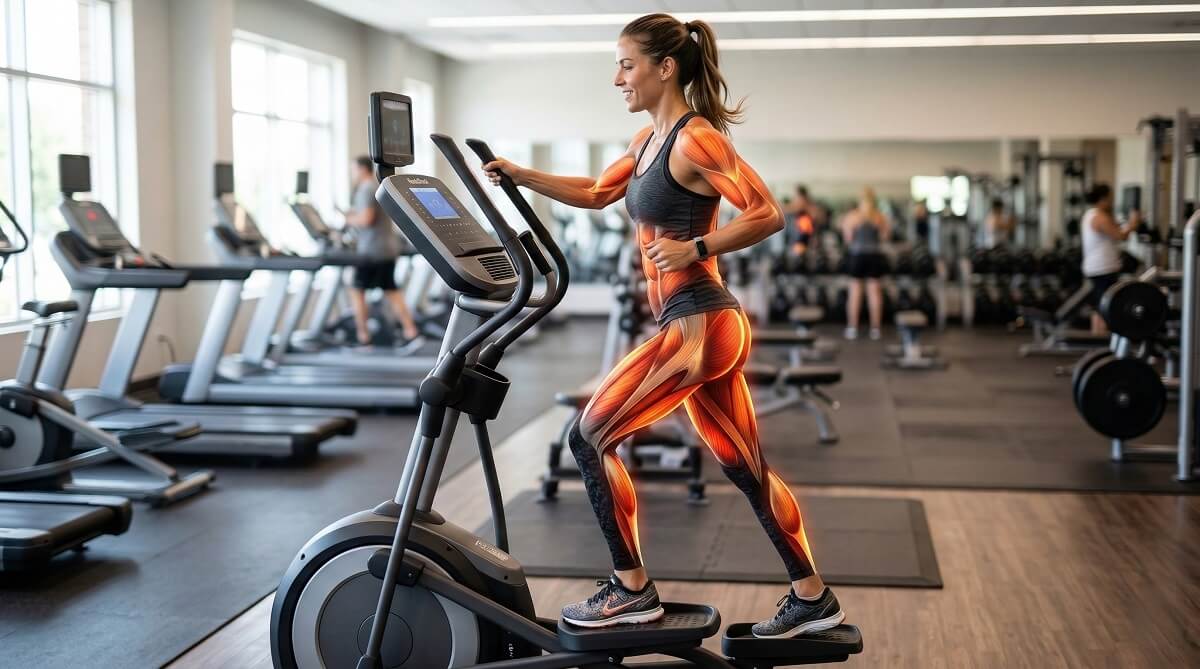
Elliptical trainers work approximately 80% of your body’s muscles when used with proper form. This includes your lower body (glutes, quadriceps, hamstrings, and calves), upper body (chest, shoulders, arms, and back), and core (abs, obliques, and lower back). Unlike treadmills that primarily target your legs, ellipticals provide full-body engagement when you actively push and pull the handles.
The specific muscles you activate depend on your resistance settings, incline angle, and whether you pedal forward or backward. According to Harvard Medical School, a 30-minute elliptical session burns between 270 and 378 calories depending on your body weight, making it an effective tool for both muscle conditioning and cardiovascular fitness.
If you’re wondering whether elliptical machines actually build muscle or just provide cardio, the answer is both. While they won’t pack on mass like , ellipticals strengthen and tone muscles while protecting your joints from the high-impact forces of running.
Who Should (and Shouldn’t) Use Ellipticals
✅ Best For
- People seeking low-impact cardio that protects knees, hips, and ankles
- Those wanting a simultaneous upper and lower body workout
- Anyone with or recovering from impact injuries
- Beginners who want equipment that’s easy to learn and use
- Cross-training athletes preventing overuse injuries from running
❌ Skip If
- You’re training specifically for events (treadmill mimics running mechanics better)
- You want maximum bone density building (needs higher-impact exercises)
- You only have 5-10 minutes to exercise (other equipment may be more time-efficient)
- You prefer outdoor exercise over stationary machines
Lower Body Muscles Worked
Your legs do most of the work on an elliptical, engaging multiple muscle groups with every stride. Here’s what happens in your lower body during an elliptical workout.
Quadriceps (Front Thighs)
Your quads fire up when you push down on the pedals during the forward portion of each stride. These muscles extend your knee and help propel your body through the elliptical motion. If you want to emphasize your quads, lower the incline and increase the resistance. Research shows ellipticals produce greater quadriceps activation compared to stationary bikes, making them particularly effective for strengthening the front of your thighs.
Hamstrings (Back Thighs)
The hamstrings work during the pulling phase of your pedal stroke, especially when you increase the incline or pedal backward. Studies on incline training show that hamstring activation increases significantly as the grade gets steeper. Your hamstrings also help balance the forces on your knees and hips, working in coordination with your glutes and quads for smooth, controlled movement.
Glutes (Buttocks)
Your glutes contract throughout the entire pedal stroke, but they work hardest when you crank up the resistance and incline. For maximum glute activation, try a high incline setting (10-15 degrees) with increased resistance. Maintain a slight squat position and focus on pushing through your heels rather than your toes. This targets your gluteus maximus—the largest muscle in your body—along with the smaller gluteus medius and minimus that stabilize your hips.
Calves (Lower Legs)
Every time you push down on the pedals, your calves engage to help propel you forward. The gastrocnemius and soleus muscles in your calves work constantly throughout your workout to stabilize your ankles and assist with the pedaling motion. You can emphasize calf engagement by focusing on pushing through the balls of your feet and varying your foot position slightly.
Hip Flexors
Your hip flexors lift your leg during the forward motion of each stride. While often overlooked, these muscles are important for hip mobility and flexibility. Regular elliptical use can help maintain healthy hip flexor function, especially if you spend most of your day sitting.
Upper Body Muscles Worked
Here’s where ellipticals stand out from treadmills and bikes: they engage your upper body when you actively push and pull the handles. Just holding onto the handles doesn’t cut it—you need to drive the movement with your arms to work these muscles effectively.
Chest (Pectorals)
When you push the handles forward, your chest muscles do the work. Initiate the push from your chest, not just your arms, to maximize pectoral engagement. Think of it like a standing chest press that happens with every stride.
Back Muscles (Lats, Rhomboids, Traps)
Pulling the handles toward your body activates your back muscles, including your latissimus dorsi, rhomboids, and trapezius. This pulling motion helps balance out the chest work and improves posture. Research shows that ellipticals activate upper body muscles significantly more than treadmills or stationary bikes, making them a superior choice for .
Shoulders (Deltoids)
Your shoulders stay engaged throughout the entire push-pull arm motion. The front deltoids work during the push phase, while the rear deltoids activate during the pull phase. This balanced shoulder workout helps build strength without the joint stress of overhead pressing movements.
Arms (Biceps and Triceps)
Your biceps engage when you pull the handles toward you, while your triceps work when you push them away. The dual action ensures both muscle groups get a workout. However, many people let their legs do all the work while their arms just coast along. Make a conscious effort to actively push and pull with your arms to get the full upper body benefit.
Core Muscles Engaged
Your core works throughout your entire elliptical workout to stabilize your torso and maintain balance. When fitness experts talk about core muscles, they mean more than just abs—they’re referring to all the muscles that support and protect your spine.
Abdominals (Rectus Abdominis, Transverse Abdominis)
Your ab muscles engage to keep your torso upright and stable as your arms and legs move. The rectus abdominis (your “six-pack” muscles) and the deeper transverse abdominis both work to prevent your torso from twisting or bending excessively. For extra ab engagement, try releasing the handles and placing your hands on your hips—you’ll immediately feel your core working harder to maintain balance.
Obliques (Side Abs)
The oblique muscles on the sides of your abdomen help control rotational stability and keep your pelvis level as you stride. They work continuously to prevent excessive twisting motions that could compromise your form.
Lower Back (Erector Spinae)
The erector spinae muscles run along your spine and activate to help you maintain an upright posture. They prevent slouching and back pain during your workout. Keeping these muscles engaged also strengthens your overall stability and balance.
How to Target Specific Muscle Groups
Want to emphasize certain muscles during your elliptical workout? Here’s how to adjust your settings and technique to target different areas.
For Maximum Glute Activation
Set your resistance to a challenging level (Level 12-15 if your machine has 20 levels) and increase the incline to 10-15 degrees. Adopt a slight squat position and push through your heels rather than your toes. Maintain this for 20-30 minute sessions. Studies show that higher inclines dramatically increase glute and hamstring engagement—one study found hip power generation increased 163% between a 0% and 10% incline.
For Quad Development
Use moderate resistance (Level 8-12) with a low to moderate incline (0-8 degrees). Keep your body upright and push through your toes. Pedal in the forward direction, which emphasizes the quadriceps more than reverse pedaling.
For Hamstring Focus
Increase both resistance (Level 12-18) and incline (12-20 degrees if available). The key technique for hamstrings: pedal in reverse. A University of Idaho study found that varying stride length and direction activates different muscle fibers, with reverse pedaling recruiting more hamstring engagement than forward pedaling.
For Upper Body Emphasis
Use moderate resistance on the handles and actively push and pull with your arms while slightly reducing your leg effort. Start the movement from your arms and let your legs follow. This shifts more work to your upper body muscles.
For Core Strengthening
Release the handles and place your hands on your hips while maintaining your balance. Keep your torso stable and resist the urge to lean side to side. Start with lower resistance and speed when exercising hands-free until you build the necessary balance and core strength.
How Ellipticals Compare to Other Cardio Equipment
Wondering how ellipticals stack up against treadmills, bikes, and other cardio machines for muscle engagement? Here’s a direct comparison.
| Equipment | Lower Body | Upper Body | Core | Impact Level | Muscle Groups |
|---|---|---|---|---|---|
| Elliptical | High | Moderate-High | Moderate | Very Low | 12+ muscles |
| Treadmill | High | Minimal | Low-Moderate | Moderate-High | 6-8 muscles |
| Stationary Bike | Moderate | None | Low | Very Low | 4-6 muscles |
| Rowing Machine | Moderate | Very High | High | Very Low | 14+ muscles |
| Stair Climber | Very High | Minimal | Moderate | Low-Moderate | 6-8 muscles |
Research comparing muscle activation across equipment types shows ellipticals activate all measured upper body muscles more than treadmills or bikes. For lower body, treadmills produce slightly higher activation in some muscles like the gastrocnemius and gluteus maximus, but ellipticals offer a superior balance of with less joint stress.
Does the Elliptical Build Muscle?
Let’s be realistic about what ellipticals can and can’t do for muscle building.
Muscle Building vs. Muscle Toning
Ellipticals primarily build muscular endurance and definition rather than significant muscle mass. Muscle hypertrophy—the scientific term for muscle growth—requires progressive resistance training with weights. Ellipticals tone and define your existing muscles while improving cardiovascular fitness. Research shows that aerobic exercise like elliptical training can produce some muscle growth, but it’s modest compared to dedicated strength training.
When Ellipticals Can Build Muscle
You’re more likely to see muscle building from elliptical use if you’re a beginner with limited existing muscle mass, a senior looking to maintain or regain muscle, or you use very high resistance settings that approach strength-training levels. Proper protein intake also matters—your muscles need adequate protein to repair and grow after exercise.
Combining Elliptical with Strength Training
For optimal muscle development, use your elliptical for cardio and muscle endurance while adding resistance training 2-3 times per week. A simple split: 3 days of elliptical work, 2 days of weight training. This gives you cardiovascular benefits, muscle endurance, and actual muscle growth from the strength work.
Tips for Maximizing Muscle Engagement
Proper Form is Everything
Stand upright with your shoulders back and relaxed. Keep a slight bend in your knees—never lock them straight. Distribute your weight evenly between both feet and engage your core throughout the workout. As Maura Daly Iversen, Dean of Health Sciences at Sacred Heart University, explains: “The nice fluid motion of the elliptical reduces stress on the hips and knees,” but only if you maintain proper form.
Vary Your Resistance
Don’t use the same resistance setting for every workout. Progressive overload—gradually increasing the challenge over time—helps your muscles continue adapting and getting stronger. Try increasing resistance by one level every couple of weeks. For example, progress from Level 8 to Level 10 to Level 12 over a month.
Use Interval Training
Alternating between high and low intensities activates more muscle fibers than steady-state cardio. Try 2 minutes at moderate intensity followed by 1 minute at high intensity, then repeat. According to the CDC, you can also mix and match your cardio—one minute of vigorous-intensity activity equals about two minutes of moderate-intensity work.
Switch Directions
Forward pedaling emphasizes your quads and hip flexors, while backward pedaling targets your hamstrings and glutes more effectively. Alternate directions every 5-10 minutes to engage different muscle groups and prevent boredom.
Don’t Neglect the Handles
Actively push and pull the handles—don’t just hold on for balance. Match your arm effort with your leg effort to create a true full-body workout. Research shows this approach significantly increases upper body muscle activation.
Common Mistakes That Reduce Muscle Activation
Leaning on the Handles
When you lean heavily on the handles for support, you reduce lower body engagement and decrease your calorie burn by 20-30%. Use a light grip and keep your posture upright instead.
Using Too Little Resistance
If the workout feels too easy, your muscles aren’t being challenged enough. You should feel moderate difficulty—able to maintain a conversation, but working hard enough that you’re slightly out of breath.
Letting Momentum Do the Work
Passive motion where you’re just along for the ride won’t build muscle or burn many calories. Focus on deliberate, controlled pushing and pulling movements throughout your workout.
Same Routine Every Time
Your muscles adapt quickly to repetitive workouts. Change your resistance, incline, direction, and workout duration every 2-3 weeks to keep seeing progress and prevent plateaus.
Ignoring Upper Body
Holding the stationary handles instead of using the moving ones means you’re missing out on 40% of the elliptical’s potential. Push and pull with intention to engage your chest, back, shoulders, and arms.
Who Benefits Most from Elliptical Training
People with Joint Issues
The Arthritis Foundation specifically recommends ellipticals for people with knee and hip arthritis. According to their expert, Maura Daly Iversen: “The elliptical machine can be a beneficial form of exercise for people with knee and hip arthritis because it provides both strengthening and cardiovascular benefits while exerting less force on the joints.” This makes ellipticals excellent for arthritis sufferers, those recovering from , and people with hip replacement rehabilitation needs.
Fitness Beginners
Ellipticals have an easy learning curve and low injury risk. You can get an effective workout without mastering complex techniques or coordination patterns. This builds confidence and creates a sustainable exercise habit.
Cross-Training Athletes
Runners benefit from elliptical workouts that prevent overuse injuries while maintaining cardiovascular fitness. Cyclists gain upper body engagement that biking doesn’t provide. The balanced muscle development helps prevent the muscle imbalances that can develop from single-sport training.
Weight Loss Seekers
According to Harvard Medical School, ellipticals burn 270-378 calories in 30 minutes depending on your body weight (125-185 lbs). This high calorie burn combined with low injury risk makes ellipticals sustainable for .
Seniors and Older Adults
Ellipticals help seniors maintain muscle mass, improve balance, and support cardiovascular health without the fall risk or joint stress of other exercises. The Arthritis Foundation recommends starting with just 5-10 minutes and gradually progressing to 30 minutes on most days.
Who Should Consider Alternatives
Serious runners training for races should prioritize treadmill work, which better mimics running mechanics and builds running-specific muscle memory. If maximum bone density is your goal, you’ll need higher-impact exercises and weight training—ellipticals are too low-impact for optimal bone building. Those seeking significant muscle mass should focus on resistance training instead, using ellipticals only as a cardio supplement.
Best Ellipticals for Muscle Engagement (2026)
Not all ellipticals are created equal for muscle targeting. Here are the top models based on resistance levels, incline options, and features that maximize muscle engagement.
NordicTrack Commercial 14.9 — Best for Serious Home Users
Price: $1,499-$1,999 (prices vary by retailer)
Key Features: 26 resistance levels, 20% incline capability, 14-inch HD touchscreen, 17.5-18.7 inch adjustable stride length, 30-day iFIT family membership
Why It’s Good for Muscles: The 26 resistance levels and 20% incline give you plenty of room to challenge your glutes, hamstrings, and quads as you progress. The adjustable stride helps you recruit different muscle fibers.
Sole E95 — Best for Glute and Hamstring Targeting
Price: Around $1,500 (check current pricing)
Key Features: 20 resistance levels, 20 incline levels, power-adjustable stride, 27-lb flywheel, eddy current magnetic resistance
Why It’s Good for Muscles: The combination of 20 incline levels and power-adjustable stride makes this ideal for targeting specific muscle groups. Available at Sole Fitness, Amazon, and Dick’s Sporting Goods.
Schwinn 470 — Best Budget Option
Price: Approximately $1,100 plus $199 shipping
Key Features: 25 resistance levels, dual rail system, multiple workout programs
Why It’s Good for Muscles: Schwinn’s top-of-the-line home elliptical offers 25 resistance levels—more than many pricier competitors. The dual rail system provides smooth, consistent motion that lets you focus on muscle engagement.
Important Note: Prices as of February 2026. Check current pricing at retailers as deals and availability change frequently. Some models like the ProForm Carbon HIIT H7 have been discontinued, so focus on current models from each manufacturer’s lineup.
Frequently Asked Questions
What muscles does the elliptical work the most?
The elliptical works your lower body muscles most intensively, particularly your glutes, quadriceps, and hamstrings. However, upper body engagement depends heavily on whether you actively push and pull the handles. With proper technique using the handles, you’ll also work your chest, shoulders, arms, back, and core muscles.
Does the elliptical work abs?
Yes, your core muscles including your abs work continuously to stabilize your body during elliptical exercise. For extra ab engagement, try releasing the handles and maintaining balance without support—you’ll immediately feel your core working harder. Your obliques and lower back muscles also activate to keep your torso stable and prevent twisting.
Can you build leg muscle on an elliptical?
You can tone and define your leg muscles on an elliptical, especially if you use high resistance settings. However, you won’t build significant muscle mass without progressive resistance training with weights. Ellipticals excel at building muscular endurance and cardiovascular fitness rather than muscle size.
Is 30 minutes on the elliptical enough?
Yes, 30 minutes provides substantial cardiovascular and muscle endurance benefits. The CDC recommends at least 150 minutes of moderate-intensity aerobic activity per week, which breaks down to 30 minutes a day, five days a week. A 30-minute session on an elliptical burns 270-378 calories depending on your body weight, according to Harvard Medical School.
How does the elliptical compare to running for muscle building?
Running builds more leg power and bone density due to higher impact forces. However, ellipticals offer more upper body engagement through the handles and put less stress on your joints. Research shows ellipticals reduce muscular effort by up to 60% compared to treadmill running, making them better for injury prevention and recovery while still providing effective muscle conditioning.
Should I use high or low resistance for muscle building?
Higher resistance (Level 12 and above on most machines) provides more muscle engagement, similar to resistance training. Lower resistance focuses more on cardiovascular endurance with less muscle challenge. For muscle toning and strengthening, progressively increase your resistance over time rather than staying at the same easy level.
Does pedaling backward work different muscles?
Yes, backward pedaling emphasizes your hamstrings and glutes more than forward pedaling, which focuses on quadriceps and hip flexors. A University of Idaho study found that varying stride direction activates different muscle fibers and can recruit more overall muscle engagement. Alternate between forward and backward every 5-10 minutes for balanced leg development.
Can seniors build muscle on an elliptical?
Seniors can maintain and modestly build muscle using ellipticals, especially when starting from a lower fitness baseline. The Arthritis Foundation recommends seniors start with just 5-10 minutes and progress to 30 minutes most days. Combining elliptical work with adequate protein intake (check with your doctor for personalized recommendations) supports muscle maintenance and growth.
How often should I use the elliptical to see muscle results?
Aim for 3-5 times per week, 30-45 minutes per session, while progressively increasing resistance. Combine this with proper nutrition—your muscles need protein and overall calories to repair and strengthen. You’ll typically start seeing muscle tone improvements within 4-6 weeks of consistent training.
Will the elliptical make my legs bulky?
No, ellipticals build lean muscle and endurance rather than bulk. Significant muscle mass requires heavy resistance training with progressive overload, high protein intake, and often a calorie surplus. Elliptical training tones and defines your legs without adding substantial size.
The Bottom Line
Elliptical trainers work more than a dozen muscle groups across your entire body, making them one of the most comprehensive cardio machines available. Your glutes, quads, hamstrings, and calves handle the lower body work, while your chest, shoulders, arms, and back engage when you actively use the handles. Your core muscles stabilize everything throughout the workout.
The key to getting the most from your elliptical: adjust your resistance and incline to target specific muscles, alternate between forward and backward pedaling, and actually push and pull those handles instead of just holding on. While ellipticals won’t build muscle mass like weight training, they excel at toning, strengthening, and conditioning your muscles while delivering cardiovascular benefits—all without the joint-punishing impact of running.
For best results, combine your elliptical workouts with resistance training 2-3 times per week. This gives you the cardiovascular fitness and muscle endurance from the elliptical plus the muscle-building benefits of strength work.
Ready to start working those muscles? Check current prices and deals on ellipticals at or . For more fitness equipment guides and workout tips, explore other articles on .
