


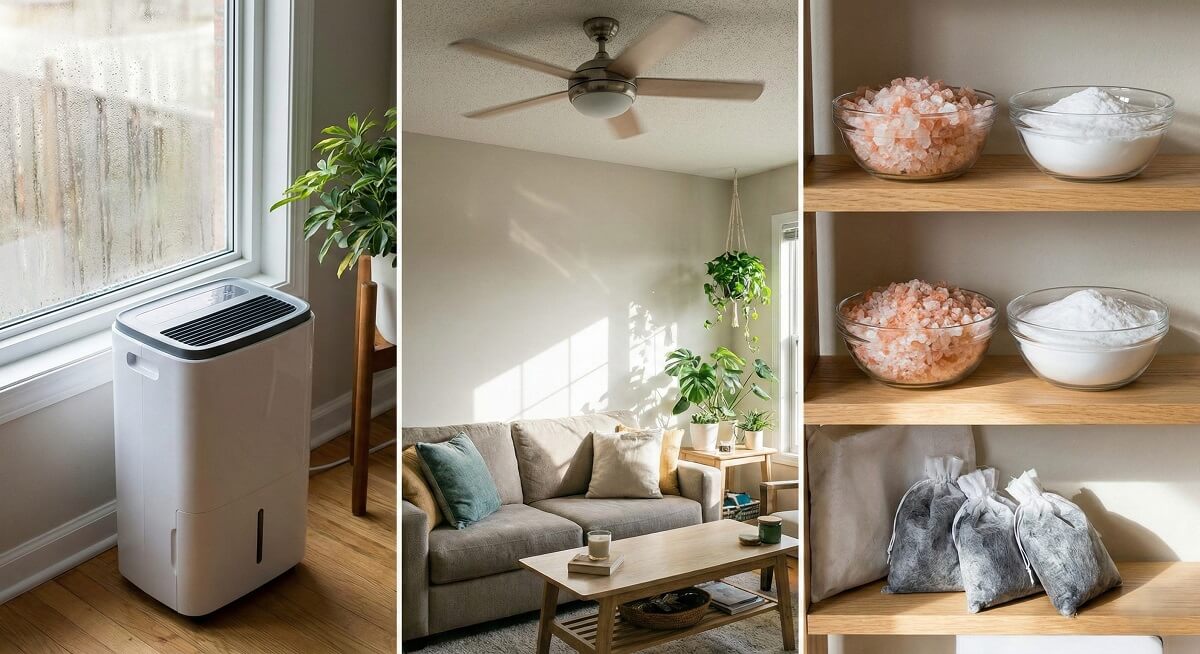
The fastest way to lower humidity in a room is to use a portable dehumidifier, run your air conditioner, or improve ventilation by opening windows and running fans. Each approach has different costs, energy requirements, and effectiveness depending on your situation.
If you deal with humidity only occasionally—during summer storms or after cooking—simple solutions like opening windows or running exhaust fans should do the trick. But if your home consistently stays above 60% humidity, you’ll want a dedicated dehumidifier to prevent mold, protect your belongings, and stay comfortable. for related tips.
The EPA recommends keeping indoor humidity between 30% and 50%. Above that range, you risk mold growth, musty odors, and potential health issues. Below, we’ll cover nine ways to get your humidity under control—from free methods to appliance recommendations with current pricing.
Quick Decision: Do You Need This Guide?
This Guide Is For You If:
- You notice condensation forming on windows
- Your home has a musty or damp smell
- You live in a humid climate (Florida, Gulf Coast, Pacific Northwest)
- You’ve spotted mold or mildew in bathrooms or basements
- The air in your home feels heavy or “sticky”
Consider Calling a Professional If:
- You see mold covering more than 10 square feet
- You have active water leaks or flooding damage
- Multiple methods haven’t solved persistent humidity issues
- Your HVAC system isn’t managing whole-house humidity
How to Tell If Your Room Has a Humidity Problem
Signs of High Humidity
Before you start troubleshooting, make sure humidity is actually your problem. Here are the telltale signs:
- Condensation on windows – Water droplets forming on glass, especially in the morning
- Musty or damp odors – That basement smell creeping into living spaces
- Visible mold or mildew – Black spots in corners, bathrooms, or near windows
- Peeling paint or wallpaper – Moisture breaking down adhesives
- Warped wood – Floors, doors, or furniture that no longer sit flat
- Clammy feeling air – That thick, uncomfortable sensation even with AC running
Measuring Your Humidity Level
Rather than guessing, pick up a digital hygrometer. These small devices measure relative humidity and cost as little as $10-15 on Amazon. The ThermoPro TP49 runs about $16 and shows both temperature and humidity at a glance. for more product recommendations.
What to look for: 30-50% humidity is ideal. If your readings consistently show 55% or higher, it’s time to take action. At 60% and above, mold can start growing within 24-48 hours on the right surfaces.
9 Ways to Dehumidify a Room
1. Open Windows and Doors (Free)
The simplest approach works when outdoor humidity is lower than what’s inside your home. On dry, breezy days, opening windows on opposite sides of a room creates cross-ventilation that pushes moist air out.
Best for: Mild humidity on dry weather days
Limitation: Useless when it’s raining or in naturally humid climates
2. Run Exhaust Fans
Your bathroom and kitchen exhaust fans exist specifically to remove moisture. Turn them on before you shower or cook, and let them run for 15-20 minutes afterward. Many people install these fans but never actually use them.
Pro tip: Make sure your fans actually vent outside, not into the attic. Venting into the attic just moves the moisture problem somewhere else.
3. Use Ceiling or Box Fans
While fans don’t remove moisture directly, they improve air circulation and help moisture evaporate from surfaces. Set ceiling fans to rotate counterclockwise in summer—this pushes air downward and creates a cooling breeze.
Position box fans near windows pointing outward to push humid air outside while drawing drier air in through other openings.
4. Turn On Your Air Conditioner
Air conditioners naturally remove moisture as they cool. When warm, humid air passes over the cold evaporator coils, water condenses and drains away. A properly working AC can remove 5-20 gallons of water from your home daily.
Important: AC only dehumidifies effectively when actively cooling. If your thermostat is set at 72°F and the room is already 72°F, the compressor won’t run—and neither will the dehumidification. AC also won’t help in heating mode.
5. Use a Portable Dehumidifier (Most Effective)
For consistent humidity control, a dedicated dehumidifier is your best option. These appliances pull humid air over cold coils, collect the water in a tank (or drain it through a hose), and release drier air back into the room.
Top picks for 2026:
- Best overall: Midea Cube (MAD50S1QWT) – Consistently ranked highest by reviewers; lowered room humidity from 90% to 40% faster than competitors in testing
- Best value: GoveeLife H7151 – Outperforms many 50-pint models at a 35-pint price point
- Best budget: Midea MAD35S1QWT – Rated highest by Consumer Reports under $250; excellent at water removal with low noise
6. Try DIY Moisture Absorbers
For small spaces or supplemental moisture control, household products can help:
- Baking soda: Set bowls around the room; replace when the powder cakes together
- Rock salt (calcium chloride): The bucket method works well in basements—drill holes in one bucket, nest it in another, and fill with rock salt. Water collects in the bottom bucket.
- Commercial products: DampRid and Humydry sell moisture-absorbing containers designed for closets and small rooms
Reality check: These methods work for closets, wardrobes, and small enclosed spaces. They won’t meaningfully reduce humidity in an entire room.
7. Add Moisture-Absorbing Houseplants
Certain plants absorb moisture through their leaves—English Ivy, Boston Fern, and Peace Lily are popular choices. That said, plants also release moisture through transpiration, so the net effect is modest at best.
Consider houseplants a minor supplement, not a primary solution. They won’t replace a dehumidifier in a truly humid environment. for dehumidifier comparisons.
8. Take Shorter, Cooler Showers
Hot showers pump serious moisture into your home. A 10-minute shower releases roughly half a pint of water vapor into the air. Multiply that by family members and daily showers, and you’ve got a significant humidity source.
Turn down the water temperature when practical, keep showers brief, and always run the exhaust fan. Leave the bathroom door open afterward if possible to help moisture dissipate.
9. Dry Clothes Outside
Hanging wet laundry indoors releases all that water directly into your living space. A single load of laundry contains about 2 gallons of water that has to go somewhere.
Whenever weather permits, dry clothes outside. When using a dryer, make sure it vents to the exterior—interior-vented dryers add enormous amounts of moisture to your home.
Room-by-Room Dehumidification Tips
Bathroom
- Run the exhaust fan during and for 20 minutes after every shower
- Wipe down shower walls with a squeegee to remove standing water
- Fix leaky faucets and running toilets immediately
- Consider moisture-resistant paint for walls and ceiling
Kitchen
- Use the range hood whenever cooking, especially when boiling water
- Cover pots while cooking to keep steam contained
- Run the dishwasher at night when you’re not adding more moisture from cooking
- Check under the sink periodically for slow leaks
Basement
- Basements are often the most humid area—consider a dedicated basement dehumidifier
- Check walls and floor for water seepage after heavy rain
- Seal concrete walls if moisture is penetrating
- Look into whole-house dehumidifier integration if your basement is finished
Bedroom
- Keep the door open during the day for air circulation
- Limit houseplants in small bedrooms
- A portable dehumidifier on a low setting works well overnight
- Wash bedding regularly—it absorbs body moisture nightly
available on our site.
Comparing Dehumidification Methods
| Method | Upfront Cost | Effectiveness | Best For | Monthly Energy Cost |
|---|---|---|---|---|
| Open windows | Free | Low-Medium | Mild humidity, dry days | $0 |
| Exhaust fans | Free (if installed) | Medium | Bathrooms, kitchens | Negligible |
| Ceiling/box fans | $20-50 | Low-Medium | Air circulation support | $2-5 |
| Air conditioner | Existing | Medium-High | Hot + humid conditions | $50-150 (varies) |
| Portable dehumidifier | $150-300 | High | Any room, chronic humidity | $18-42 |
| Whole-house dehumidifier | $1,000-2,500+ | Very High | Entire home | $20-50 |
| DIY absorbers (baking soda) | $5-10 | Low | Closets, small spaces | $0 |
| Commercial absorbers | $10-30 | Low-Medium | Supplemental use | $0 |
Energy costs based on national average electricity rates. According to Perch Energy’s analysis, regional rates create significant cost differences—the same dehumidifier costs $28/month in Louisiana but $83/month in Hawaii.
When to Invest in a Dehumidifier
Buy a Dehumidifier If:
- Your humidity stays above 55-60% consistently
- You live in a humid climate year-round (Southeast, Gulf Coast, Pacific Northwest)
- You’ve had mold problems before and want to prevent recurrence
- Natural ventilation methods aren’t keeping up
- Anyone in your household has allergies, asthma, or respiratory concerns
Skip the Dehumidifier If:
- High humidity only happens a few days per year
- Opening windows reliably solves the problem
- Budget is extremely tight—try DIY methods first
- You’re renting short-term and don’t want to move a heavy appliance
Choosing the Right Size
Dehumidifiers are rated by how many pints of water they remove in 24 hours. Based on AHAM (Association of Home Appliance Manufacturers) guidelines:
| Room Size | Recommended Capacity |
|---|---|
| Up to 500 sq ft | 20-30 pints |
| 500-1,000 sq ft | 30 pints |
| 1,000-1,500 sq ft | 30-40 pints |
| 1,500-2,000 sq ft | 50 pints |
| Over 2,000 sq ft | 60-70 pints |
Sizing adjustments: Add 10 pints if you live in a particularly humid climate. Add 5 pints if multiple people use the space regularly. Add 5 pints if a washer/dryer is in or near the room.
Preventing Humidity Problems
Fix Water Sources
- Repair leaky pipes, faucets, and running toilets promptly
- Clean gutters and extend downspouts away from your foundation
- Grade your yard so water flows away from the house, not toward it
- Seal basement walls if you notice moisture penetration
Improve Ventilation
- Verify bathroom and kitchen fans vent outside, not into the attic
- Check dryer vents for blockages or disconnections
- Consider adding vents in problem areas like laundry rooms
Routine Maintenance
- Clean or replace AC filters monthly during humid season
- Empty the dehumidifier water tank before it reaches capacity
- Clean exhaust fan covers to maintain proper airflow
Frequently Asked Questions
How long does it take to dehumidify a room?
With a properly sized dehumidifier, you should notice improvement within a few hours. Reaching the ideal 30-50% humidity range typically takes 1-3 days depending on room size, starting humidity level, and how well-sealed the space is.
Does running the AC dehumidify a room?
Yes, air conditioners remove moisture while cooling. They’re most effective when actively running—when the room temperature is significantly above the thermostat setting. If your home is already at the set temperature, the AC won’t run much, and you won’t get much dehumidification.
Can I dehumidify a room without electricity?
Your options are limited but include: opening windows when outdoor humidity is lower, using baking soda or rock salt as desiccants, and reducing moisture-producing activities like long showers or indoor clothes drying.
What humidity level causes mold?
Mold can begin growing when humidity stays consistently above 60%. The EPA recommends keeping indoor humidity between 30-50% to prevent mold and maintain healthy air quality.
Are dehumidifiers expensive to run?
A typical 50-pint dehumidifier uses 500-600 watts. Running one 8-12 hours daily costs roughly $30-42 per month at average electricity rates. Energy Star certified models use about 13% less electricity than standard units.
Do houseplants increase or decrease humidity?
Both. Plants absorb some moisture through their leaves but also release moisture through transpiration. The net effect is usually minimal, so don’t count on plants as a meaningful dehumidification method.
What’s better for humidity: dehumidifier or AC?
For pure humidity control, a dehumidifier is more efficient and works in any temperature. If you also need cooling, AC does both jobs. In hot, humid weather, some people run both for maximum comfort.
How often should I empty my dehumidifier?
It depends on humidity levels and tank size. A 50-pint unit in high humidity typically needs emptying every 1-2 days. Most modern dehumidifiers have auto-shutoff when full, and many offer a continuous drain option via hose. for more practical home tips.
Next Steps
Start by measuring your current humidity level with a hygrometer. If you’re consistently above 55%, try the free methods first—ventilation, exhaust fans, and reducing moisture sources. If those aren’t enough, a portable dehumidifier in the $150-300 range will solve most home humidity problems.
Check current dehumidifier prices at Amazon, Home Depot, or Lowe’s to find the right model for your space.
