


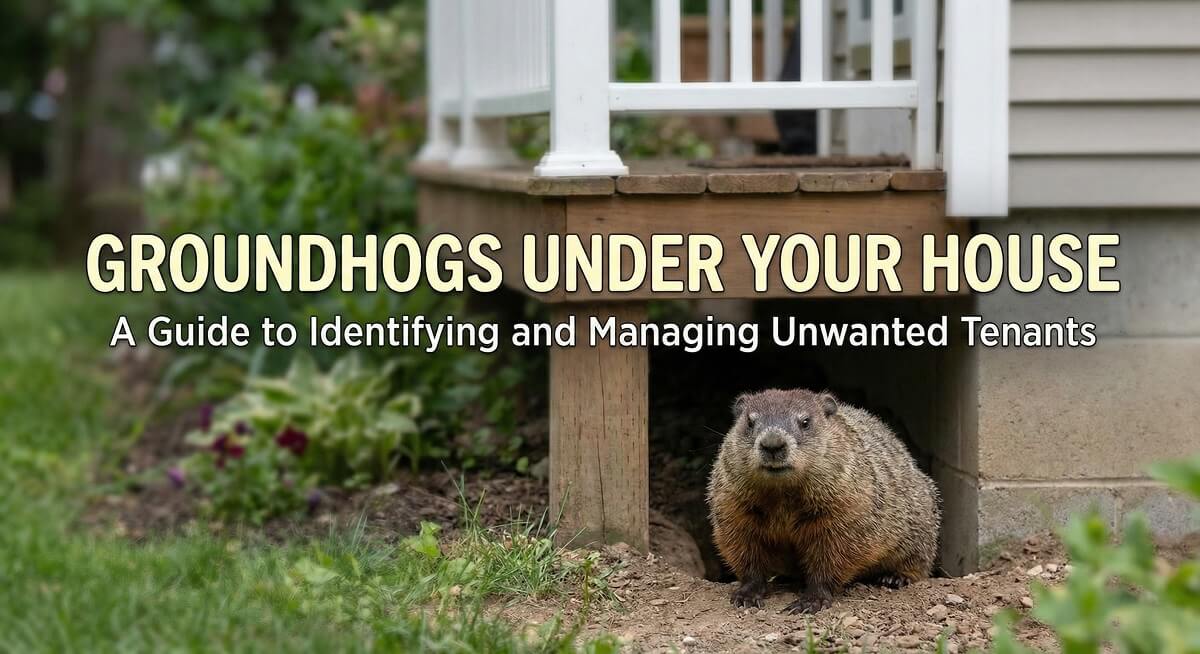
If you’ve spotted a groundhog den under your house, shed, or deck, you need to act fast. Live trapping combined with exclusion barriers is the most reliable long-term solution. Natural repellents like fox urine and cayenne pepper can help discourage these burrowing rodents, but they rarely solve the problem on their own. If you’re also dealing with other yard pests, our cover similar removal strategies.
Most DIY removal methods take one to three weeks to work. Professional wildlife removal typically resolves the issue within days. The sooner you address the problem, the better—according to Cornell University research cited by Critter Control, a single groundhog can displace up to 700 pounds of dirt while building its tunnel system, which can undermine foundations and create serious structural problems.
DIY approaches run $20-$150 depending on what you need. Professional removal averages $150-$300, according to HomeGuide’s 2026 cost estimates. Ignoring the problem could lead to foundation repairs costing thousands of dollars.
Should You DIY or Call a Pro?
Try DIY Methods If:
- You’re dealing with a single groundhog
- The burrow entrance is visible and accessible
- No signs of foundation damage yet
- You can check traps daily
- Your state allows DIY trapping and relocation
Call a Professional If:
- Multiple groundhogs or an extensive tunnel system
- The burrow is directly under your house foundation
- You’ve noticed cracks, settling, or water intrusion
- You’re uncomfortable handling wildlife
- Previous DIY attempts haven’t worked
- Your state restricts wildlife relocation
Signs You Have a Groundhog Under Your House
What Groundhog Burrows Look Like
Groundhog burrow entrances are distinctive—look for holes that are 10 to 12 inches wide with mounds of freshly excavated dirt piled nearby. Unlike smaller rodent holes, these openings are large enough to fit a cantaloupe.
The tunnel system behind that entrance is more extensive than most homeowners realize. According to University of Maryland Extension, groundhog tunnels extend 4 to 5 feet underground and can run anywhere from 8 to 66 feet in total length. Each burrow typically has multiple entrances—a main opening plus up to four escape routes.
Damage to Watch For
Groundhogs don’t just dig—they can cause real structural problems:
- Foundation issues: Tunneling removes soil from under foundations, causing settling, cracks, and water intrusion
- Utility damage: Groundhogs will chew through electrical wires, irrigation lines, and cables that cross their path
- Trip hazards: Surface holes create ankle-twisting dangers in your yard
- Garden destruction: According to Rutgers University, these animals eat up to 1.5 pounds of vegetation daily during summer months
6 Effective Methods to Remove Groundhogs
1. Live Trapping (Most Effective for Removal)
Live trapping remains the most reliable way to actually remove a groundhog from your property. You’re not just discouraging it—you’re physically relocating it elsewhere.
How to do it:
- Purchase a large live trap (Havahart 1079 or similar, approximately $50-$95 at hardware stores or Amazon)
- Wash the trap to remove human scent, then handle with gloves
- Place the trap near the main burrow entrance on level ground
- Bait with cantaloupe chunks—groundhogs love it. Apples, carrots, and lettuce also work
- Disguise the trap with leaves and twigs to make it look natural
- Check the trap at least once daily
After capture: Transport the groundhog at least 10 miles away and release in suitable habitat. Check your state’s regulations first—relocation is restricted or prohibited in some areas.
2. One-Way Exclusion Doors
A one-way door lets the groundhog leave to forage but prevents re-entry. This works well when you’ve identified all burrow exits.
How to use:
- Block all burrow entrances except one
- Install the one-way door at the remaining exit
- Wait several days to ensure the groundhog has left
- Once confirmed empty, seal all entrances permanently
Allow at least two weeks before permanently sealing, and avoid using this method during breeding season (February-June) when young may be trapped inside.
3. Natural Repellents (Best for Deterrence)
Repellents work by making the area unpleasant through smell or taste. They’re better for prevention than removal—a determined groundhog with an established den often ignores them. can help you find effective products.
Options that have some effectiveness:
- Predator urine: Fox or coyote urine granules ($22-$25 for 16 oz) trigger the groundhog’s instinctive fear of predators. Sprinkle around burrow entrances.
- Epsom salts: Groundhogs dislike the taste. Sprinkle around the garden perimeter and near tunnel openings. Reapply after rain.
- Cayenne pepper: Pour near burrow entrances. The smell and heat irritate their sensitive noses.
- Castor oil: Mix 1/2 cup with 2 cups water and spray around (not inside) burrow openings.
- Soiled cat litter: Pour near one burrow entrance (leave another exit clear). The predator scent can encourage relocation.
Reality check: Most wildlife professionals consider repellents a temporary measure at best. They need frequent reapplication and rarely work alone on an established groundhog.
4. Fencing and Exclusion Barriers
Proper fencing is the most reliable long-term prevention. It’s more work upfront but creates a permanent barrier.
Installation specifications (based on University of Maryland Extension and Rutgers NJAES recommendations):
- Use hardware cloth or welded wire with mesh no larger than 3×3 inches (1/2 inch is better)
- Extend fence 3-4 feet above ground
- Bury at least 12 inches deep
- Bend the buried portion outward in an L-shape (another 12 inches horizontal) to prevent digging underneath
- For added protection, install an electric wire strand 4-5 inches above ground
Cost estimate: Hardware cloth at Home Depot runs $50-$80 for a 36″x50′ roll. A typical shed perimeter project might require 1-2 rolls plus posts and fasteners.
5. Habitat Modification
Making your property less attractive reduces the chance of groundhogs settling in—or returning after removal.
- Clear tall vegetation and brush piles near structures
- Keep grass trimmed low around foundations, sheds, and decks
- Harvest garden produce promptly and pick up fallen fruit
- Secure garbage bins with tight-fitting lids
- Remove woodpiles and debris that provide cover
Groundhogs feel vulnerable in open areas. Eliminating their hiding spots makes your property less appealing.
6. Professional Wildlife Removal
When DIY methods aren’t working—or when you’d rather not handle it yourself—professional removal is worth considering.
What professionals offer:
- Initial inspection to assess the situation ($100-$200)
- Humane trapping and removal ($150-$350)
- Exclusion barrier installation
- Damage assessment and repair recommendations
- Knowledge of local regulations
Cost breakdown (according to HomeGuide):
- Single groundhog removal: $150-$300
- Multiple animals or complex situation: $200-$400
- Some companies offer flat-rate packages around $400-$700 that include trapping, removal, and basic exclusion
To find a licensed operator, contact your state wildlife agency or search for “nuisance wildlife control” in your area. Ask about licensing, insurance, and whether they use humane methods.
Groundhog Removal Methods Compared
| Method | Effectiveness | Cost | Time to Work | Difficulty | Best For |
|---|---|---|---|---|---|
| Live Trapping | High | $50-$95 | 1-7 days | Medium | Active removal |
| One-Way Doors | High | $25-$50 | 3-14 days | Medium | Single-exit burrows |
| Natural Repellents | Low-Medium | $10-$40 | Ongoing | Easy | Deterrence/prevention |
| Exclusion Fencing | High | $50-$200 | Permanent | Hard | Long-term prevention |
| Habitat Modification | Medium | Free-Low | 2-4 weeks | Easy | Prevention |
| Professional Removal | Very High | $150-$400 | 1-3 days | None (for you) | Complex situations |
How to Fill Groundhog Holes Properly
Once you’ve confirmed the groundhog is gone, you need to fill the burrow correctly—otherwise another animal will move right in.
First, confirm the burrow is empty (as recommended by Humane World):
- Loosely cover all entrances with newspaper or grass clippings
- Wait 3-5 days
- If the material hasn’t been disturbed, the burrow is likely vacant
Fill with the right materials:
- Use: Gravel, crushed stone, sand, or concrete
- Avoid: Soil or mulch (groundhogs can dig through organic materials easily)
- Pack the material tightly with no air gaps
- For added security, bury a 3×3 foot section of hardware cloth over each filled entrance
If the burrow was under your foundation and you’re noticing cracks, settling, or water issues, consider having a foundation specialist assess the damage before filling. Structural repairs may be needed.
State Laws on Groundhog Removal
Before trapping and relocating a groundhog, check your state’s regulations. Laws vary significantly:
- Virginia: According to the Virginia Department of Wildlife Resources, it’s illegal to trap and relocate wildlife. Only licensed professionals can transport animals.
- New Jersey: Per Rutgers NJAES, relocation is strongly discouraged because groundhogs are classified as a rabies vector species. If relocation is necessary, it must be within a 5-mile radius.
- Maryland: No permit required for trapping. Landowner permission needed for release on private property.
- North Carolina: Groundhogs can be trapped and removed year-round with no bag limit.
- Ohio: Live trapping allowed with landowner permission.
- Illinois: Requires a Nuisance Animal Removal Permit.
When in doubt, contact your state wildlife agency before trapping. Many states have nuisance wildlife hotlines that can clarify local rules.
Best Time to Remove Groundhogs
Timing matters for both effectiveness and humane treatment:
- Best window: Mid-July through September — Young have left the den, and groundhogs are active before hibernation prep begins.
- Avoid: Late winter through early summer (February-June) — This is breeding season and when mothers have dependent young in the burrow. Removing the adult could leave babies to starve.
- Hibernation period: October through February — Groundhogs are dormant and won’t respond to traps or repellents. Wait until spring.
If you must act during breeding season, watch for signs of young (multiple groundhogs coming and going, increased activity). Consider consulting a professional who can assess the situation. For more seasonal pest management tips, check out .
Frequently Asked Questions
How deep do groundhog burrows go?
Groundhog tunnels typically extend 4 to 5 feet below ground and can run 30 to 66 feet in total length, according to University of Maryland Extension. The burrow system includes multiple chambers for sleeping, hibernating, and raising young, plus several entrance and exit holes.
Can groundhogs damage my house foundation?
Yes. Their tunneling removes large amounts of soil from under foundations, which can cause settling, cracks, and water intrusion. A single groundhog can displace up to 700 pounds of dirt. If you notice foundation problems, address the groundhog issue immediately and consider a structural assessment.
What smell do groundhogs hate most?
Groundhogs are most deterred by predator scents—fox and coyote urine are the strongest options. They also dislike garlic, cayenne pepper, and ammonia. However, repellents alone rarely solve an established groundhog problem.
How much does professional groundhog removal cost?
Professional removal averages $150 to $300 for a single groundhog. More complex situations with multiple animals or extensive burrow systems can run $200 to $400. Initial inspections typically cost $100 to $200. Some companies offer package deals around $400-$700 that include trapping, removal, and basic exclusion work.
Is it legal to kill groundhogs?
In most states, property owners can legally remove groundhogs causing damage on their own land. However, specific methods may be regulated. Lethal traps are prohibited in some states (like New Jersey), and poison is generally discouraged due to risks to pets and non-target wildlife. Check your state’s wildlife regulations.
Do mothballs work on groundhogs?
Mothballs are not recommended. They have minimal effectiveness against groundhogs and are toxic to children and pets. The EPA doesn’t approve mothballs for outdoor pest control. Stick to safer options like predator urine or Epsom salts.
How long does it take to get rid of a groundhog?
DIY methods typically take 1 to 3 weeks, depending on the approach. Live trapping can succeed within days if placed correctly. Professional removal usually resolves the issue within 1 to 3 days. Repellent-only approaches may take much longer and often fail entirely.
Will groundhogs come back after relocation?
A relocated groundhog generally won’t return if released at least 10 miles away. However, new groundhogs may move into vacant burrows on your property. That’s why exclusion barriers are important—they prevent future animals from taking up residence.
Taking Action
If you’re dealing with a groundhog under your house, shed, or deck, start with an assessment of the situation. For a single, accessible burrow, DIY trapping often works well. For complex situations or foundation concerns, professional help is worth the investment.
Check current prices on live traps and exclusion materials at your local hardware store or online retailers like Amazon or Home Depot. If you decide to hire a professional, contact your state wildlife agency for referrals to licensed operators in your area.
