


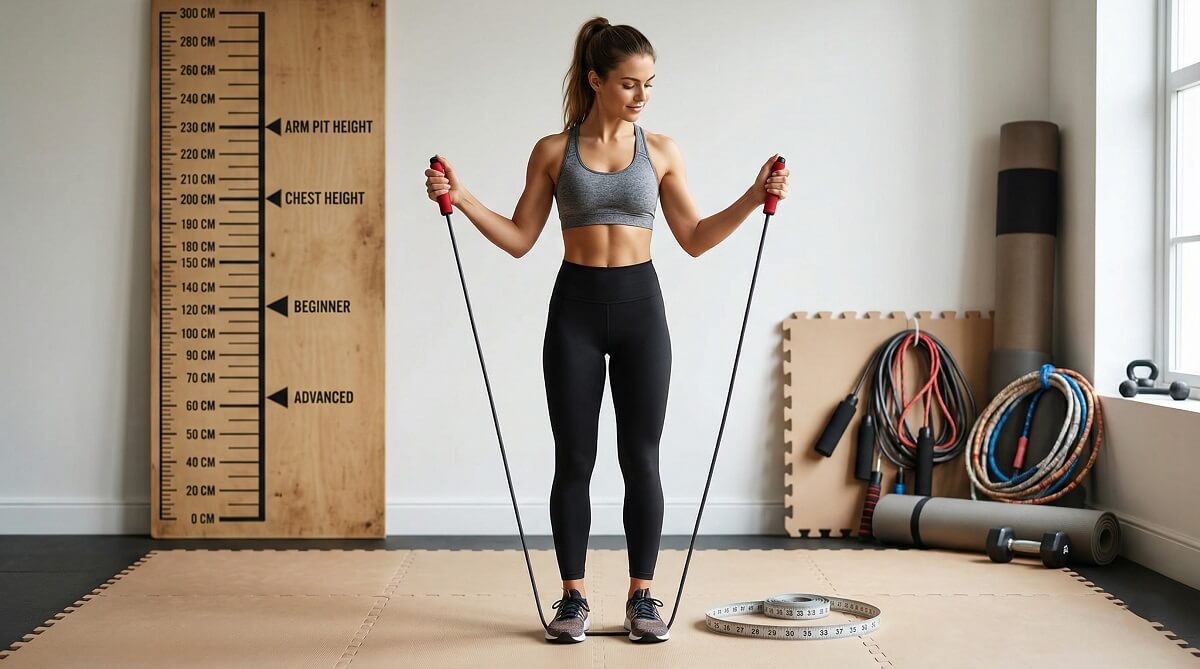
The fastest way to size a skipping rope: stand on the midpoint of the rope with both feet together, pull the handles straight up, and check that they reach somewhere between your lower chest and armpit. That single test covers most people most of the time. If your handles hit chin height or above, the rope is too long. If they barely clear your navel, it’s too short.
That said, there are four widely used methods, each suited to a different situation — whether you’re buying online and can’t test the rope first, adjusting an existing rope at home, or picking a size for a child. Getting the length wrong has real consequences: a rope that’s too long forces you to jump higher than necessary, burns more energy per rep, and wears the cable out faster. A rope that’s too short trips you up constantly and strains your ankles and Achilles tendon over time. Getting it right makes the whole thing feel effortless by comparison.
This guide covers all four sizing methods, a height-to-length reference chart, the one factor most guides miss (arm position), and clear signs your current rope isn’t fitting you well. are also available if you’re still putting together your home workout space.
Which Sizing Method Should You Use?
✅ Use the Chest/Armpit Method if:
- You already own a rope and want to check or adjust it right now
- You’re a beginner or general fitness jumper
- You want the most reliable single test without any math
✅ Use the Height + 3 Feet Formula if:
- You’re ordering online and can’t try the rope before it ships
- Your rope is fixed-length (non-adjustable) and you need to pick a size from a chart
- You’re a complete beginner with no existing rope to measure
✅ Use the Height × 1.5 Formula if:
- You think in meters and centimeters
- You’re buying from a European brand that sizes ropes in centimeters
✅ Use the Underarm/Clip Method if:
- Your rope has an adjustable clip or locking mechanism
- You want a quick-adjust without much guesswork
❌ Skip measuring if:
- You’re buying an adjustable rope — just size up, then fine-tune after it arrives
- You already have a rope that feels comfortable and controlled — trust your feel
Method 1: The Chest/Armpit Method (Best for Most People)
Coaches and most major rope manufacturers rely on this test because it accounts for arm length and natural jumping stance — not just height. For the vast majority of people, it gives a more accurate fit than any formula.
Step-by-step:
- Lay the rope flat on the floor
- Stand on the midpoint with both feet together
- Pull both handles straight up toward your torso
- Check where the top of the handles land on your body
- Ideal: handles reach between your lower chest and armpit
Reading the result:
- Handles at armpit or just below: Good beginner length — plenty of clearance for learning
- Handles at lower chest/sternum: Intermediate range — efficient, controlled rotation
- Handles at lower chest or below: Advanced/speed range — tight arc, maximum efficiency
- Handles at chin or above: Too long — shorten before using
- Handles below navel: Too short — you’ll be tripping constantly
One important detail: This test measures cable only. The handles themselves are not part of the sizing equation. Most standard jump rope handles are 5–7 inches long each, and they don’t affect the arc the rope makes when you jump — so never count handle length in your total.
According to RX Smart Gear’s official sizing guide, the cable should stop at your sternum or lower pecs when you step on the rope and pull the handles up — anything longer creates excess rope above your head that slaps the ground on every pass.
Method 2: Height + 3 Feet Formula (Best for Buying Online)
When you can’t physically test a rope before buying, this formula gives you a reliable starting point. It’s the most widely cited sizing standard across jump rope brands and coaches.
Formula: Your height + 3 feet = suggested rope length (cable only, not including handles)
So if you’re 5’8″, your starting rope length would be 8’8″ — or about 8.5 feet.
Height-to-Rope-Length Reference Chart
| Your Height | Beginner Length | Intermediate Length | Advanced Length |
|---|---|---|---|
| Under 4’10” (147cm) | 7’6″ (229cm) | 7′ (213cm) | 6’6″ (198cm) |
| 4’10″–5’2″ (147–157cm) | 8′ (244cm) | 7’6″ (229cm) | 7′ (213cm) |
| 5’3″–5’6″ (160–168cm) | 8’6″ (259cm) | 8′ (244cm) | 7’6″ (229cm) |
| 5’7″–5’10” (170–178cm) | 9′ (274cm) | 8’6″ (259cm) | 8′ (244cm) |
| 5’11″–6’2″ (180–188cm) | 9’6″ (290cm) | 9′ (274cm) | 8’6″ (259cm) |
| Over 6’2″ (188cm+) | 10′ (305cm) | 9’6″ (290cm) | 9′ (274cm) |
What the skill levels mean in practice:
- Beginner: Roughly 18–24 inches of clearance above your head as the rope passes over — plenty of room to develop timing without tripping every few jumps
- Intermediate: Arc tightens up, clearance drops to about 10–14 inches overhead — forces better arm position with elbows closer to the body
- Advanced: Minimal overhead clearance, around 4–8 inches — used for speed work, double unders, and competition jumping where efficiency is everything
The consistent advice from coaches — and from independent sizing guides like Dope Ropes and SEALgrinderPT: start with the beginner length and shorten as your technique develops. Most jumpers trim their cord within the first couple months of consistent practice. Don’t overthink the starting size — just err on the side of a little longer, and can help you pick the right rope type for your goals.
Method 3: Height × 1.5 (The Metric Formula)
If you’re used to metric measurements, this formula is the simplest approach — and it’s the method most European brands use when sizing their ropes.
Formula: Cable length (meters) = Your height in meters × 1.5
Examples:
- 5’6″ (1.68m) × 1.5 = 2.52m cable length
- 5’10” (1.78m) × 1.5 = 2.67m → round to 2.7m
- 6’0″ (1.83m) × 1.5 = 2.74m → round to 2.8m
According to Velites Sport’s sizing guide, this formula gives you the correct cable length for a person with standard arm positioning. Note that all measurements exclude handle length.
This formula lands you squarely in the beginner-to-intermediate range. CrossFit athletes working on double unders often go shorter — typically around 1.3–1.4× their height in meters as their form improves.
Method 4: The Underarm/Clip Method (For Adjustable Ropes)
Adjustable ropes with a built-in locking mechanism are the easiest to size — no formula needed, no cutting. Here’s the standard approach:
- Stand on the midpoint of the rope with one foot
- Hold one handle horizontally and pull the rope taut
- Tighten the clip so the handle top sits level with your underarm
- Repeat on the other side
The underarm landmark puts you right at beginner range — enough clearance to learn technique without excessive rope slapping the ground. Once you’re comfortable jumping consistently, loosen the clip and shorten by an inch or two at a time.
This works well with models like the RENPHO Smart Jump Rope and similar clip-adjust designs. For fixed-length wire or PVC ropes — where you’d need to physically cut the cord — use Method 1 or 2 to verify the target length before making any permanent changes. if you’re looking to upgrade handles or replace cables.
The Factor Most Guides Ignore: Your Arm Position
Two people who are exactly the same height can need ropes that differ by 4–6 inches — simply because of how they hold their arms when jumping. This is the single most commonly overlooked variable in sizing.
According to RX Smart Gear’s sizing methodology:
| Elbow Position | What It Looks Like | Sizing Adjustment |
|---|---|---|
| Elbows back, hands in | Compact form — wrists near hips, palms forward | Go 4–6 inches shorter than chart recommendation |
| Elbows at sides, hands out | Standard position — arms slightly away from body | Use chart as-is |
| Elbows flared out | Wide position — common in beginners | Add 2–3 inches to chart recommendation |
The target over time is the elbows-back position — more efficient, less fatiguing, and it lets you generate faster rotation with less arm effort. A shorter cord actively encourages this compact form because there’s no excess slack to bail you out when your arms drift wide. can help if you’re still dialing in your form.
Signs Your Rope Isn’t the Right Length
Your rope is too long if:
- The rope makes a loud slapping sound on each pass (excess rope hitting the ground ahead of your feet)
- You find yourself jumping noticeably higher than feels natural
- The rope handles swing up past your shoulders mid-rotation
- Your cable is wearing down unevenly or faster than expected
Your rope is too short if:
- You trip on almost every attempt, even after warming up
- You’re jumping with a forward lean or crouched posture
- Your arms are being pulled wide or backward to create clearance
- The rope feels like it’s “snatching” rather than flowing smoothly
Research cited by Velites Sport (referencing Drews et al., 2020 and Franchini et al., 2022) found that the most common jump rope injuries affect the lower limb — particularly the calves, Achilles tendon, and ankles. A poorly fitted rope that forces compensatory jumping mechanics is a significant contributing factor. Getting the fit right isn’t just about performance; it protects your joints.
How to Measure Your Current Rope at Home
Already have a rope and want to know its exact cable length? Here’s how to do it at home in under two minutes:
- Lay the rope on a flat surface — floor or a long table works
- Stretch it fully without putting tension on it
- Measure from one end of the cable to the other — do not include the handles
- Write down the measurement in feet/inches or centimeters
- Compare against the reference table above
If you’re planning to cut a fixed-length rope: Measure twice. Mark the target cut point with tape before cutting. Most fixed-length wire and PVC ropes can’t be extended once shortened — so verify the new length with the step-on test (Method 1) before making the cut permanent.
Standard handles on most consumer ropes are around 6 inches each, meaning a rope listed as “9 feet” typically means 9 feet of cable plus roughly 12 inches of handle material (6 inches per side). When comparing ropes between brands, always confirm whether the stated length includes handles or not.
Sizing a Skipping Rope for Kids
The step-on-and-pull-up test works for children too — use the same process as Method 1. Kids tend to have proportionally shorter arms relative to their height, so erring on the longer side of the range below is smart. for more help picking the right gear for younger athletes.
| Child’s Height | Recommended Rope Length (cable) |
|---|---|
| Under 3’6″ (107cm) | 5’–5’6″ (152–168cm) |
| 3’6″–4′ (107–122cm) | 5’6″–6′ (168–183cm) |
| 4’–4’6″ (122–137cm) | 6’–6’6″ (183–198cm) |
| 4’6″–5′ (137–152cm) | 6’6″–7′ (198–213cm) |
Rope type for kids: Beaded ropes are a better starting point for young jumpers than thin wire or PVC options. The weight of the beads gives better feedback on the cord’s position — children can feel where it is during rotation, which helps them develop timing. Jump rope speed cables are nearly weightless and significantly harder to learn with, so hold off on those until the basics are solid.
Frequently Asked Questions
How do you measure a skipping rope without stepping on it?
Lay the rope flat on a surface and use a tape measure from cable end to cable end, excluding handles. Compare that measurement to the height chart above to determine whether it fits your height at beginner, intermediate, or advanced level.
Does the rope length include the handles?
No — rope sizing is always based on cable length only. Handles typically add 5–7 inches per side and don’t affect the arc of the rope in use. When you see a rope listed as “9 feet,” that should refer to the cable portion, but check each brand’s product listing to confirm.
What length skipping rope do I need for my height?
Start with your height plus 3 feet for the cable length. A person who’s 5’7″ would start with a 8’7″ rope (roughly 8.5 feet). Use the chart above for more precise bracket recommendations at beginner, intermediate, and advanced levels.
How long should a skipping rope be for a beginner?
The beginner standard is your height plus 3 feet of cable. This gives roughly 18–24 inches of clearance above your head as the rope passes over, which is enough room to develop timing without tripping constantly. Plan to shorten it as your form improves — most people move to a shorter rope within the first month or two of regular practice.
What’s the right jump rope length for double unders?
Most CrossFit athletes start double unders at height plus 2.5 feet and work down to height plus 2 feet as they get comfortable. The tighter arc forces better mechanics — elbows back, wrists close to the hips — which is exactly the form you need for efficient double unders. Starting too long means you’re developing habits you’ll need to undo later.
Can my rope be too short even if I bought the right size?
Yes. If you jump with your elbows flared wide, you’re effectively making the functional rope length shorter than it measures. Two people the same height can need ropes 4–6 inches apart depending on arm positioning. If you sized by the chart but still feel the rope catching, try going up an inch or two before assuming your technique is wrong.
Is an adjustable jump rope worth buying?
For most beginners, yes. Adjustable ropes remove the risk of buying the wrong fixed length, and they let you fine-tune the fit as your form develops. They’re also practical if multiple people in your household will use the same rope. Basic adjustable options are available on Amazon for around $10–20; premium weighted systems run $100 and up.
Does rope material affect sizing?
Slightly. Beaded and thick PVC ropes are more forgiving if you go a touch long, because their weight gives you better feedback on the rope’s position. Wire speed ropes are much less forgiving — even 2–3 extra inches can noticeably drag on rotation speed and timing. If you’re using a wire cable rope, follow the sizing guidelines closely.
Next Steps
If you haven’t measured your rope yet, the quickest way to start is Method 1 — step on it, pull the handles up, see where they land. That single check takes about 10 seconds and will tell you whether your current setup is working for you.
Looking for a new cord? Check current prices and options on Amazon’s jump rope category. For newcomers to jumping, an adjustable option gives you room to dial in fit without committing to a fixed length. for help choosing the right equipment for your workout goals.
