


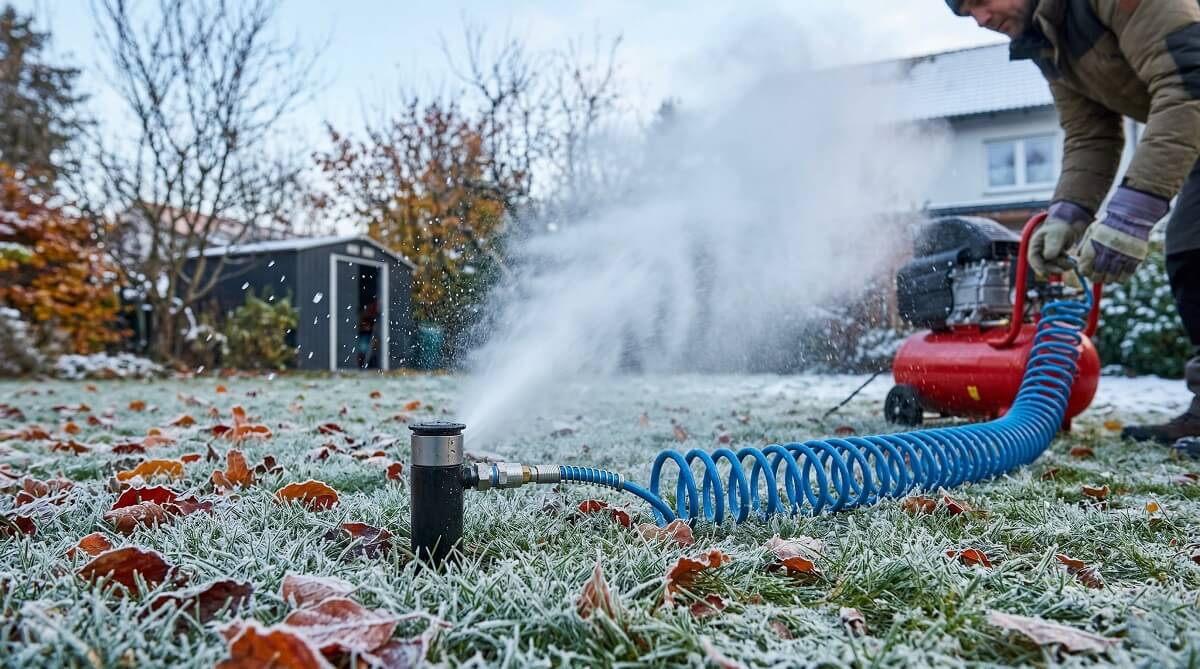
If your area drops below freezing in winter, draining your in-ground irrigation system before the first hard frost is one of the cheapest pieces of home maintenance you can do. Frozen water expands inside PVC and polyethylene pipes, and that expansion cracks lines, destroys backflow preventers, and can turn a $60–$150 annual service call into a $370–$1,500 repair bill. The math isn’t complicated. For more , see the ChubbytIps how-to section.
Three methods exist for clearing water from irrigation lines: the blowout method (compressed air), manual drain, and automatic drain. Most residential systems in freeze-prone climates were installed with the blowout method in mind, and it’s the right default if you’re not certain what your system was designed for.
This guide covers the full process — when to start, what equipment you need, the step-by-step blowout procedure, how to handle backflow preventers and smart controllers, and the honest case for calling a professional instead of renting a compressor and doing it yourself.
Do You Actually Need to Winterize?
Not every irrigation system requires the same prep. Your geography and your system design both matter.
✅ Winterize If:
- Your region experiences temperatures at or below 32°F during winter months
- You have exposed backflow preventers or shallow buried piping
- Your pipes are PVC (rigid white) or polyethylene (flexible black) — which accounts for most residential systems
- You live anywhere in the northern half of the US, the Mountain West, or areas with unpredictable late-fall temperature drops
❌ You Can Probably Skip If:
- You’re in a consistently frost-free zone — southern Florida, Hawaii, or desert areas that rarely drop below 40°F
- Your entire system was installed below your region’s frost depth with automatic drain valves at every low point
- Your municipality shuts down the exterior water supply to irrigation lines for the season
Texas is a good example of a gray zone. Most of the state rarely freezes, but a hard freeze every few years can still crack exposed pipes and backflow devices. Homeowners there can usually get away with draining manually and insulating exposed components rather than a full compressed-air blowout.
When to Winterize — Timing by Region
The practical rule: aim to winterize 2–3 weeks before your area’s average first hard freeze. One night below 32°F is enough to damage an exposed pressure vacuum breaker. You don’t have to wait for a forecast warning — use historical averages to plan ahead.
Based on NOAA’s 1991–2020 Climate Normals, here are average first freeze dates for major US regions:
| Region | Representative City | Avg. First Freeze | Winterize By |
|---|---|---|---|
| Northern Plains | Minneapolis, MN | October 8 | Late September |
| Mountain West | Denver, CO | October 7 | Late September |
| Midwest | Chicago, IL | October 19 | Early October |
| Mid-Atlantic | Philadelphia, PA | ~November 4 | Mid-October |
| Upper South | Nashville, TN | November 1 | Mid-October |
| Pacific Northwest | Seattle, WA | November 21 | Late October/November |
Source: NWS Denver/Boulder, NWS Chicago, Minnesota DNR, The Old Farmer’s Almanac (NOAA 1991–2020 normals).
What You’ll Need
Gather your gear before you start — stopping mid-process to hunt for a fitting or a screwdriver while the compressor is running is how mistakes happen. Here’s what each method requires. For equipment-buying decisions, can help with tools and gear selection.
For the Blowout Method (Most Common)
- Air compressor — must provide enough sustained CFM for your system (see sizing below). Available at equipment rental shops; daily rental typically runs $30–$60 for a residential-scale unit, per LawnStarter’s 2026 pricing data.
- Compressor hose with quick-coupler fitting — must match your system’s blow-out port (usually a hose bib or quick coupler after the backflow device)
- ANSI-approved safety glasses — non-negotiable; flying debris from a pressurized system causes serious eye injury
- Irrigation controller manual or app — needed to manually activate zones
For the Manual Drain Method
- Flathead screwdriver or manual drain key (to open drain valves)
- System map showing the location of low-point drain valves (usually came with your install paperwork)
Either Method
- Garden hose (to flush water toward drain valves if needed)
- Foam pipe insulation or a backflow preventer cover for any exposed components in mild-freeze zones
Sizing Your Compressor
According to Hunter Industries, the leading irrigation equipment manufacturer, the formula is straightforward: divide the GPM (gallons per minute) of your largest zone by 7.5 to get the CFM rating you need. Colorado State University Extension confirms this formula for residential systems. Most residential setups fall in the 20–50 CFM range. If your largest zone runs 15 GPM, you need a 2 CFM minimum — in practice, account for sustained output and rent at least a 20 CFM unit.
The Three Winterization Methods
Understanding which method your irrigation setup supports is the first step. Choosing the wrong approach can leave water pockets trapped in lines, which defeats the whole purpose.
Method 1: Blowout (Recommended for Most Systems)
Compressed air is introduced into the mainline and pushes remaining water out through the sprinkler heads, zone by zone. Works with both PVC and polyethylene pipe. The most widely applicable method and the only option if your system doesn’t have drain valves. Pressure limits:
- PVC pipe (rigid white): maximum 80 psi
- Polyethylene pipe (flexible black): maximum 50 psi
These limits come directly from Hunter Industries’ official winterization documentation and are confirmed by Weathermatic. If you’re unsure which pipe type you have, default to 50 psi to stay safe.
Method 2: Manual Drain
Only works if your system was installed with manual drain valves at the low points and ends of each lateral line. If your system doesn’t have these valves, skip this method entirely — you’ll leave water pockets that will freeze. To confirm: check with whoever installed your system, or look for ball valves at the ends of each run.
Method 3: Automatic Drain
Some systems use spring-loaded automatic drain valves that open when line pressure drops below a certain threshold. When you shut off the supply, these valves open and water drains out on its own. Even with automatic drain, you’ll still need to manually drain the backflow preventer and prepare the controller separately.
Step-by-Step Blowout Instructions
Before starting: put on your safety glasses and keep anyone else — especially children — well away from the work area. Never stand directly over sprinkler heads, valves, or pipe fittings while air pressure is in the system.
- Shut off the irrigation water supply valve — this is usually a separate shutoff near the main water line or backflow preventer, not the house main.
- Connect the compressor hose to the system’s blow-out port — located after the backflow device. Keep the compressor valve in the closed position before connecting.
- On your controller, activate the zone that is highest in elevation and furthest from the compressor — starting from the top down ensures gravity assists the drainage.
- Close the isolation valves on the backflow device — do not blow air through the backflow device itself; the compressor connects to the mainline downstream of it.
- Slowly open the compressor valve — introduce air gradually. Don’t dump the full tank pressure at once; this is how pipes get damaged.
- Watch for water to stop exiting the heads — typically takes 1–3 minutes per zone. Run 2–3 short cycles per zone rather than one continuous blast. Once a zone is dry, stop blowing immediately — compressed air through dry pipe creates heat from friction, which can melt or deform components.
- Move to the next zone — work from the zone furthest from the compressor toward the closest, one station at a time.
- After all zones are cleared, disconnect the compressor and release any remaining air pressure from the system.
- Cycle the backflow preventer’s ball valves — open and close them several times to release any trapped water. Leave the isolation valves set at approximately 45° (halfway open) and open the test cocks to allow any final moisture to escape.
Safety reminders from Hunter Industries:
- Remove flow sensors before blowout — compressed air will damage them. Cap the pipe opening after removal.
- Never leave the compressor running unattended with all zones closed — always keep at least one zone active while the compressor is running.
- Don’t blow through pumps or backflow devices; connect only to the system side of the backflow.
- Wear ANSI-approved eye protection throughout the entire process.
Preparing System Components
Clearing the pipes is only part of winterization. Each major component — controllers, backflow preventers, sensors, and heads — has its own prep step. Skip any of these and you can still end up with freeze damage even after a successful blowout.
Controllers and Smart Timers
For standard dial controllers — outdoor or indoor — leave the power connected and set the dial to the OFF position. The heat from the transformer keeps condensation from forming inside the enclosure; unplugging it fully removes that protection.
For Rachio smart controllers: use the app to enable Standby Mode. Go to your Dashboard, tap Device Settings, and toggle Standby Mode on. According to Rachio’s support documentation and confirmed by Rachio staff in their community forum, Standby Mode pauses all scheduled watering while keeping the device connected to the cloud. Your schedules and settings are preserved. Alternatively, you can unplug the Rachio entirely — all settings sync back when you reconnect in spring.
Other smart controller brands (Rain Bird, Hunter Hydrawise, Orbit B-hyve) each have similar seasonal pause or hold features. Check your app or manufacturer support documentation for the specific toggle.
Backflow Preventers
After completing the blowout, leave the pressure vacuum breaker’s test cocks open. The isolation ball valve handles should rest at the 45° angle — this is the standard post-winterization position recommended by Hunter Industries. For units in mild-freeze zones where full drainage is less critical, wrapping the exposed preventer with foam pipe insulation or an insulated backflow cover adds a useful buffer against surprise temperature drops.
Rain Sensors and Flow Sensors
Rain sensors with cup-style catch bowls: pour out any standing water and drape a plastic bag over the sensor to keep winter precipitation from refreezing in the cup.
Flow sensors: remove them entirely before blowout. Compressed air at operating pressures will damage the internal components. Seal the pipe opening with a cap before proceeding.
Sprinkler Heads
Heads with built-in check valves: manually pull each head upward to release trapped water before beginning the blowout. After the blowout, verify that every head retracted fully into the ground. Any head sitting proud of the soil is at risk of being damaged by lawn equipment or ground freeze.
DIY vs. Hiring a Professional
Here’s the honest breakdown:
| Factor | DIY Blowout | Professional Service |
|---|---|---|
| Typical cost | $30–$60 compressor rental + time | $60–$150 total (avg. ~$85–$91) |
| Time investment | 2–4 hours (including pickup/return) | 30–60 minutes on-site |
| Equipment required | Rented compressor + fittings | None (tech brings everything) |
| Risk | Moderate — over-pressure can crack pipes or heads | Minimal |
| Best for | Experienced DIYers, straightforward systems | First-timers, complex systems, larger properties |
Professional winterization cost data comes from Angi’s 2026 service cost data ($60–$150 range, averaging $85–$91) and HomeAdvisor ($56–$133, averaging $91).
When Hiring Out Makes More Sense
- You’ve never done a blowout and don’t want to risk damage on your first attempt
- Your system has a complex backflow assembly or multiple zones spread across a large property
- You don’t own a vehicle large enough to transport a suitable compressor from a rental location
- The compressor you own doesn’t produce enough sustained CFM
To find a licensed irrigation contractor near you, Hunter Industries maintains a contractor locator. You can also search on Angi or Thumbtack and read verified reviews.
What Skipping Winterization Actually Costs
The numbers make a clear case. Cost data from HomeAdvisor and Angi shows what freeze damage actually runs:
- Cracked underground pipe repair: $140–$370 per repair (includes excavation and labor)
- Backflow preventer replacement: $280–$1,550 installed, depending on device type and local code requirements. A standard residential pressure vacuum breaker runs $300–$500 total including installation.
- Multiple zone failures in a single freeze event: easily $500–$2,000+ across the full irrigation setup
Compare that to a $60–$150 annual blowout. Most homeowners do this math once and never skip winterization again.
Frequently Asked Questions
What CFM compressor do I need to blow out my sprinkler system?
Use the formula confirmed by Hunter Industries: divide the GPM (gallons per minute) of your largest zone by 7.5. That gives you the CFM you need at the connection point. Most residential systems require between 20–50 CFM of sustained output. If you’re not sure of your zone’s GPM, check your system’s installation paperwork or count the number of heads per zone — each rotor head typically uses 1–3 GPM.
How many times should I blow out each zone?
Two to three short cycles, each lasting 1–2 minutes, is the standard recommendation from Hunter Industries. Run until no water exits the heads, then stop. Continuing to blow air through dry pipes creates friction heat, which can warp or melt plastic components. Don’t time it — watch for the water.
Can I use a regular shop compressor to blow out my sprinklers?
Most small workshop compressors (2–6 gallon tanks) don’t produce enough sustained CFM to do the job properly. Even if the tank pressure is high enough, the output volume runs out too quickly before a zone is fully cleared. Rent a 20+ CFM unit from Home Depot, Sunbelt Rentals, United Rentals, or a local equipment shop. Typical daily rental runs $30–$60.
What temperature should I winterize my sprinklers at?
Winterize before temperatures drop to 32°F (0°C). Since a single hard frost night is enough to crack an exposed backflow preventer, don’t wait for a weather warning. Use historical first-freeze data for your region to plan 2–3 weeks ahead — the dates in the table above are a solid starting point.
How do I winterize my Rachio smart sprinkler controller?
Enable Standby Mode in the Rachio app: tap your device on the Dashboard, go to Device Settings, and toggle Standby Mode on. This pauses all watering while keeping your schedules and settings intact. Note that Standby Mode handles the controller side only — you still need to physically blow out or drain the irrigation pipes.
What’s the difference between PVC and polyethylene irrigation pipe?
PVC is the rigid white pipe you might recognize from plumbing. Polyethylene is flexible and black, common in northern and western states where ground movement is a factor. Both can be damaged by a hard freeze, but their blowout pressure limits differ: 80 psi maximum for PVC, 50 psi maximum for polyethylene. If you’re not certain which type your system uses, default to the 50 psi limit — it’s safe for both.
Is it safe to DIY a sprinkler system blowout?
With the right compressor, proper pressure limits, and ANSI-approved eye protection, the blowout method is manageable for a careful homeowner. The main risks are over-pressurizing pipes and standing too close to components during pressurization. Follow the steps, wear the glasses, and stay to the side rather than directly over heads and valves while air is flowing.
What if I missed winterization and my pipes already froze?
Shut off the irrigation water supply immediately. Don’t try to thaw frozen pipes with open flame or a heat gun at close range — you can melt PVC or cause a steam explosion in a sealed section. Let the lines thaw naturally, then have a certified technician inspect for cracks before repressurizing in spring. Running water through a damaged underground pipe will saturate your lawn and foundation. Learn more about .
Ready to get started? Rent a compressor locally at Home Depot Tool & Truck Rental, Sunbelt Rentals, or United Rentals. To find a licensed irrigation contractor for professional service, check Angi or Hunter’s contractor finder.
