


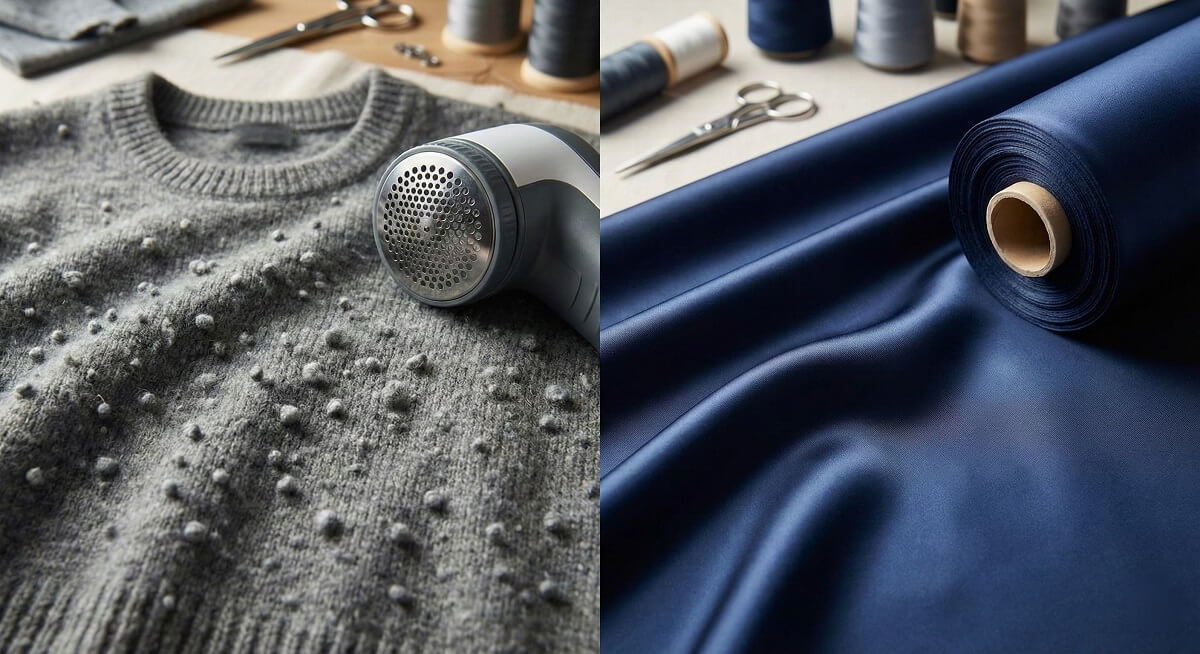
Fabrics with long, tightly twisted fibers hold up best against pilling. Silk, linen, denim, and long-staple cottons like Pima naturally shed loose fibers rather than forming those frustrating little balls. For synthetic options, nylon and treated anti-pill fleece perform well. If you’re also shopping for bedding, similar principles apply to that won’t deteriorate quickly.
On the flip side, acrylic, loose-knit wool blends, and cheap cotton-polyester mixes tend to pill aggressively. The good news: knowing what to look for when shopping—and how to care for your clothes—makes a real difference in how long they last.
Quick Guide: Pill-Resistant vs. Pill-Prone Fabrics
Best for Pilling Resistance
- Silk — Natural long continuous fiber
- Linen — Sheds rather than balls up
- Pima/Egyptian cotton — Extra-long staple fibers
- Denim — Tight twill weave
- Nylon — Smooth synthetic surface
- Anti-pill fleece — Specially treated
- Fine merino wool — Under 19.5 microns
Skip If You Hate Pilling
- Acrylic and acrylic blends
- Standard cotton-polyester blends
- Loosely knit wool
- Cheap untreated fleece
- Fabrics listing 3+ different materials
Why Do Some Fabrics Pill While Others Don’t?
Pilling happens when loose fibers work their way to the fabric surface, break off, and tangle into tiny balls. Three factors determine whether a fabric will pill:
Fiber length matters most. Short fibers have more ends that can break loose and tangle. Long fibers stay anchored in the fabric. That’s why silk—which can produce a single continuous thread measuring 300 to 1,500 meters from one cocoon—rarely pills at all.
Weave tightness plays a role too. Dense, tightly woven fabrics trap fibers in place. Loose knits leave more room for fibers to work free and rub against each other.
Fiber strength differences cause problems in blends. When you combine a strong fiber with a weaker one, the stronger fiber pulls the weaker one loose during wear. This is why cotton-polyester blends often pill more than either fabric alone.
Fabrics That Resist Pilling
Natural Fibers That Hold Up
Silk stands in a class by itself. Unlike cotton or wool, which are made from short staple fibers, silk is a continuous filament. A single silkworm cocoon produces an unbroken thread that can stretch over 1,000 meters. There simply aren’t loose fiber ends to break off and pill.
Linen handles friction differently than most fabrics. When linen fibers break, they shed cleanly away from the fabric rather than tangling into balls on the surface. This is why linen garments often look better after years of wear—they develop a soft patina without the fuzzy appearance of pilled fabric.
Pima and Egyptian cotton use extra-long staple fibers measuring 1.4 to 2 inches—roughly 50% longer than standard cotton. According to Cotton Incorporated, these longer fibers create smoother, stronger fabric that resists pilling. Pima cotton also tests about 30% stronger in tensile strength than regular cotton.
Denim earns its reputation for durability. The tight twill weave and heavy cotton yarn leave little room for loose fibers to escape. You’ll rarely see pills on a quality pair of jeans.
Synthetics That Won’t Fuzz
Nylon has a naturally smooth fiber surface that resists friction damage. It’s one of the strongest synthetic fibers available, which is why it shows up in that face heavy use.
Anti-pill fleece goes through a manufacturing treatment that locks fibers in place. Standard fleece is notorious for pilling, but treated versions hold up through repeated washing and wear. This matters especially for you’ll wear regularly. Look for “anti-pill” on the label—it’s not just marketing.
High-quality polyester with tight weaves performs well. The fiber itself is strong, so when it’s densely woven into performance fabrics, it resists the abrasion that causes pilling. Cheap, loosely constructed polyester is a different story.
Wool That Works
Merino wool quality depends heavily on fiber diameter, measured in microns. According to wool industry standards, ultrafine merino measures under 17.5 microns, while fine merino comes in under 19.5 microns. For comparison, human hair runs about 100 microns thick.
Finer fibers bend rather than break, which reduces pilling. Products certified by Woolmark undergo pilling resistance testing as part of their quality standards.
Cashmere does pill initially—even expensive cashmere. But unlike synthetic pills that stick around forever, cashmere pills eventually shed and the fabric stabilizes. Higher ply cashmere (2-ply or 4-ply) pills less than single-ply.
Fabrics to Avoid If You Hate Pilling
The Biggest Offenders
Acrylic tops the list for aggressive pilling. It’s often used as a cheap wool substitute in hats, scarves, and sweaters. The short synthetic fibers pill quickly and the pills cling to the fabric rather than shedding away.
Cotton-polyester blends combine two fibers with different strengths. Polyester is stronger than cotton, so it tends to pull cotton fibers loose over time. The result: pilling that’s tougher to remove than on pure cotton.
Cheap fleece without anti-pill treatment pills almost immediately. That cozy sweatshirt might feel great in the store but look worn after a few washes.
Loosely knit anything creates more surface area for friction and gives fibers room to work loose. A chunky-knit sweater might be trendy, but expect some maintenance.
Why Blends Can Be Tricky
Blended fabrics aren’t automatically bad—plenty perform well. The issue arises when different fibers wear at different rates. In a wool-acrylic blend, the acrylic pills while the wool doesn’t, creating an uneven mess.
Standard upland cotton accounts for nearly 90% of global cotton production. When it’s blended with synthetics to reduce cost, you often get the worst of both worlds.
Fabric Pilling Resistance Comparison
| Fabric Type | Pill Resistance | Best For | Price Range |
|---|---|---|---|
| Silk | Excellent | Sleepwear, blouses, scarves | $$$ |
| Linen | Excellent | Summer clothes, bedding | $$ |
| Pima Cotton | Very Good | T-shirts, basics, underwear | $$ |
| Denim | Excellent | Jeans, jackets | $-$$ |
| Nylon | Very Good | Activewear, leggings, swimwear | $-$$ |
| Anti-Pill Fleece | Very Good | Hoodies, blankets, jackets | $-$$ |
| Fine Merino Wool | Good | Sweaters, base layers | $$$ |
| Standard Cotton | Fair | Budget basics | $ |
| Cotton-Poly Blend | Fair | Budget basics (with trade-offs) | $ |
| Acrylic | Poor | Avoid for durability | $ |
How to Identify Pill-Resistant Fabrics Before Buying
Read the Label
Labels tell you more than you might think. Look for:
- 100% cotton, 100% polyester, linen, silk — Single-fiber fabrics often perform better than blends
- “Ring-spun” or “combed” cotton — Processing methods that remove short, weak fibers
- “Anti-pill” — Specifically treated for pilling resistance
- Woolmark certification — Quality-tested wool products
Be cautious with labels listing three or more different fiber types. Complex blends increase the chance of uneven wear.
Feel the Fabric
Run your hand over the material. Dense, tightly woven fabric feels sturdy and smooth. Loose knits show visible gaps when you stretch them. Quality fleece has a firm, even surface rather than fuzzy looseness.
Check Fabric Weight (GSM)
GSM stands for grams per square meter—a measure of fabric density. Heavier fabric generally resists pilling better:
- Under 200 GSM: Lightweight, more prone to pilling
- 200-350 GSM: Mid-weight, moderate durability
- 350+ GSM: Heavyweight, best pilling resistance
Premium hoodies and sweatshirts typically run 350 GSM or higher. Budget versions often come in around 200-280 GSM.
Care Tips to Prevent Pilling
Washing Best Practices
Most pilling happens in the wash. Proper make a noticeable difference. Here’s how to minimize it:
- Turn clothes inside out — Protects the visible surface from rubbing against other items
- Use cold water and a gentle cycle — Heat weakens fibers; agitation causes friction
- Wash similar fabrics together — Don’t mix delicate knits with jeans or towels
- Use liquid detergent — Less abrasive than powder formulas
- Don’t overload the machine — Crowded loads mean more friction
Drying Without Damage
Air drying is gentlest on fabric. If you use a dryer:
- Choose low heat settings
- Remove items promptly to reduce tumbling time
- Use dryer balls to separate items and reduce friction
Storage Matters
Fold knit items rather than hanging them—hangers can stretch fabric and create stress points. Proper helps too. Avoid overcrowded drawers where items rub against each other constantly.
How to Remove Pills When They Happen
Even careful maintenance won’t prevent all pilling. When it happens, these tools help:
Fabric Shavers
Electric fabric shavers remove pills quickly and safely. According to TODAY’s 2026 testing, top options include:
- Homeasy Electric Fabric Shaver — Features six blades, 3+ hour battery life, LED display with speed settings. Removes most pills in one pass.
- Conair Battery Operated Fabric Defuzzer — 2-inch head covers more ground, three depth settings for different fabric weights.
- Evercare Shaver — Budget option around $9, effective for smaller items like hats and scarves.
Manual Options
Sweater stones work well on delicate knits like cashmere. The porous surface catches and removes pills without cutting into the fabric.
Disposable razors can work in a pinch, but require a light touch. Press too hard and you risk cutting the fabric.
When to Remove vs. Replace
Light pilling on quality fabric is worth removing—the garment has plenty of life left. Heavy pilling combined with fabric thinning signals it’s time to move on. If you can see through the material or it feels weak when stretched, replacement makes more sense than maintenance.
Who Should Prioritize Pill-Resistant Fabrics
Worth the Investment If You:
- Don’t want to spend time maintaining clothes
- Travel frequently (suitcase friction accelerates pilling)
- Buy kids’ clothes (they get rougher wear)
- Prefer a capsule wardrobe with fewer, longer-lasting pieces
- Shop for loungewear and activewear you’ll wear constantly
Less Critical If You:
- Don’t mind occasional de-pilling
- Need to prioritize budget over longevity
- Buy items for occasional or single-season use
Frequently Asked Questions
Does expensive clothing pill less?
Not automatically. Price doesn’t guarantee quality—plenty of expensive garments use pill-prone materials. Check the fiber content and construction rather than assuming cost equals durability.
Is pilling a sign of bad quality?
Not necessarily. Even premium materials like cashmere pill initially. The difference is whether pills shed naturally over time (quality fabrics) or accumulate permanently (cheap synthetics).
Does cotton pill?
Standard cotton can pill, especially budget varieties with short fibers. Ring-spun cotton, combed cotton, and long-staple Pima cotton resist pilling much better.
What’s the best fabric for hoodies that won’t pill?
Anti-pill fleece or heavyweight French terry (350+ GSM). Both combine warmth with good pilling resistance. Check our for specific brand recommendations, and look for anti-pill treatment on the label.
Does silk ever pill?
Rarely. Silk’s continuous filament structure—a single thread can measure over 1,000 meters—means there are few loose fiber ends to form pills.
Can you prevent pilling completely?
No fabric is 100% pill-proof forever. But choosing the right materials and caring for them properly reduces pilling significantly.
Is polyester pill-resistant?
High-quality, tightly woven polyester resists pilling well. Cheap, loosely constructed polyester does not. The fiber matters less than the fabric construction.
What causes the worst pilling?
The combination of weak or short fibers with heavy friction. Acrylic is the biggest offender—its short synthetic fibers pill aggressively and the pills cling permanently.
Bottom Line
Finding clothes that hold up starts with knowing what to look for. Prioritize silk, linen, Pima cotton, and treated synthetics when durability matters. Read labels, feel the fabric weight, and don’t assume price equals quality.
For everyday basics, check current selections of anti-pill fleece and Pima cotton items at major retailers like Amazon, Target, or Nordstrom.
