


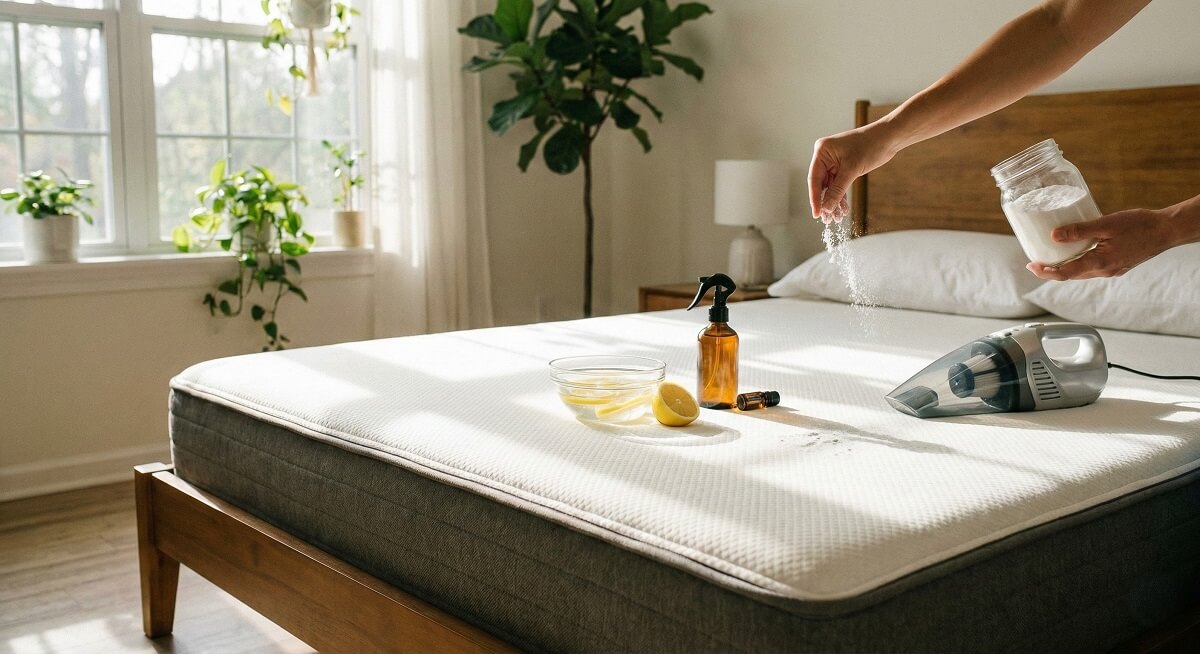
Here’s the short version: baking soda is the most effective DIY solution for most mattress odors. Sprinkle it on, wait 30 minutes to overnight, vacuum it up. For stubborn smells like urine or pet accidents, you’ll need an enzyme cleaner instead — vinegar alone won’t cut it for those.
Why does your mattress smell in the first place? Memory foam and innerspring mattresses both absorb sweat, body oils, and spills over time. The good news is that most odors can be eliminated with common household items you probably already have. The not-so-good news: if you’re dealing with visible mold or a mattress that’s seen better days (8-10+ years old), cleaning might not be enough.
This guide covers 5 proven cleaning methods, specific solutions for different odor types, professional cleaning costs, and prevention tips to keep your mattress fresh longer. If you’re also dealing with bedroom odors beyond just the mattress, check out our for more tips.
Who Should Use These Methods (And Who Shouldn’t)
These Methods Work Best For:
- Sweat and general body odor buildup
- Pet accidents (using enzyme cleaners)
- Musty or dusty smells from lack of cleaning
- Spill residue that’s left a lingering scent
- New mattress “chemical” smell (off-gassing)
You May Need Professional Help or Replacement If:
- Visible mold or mildew is growing on or inside the mattress
- Deep stains that won’t lift after multiple treatments
- Your mattress is 8+ years old with persistent odor
- You’re experiencing allergic reactions when sleeping
Why Your Mattress Smells (And Why It Matters)
Your mattress absorbs more than you might think. The average person sweats about 26 gallons per year — and a good chunk of that happens while you sleep. Add in body oils, dead skin cells (which dust mites love to eat), pet dander, and the occasional spill, and you’ve got a recipe for odors.
Here’s what typically causes mattress odors:
- Sweat and body oils — These seep through sheets and into mattress layers, feeding bacteria that produce odor
- Dust mites — These microscopic creatures thrive in mattresses and their waste products smell
- Pet accidents — Urine contains uric acid crystals that standard cleaners can’t break down
- Poor ventilation — Trapped moisture encourages mold and mildew growth
- Off-gassing — New mattresses release volatile organic compounds (VOCs) from manufacturing
Speaking of off-gassing: according to Consumer Reports, VOC fumes can trigger allergic reactions and other health issues with extended exposure. Most new mattress smells dissipate within 3-7 days, with the bulk of VOC emission happening in the first hour according to Tom’s Guide. Opening windows and running a fan speeds this up considerably.
5 Proven Methods to Deodorize Your Mattress
Method 1: Baking Soda (Best for General Odors)
Baking soda is the go-to solution for a reason. It’s cheap, safe, and actually works. The science: baking soda is amphoteric, meaning it neutralizes both acidic odors (like sweat) and alkaline odors (like fish or certain foods). According to McGill University’s Office for Science and Society, this chemical property allows it to react with most odor-causing compounds. Research has shown it can reduce odors by approximately 70% when used properly.
What you need:
- 1 cup baking soda (more for king-size mattresses)
- Flour sifter or fine mesh strainer
- Vacuum with upholstery attachment
Steps:
- Strip all bedding and wash it while you work on the mattress
- Vacuum the mattress surface to remove loose debris
- Sift baking soda evenly over the entire surface
- Let it sit for 30 minutes minimum — overnight for strong odors
- Vacuum thoroughly, including seams and edges
Time required: 1-8 hours
Cost: $1-2
Method 2: Vinegar Solution (Best for Bacteria and Light Stains)
White vinegar kills bacteria and neutralizes odors through its acetic acid content. The catch? It smells pretty strong itself at first. Don’t worry — the vinegar smell dissipates as it dries, usually within 2-4 hours with good ventilation.
What you need:
- White distilled vinegar
- Water
- Spray bottle
- Clean towels
Steps:
- Mix equal parts vinegar and water in a spray bottle
- Lightly mist the mattress — don’t soak it
- Open windows or use a fan for ventilation
- Allow to air dry completely (2-4 hours)
- Follow up with baking soda if vinegar smell lingers
Time required: 3-6 hours including drying
Cost: $2-3
Method 3: Enzyme Cleaners (Best for Urine and Pet Odors)
Here’s something important: regular cleaning products — including vinegar — don’t fully eliminate pet urine odors. That’s because pet urine contains uric acid crystals that standard cleaners can’t break down. Enzyme cleaners contain natural bacteria that feed on these crystals until they’re completely gone.
Even more important: if you use vinegar on pet urine, the lingering scent can actually cause pets to re-mark the same spot. Enzyme cleaners eliminate the odor completely, preventing this cycle.
Top enzyme cleaner options (based on testing by Good Housekeeping and Family Handyman):
- Nature’s Miracle — Around $12 for 32 oz. Best budget option, works well for dog urine
- Rocco & Roxie — Around $20 for 32 oz. Premium option with Carpet and Rug Institute certification, especially effective for cat urine
Steps:
- Blot fresh accidents immediately — don’t rub
- Apply enzyme cleaner according to product instructions
- Let sit for the recommended time (usually 10-15 minutes)
- Blot excess moisture
- Allow to air dry completely
Time required: 30 minutes + drying time
Cost: $10-25 per bottle
Method 4: Essential Oils + Baking Soda (Best for Adding Freshness)
Essential oils don’t just smell nice — many have antibacterial properties that help keep your mattress fresh. This method combines the odor-neutralizing power of baking soda with a pleasant scent that can promote better sleep.
What you need:
- 1 cup baking soda
- 10-15 drops essential oil
- Bowl for mixing
- Vacuum
Best oils for mattresses:
- Lavender — Calming properties, antibacterial
- Tea tree — Strong antimicrobial properties
- Eucalyptus — Fresh scent, natural decongestant
- Lemon — Bright, clean scent
Caution: Essential oils can be toxic to pets. Keep animals away during treatment and vacuum thoroughly before allowing them back on the bed.
Time required: 3-6 hours
Cost: $3-8
Method 5: Activated Charcoal (Best for Persistent Odors)
Activated charcoal has millions of tiny pores that trap odor molecules. It’s slower than baking soda but works well for deep-set odors that other methods haven’t fully eliminated.
What you need:
- Activated charcoal packets or loose charcoal in containers
- Breathable sheet to cover mattress
Steps:
- Place charcoal packets on mattress surface
- Cover with a breathable sheet
- Leave for 24-48 hours
- Remove charcoal and vacuum any residue
Time required: 24-48 hours
Cost: $8-15 for reusable packets
Quick Comparison: Which Method to Use
| Method | Best For | Time Needed | Cost | Effectiveness |
|---|---|---|---|---|
| Baking soda | General odors, sweat | 1-8 hours | $1-2 | High |
| Vinegar solution | Bacteria, light stains | 3-6 hours | $2-3 | Medium |
| Enzyme cleaner | Urine, pet accidents | 30 min + dry | $10-25 | Very High |
| Essential oils + baking soda | Freshening, light odors | 3-6 hours | $3-8 | Medium |
| Activated charcoal | Persistent, deep odors | 24-48 hours | $8-15 | High |
Tackling Specific Odor Types
New Mattress Smell (Off-Gassing)
That “new mattress smell” is actually VOCs being released from manufacturing materials. It’s normal for memory foam and hybrid mattresses. Most off-gassing completes within 3-7 days, though some lower-quality mattresses may take up to 2 weeks.
Speed it up by:
- Placing mattress in a well-ventilated room
- Opening windows and running fans
- Exposing to direct sunlight if possible (accelerates VOC release)
Look for CertiPUR-US certification when buying a new mattress — it means the foam was made without formaldehyde, phthalates, and other harmful chemicals.
Urine Odors (Human or Pet)
Act fast if you can — fresh urine is easier to treat than dried. For pet urine specifically, skip the vinegar and go straight to an enzyme cleaner. Set-in stains may need multiple applications.
After treating a urine accident, consider adding a to prevent future incidents from reaching the mattress.
Mold or Mildew Smell
This is the one odor type where DIY cleaning has limits. Surface mold can sometimes be treated with a vinegar solution and thorough drying. But if mold has grown inside the mattress — indicated by a persistent musty smell that won’t go away — it’s time for a replacement. Mold inside a mattress is a health hazard that cleaning can’t fix.
To prevent mold: address humidity sources in your bedroom and ensure your mattress has proper ventilation underneath (slatted bed frames work better than solid platforms).
When DIY Methods Won’t Work
Signs You Need Professional Cleaning
- Odor returns within days despite repeated treatments
- Deep staining that multiple cleaning attempts haven’t lifted
- Allergic symptoms continue even after cleaning
- Mattress feels damp or cool in spots (indicates trapped moisture)
What Professional Cleaning Costs
According to Angi’s 2026 cost guide, professional mattress cleaning costs $130 on average. Here’s the breakdown:
- Basic cleaning: $80-$130
- Deep cleaning: $130-$200
- Memory foam (requires specialized equipment): $150-$200
- By size: Twin ~$50, Queen ~$100-150, King ~$120
Professional cleaning includes deep extraction, sanitization, and deodorizing that DIY methods can’t match. It’s worth the investment for a mattress you want to keep using but can’t get fresh on your own.
When to Replace Instead
According to the Sleep Foundation, most mattresses last 7-10 years. Here’s how different types compare:
- Memory foam: 7-10 years
- Latex: 8-12+ years
- Hybrid: 6-10 years
- Innerspring: 5-8 years
Consider replacement if your mattress is past its expected lifespan, has visible sagging or structural damage, or the cost of professional cleaning approaches what you’d spend on a new mattress.
How to Prevent Mattress Odors
Use a Mattress Protector
A waterproof mattress protector is the single most effective way to prevent odors from reaching your mattress in the first place. They block sweat, spills, and accidents from soaking into the mattress layers.
Current prices on Amazon:
- Budget options: $23-$40 (BEDLORE, generic brands)
- Mid-range: $40-$50 (SafeRest, SureGuard)
- Premium: $100-$170 (Coop Home Goods, Whisper Organics)
Wash your protector monthly — it’s much easier than cleaning the mattress itself.
Wash Bedding Weekly
Your sheets are the first line of defense. Washing them in hot water weekly removes sweat, body oils, and dust mites before they can transfer to the mattress. If you’re dealing with stubborn sheet odors too, our covers how to get them truly fresh.
Improve Ventilation
- Don’t make your bed immediately after waking — let it air out for 15-30 minutes
- Use a bed frame with slats rather than a solid platform
- Keep bedroom humidity below 50% to discourage mold growth — a can help in humid climates
Regular Maintenance
- Vacuum your mattress monthly with an upholstery attachment
- Rotate your mattress every 3-6 months for even wear
- Do a baking soda treatment every 3-6 months as preventive maintenance
Frequently Asked Questions
How do I deodorize a mattress quickly?
Baking soda is the fastest DIY method. Sprinkle it on, wait 30 minutes minimum, and vacuum. For immediate results, a commercial mattress spray can mask odors while you do a deeper cleaning later — but sprays don’t address the source of the smell.
Why does my mattress smell even though it looks clean?
Odors live below the surface. Sweat, body oils, and bacteria accumulate in mattress layers over time. Surface cleaning doesn’t reach these trapped sources — that’s why absorption methods like baking soda and charcoal work better than surface sprays.
Can I use bleach to clean my mattress?
No. Bleach can damage mattress materials, void your warranty, and leave harmful residue where you sleep. Stick to vinegar, baking soda, or enzyme cleaners.
How often should I deodorize my mattress?
Every 3-6 months for general freshening. More frequently if you sweat heavily, have pets on the bed, or live in a humid climate.
Will the vinegar smell go away?
Yes. Vinegar smell dissipates as it dries, usually within 2-4 hours with good ventilation. If it lingers, a baking soda treatment will absorb the remaining odor.
How do I know if my mattress has mold?
Look for dark spots (green, black, or brown), a persistent musty smell that doesn’t go away after cleaning, and allergic symptoms (sneezing, congestion, itchy eyes) when you’re in bed. If you suspect mold inside the mattress, replacement is the safest option. For general mold concerns in your home, check our .
Can I put my mattress in the sun to remove odors?
Yes — sunlight is a natural deodorizer and disinfectant. UV rays help kill bacteria while heat accelerates moisture evaporation. Just don’t leave it out longer than 3-4 hours, as prolonged exposure can damage some mattress materials.
Do mattress sprays actually work?
They can mask odors temporarily but don’t address the source. Use them as a quick fix between deeper cleaning treatments, not as a replacement for actual deodorizing methods.
A fresh-smelling mattress makes a real difference in sleep quality. Most odors can be handled with items you already have at home — baking soda for general freshening, enzyme cleaners for pet accidents, and a mattress protector to prevent future issues. Start with the method that matches your odor type, and you’ll be sleeping better in no time.
For more bedroom and home care tips, browse our or check current mattress protector prices on Amazon.
