


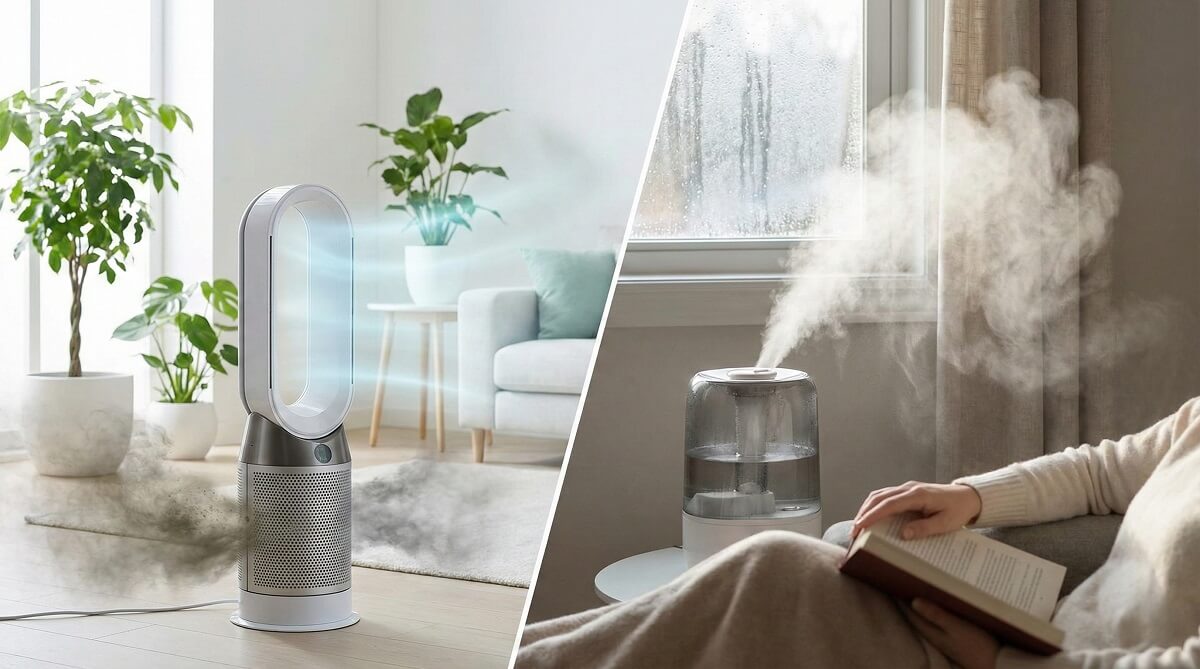
Air purifiers and humidifiers serve completely different purposes, and choosing between them comes down to what problem you’re trying to solve. An air purifier removes allergens, dust, smoke, and other airborne pollutants by filtering the air through HEPA or carbon filters. A humidifier adds moisture to dry indoor air, which helps with dry skin, sinus irritation, and static electricity.
If you’re dealing with allergies, asthma, pet dander, or smoke, you need an air purifier. If you’re struggling with dry skin, chapped lips, or stuffy sinuses during winter, a humidifier is the answer. Many homes benefit from both, especially during cold months when heating systems dry out the air while also trapping indoor pollutants. Air purifiers typically cost $60-$800 depending on features, while humidifiers range from $30-$150 for portable models. Both run about $3-5 per month in electricity. For more guidance on improving your indoor environment, check our .
Who Should Choose an Air Purifier vs. Humidifier
✅ Choose an Air Purifier If:
- You have allergies or asthma triggered by dust, pollen, or pet dander
- You live with pets or smokers
- You’re in an area affected by wildfire smoke or high pollution
- You want to reduce mold spores, bacteria, or viruses
- You’re sensitive to odors or VOCs from cleaning products or furniture
✅ Choose a Humidifier If:
- Your home feels dry, especially in winter
- You wake up with a dry throat or bloody nose
- You have dry, itchy skin or chapped lips
- Your sinuses feel congested from dryness (not allergies)
- You notice static electricity or cracking wood furniture
✅ Consider Both If:
- You run heating or AC systems that dry out air AND trap pollutants
- You have young children or babies who need clean, comfortable air
- You live in a climate with cold, dry winters and seasonal allergies
What Each Device Actually Does (The Core Difference)
How Air Purifiers Work
Air purifiers pull air through filters to trap particles and pollutants. The most common type uses HEPA (High-Efficiency Particulate Air) filters, which capture 99.97% of particles 0.3 microns or larger according to EPA standards. This includes bacteria (0.2-2.0 microns), viruses (0.02-0.3 microns), dust mites, pollen, pet dander, and mold spores.
Many models also include activated carbon filters that absorb odors, smoke, and volatile organic compounds (VOCs) from cleaning products, paint, and off-gassing furniture. Air purifiers don’t add or remove moisture from the air—they only filter what’s already there. For optimal results, they run continuously in the background.
How Humidifiers Work
Humidifiers add water vapor to increase indoor humidity levels. There are three main types: ultrasonic models use high-frequency vibrations to create a cool mist, evaporative models blow air through a wet wick, and steam vaporizers boil water to produce warm vapor.
The EPA recommends maintaining indoor humidity between 30-50% for comfort and health. Below 30%, you’ll notice dry skin, irritated nasal passages, and static electricity. Above 60%, you risk mold growth and dust mite proliferation. Humidifiers don’t filter or clean the air—they only adjust moisture levels.
Key Differences at a Glance
| Feature | Air Purifier | Humidifier |
|---|---|---|
| Primary Function | Removes airborne particles and pollutants | Adds moisture to dry air |
| Helps With | Allergies, asthma, smoke, odors, mold spores | Dry skin, sinus dryness, static, chapped lips |
| Filter Type | HEPA, carbon, UV (depending on model) | None (may have wick or mineral filter) |
| Maintenance | Replace filters every 6-12 months | Clean weekly, use distilled water |
| Effect on Humidity | None | Increases humidity 10-30% |
| Typical Cost | $60-$800 (most $99-$400) | $30-$150 portable models |
| Operating Cost/Month | $3-5 (electricity + filters) | $3-4 (electricity + distilled water) |
| Noise Level | 22-60 dB (quietest to high speed) | 25-45 dB (varies by type) |
When to Use an Air Purifier vs. a Humidifier
For Allergies and Asthma
Air purifier wins. HEPA filters remove allergens like pollen, dust mites, pet dander, and mold spores that trigger allergic reactions and asthma attacks. Humidifiers can actually make allergies worse—humidity above 50-60% promotes dust mite survival and mold growth, both common allergens.
If dry air irritates your already-inflamed nasal passages, you might benefit from both devices. The air purifier removes the triggers while the humidifier (kept at proper levels) prevents additional dryness irritation.
For Babies and Young Children
Both have benefits. Air purifiers remove irritants and pollutants, creating cleaner air for developing lungs. They filter out pet dander, pollen, mold spores, and VOCs from plastics, paints, and furniture—all potential respiratory irritants for babies.
Humidifiers prevent dry nasal passages and make breathing easier during colds. The FDA notes that cool mist humidifiers can help infants with cough and cold symptoms by keeping airways moist. However, avoid warm mist models in nurseries—they can cause nasal passages to swell and pose a burn risk if tipped over.
Many parents use both: an air purifier running continuously for baseline air quality, plus a humidifier during dry winter months or when the baby has a cold. For more nursery tips, see our .
For Dry Skin and Sinus Issues
Humidifier wins. Dry air pulls moisture from skin and mucous membranes, leading to itchy skin, chapped lips, and irritated sinuses. Adding humidity provides relief within hours by restoring moisture to the air. Aim for 40-50% relative humidity for maximum comfort.
Air purifiers don’t address dryness, but they can help if your sinus issues stem from allergens rather than dry air. If you wake up congested every morning, try a humidifier first. If congestion varies with pollen seasons or follows exposure to pets, an air purifier will be more effective.
For Smoke, Odors, and VOCs
Air purifier wins. Activated carbon filters absorb smoke particles and chemical odors from cooking, cleaning products, new furniture, and paint. HEPA filters capture the solid particles in smoke, while carbon handles the gaseous compounds.
Humidifiers have no effect on airborne pollutants or odors. If you’re dealing with lingering cooking smells, tobacco smoke, or that “new furniture” chemical smell, only an air purifier with a carbon filter will help.
For Winter Heating System Dryness
Humidifier wins. Furnaces and electric heaters can drop indoor humidity below 20%, well under the EPA-recommended 30-50% range. This causes dry skin, irritated throats, and increased static electricity. A humidifier restores comfortable moisture levels.
Bonus: Properly humidified air feels warmer than dry air at the same temperature, potentially allowing you to lower your thermostat by 2-3 degrees and save on heating costs.
For Respiratory Infections (Colds, Flu)
Humidifier helps symptoms; air purifier prevents spread. Humidifiers ease dry throat and nasal congestion, making you more comfortable while sick. Research published by the NIH shows that low humidity (below 23%) allows influenza viruses to retain 70-77% infectivity after 60 minutes, while higher humidity (above 43%) reduces this to just 14-22%.
Air purifiers with HEPA filters can trap some airborne viruses and bacteria, potentially reducing transmission between family members. The combination of both—maintaining 40-60% humidity to reduce viral survival plus filtering the air—provides the most protection during cold and flu season.
Can You Use Both Together? (And Should You?)
Yes, air purifiers and humidifiers work well together because they serve different functions. One cleans the air; the other adds moisture. Using both is especially beneficial during winter when heating systems dry out the air while sealed homes trap pollutants.
Placement Tips for Using Both
- Keep devices on opposite sides of the room for optimal air circulation
- Don’t point humidifier mist at air purifier intake—excessive moisture can clog filters and promote mold growth on filter media
- Maintain 30-50% humidity using a hygrometer to monitor levels
- Run air purifier continuously for consistent air cleaning; use humidifier as needed based on humidity readings and comfort
Potential Issues to Avoid
Clogged filters: If a HEPA filter gets consistently damp from humidifier mist, it can develop mold and bacteria. This defeats the purpose of the air purifier and can actually worsen air quality. Maintain distance between devices.
Over-humidification: Humidity above 60% encourages dust mites and mold growth. Both are common allergens that can trigger respiratory issues. If you notice condensation on windows or walls, reduce humidifier output immediately.
Maintenance neglect: Dirty humidifiers can release mold spores and bacteria into the air. Clogged air purifier filters lose effectiveness and can’t remove pollutants. Clean your humidifier weekly and replace air purifier filters every 6-12 months.
How to Choose the Right Air Purifier or Humidifier
Air Purifier Buying Guide
Room size matching: Check the CADR (Clean Air Delivery Rate) rating, which measures how quickly a purifier can clean the air in a specific room size. For a 300 sq ft bedroom, look for a CADR of at least 200. Undersized units won’t effectively filter the air.
Filter type: HEPA filters remove particles; activated carbon removes odors and gases. Combination models with both filter types handle the widest range of pollutants. Some units add UV lights to kill bacteria and viruses, though HEPA filtration alone captures most pathogens. For more on choosing home , explore our guides.
Noise level: For bedrooms, look for models operating below 30 dB on low settings—quieter than a whisper. Models like the Coway AP-1512HH Mighty (24.4 dB), Alen BreatheSmart 45i (23 dB), and Levoit models (25 dB) are among the quietest available.
Running costs: Calculate both electricity and filter replacement costs. Most air purifiers use 30-100 watts, costing $3-5 per month in electricity when run 24/7. HEPA filters need replacing every 6-12 months ($50-$200), while carbon filters last 3-6 months (up to $50). Total annual cost typically runs $120-$250.
Smart features: Air quality sensors automatically adjust fan speed based on detected pollution levels. App control lets you monitor air quality remotely and schedule operation. These features add $50-$200 to the price but can improve efficiency.
Top picks for 2026: The Coway Airmega AP-1512HH Mighty offers the best balance of performance, quiet operation, and value. For larger rooms, the Coway Airmega ProX delivers premium performance but costs over $800. Budget-conscious buyers should consider the Levoit Core 300 (around $99) or AirFanta 3Pro ($150) for reliable HEPA filtration. Check current prices on Amazon’s best-sellers list.
Humidifier Buying Guide
Coverage area: Match the humidifier’s output (measured in gallons per day) to your room size. Small bedroom units typically cover 200-400 sq ft, while large models handle 600-1,000+ sq ft. Undersized humidifiers won’t effectively raise humidity in large spaces.
Mist type: Cool mist ultrasonic and evaporative models are safest for children and pets—no hot water to spill. Warm mist vaporizers feel soothing but use more energy (3.6-7.2 kWh per day vs. 0.24-2.28 kWh for ultrasonic models) and pose burn risks. Ultrasonic models are quietest at 25-35 dB.
Tank capacity: Larger tanks (1+ gallon) mean less frequent refilling. If you run a humidifier all night, look for at least a 1-gallon tank to avoid midnight refills. Some models run 24+ hours on a single fill.
Auto shut-off: Essential safety feature that prevents the humidifier from running dry and burning out the motor. Most modern units include this.
Built-in humidistat: Automatically maintains your target humidity level (usually 40-50%) without over-humidifying. Models without this feature require manual monitoring with a separate hygrometer.
Top picks for 2026: Budget shoppers will find quality options under $50, including the Levoit Dual 150 (~$40) and various Honeywell mini models. Mid-range options like Crane’s Drop Cool-Mist Humidifier ($60) offer solid performance and reliability. For premium features, Canopy ($90+) and Blueair ($150+) models include app control and auto-adjust functionality.
Operating Costs: What You’ll Actually Spend
Air Purifier Costs
| Cost Type | Amount | Frequency |
|---|---|---|
| Initial purchase | $60-$800 (most $99-$400) | One-time |
| HEPA filter replacement | $50-$200 | Every 6-12 months |
| Carbon filter replacement | $30-$50 | Every 3-6 months |
| Electricity (24/7 operation) | $3-5/month ($36-60/year) | Monthly |
| Total 3-year cost | $400-$1,200 | Purchase + filters + electricity |
ENERGY STAR certified models save approximately $19 annually in electricity costs compared to standard units. High-pollution areas, wildfire smoke, heavy pollen seasons, and households with pets or smokers will wear filters faster, increasing replacement costs.
Humidifier Costs
| Cost Type | Amount | Frequency |
|---|---|---|
| Initial purchase (portable) | $30-$150 | One-time |
| Distilled water (recommended) | $5-10/month | Monthly (optional but recommended) |
| Cleaning supplies (vinegar) | $3-5/month | As needed |
| Electricity (ultrasonic model) | $2-3/month | Monthly |
| Electricity (steam vaporizer) | $8-12/month | Monthly |
| Total 3-year cost (ultrasonic) | $250-$450 | Purchase + water + electricity + cleaning |
Ultrasonic humidifiers are significantly more energy-efficient than steam vaporizers, using 0.24-2.28 kWh per day compared to 3.6-7.2 kWh for steam models. Using distilled water is recommended for ultrasonic models to prevent mineral deposits and “white dust” from being released into the air.
Common Mistakes to Avoid
With Air Purifiers:
- Running only when you remember: Air purifiers work best when run continuously. Turning them on for a few hours here and there won’t effectively reduce allergen and pollutant levels.
- Ignoring filter replacement schedules: Clogged filters reduce effectiveness and can harbor mold and bacteria. Check your filter indicator light or set calendar reminders for replacement.
- Buying undersized units: A purifier rated for 200 sq ft won’t effectively clean a 400 sq ft room. Check CADR ratings and match them to your actual room size.
- Placing near walls: Air purifiers need space for airflow. Place them at least 6-12 inches from walls and furniture for optimal circulation.
With Humidifiers:
- Using tap water in ultrasonic models: Minerals in tap water get dispersed as “white dust” that settles on surfaces and may irritate lungs. Use distilled water instead.
- Over-humidifying beyond 50-60%: High humidity promotes mold and dust mites. Use a hygrometer to monitor levels and adjust output accordingly.
- Neglecting weekly cleaning: Humidifiers develop mold and bacteria quickly. Empty daily, rinse with white vinegar weekly, and deep clean monthly.
- Placing too close to electronics or wood furniture: Excess moisture can damage electronics and cause wood to warp. Keep humidifiers at least 3 feet away from vulnerable items.
Frequently Asked Questions
Does an air purifier remove humidity from the air?
No. Air purifiers only filter particles and don’t affect moisture levels. The fan may create a slight drying sensation from airflow, but relative humidity stays the same. If you need to reduce humidity, you need a dehumidifier, not an air purifier.
Does a humidifier clean the air?
No. Humidifiers only add moisture to the air. While increased humidity can help some particles settle faster, allergens and pollutants remain in your home. Use an air purifier if you want to remove contaminants from the air.
Can you run an air purifier and humidifier in the same room?
Yes, they work well together. Keep them on opposite sides of the room and avoid pointing humidifier mist directly at the air purifier intake. Excess moisture can clog HEPA filters and reduce effectiveness. Monitor humidity with a hygrometer and keep it between 30-50%.
Which is better for congestion—air purifier or humidifier?
It depends on the cause. If congestion comes from dry air (common in winter with heating systems), a humidifier will provide quick relief. If it’s from allergies or irritants (pollen, pet dander, dust), an air purifier is more effective. Many people benefit from both.
What humidity level is best for your home?
The EPA recommends maintaining indoor humidity between 30-50%. Below 30% causes dry skin and respiratory irritation. Above 60% promotes mold growth and dust mites. Aim for 40-50% for optimal comfort and health. Use a hygrometer to monitor levels—they’re available for $10-20 at most hardware stores.
Do air purifiers help with mold?
Yes, HEPA filters trap mold spores floating in the air, preventing them from being inhaled or spreading to new areas. However, air purifiers don’t remove mold growing on surfaces (walls, ceilings, etc.). Address moisture problems causing the mold and clean visible growth separately. The air purifier prevents spores from becoming airborne during cleanup. For more home maintenance advice, see our .
Can humidifiers make allergies worse?
Yes, if humidity exceeds 50-60%. High humidity increases dust mite populations and mold growth—both common allergens. Dust mites thrive in humidity above 50%, while mold grows readily above 60%. Monitor with a hygrometer and keep humidity in the 30-50% range to avoid this problem.
How often should you clean a humidifier?
Clean your humidifier at least once a week to prevent mold and bacteria buildup. Empty the tank daily, rinse with white vinegar weekly, and perform a deep clean monthly. Neglected humidifiers can release harmful microorganisms into the air, potentially causing respiratory infections.
Bottom Line: Which One Do You Need?
For most households, an air purifier provides year-round benefits by removing allergens, dust, and pollutants that accumulate indoors. Models like the Coway AP-1512HH Mighty or budget-friendly Levoit Core 300 run quietly in the background, filtering the air continuously without needing daily attention beyond occasional filter changes.
A humidifier is a seasonal tool for combating dry winter air when heating systems drop humidity below comfortable levels. If you wake up with a dry throat every morning from November through March, a $40-60 humidifier will solve the problem for just a few dollars per month in operating costs.
If you have allergies, asthma, or pets, prioritize an air purifier—it addresses the root cause of respiratory irritation by removing triggers from the air. If winter dryness is your main complaint, start with a humidifier and add an air purifier later if needed. And if you deal with both issues, using both devices together gives you clean, comfortable air all year. Browse more to find the right fit for your needs.
Check current prices and user reviews on Amazon or compare models at Best Buy to find the right fit for your home.
