


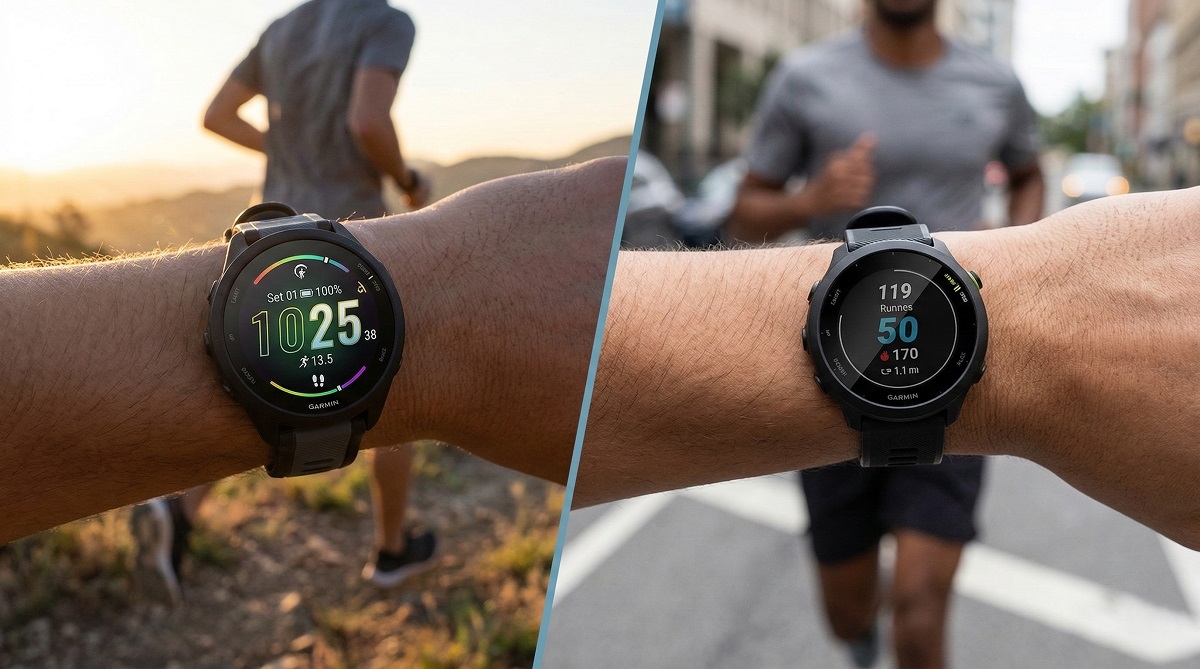
The Garmin Forerunner 165 is the better choice for most runners who can spend around $225. You get a bright AMOLED display, elevation tracking, and navigation features that make the $50-75 premium over the Forerunner 55 worthwhile. The 55 remains a solid option if you’re on a tight budget or simply want a no-frills GPS watch that tracks runs accurately and lasts two weeks on a charge.
The real question isn’t which watch has more features—the 165 clearly wins there. It’s whether those extras matter for your running. If you hit trails with hills, run in unfamiliar places, or want detailed training metrics, the 165 makes sense. If you stick to familiar flat routes and only care about time, distance, and pace, the 55 gets the job done for less money.
As of February 2026, the Forerunner 165 runs about $225 on Amazon (down from $249 MSRP), while the 55 frequently sells for $149-157—historically low pricing that makes both watches solid values.
Quick Decision Guide: Which Watch For You?
✅ Choose the Forerunner 165 if:
- You want a vibrant, colorful AMOLED display that’s easy to read in any light
- You run trails or hilly routes and need elevation tracking
- Navigation features matter (back to start, course guidance, breadcrumb trail)
- You want music storage for phone-free runs (Music edition)
- You value advanced health metrics like Pulse Ox, sleep scores, and nap detection
- You need running dynamics (cadence, stride length, ground contact time)
✅ Choose the Forerunner 55 if:
- You want the longest possible battery life (14 days vs 11)
- You prefer a simpler, less expensive watch without extra features
- You’re a beginner who only needs basic run tracking
- You run mostly flat routes where elevation doesn’t matter
- You’re happy with time, distance, pace, and heart rate—nothing more
- You want to save $75+ for running shoes or other gear
Price Comparison: What You’ll Actually Pay
List prices don’t tell the whole story. Both watches are frequently discounted, and the gap between them narrows considerably when sales hit.
Official retail pricing:
- Forerunner 55: $199.99 MSRP
- Forerunner 165: $249.99 MSRP
- Forerunner 165 Music: $299.99 MSRP
As of February 2026, actual street prices look different. The Forerunner 55 is widely available for $149 on Amazon (a 29% discount), with Best Buy and Walmart pricing it around $157-168. The Forerunner 165 sits at $225-226 across major retailers, down about 10% from list price.
That puts the real-world price difference at roughly $75, not the $50 gap suggested by MSRP. Still worthwhile for the feature upgrades, but worth knowing if you’re budget-conscious.
Garmin offers a 20% student discount through and military discounts through . Both watches appear to qualify, with a limit of 2 devices per verified member.
Display and Design: AMOLED vs MIP
The Screen Makes All the Difference
This is the single biggest hardware difference between these watches. The Forerunner 165 features a 1.2-inch AMOLED display with 390×390 pixel resolution. It’s bright, colorful, and easily readable even in direct sunlight. The touchscreen responds quickly, and you can still use traditional five-button controls if you prefer.
The Forerunner 55 uses a 1.04-inch transflective memory-in-pixel (MIP) display at 208×208 resolution. Think of it as a color version of an E Ink display. It’s readable outdoors without a backlight, but the colors are muted and the overall experience feels dated compared to modern smartwatch screens. There’s no touchscreen—buttons only.
In real-world use, the AMOLED display on the 165 makes checking your stats mid-run much easier. Glancing at your pace or heart rate zone is instant and clear. The 55 requires more focus to read the display, especially if you’re moving fast or dealing with motion blur.
Size and Weight
Both watches are lightweight and comfortable for all-day wear. The Forerunner 55 weighs 37g and measures 42 x 42 x 11.6mm. The Forerunner 165 is marginally larger at 39g and 43 x 43 x 11.6mm. That 2-gram difference is imperceptible on your wrist.
Neither watch feels bulky or gets in the way during runs. They’re both sized to fit small to average wrists comfortably (126-203mm circumference). Garmin doesn’t offer size options at this price point—you get one size that works for most people.
GPS Accuracy: How They Track Your Runs
Both watches use single-frequency GPS without the multiband (dual-frequency) technology found in higher-end models like the Forerunner 265. For typical running, that’s perfectly fine.
The Forerunner 165 supports GPS, GLONASS, and Galileo satellite systems. The Forerunner 55 supports GPS only. In practice, the multi-GNSS support on the 165 helps in challenging conditions—dense trees, urban canyons, tall buildings—but the difference isn’t dramatic for road running in open areas.
Independent testing found the Forerunner 165 tracked within hundredths of a mile on known-distance loops. The Forerunner 55 typically shows 2-3% variance compared to measured routes, with occasional fluctuations in heavily wooded areas. Both are accurate enough that you won’t question your distance or pace data.
For context, even the best GPS watches sometimes disagree with each other by 0.1-0.2 miles on a 5-mile run. Unless you’re pacing for an exact race time or running track intervals, the difference between these two GPS chipsets won’t affect your training.
Running Features: Where the 165 Pulls Ahead
Training Tools and Metrics
Both watches offer Garmin Coach training plans and daily suggested workouts to guide your running. The Forerunner 165 adds several features that matter for intermediate runners.
Running Dynamics: The 165 calculates wrist-based running power, cadence, stride length, ground contact time, and vertical oscillation. These metrics help you improve running form and efficiency. The 55 gives you cadence only.
Training Effect: After each workout, the 165 tells you which energy systems you worked (aerobic, anaerobic, or both) and how the run affects your fitness. The 55 just logs the activity without this analysis.
PacePro and Race Predictor: Both watches offer race time predictions based on your VO2 max estimate and pacing strategies for races. The 165 presents this information more clearly with its larger, sharper display.
Neither watch includes Training Readiness, Training Status, or Training Load features—those require stepping up to the Forerunner 265 or higher. But for most runners, the combination of daily suggested workouts and basic training metrics is enough.
Elevation and Navigation: The 165’s Secret Weapons
The Forerunner 165 includes a barometric altimeter, compass, and thermometer. The Forerunner 55 has none of these sensors.
The altimeter tracks floors climbed, elevation profile, and total ascent/descent during runs. If you run hills or trails, this data is valuable for understanding workout intensity. A “flat” 5-mile run at 8:00 pace is very different from 5 miles with 500 feet of climbing.
Navigation features include:
- Back to start: Creates a route back to your starting point
- Point-to-point: Navigate to a saved location
- Course guidance: Follow a pre-loaded route with turn-by-turn prompts
- Trackback: Retrace your exact path
The Forerunner 55 offers zero navigation. No compass, no breadcrumb trail, no back to start. If you run in familiar areas only, that’s fine. If you explore new trails or urban routes, the lack of navigation is a real limitation.
Health and Wellness Tracking
Both watches monitor heart rate 24/7 using Garmin’s Elevate V4 optical sensor. Accuracy is good for general training zones but not medical-grade precise. If you want more accurate heart rate data, pair either watch with a chest strap.
The Forerunner 165 adds several health features:
Sleep Tracking: The 165 provides sleep scores, detects naps, and breaks down sleep stages in detail. The 55 tracks sleep but only logs hours and stages without a summary score.
Pulse Ox: The 165 can take spot blood oxygen readings or monitor continuously during sleep. The 55 doesn’t have this sensor. Pulse Ox accuracy on wrist-based devices is questionable, but it can flag unusual drops that warrant attention.
Body Battery: Both watches offer Body Battery energy monitoring, but the 165 shows more detailed breakdowns of how activities, rest, and sleep affect your score. The 55 gives you a number without much context.
HRV Status: Heart rate variability tracking is available on both watches. The 165 presents the data more clearly with better visualization.
Neither watch offers advanced metrics like Training Readiness or Morning Report—those require the Forerunner 265. But the 165’s enhanced sleep tracking and Pulse Ox give you more complete health data than the 55.
Battery Life: The 55’s Advantage
Battery life is the Forerunner 55’s strongest feature. It lasts up to 14 days in smartwatch mode and 20 hours with GPS active. In real-world use, those numbers hold up. You can comfortably get two weeks between charges running 3-4 times per week.
The Forerunner 165 offers 11 days in smartwatch mode and 19 hours in GPS mode. That’s still solid—you’ll charge weekly with regular use. But if you enable the always-on display at maximum brightness, battery life drops to about a week.
The AMOLED display on the 165 is the main battery drain. It’s a worthwhile tradeoff for most people, but if you want maximum battery life, the 55 wins. Neither watch comes close to the multi-day GPS tracking of premium models like the Fenix or Enduro.
Charging time is similar for both watches—approximately 1-2 hours to full charge using Garmin’s proprietary USB cable.
Smart Features and Connectivity
Music Storage (165 Music Only)
The Forerunner 165 Music edition includes 4GB of storage for up to 500 songs. You can download playlists from Spotify, Amazon Music, or Deezer (premium subscriptions required) and listen phone-free with Bluetooth headphones.
The standard Forerunner 165 and the Forerunner 55 both offer music control—you can play, pause, and skip tracks on your phone—but no onboard storage. If phone-free running with music matters to you, the 165 Music ($299) is the only option.
Garmin Pay and Notifications
The Forerunner 165 supports Garmin Pay for contactless payments at stores and transit systems. It’s convenient for post-run coffee stops without carrying your wallet. The 55 doesn’t have Garmin Pay.
Both watches display smartphone notifications (calls, texts, app alerts) when paired via Bluetooth. You can’t respond to texts on iPhone, but Android users can send canned replies from the 165. The 55 only displays notifications without any response capability.
Safety Features
Both watches include incident detection and LiveTrack. If the watch detects a hard fall or sudden stop during an activity, it can send your location to emergency contacts. LiveTrack lets friends and family follow your route in real-time. These features work identically on both models.
Sport Profiles and Versatility
The Forerunner 165 supports more than 25 activity profiles including road running, trail running, track, ultra running, treadmill, pool swimming, open water swimming, cycling, strength training, yoga, HIIT, tennis, pickleball, and more.
The Forerunner 55 covers basic running modes plus pool swimming, cycling, and a few cardio activities. It’s focused on running first, with other sports as secondary options.
Neither watch supports triathlon or multisport mode. You can log a swim, bike ride, and run separately, but not as one continuous workout with transition times. If you do triathlons, you need at least the Forerunner 265.
Complete Specs Comparison
| Feature | Forerunner 55 | Forerunner 165 | Forerunner 165 Music |
|---|---|---|---|
| Price (Feb 2026) | ~$149 | ~$225 | ~$275 |
| Display | 1.04″ MIP, 208x208px | 1.2″ AMOLED, 390x390px | 1.2″ AMOLED, 390x390px |
| Touchscreen | No | Yes | Yes |
| Weight | 37g | 39g | 39g |
| Battery (Smartwatch) | 14 days | 11 days | 11 days |
| Battery (GPS) | 20 hours | 19 hours | 19 hours (7hrs with music) |
| GPS | GPS only | GPS + GLONASS + Galileo | GPS + GLONASS + Galileo |
| Heart Rate Sensor | Elevate V4 | Elevate V4 | Elevate V4 |
| Altimeter | No | Yes (barometric) | Yes (barometric) |
| Compass | No | Yes | Yes |
| Navigation | None | Back to start, courses, trackback | Back to start, courses, trackback |
| Pulse Ox | No | Yes | Yes |
| Music Storage | No | No | Yes (4GB, ~500 songs) |
| Garmin Pay | No | Yes | Yes |
| Sleep Score | No | Yes | Yes |
| Nap Detection | No | Yes | Yes |
| Running Dynamics | Cadence only | Power, cadence, stride, GCT | Power, cadence, stride, GCT |
| Training Effect | No | Yes | Yes |
| Training Readiness | No | No | No |
| Triathlon Mode | No | No | No |
| Water Rating | 5 ATM (50m) | 5 ATM (50m) | 5 ATM (50m) |
Who Should Buy the Forerunner 165?
Best for These Runners
The Forerunner 165 makes sense if you’ve outgrown basic run tracking and want more data without jumping to a $450 watch. It’s particularly good for:
- Intermediate runners training for half marathons or marathons who want elevation data and pacing tools
- Trail runners who need altimeter tracking and back-to-start navigation
- Urban explorers who run in new neighborhoods and value course guidance
- Runners upgrading from Fitbit or Apple Watch who want dedicated GPS running features
- People who value screen quality and want an easy-to-read display during runs
- Multi-sport athletes who swim, bike, and run but don’t need full triathlon features
Specific Use Cases
Choose the 165 if you’re training for races with elevation (Boston Marathon qualifiers, trail races, hilly marathons). The altimeter data helps you understand how hills affect your pace and effort. It’s also great if you travel and run in unfamiliar places—the back-to-start feature is genuinely useful when you’re lost.
The Music edition specifically appeals to runners who hate carrying phones. If you’re doing long runs or easy miles where music helps you zone out, the $50 premium for 500 songs is worth it.
Who Should Buy the Forerunner 55?
Best for These Runners
The Forerunner 55 remains a solid choice for runners who want accurate GPS tracking without paying for features they won’t use. It’s ideal for:
- Beginners just starting a Couch to 5K program who need time, distance, and pace
- Budget-conscious runners who’d rather spend on shoes and race entries than watch features
- Minimalists who find modern smartwatches overwhelming and want something simple
- Road runners on flat terrain where elevation tracking doesn’t matter
- Runners who prioritize battery life and don’t want to charge weekly
- Backup watch buyers who already own a premium watch but want a lightweight option
Specific Use Cases
If you run the same routes regularly—neighborhood loops, park paths, local trails you know by heart—navigation features don’t add value. If you’re training for flat marathons or 5Ks on road courses, elevation data is nice to have but not essential.
At $149, the Forerunner 55 costs less than many running shoes. That makes it an easy recommendation for anyone curious about GPS watches who doesn’t want to commit $200+ to find out if they’ll actually use the features.
What You’re Missing With Each Watch
Choosing the 55 Means You Skip
- Modern AMOLED display (stuck with dated MIP screen)
- All elevation and hill tracking (no altimeter)
- Every navigation feature (no compass, no back to start)
- Advanced sleep analysis with scores
- Pulse Ox blood oxygen monitoring
- Garmin Pay for contactless payments
- Detailed running dynamics beyond basic cadence
- Training Effect workout analysis
- 20+ extra sport profiles
Choosing the 165 Means You Skip
- Best-in-class battery life (stuck with 11 days vs 14)
- Training Readiness score (need Forerunner 265 or higher)
- Training Load and Training Status metrics (need 265+)
- Multiband dual-frequency GPS (need 265+)
- Triathlon and multisport mode (need 265+)
- Full-color maps with turn-by-turn directions (need 965)
- Sapphire glass protection (need 265 or higher)
How These Compare to Other Watches
If you’re considering the Forerunner 165 or 55, it’s worth knowing what else is out there.
The Forerunner 265 ($449) adds Training Readiness, Training Load, multiband GPS, triathlon support, and Sapphire glass. It’s a significant step up, but you’re paying $200+ more. Most runners don’t need those features.
The Coros Pace 3 ($229) competes directly with the Forerunner 165. It offers excellent battery life, a simpler interface, and strong value. Garmin wins on ecosystem maturity and Connect IQ apps, while Coros wins on battery efficiency.
The Apple Watch SE ($249) offers better smart features but much shorter battery life (18 hours vs 11 days) and less running-specific functionality. Choose Apple if you want a smartwatch that happens to track runs. Choose Garmin if you want a running watch that happens to have smart features.
Frequently Asked Questions
Is the AMOLED screen on the 165 worth the extra money?
Yes, for most runners. The display difference is immediately noticeable—the 165’s AMOLED screen is brighter, sharper, and easier to read mid-run. The MIP display on the 55 works fine but feels dated. If you value user experience and spend $200+ on running shoes, spending $225 on a watch with a modern display makes sense.
Can I swim with both watches?
Yes. Both watches are water-resistant to 50 meters (5 ATM) and support pool and open water swimming. They’ll track distance, pace, and stroke count. The 165 offers slightly more swimming metrics, but both handle pool workouts fine.
Which watch has better battery life for ultra marathons?
The Forerunner 55 wins with 20 hours of GPS tracking vs 19 hours on the 165. But neither watch is ideal for ultras longer than 50K. If you regularly run races over 6 hours, consider the Forerunner 265 (20-24 hours GPS) or Fenix/Enduro models with multi-day battery life.
Does the Forerunner 165 have Training Readiness like the 265?
No. Training Readiness is exclusive to the Forerunner 265, 965, and higher-end models. The 165 gives you Body Battery energy monitoring and HRV Status, but it won’t calculate a daily readiness score. If Training Readiness matters to you, budget for the 265.
Can I download third-party apps on both watches?
Yes. Both watches support Garmin’s Connect IQ app store. You can download custom watch faces, data fields, widgets, and apps. The selection is vast—thousands of options. The 165’s larger display makes some apps easier to use, but functionality is the same.
Which is better for beginner runners?
The Forerunner 55 is simpler and cheaper, making it less intimidating for true beginners. But the Forerunner 165 isn’t complicated—it just has more features available when you’re ready to use them. If you can afford the 165, it’s the better long-term choice because you won’t outgrow it as quickly.
Do these watches track cycling and swimming?
Yes, both track cycling (indoor and outdoor) and swimming (pool and open water). The 165 adds more cycling and swimming data fields and better multi-sport versatility. But neither watch replaces a dedicated cycling computer or offers advanced swimming analytics.
Can I use these watches without a smartphone?
Yes. Both watches have built-in GPS and track activities independently. You need a smartphone for initial setup, software updates, and syncing workouts to Garmin Connect. But once set up, you can track runs, view data on the watch, and sync later when your phone is nearby.
How accurate is the wrist-based heart rate?
Both watches use the same Elevate V4 sensor. Accuracy is good for general training zones and average heart rate, but not perfect. Wrist-based optical sensors struggle with interval workouts, cold weather, and dark skin tones. For most runners, it’s accurate enough. For precise HR data, pair a chest strap.
Will the Forerunner 55 get software updates?
Garmin continues supporting the Forerunner 55 with bug fixes and stability updates. Don’t expect major new features—the watch launched in 2021 and is nearing end-of-life. The Forerunner 165 (launched 2024) will receive updates for several more years, including possible feature additions.
Our Bottom Line Recommendation
For most runners, the Forerunner 165 (standard, not Music) is the sweet spot at $225. You get a modern display, elevation tracking, and navigation features without paying $450 for the Forerunner 265’s advanced training metrics you might not use.
Buy the Forerunner 55 if your budget is tight or you genuinely prefer simplicity. At $149, it’s the best value in GPS running watches—accurate tracking, two-week battery life, and core Garmin features.
Skip the Music edition unless you’re certain you’ll use offline music. That $50 buys quality running socks, energy gels, or a race entry. Most runners are fine streaming from their phone.
Save for the Forerunner 265 if you want Training Readiness, multiband GPS, or plan to do triathlons. Those features justify the $450 price for serious athletes. But if you’re a recreational runner logging 15-30 miles per week, the 165 gives you 90% of the 265’s running functionality for half the price.
Where to Buy
Check current pricing and availability at major retailers:
- Garmin.com — Official site, best warranty and return policy
- Amazon — Fast shipping, competitive pricing, easy returns
- REI — Co-op member rewards, expert staff, generous return window
- Best Buy — In-store pickup, price matching, extended warranties available
Prices fluctuate, especially during holiday sales (Black Friday, Prime Day, Cyber Monday). Both watches frequently sell below MSRP, so it’s worth waiting for a deal if you’re not in a hurry.
Student and military discounts can save an additional 20% through verified discount programs—check Student Beans, UNiDAYS, or GovX for eligibility.
