


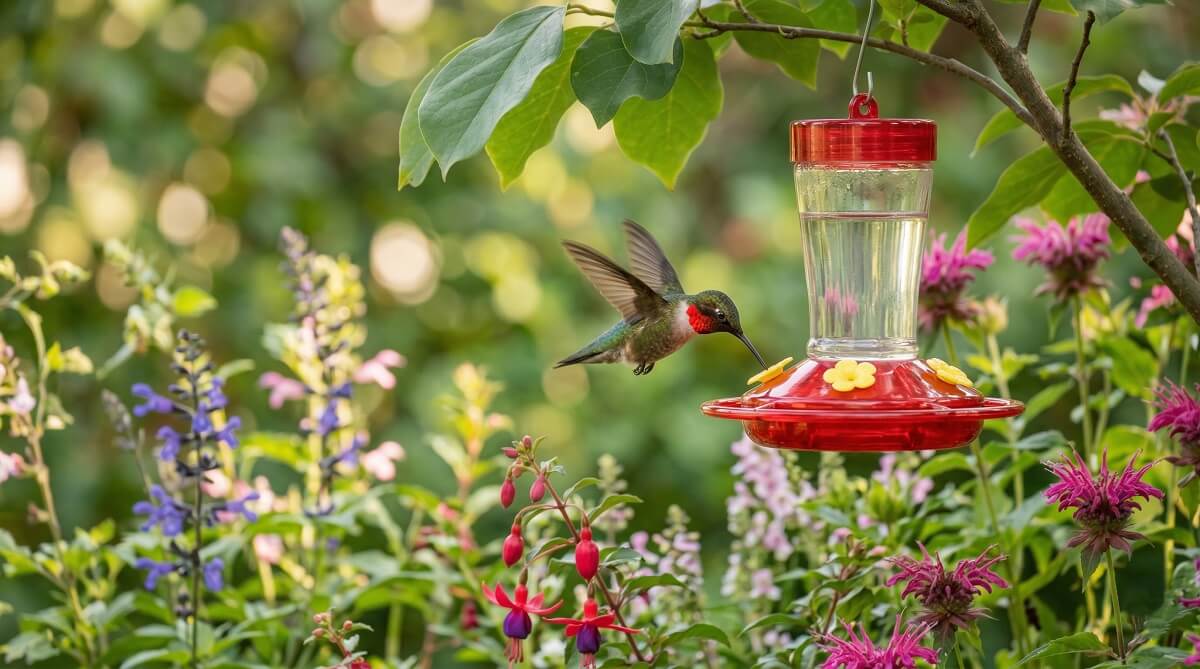
Hummingbirds find feeders the same way they find flowers: by sight, not smell. They have four types of color-sensing cone cells — compared to the three humans have — which means they can perceive colors, including ultraviolet wavelengths, that are invisible to us. Once a hummingbird has located a reliable food source, it locks that location into spatial memory and returns to it consistently, sometimes for years.
The practical takeaway: the hard part is the first visit. After that, a well-placed feeder in established hummingbird territory largely takes care of itself. Getting that first visit requires visibility, the right color signals, and timing your setup to match when the birds are moving through your area.
Is This Guide for You?
This guide will help you if:
- You put out a feeder and nothing has shown up yet
- You want to understand the biology behind why hummingbirds find (or miss) certain feeders
- You’ve had hummingbirds before and want to troubleshoot a drop in visits
- You’re setting up for the first time and want realistic expectations
This guide is less relevant if you’re looking for feeder product comparisons or a basic nectar recipe — those are covered separately.
They Use Sight, Not Smell
Hummingbirds have a poorly developed olfactory system. Smell doesn’t factor into how they navigate or locate food. If you’ve ever worried that your nectar doesn’t smell sweet enough to draw them in, you can set that concern aside — that’s not how it works.
What they have instead is color vision that puts ours to shame.
Humans have three types of cone cells in our retinas: one sensitive to red, one to green, one to blue. Hummingbirds have four. That fourth cone type responds to ultraviolet wavelengths — light completely outside the range we can perceive. A 2020 study published in Proceedings of the National Academy of Sciences by Mary Stoddard and her team at Princeton University confirmed this through field experiments at Colorado’s Rocky Mountain Biological Laboratory. Over three summers, they trained wild broad-tailed hummingbirds using LED color panels and recorded more than 6,000 feeder visits across 19 experiments. The birds consistently distinguished ultraviolet-plus-green from pure UV or pure green — color combinations that looked identical to the human observers running the tests.
Humans perceive one nonspectral color — purple, which is a mix of red and blue wavelengths that don’t appear in the rainbow. Hummingbirds can theoretically perceive up to five nonspectral colors: purple, UV+red, UV+green, UV+yellow, and UV+purple. This tetrachromacy (four-cone color vision) isn’t unique to hummingbirds — it’s the norm for birds, fish, and many reptiles, and it almost certainly existed in dinosaurs. But most of us aren’t thinking about it when we pick a feeder color.
The practical upshot for feeder color: red works because it’s a long-wavelength, high-contrast color that’s visible from a distance and has a strong evolutionary association with nectar-producing flowers. Hummingbirds aren’t just attracted to red by habit — red tubular flowers were their primary food source long before plastic feeders existed. When a bird spots something red from the air, it’s worth investigating.
Avoid feeders where the only visual cue is yellow. Yellow attracts bees as readily as hummingbirds, and a bee-infested feeder is one most hummingbirds will avoid. A feeder with red components — especially around the ports — gives you the clearest signal to the birds you’re trying to attract.
Memory Is the Real Engine
Color gets hummingbirds to your feeder the first time. Memory is what brings them back — every day, every season, and year after year.
Hummingbirds have a hippocampal formation (the brain region responsible for spatial mapping and memory) that is 2-5 times larger relative to total brain volume than any other bird studied, according to a peer-reviewed study in PubMed Central. For comparison, their hippocampus is proportionally larger than that of food-caching songbirds, seabirds, and woodpeckers — birds already known for their spatial recall. Hummingbirds also have an enlarged nidopallium, associated with storing visual information, and a larger mesopallium, linked to higher-order sensory processing.
This isn’t a metaphorical “good memory.” Their brains are physically structured for spatial precision.
In the field, this plays out in measurable ways. Rufous hummingbirds tested with arrays of artificial flowers were able to avoid returning to already-emptied flowers across retention intervals ranging from a few minutes to over an hour. Research published in Scientific Reports (2018) found that dominant male Long-billed Hermit hummingbirds have better spatial memory than less successful males — and that spatial memory is as important as body size or weapon (bill shape) for holding territory. Hummingbirds visiting thousands of flowers and feeders daily need to track which ones are worth revisiting. That requires precise, reliable recall.
For backyard feeder owners, this means two things. First: once a hummingbird finds your feeder, it will come back consistently as long as the nectar is fresh and the feeder is in place. Second: migratory hummingbirds remember specific yards from previous years. Ruby-throated hummingbirds wintering in Mexico or Central America will return to the same property — sometimes the same tree branch — that they used before. They’re not randomly searching when they arrive in spring. They know where they’re going.
Why Their Metabolism Drives Feeder-Seeking Behavior
Wing beats run 40-80 times per second depending on species. Their heart rate reaches up to 1,200 beats per minute during active flight — 50 beats per minute when in torpor at night, a hibernation-like state that dramatically reduces their energy burn. A typical hummingbird weighs between 2.5 and 4.5 grams. Despite that, they carry the highest mass-specific metabolic rate of any warm-blooded animal on Earth.
To keep that engine running, a hummingbird feeds 50-100 times per day, visiting between 1,000 and 2,000 flowers or feeders in the process. They consume roughly half their body weight in sugar daily — about 3 to 7 actual calories, which when scaled to human body size is equivalent to around 150,000 calories a day. When they emerge from overnight torpor in the morning, they’re on the edge of starvation and need to feed almost immediately.
This metabolic pressure explains why hummingbirds actively patrol their territory and aggressively explore new areas. They cannot afford gaps in their food supply. A yard with a red feeder full of fresh nectar is a caloric resource, and these birds are wired to find and defend caloric resources. That’s why a new feeder in an area with existing hummingbird activity gets found — often within days.
How Long Before They Find a New Feeder?
There’s no single answer, but reasonable ranges exist.
In a yard that’s part of an established hummingbird territory or along a known migration corridor: a few days to two weeks is typical. If you hang a red feeder in mid-April in Georgia, with Ruby-throated hummingbirds already moving through, discovery can happen within 24-72 hours.
In a yard without prior hummingbird history, in an area where the bird population is lower, or late in the season: it can take weeks, or you may not see visitors until the following year. Hummingbirds primarily discover new feeders while patrolling known territory. A completely new location — where no hummingbirds have ventured before — takes longer because there’s no existing patrol route leading to it.
Variables that speed discovery:
- Red feeder placed near existing red or tubular flowers
- Feeder hung in a visible location (not buried in foliage)
- Feeder positioned where hummingbirds are already flying — near a known perch, migration path, or neighbor’s active feeder
- Timing that matches local arrival windows (see table below)
Variables that slow it down:
- Feeder placed too late in the season
- No existing hummingbird activity in the neighborhood
- Feeder hidden by dense plant growth
- Feeder location changed frequently — disrupts memory-based returns
Practical Setup: Getting Found Faster
Color and Visibility
Red remains the most reliable attractor. Feeders with red components — especially at the ports and base — perform better than clear or all-yellow designs for initial discovery. If your feeder is minimal on red, adding red ribbon near the hang point or planting red flowers nearby can help bootstrap early detection.
Visibility from above matters more than most people realize. Hummingbirds scout from height. A feeder that’s open to the sky and visible from multiple approach angles will be found faster than one tucked against a wall or inside a shrub.
Location and Placement
Height of 4-6 feet off the ground is the consensus recommendation for hummingbird feeders. That’s high enough to deter most ground predators, low enough for you to service easily, and in the sightline range where hummingbirds typically fly. They will use feeders outside this range, but 4-6 feet hits the practical sweet spot.
Window collisions are a real concern. The safe placement zones are: within 3 feet of a window (so birds aren’t at dangerous flight speed when they spot the reflection) or more than 10-30 feet away. The dangerous middle ground — roughly 5-25 feet from glass — is where hummingbirds build up enough speed to sustain fatal impact.
Place feeders 10-15 feet from dense shrubs or trees. Close enough that birds have a nearby perch and cover to retreat to, far enough that a predator can’t ambush from the branches. Feeders fully exposed with no cover nearby make hummingbirds uncomfortable — they need escape routes.
Partial shade is better than full sun. Nectar spoils faster in heat. Morning sun with afternoon shade is a good target in most US climates.
If you’re using multiple feeders: place them out of each other’s line of sight. A dominant male can guard one feeder aggressively. If he can’t see the others, more birds get access and more hummingbirds establish your yard as a regular feeding zone.
Nectar Quality
The standard recipe: 4 parts water, 1 part plain white granulated sugar. Boil the water, dissolve the sugar, let it cool before filling. Refrigerate any extra for up to two weeks.
Do not use red food dye. The Cornell Lab of Ornithology’s All About Birds states directly that there is no research proving red dye is safe for hummingbirds, and cites compelling accounts from licensed wildlife rehabilitators of higher mortality and bill and liver tumors in birds fed dyed nectar. The Audubon Society concurs: the dye is unnecessary (feeder color attracts the birds just fine) and potentially harmful. A hummingbird consuming dyed nectar ingests an amount of dye — relative to its 2.5-4.5 gram body weight — far exceeding the doses that caused DNA damage in lab studies. There’s no upside, and there’s a documented downside. Skip it.
Do not use honey, brown sugar, organic raw sugar, powdered sugar, or artificial sweeteners. Natural flower nectar is colorless and composed of simple sugars. White granulated sugar in water is the closest match.
Change nectar based on temperature:
- 60-70°F: every 4-5 days
- 80-90°F: every 2-3 days
- Above 90°F: every 1-2 days
Cloudy nectar, black spots in the feeder, or a fermented smell means it’s past due. Hummingbirds will stop visiting a feeder with spoiled nectar.
Timing by Region
Hang feeders 1-2 weeks before hummingbirds are expected in your area. Here’s a general reference for the US:
| Region | Primary Species | Spring Arrival | Fall Departure |
|---|---|---|---|
| Gulf Coast (TX, LA, FL) | Ruby-throated | Early–mid March | October |
| Southeast (GA, AL, SC) | Ruby-throated | Mid–late March | October |
| Mid-Atlantic / Mid-South | Ruby-throated | April | September–October |
| Northeast (NY, New England) | Ruby-throated | Late April–May | September |
| Upper Midwest / Canada | Ruby-throated | May | August–September |
| Pacific Coast (CA, OR, WA) | Anna’s, Rufous | Year-round (Anna’s) / Feb–Oct (Rufous) | Varies |
| Mountain West (CO, UT) | Broad-tailed, Rufous | Late April–May | September |
| Southwest (AZ, NM) | Multiple species | Year-round or March | October |
Note: male hummingbirds migrate first in spring; females follow 10-14 days later. Real-time migration sightings are tracked at Hummingbird Central.
Feeder Comparison: Types and Discoverability
Not all feeders are equally easy for a passing bird to spot. Here’s how the main types compare:
| Feeder Type | Visibility from Air | Discovery Ease | Nectar Capacity | Ease of Cleaning |
|---|---|---|---|---|
| Dish / saucer feeder | Moderate | Good — open, low profile | Low–medium | Easy |
| Bottle / inverted tube feeder | High (usually red top) | Excellent | Medium–high | Moderate |
| Window-mount feeder | Low from distance | Requires established bird | Low | Easy |
| Large basin / multiple port | High | Excellent — multiple feeding stations | High | More involved |
For first-time setup, a bottle feeder with a red top or a dish feeder in a red housing gives you the best combination of visibility and initial attractiveness. Window-mount feeders are best added after birds have already established a pattern in your yard.
Two straightforward options worth checking:
- Perky-Pet Red Antique Glass Bottle Feeder (24 oz) — Red glass bottle, copper-finish base, four feeding ports.
- Best-1 Hummingbird Feeder by Bird Choice — Simple polycarbonate design, red coloring, straightforward to clean.
Who Should (and Shouldn’t) Prioritize Feeder Setup
Feeders work best when there’s an existing hummingbird population to draw from. If you’re in the eastern US between March and September, or anywhere in the West during warmer months, a well-placed feeder in a yard with some flowering plants has a realistic shot at regular visitors.
If your yard has heavy pesticide use, reconsider before getting invested in feeders. Hummingbirds need insects and spiders for protein — nectar alone doesn’t sustain them. A yard that’s been thoroughly treated may not support them regardless of how good the nectar is.
If you’re in a region with minimal hummingbird activity (far northern states during shoulder seasons, or areas with no documented local population), feeders can still attract migrants passing through — but manage expectations. Year-round residents require year-round commitment to nectar freshness and feeder cleanliness.
Troubleshooting: They Found the Feeder and Then Stopped Coming
Regular visitors can disappear, and it’s usually one of a short list of causes:
- Spoiled nectar. Most common reason. In warm weather, nectar ferments fast. If it’s been more than 3-4 days since the last change and temperatures have been above 80°F, empty and clean the feeder and start fresh.
- Migration timing. Ruby-throated hummingbirds in the eastern US leave on schedule regardless of feeder availability. If it’s late September or October, they may have simply departed. This isn’t a failure — keep the feeder up for a few more weeks in case late migrants pass through.
- Territorial male. A dominant male can exclude other birds. Adding a second feeder out of sightline from the first can help. You’ll often see both then get regular visitors.
- Feeder moved or changed. Hummingbirds memorize specific locations. Moving a feeder even a few feet can confuse returning birds temporarily. If you need to relocate it, do so gradually over several days.
- New competition. A neighbor’s feeder, or a garden that bloomed with abundant natural nectar, can draw birds away temporarily.
- Feeder not cleaned. Mold inside feeder ports or base discourages feeding. Clean with a bottle brush and hot water — avoid soap residue.
Frequently Asked Questions
Do hummingbirds use smell to find feeders?
No. Hummingbirds have an underdeveloped sense of smell and don’t use it for navigation or food-finding. They rely entirely on vision.
How long does it take for hummingbirds to find a new feeder?
In established hummingbird territory — meaning birds are already present and patrolling the area — typically a few days to two weeks. In a new location with no prior hummingbird activity, it may take a full season, or discovery may not happen until the following year when migratory birds return on their established routes.
What color feeder attracts hummingbirds best?
Red is the most reliable choice for initial discovery. Feeders with red components around the ports or base consistently outperform clear or all-yellow designs for first-visit attraction. Yellow should be minimized on feeders since it attracts bees.
Is red food dye safe in hummingbird nectar?
No. The Cornell Lab of Ornithology and the Audubon Society both advise against it. The dye is unnecessary — feeder color alone attracts hummingbirds — and there’s documented concern from licensed rehabilitators about higher mortality and tumor development in birds fed dyed nectar. Stick to plain white granulated sugar and water at a 4:1 ratio.
Do hummingbirds remember where my feeder is?
Yes. Hummingbirds have a proportionally enlarged hippocampus — the brain region responsible for spatial memory — compared to any other bird studied. Migratory species return to the same yards and feeding stations year after year. Once a bird has visited your feeder, it knows where it is.
Can hummingbirds see ultraviolet light?
Yes. They have four types of cone cells in their retinas; the fourth is sensitive to UV wavelengths. A 2020 study in Proceedings of the National Academy of Sciences confirmed that wild hummingbirds can discriminate nonspectral color combinations — including UV+green and UV+red — that are invisible to humans. This gives them a visual range substantially wider than ours.
When should I put out my hummingbird feeder?
One to two weeks before hummingbirds are expected in your region. For the Gulf Coast, that means late February to early March. For the Northeast, late April. For the Pacific Coast, year-round is reasonable for Anna’s hummingbirds. Check the regional timing table above or use real-time sighting data at Hummingbird Central.
Why do hummingbirds hover at my feeder and leave without drinking?
Usually they’re assessing it. If this happens consistently, check for spoiled nectar, inspect the ports for obstructions or mold, and make sure the feeder isn’t wobbling or swinging. A feeder that’s been recently cleaned and refilled with fresh nectar, in a stable position, typically converts hovering birds into feeding birds quickly.
