


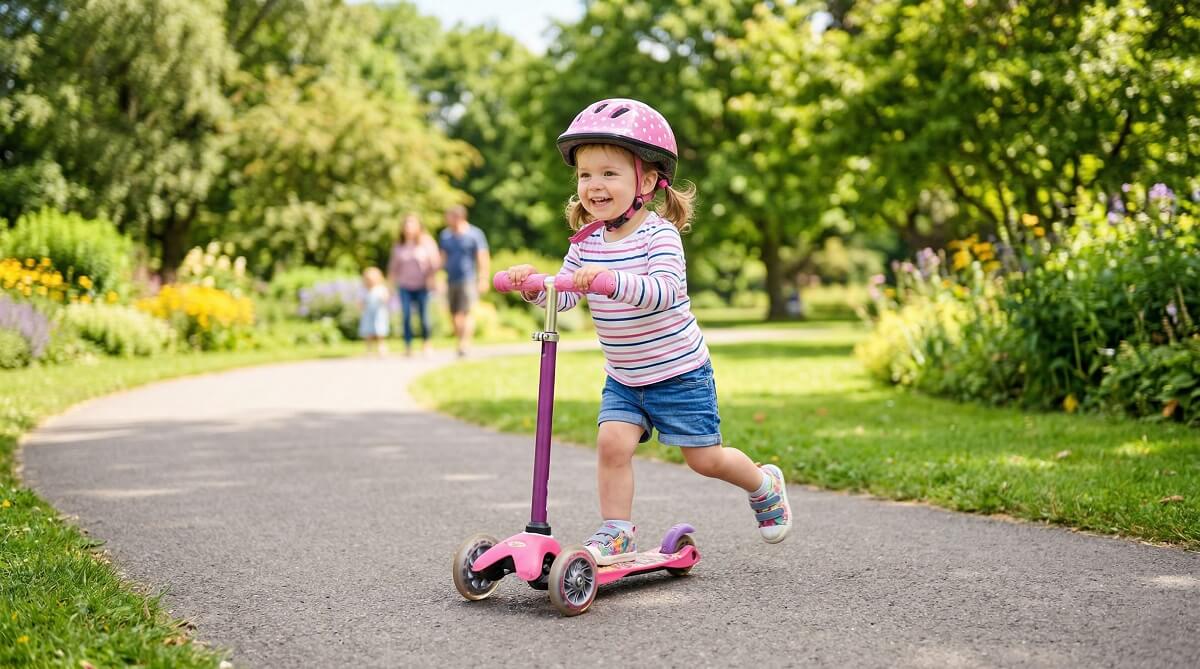
The Micro Mini Deluxe ($99.99) is the top pick for most 2-year-olds. Its adjustable handlebar starts at 19.25 inches — low enough for even the smallest riders — and reaches 27 inches, meaning the same scooter fits your child from age 2 all the way to 5. The lean-to-steer mechanism, polyurethane wheels, and 110-pound weight limit make it genuinely built to last. If you want one scooter for the next three years, this is it. For families who might pass it to a younger sibling, the long-term value is hard to argue with.
If the Micro isn’t in the budget, the GoTrax KS3 ($44) handles the basics well. It includes a foldable seat, light-up wheels, and supports up to 110 pounds — specs that punch well above its price. The steering is stiffer than the Micro, which means younger or more hesitant 2-year-olds will take longer to get comfortable. But for a first scooter where you’re not sure how much use it’ll actually get, it’s a solid starting point. Visit our full buying guides for more toddler gear recommendations.
The Retrospec Chipmunk Plus (~$50) sits between those two options in a sensible way. Its foldable seat removes without tools, the ride is noticeably smooth for a budget model, and it grows from age 3 to 8. The one catch: its minimum handlebar height is 26 inches, which is tall for a small 2-year-old. If your child is on the smaller side, give it a few more months — this one’s better suited for kids closer to 2.5 or 3.
Who Should (and Shouldn’t) Start Scooting at 2
✅ Good Fit If Your Child:
- Walks confidently without frequent tumbles
- Shows interest in other kids’ scooters or bikes
- Has access to smooth pavement, a driveway, or sidewalk
- Is ready for some outdoor independence (even supervised)
- Has a sibling or friend who already scoots — peer motivation is real
❌ Hold Off If:
- Your child is still unsteady on their feet — a scooter will only frustrate them
- You don’t have access to smooth outdoor surfaces (grass and gravel don’t work)
- Your child is under 18 months
- Your toddler simply isn’t interested — forcing it rarely works and can put them off scooting entirely
Why 3-Wheel Scooters Are the Right Choice for Age 2
Two-wheel scooters are meant for kids who already have solid balance — typically 5 and up. For 2-year-olds, a three-wheel design is the practical choice. The two front wheels create a self-stable platform that won’t tip over when your toddler steps off, which matters a lot when kids are constantly hopping on and off.
The wider foot deck — usually around 4.5 to 5 inches on quality toddler models — gives small feet a larger, more forgiving surface to land on. This is the detail that separates beginner-appropriate scooters from ones that look toddler-friendly but aren’t.
Lean-to-Steer: What It Is and Why It Matters
All the top picks in this guide use lean-to-steer technology. Instead of turning handlebars like a bike, your child shifts their weight in the direction they want to go — similar to how a skateboard works. Leaning left tilts the front wheels left; the scooter follows. This is more forgiving than handlebar steering for beginners because there’s no sudden jerking motion that leads to falls. Most 2-year-olds pick it up quickly, often within a few sessions.
Browse our full product reviews for more tested kids’ outdoor gear.
Top Picks for 2-Year-Olds
Micro Mini Deluxe — Best Overall
Price: $99.99 (microkickboard.com as of March 2026; check current pricing on Amazon)
Age range: 2–5 years | Max rider weight: 110 lbs | Scooter weight: 4.2 lbs
Handlebar height: 19.25″ to 27″ (7.75 inches of continuous adjustment — more than any comparable model)
Deck: 12″ × 4.5″ fiberglass-reinforced | Wheels: Polyurethane (120mm front, 80mm rear)
Warranty: 2-year manufacturer defect warranty (replaceable modular parts)
The Micro Mini consistently comes out on top in independent tests, and for straightforward reasons. Its handlebar starts at 19.25 inches — a full 6 to 7 inches lower than the GoTrax KS3 and Retrospec Chipmunk Plus — which means it actually fits very young 2-year-olds, not just the upper end of that age range. The lean-to-steer mechanism has the tightest, most responsive feel of any toddler scooter at this price point. Steering requires less physical lean, which helps young riders who haven’t yet developed strong core control.
The polyurethane wheels are quiet enough for indoor use, non-marking on hardwood and tile, and smooth enough on textured pavement to avoid the jolting that cheaper plastic wheels produce. Over 300 verified purchasers on microkickboard.com give it five stars. One reviewer noted their daughter started using it as a second birthday gift and was “riding it around the house” within days.
The downsides are real: it doesn’t fold, and the optional seat costs an additional $29.99 if you want that feature. If storage space is tight or you’re a city family who needs a scooter that fits under a stroller, the Micro Mini Foldable LED is worth the extra cost.
GoTrax KS3 — Best Budget Pick
Price: $44 (gotrax.com as of March 2026; check Amazon and Walmart for current pricing)
Age range: 2–8 years | Max rider weight: 110 lbs | Handlebar: 26″–34″ (3 settings)
Foldable seat: Included | LED wheels: Yes
At $44, the GoTrax KS3 does a lot. The seat folds up without tools, light-up wheels engage kids reliably, and the 110-pound weight limit means this scooter won’t be outgrown for years. The wide handlebar range (26″–34″) also means it’ll stay usable well into the elementary school years. See our how-to guides for setup tips.
The trade-off at this price is steering stiffness. The KS3 requires more of a lean to initiate a turn than the Micro Mini does. For adventurous 2-year-olds who already walk confidently and are eager to move fast, this rarely matters. For hesitant or smaller toddlers just getting started, the extra effort can be discouraging early on. If your child gives up after a few sessions, the steering is likely the culprit — give it a few weeks before drawing conclusions.
One quirk: the seat lock mechanism uses a small button that younger toddlers often can’t release independently. Parents end up doing the seat/standing transition for them, which gets old quickly. The seat height also requires tools to adjust — the Retrospec handles this better.
Retrospec Chipmunk Plus — Best Value for the Price
Price: Approximately $50 (check current pricing at Amazon or retrospec.com)
Age range: 3–8 years | Max rider weight: 110 lbs | Handlebar: 26″–33.5″
Foldable seat: Yes, tool-free with 3 height settings
The Retrospec Chipmunk Plus is the most impressive budget model for build quality. Independent testers noted it “matches — or even outperforms — scooters at higher prices” in ride smoothness and assembly ease. The foldable seat is the standout practical feature: it flips up without tools, has three height settings, and can be removed entirely once your child no longer wants it. For families with siblings at different riding stages, this flexibility is genuinely useful.
The reason it’s third on the list rather than first comes down to the 26″ minimum handlebar. Small 2-year-olds — especially those under 36 inches tall — will find this handlebar too high for comfortable riding posture. The Chipmunk Plus is an excellent scooter for ages 2.5 and up; for the youngest 2-year-olds, the Micro Mini’s lower 19.25″ minimum is a meaningful advantage.
Radio Flyer Glider Jr. — Best for True Beginners
Price: $69.99 at Target (as of March 2026)
Age range: 2–5 years | Max rider weight: 44 lbs | Handlebar: 20″–29.53″
Scooter weight: 5.05 lbs | Aluminum frame | LED wheels
The Radio Flyer Glider Jr. earns its spot on this list because of one design detail that the others don’t have: an angled deck that naturally positions a toddler’s back foot closer to the rear brake. For new riders who haven’t learned to stomp-brake yet, this subtle slope teaches the motion without requiring explicit coaching. Five-inch wheels — the largest of any toddler scooter tested — absorb sidewalk bumps and cracks better than the 4.5-inch wheels on competing models. The result is a noticeably stable first ride.
The limitation is the 44-pound weight cap. The average 4-year-old weighs around 38–40 pounds, which means this scooter has about two good years of use before you’re near the limit. If you’re buying for the long term, the Micro Mini or Retrospec are significantly better investments. But if your goal is a beginner scooter for a cautious 2-year-old who needs every stability advantage available, the Glider Jr. delivers that.
Quick Comparison Table
| Model | Price (Est.) | Age Range | Min Handlebar | Max Weight | Seat Included | Folds |
|---|---|---|---|---|---|---|
| Micro Mini Deluxe | $99.99 | 2–5 yrs | 19.25″ | 110 lbs | Optional (+$30) | No |
| GoTrax KS3 | $44 | 2–8 yrs | 26″ | 110 lbs | Yes (foldable) | No |
| Retrospec Chipmunk Plus | ~$50 | 3–8 yrs | 26″ | 110 lbs | Yes (foldable) | No |
| Radio Flyer Glider Jr. | $69.99 | 2–5 yrs | 20″ | 44 lbs | No | No |
Prices verified March 2026. Check current pricing before purchasing.
What to Actually Look for in a Scooter for a 2-Year-Old
Handlebar Height Is the Most Important Spec
The minimum handlebar height determines whether a scooter can actually fit your child right now — not in a year. For most 2-year-olds, the handlebar should sit roughly at belly button to mid-chest height. That typically puts the target handlebar at 19 to 22 inches. The Micro Mini’s 19.25-inch minimum is the lowest of any scooter reviewed here. The GoTrax KS3 and Retrospec both start at 26 inches — workable for taller 2-year-olds but awkward for smaller ones.
If you’re unsure, measure your child from the floor to their belly button. That’s the practical minimum handlebar height they’ll need to ride comfortably.
Wheel Material Affects More Than You’d Think
Polyurethane wheels (found on the Micro Mini and Retrospec Chipmunk Plus) are quiet, non-marking on indoor floors, and absorb small bumps rather than transmitting them. If you live in an apartment or plan to let your toddler scoot indoors during rainy days, polyurethane is the right choice. Plastic wheels — common on lower-cost models — are louder, can scuff flooring, and bounce harder on uneven pavement. The ride difference is noticeable even to toddlers.
The Seat Question
You don’t need a seat, but some children ease into scooting more comfortably with one. The seated position lets hesitant toddlers push with both feet while staying close to the ground — less commitment, less fear. Most kids naturally transition to standing within a few weeks once they build confidence. If you want the seat option, look for models where it folds up (not ones that require full removal with tools). The Retrospec’s foldable seat is the easiest to manage; the GoTrax KS3’s seat lock can frustrate toddlers who want to switch between modes on their own.
Weight Capacity Matters for Long-Term Value
The Radio Flyer Glider Jr.’s 44-pound limit is the sharpest limitation in this roundup. The average 4-year-old weighs around 38–40 pounds — you’re looking at two years of use, maximum, before you’re pushing that threshold. The Micro Mini, GoTrax KS3, and Retrospec Chipmunk Plus all support 110 pounds, which means they can realistically last from age 2 through early elementary school. Read more reviews of kids’ outdoor toys.
Scooter or Balance Bike First?
This question comes up a lot, and the honest answer is: balance bikes are better for developing the skills that lead to pedal bike riding. A balance bike forces children to balance and steer simultaneously — harder skills that transfer directly to cycling. Scooters are easier to learn, which is why kids often prefer them. But that ease can make children resistant to later learning the harder balance-bike skills.
The practical recommendation: if budget allows only one, a balance bike serves long-term skill development better. If you already have or plan to get a balance bike, a scooter makes excellent complementary outdoor equipment. Many families use both — the scooter for quick trips and neighborhood rides, the balance bike for skill development. Our gear reviews cover tested picks in both categories.
Scooters do build genuine coordination and gross motor skills. According to occupational therapist Pamela Skinner, MSOTR, as cited by The Bump, “Scooting requires a combination of balance, coordination and strength — all of which contribute to the development of a child’s gross motor skills and engage muscles that are essential in walking, running and sports.”
Safety Gear Your 2-Year-Old Needs
Falls at this age are not a matter of if — they’re a matter of when. Gear up before the first ride, not after the first fall.
- Helmet: Non-negotiable. A CPSC-certified bike helmet fits most toddler heads and protects against the head impacts that happen when toddlers lose balance at low speeds. Note: the American Academy of Pediatrics specifically advises that children under 16 should not ride electric scooters — but helmets are equally important for kick scooters.
- Knee pads: Highly recommended. Knee scrapes are the most common scooter injury at this age. Foam or hard-shell pads designed for toddlers stay in place better than adult versions cut down to size.
- Elbow pads: A solid addition, particularly on pavement. Optional for early indoor sessions.
- Adult supervision: Always, for children under 8. Supervision means being close enough to intervene, not watching from inside.
- Surface selection: Stick to smooth, flat pavement, driveways, or hard-surface playgrounds. Hills, grass, and gravel are not appropriate for 2-year-old riders.
Frequently Asked Questions
What age can a toddler start using a kick scooter?
Most children who walk confidently — typically around 18 months to 2 years — can start on a three-wheel toddler scooter. The key indicator is steady walking, not calendar age. A 2-year-old who still trips frequently will struggle with a scooter; a confident 20-month-old may manage just fine. Start with a ride-on or sit-down scooter if your child isn’t walking steadily yet.
Does my 2-year-old need a seat on their scooter?
No, but it can help timid riders get started. Seated scooting lets children push with both feet at once and stay low to the ground — less intimidating for hesitant toddlers. Most kids naturally move to standing within a few weeks. If you want the option, choose a model with a seat that folds up rather than one that requires tools to remove. The Retrospec Chipmunk Plus handles this the most cleanly.
Is the Micro Mini worth $100 for a 2-year-old?
For most families, yes — if the scooter will be used regularly. The Micro Mini’s 19.25-inch minimum handlebar fits children that other scooters don’t, and the 110-pound weight limit and modular replacement parts mean it can last 3–5 years with normal use. Families who pass it to a younger sibling or resell it recoup a meaningful portion of the cost. If you’re unsure your child will take to scooting, start with the GoTrax KS3 at $44 and upgrade later.
What is lean-to-steer and is it better for 2-year-olds?
Lean-to-steer means the child shifts their body weight sideways to turn, rather than twisting handlebars. All three-wheel scooters in this guide use this system. It’s generally better for young toddlers because it produces smoother, more gradual turns without the sudden jerks that handlebar steering can cause. It also builds the balance intuitions that transfer to bike riding later.
What’s the difference between the Micro Mini and Micro Maxi?
The Mini is designed for ages 2–5 with a handlebar range of 19.25″–27″ and a 12″ × 4.5″ deck. The Maxi is for ages 5–12 with a handlebar range of 26.25″–35.75″ and a larger 13″ × 5.5″ deck. Most 2-year-olds will fit the Mini for 3 or more years before needing to move up to the Maxi.
What safety gear does a 2-year-old need to ride a scooter?
At minimum: a properly fitted, CPSC-certified bike helmet. Knee pads are strongly recommended — knee scrapes are the most common toddler scooter injury. Elbow pads are a useful addition, especially for outdoor pavement riding. Always supervise children under 8 while scooting.
Can my 2-year-old use a scooter indoors?
Yes, if the wheels are polyurethane — like those on the Micro Mini and Retrospec Chipmunk Plus. Polyurethane wheels are quiet, non-marking, and smooth on hard floors. Avoid scooters with plastic wheels indoors; they’re louder, can scuff flooring, and are harder to control on slick surfaces.
How long does a toddler scooter last?
Budget models like the GoTrax KS3 typically provide 2–4 years of good use. The Micro Mini can last 3–5 years for a single child, and holds resale value well enough to recoup $40–60 on secondary markets. Retrospec’s modular design also supports longevity — replacement parts are available if something breaks. Radio Flyer’s 44-pound weight limit is the binding constraint there, regardless of build quality.
Ready to Buy?
Check current prices before purchasing — deals shift regularly, and the premium picks occasionally go on sale:
- Micro Mini Scooter on Amazon
- GoTrax KS3 on Amazon
- Retrospec Chipmunk Plus on Amazon
- Radio Flyer Glider Jr. at Target
Browse more buying guides on ChubbytIps for additional recommendations across kids’ gear categories.
