


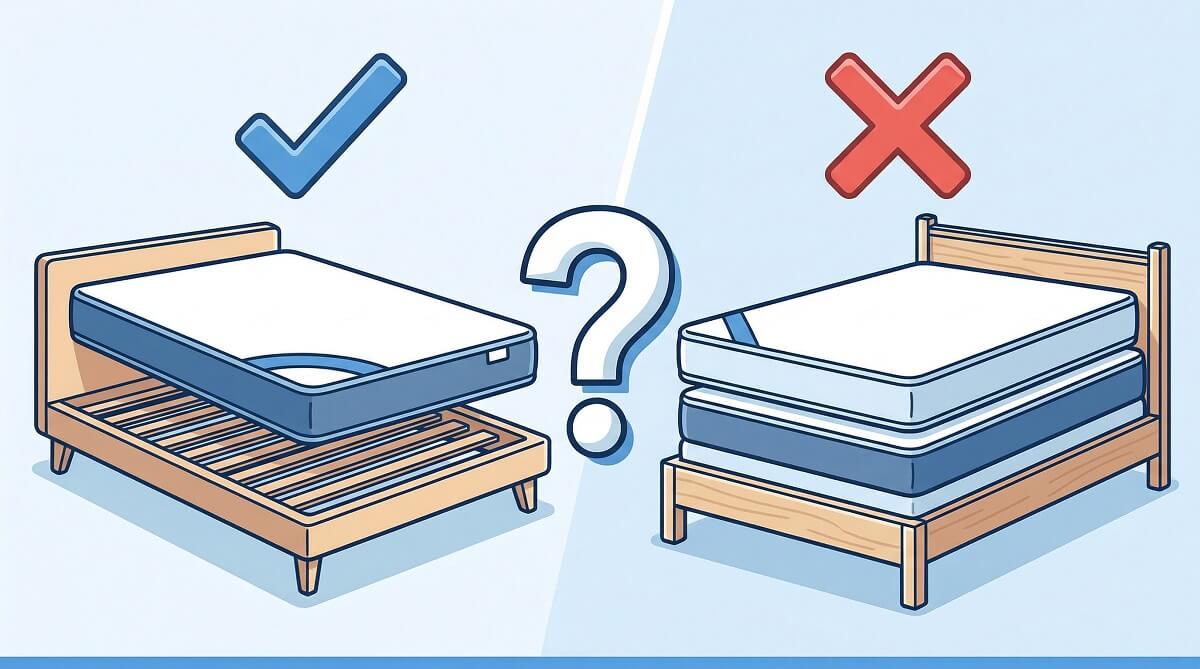
No — you don’t need a box spring with a platform bed. The slats or solid deck built into a platform frame do the same structural job that a box spring used to do. For most people buying a modern mattress (memory foam, hybrid, latex), skipping the box spring isn’t just fine — adding one can actually void your warranty. Brands like Purple and Casper explicitly list box springs as incompatible with their mattresses.
That said, three situations make a box spring — or a cheaper alternative — worth considering: you want more height off the floor, you have an older innerspring mattress, or your platform bed’s slat gaps are too wide for your specific mattress. We’ll cover all three, plus the slat spacing question that confuses a lot of people (hint: the answer depends on which mattress brand you own). has more on foundation types if you’re still shopping.
Below: what platform beds actually provide, the rare cases where a box spring still makes sense, and cheaper alternatives (bunkie boards, bed risers) that most articles skip over entirely.
Quick Guide: Do You Need a Box Spring?
✅ Skip the Box Spring If:
- Your platform bed has slats spaced 3 inches or less apart (or a solid deck)
- You have a memory foam, latex, or hybrid mattress
- Your mattress warranty doesn’t require one — check your brand’s guidelines
- You’re happy with the current height off the floor
❌ Consider a Box Spring (or Alternative) If:
- Your platform’s slat gaps are wider than your mattress brand allows
- You have a traditional innerspring mattress that works best with coil-on-coil support
- The bed feels too low and getting in and out is uncomfortable
- You specifically want the taller, traditional bed height
What Platform Beds Actually Provide (and Why Box Springs Became Optional)
How Platform Bed Slats Work
A platform bed supports your mattress through either a solid wood deck or a series of slats — horizontal boards spanning the frame’s width. Both methods distribute your body weight across the mattress without the spring mechanism that older bed setups required.
Slat spacing matters a lot for foam mattresses. If the gaps between slats are too wide, a memory foam or latex mattress can sag into the gaps over time, both reducing comfort and voiding your warranty. According to Purple’s official support documentation, slats must be no more than 3.5 inches apart for Purple mattresses. Tempur-Pedic is stricter: slats need to be at least 3 inches wide with gaps of no more than 4 inches. Sleep Foundation’s guide on box springs vs. slats confirms that spacing requirements vary by brand, and getting it wrong commonly voids mattress warranties. The safe practical target is keeping gaps at 3 inches or less — that satisfies the requirements for most foam-based brands.
Solid-deck platform beds (no gaps at all) eliminate the spacing concern but can trap heat more than slatted designs. If you sleep hot, a slatted platform with appropriately spaced slats generally gives better airflow. for mattresses that pair well with slatted platforms.
Why Box Springs Existed in the First Place
Decades ago, mattresses were filled with materials like cotton batting, wool, or basic coils that had little structural integrity on their own. The box spring — a wooden frame containing metal coils — provided the rigidity and bounce the mattress lacked. It was load-bearing infrastructure, not just a height extender.
Modern mattresses are different. Memory foam, latex, and hybrid constructions are self-supporting. The foam layers are engineered to maintain their shape and provide spinal alignment without help from below. Many box springs sold today don’t even contain springs — they’re just a fabric-covered wooden box. The name stuck even after the function changed.
Platform Bed vs. Box Spring: What Actually Differs
Height
Height is where the two setups diverge most clearly. Platform beds typically raise the sleeping surface 6 to 18 inches off the floor (the frame itself, before adding your mattress). A standard box spring adds 9 inches; low-profile versions add 5 to 5.5 inches.
Most ergonomists suggest a finished bed height of 20 to 25 inches from floor to mattress surface. With a 10-inch mattress on a typical platform frame, you might land at 18 to 20 inches — workable for most people, but lower than some prefer. If height is a concern, there are solutions short of a full box spring (covered below).
Cost
Platform beds span a wide range: basic metal queen frames start around $221 on Amazon, mid-range wood designs run $250 to $500, and upholstered or storage-integrated styles climb higher from there. The key point is that a platform bed replaces both a bed frame and a box spring — it’s an all-in-one setup.
Box springs (queen) on Amazon typically run $50 to $90 for low-profile 5-inch models and somewhat more for standard 9-inch versions (as of March 2026 — check current pricing before buying, as these fluctuate). You’d still need a separate bed frame to use one, so the combined cost often exceeds a platform bed’s price.
If you don’t need a full box spring but want something between slats and a traditional foundation, a bunkie board is worth knowing about. These thin (1 to 3 inch) solid support panels run approximately $50 to $145 for queen size on Amazon (March 2026). They close up wide slat gaps without meaningfully raising your bed height.
Mattress Compatibility
Platform beds work with essentially every modern mattress type. Memory foam, latex, and hybrid mattresses all sit well on properly spaced slats. The compatibility concern runs the other way: most foam mattress brands specifically prohibit box springs and will void your warranty if you use one. Here’s a quick reference:
- Purple: Box springs void warranty. Max slat spacing: 3.5 inches.
- Casper: Box springs void warranty. Platform beds and adjustable bases approved.
- Tempur-Pedic: Requires firm, non-spring foundation. Slat max: 4 inches apart, each slat at least 3 inches wide.
- Nectar: Recommends slat spacing of 3 to 5 inches; proof of supportive base required for warranty claims.
- Innerspring mattresses: Can benefit from a box spring for coil-on-coil support — check your specific brand’s guidelines.
Before buying any foundation, look up your mattress brand’s support page or warranty document. Most have a brief FAQ or support article that lists approved and prohibited base types. for brand-specific mattress recommendations.
Storage Space
Platform beds, particularly storage models with built-in drawers, make use of the space a box spring would otherwise occupy. For smaller bedrooms or anyone who needs under-bed organization, this is a meaningful advantage. Box springs offer little to no under-bed storage by design — the spring mechanism fills the interior.
Platform Bed vs. Box Spring: Side-by-Side
| Feature | Platform Bed (Queen) | Box Spring (Queen) |
|---|---|---|
| Requires separate bed frame? | No — frame included | Yes — needs a compatible frame |
| Height added | 6–18 inches (frame height) | 5 inches (low-profile) or 9 inches (standard) |
| Price range (queen) | ~$221+ (check current Amazon pricing) | ~$50–$90+ low-profile; more for standard (check Amazon) |
| Under-bed storage | Yes (storage models), open space (most) | Minimal |
| Best mattress type | Memory foam, hybrid, latex, innerspring | Traditional innerspring |
| Foam mattress warranty impact | Safe — most brands approve | May void warranty (Purple, Casper, others) |
| Weight capacity | Varies by frame — check specs | Typically up to 3,000 lbs (heavy-duty metal models) |
| Noise over time | Minimal — no springs to wear out | Can squeak as springs lose tension |
| Lifespan | Often outlasts the mattress | ~8–10 years before spring degradation |
| Style options | Wide range — minimal to upholstered | Traditional/classic look only |
When a Box Spring (or Cheaper Alternative) Still Makes Sense
Your Platform Bed’s Slats Are Too Wide
If you already have a platform bed with slats spaced wider than your mattress brand allows — common in older or cheaper frames — a few fixes are available short of replacing the whole frame:
- Bunkie board: A thin panel (1–3 inches) placed directly on the slats, bridging the gaps. Cost: roughly $50–$145 for queen size. This is the cleanest solution — it doesn’t meaningfully raise your bed height and gives foam mattresses the solid surface they need.
- Plywood sheet: A DIY version of the bunkie board. Cut a sheet of 3/4″ plywood to fit inside your frame and place it over the slats. Less expensive but heavier and harder to move.
- Replace the slats: If your frame uses wooden slats, adding more slats or replacing them with closer-spaced ones is often cheaper than buying a new foundation.
You Want More Height Off the Floor
If the platform bed feels too low — a common concern for older adults, taller individuals, or anyone with knee or hip issues — you don’t necessarily need a box spring. Options in order of cost:
- Bed risers: Plastic or metal sleeves that slide under each leg, adding 2 to 6 inches of height. Typically $20–$40 for a set. Quick, reversible, and inexpensive.
- Low-profile foundation or bunkie board: Adds 1–5 inches without the full 9-inch height of a standard box spring.
- Taller platform frame: If you’re buying new, look for frames with longer legs — many manufacturers offer height options.
You Have a Traditional Innerspring Mattress
If your mattress uses coil construction (not hybrid — purely innerspring), a box spring can genuinely improve the feel. The coils in a box spring align with the coils in the mattress, adding responsiveness and reducing the firmness of a mattress sitting on a rigid surface. Not every innerspring mattress requires one, but if yours recommends it, it’s worth following — both for comfort and warranty compliance.
What Your Mattress Brand Actually Requires
This is the part most buying guides skip. Before you decide whether to buy a box spring, check your mattress warranty — not because the rules are identical across brands, but because they’re not. Getting this wrong can cost you warranty coverage on a $1,000+ mattress.
Here’s a summary of what major brands require, verified from their official support pages (as of March 2026 — requirements can change, so verify directly with your brand):
- Purple: Slats must be no more than 3.5 inches apart. Box springs are explicitly prohibited and will void the warranty. According to Purple’s foundation guide, compatible options include adjustable bases, flat foundations, platform beds, slatted frames (within spec), and bunkie boards.
- Tempur-Pedic: Requires a firm, non-spring foundation. If using slats, each slat must be at least 3 inches wide with gaps of no more than 4 inches. Also requires a center support leg and 5–6 total legs for queen and king sizes. See Tempur-Pedic’s slatted foundation FAQ.
- Casper: Box springs void the warranty. Approved: platform beds with solid or slatted bases, adjustable bases.
- Nectar: Requires proof of a supportive base for warranty claims. Recommends slat spacing of 3 to 5 inches. Does not recommend placement on the floor or a plastic base.
For other brands not listed here, search “[brand name] mattress warranty foundation requirements” — virtually every major mattress company has a support article or FAQ page covering this. for brand-specific setup tips alongside each recommendation.
Frequently Asked Questions
Can you put a box spring on a platform bed?
Yes, physically it’s possible. Whether you should depends on your mattress type and warranty. For memory foam, hybrid, or latex mattresses, adding a box spring on top of a platform bed may void your warranty and significantly raises the total bed height without improving support. The combination makes most sense only if you have an innerspring mattress and want more height.
What is the maximum slat spacing for a memory foam mattress?
This varies by brand, but the general safe target is no more than 3 inches between slats. Purple allows up to 3.5 inches; Tempur-Pedic allows up to 4 inches (with slats at least 3 inches wide). Some retailers cite 6 inches as a practical limit, but that exceeds most foam brand warranties. When in doubt, aim for 3 inches or add a bunkie board.
How do I keep my mattress from sliding on a platform bed?
Non-slip pads placed under the mattress work well — these run $10–$20 for a full-size piece of rubber grip material. Most slatted platforms with standard spacing have enough friction to hold a mattress in place on their own; sliding is more common with solid-top platforms or widely spaced slats. Some mattresses also come with a non-slip bottom layer by design.
How do I raise a platform bed if it’s too low?
Three options, in order of cost: (1) Bed risers under each leg — around $20–$40, add 2 to 6 inches of height, completely reversible. (2) A bunkie board or low-profile foundation between the mattress and frame — adds 1 to 5 inches. (3) Replace the frame with a taller platform model — more work but a clean permanent solution.
Are box springs obsolete?
For most modern mattresses, yes. The original function — providing structural support to a floppy mattress — is no longer needed since foam and hybrid mattresses are self-supporting. Many box springs sold today don’t even contain springs; they’re a fabric-covered wood frame. The main remaining use case is paired with a traditional innerspring mattress for coil-on-coil support and added height.
What is a bunkie board and when do I need one?
A bunkie board is a thin (typically 1 to 3 inches) solid panel that sits between your mattress and the bed frame. It’s useful when your platform bed’s slat gaps are too wide for your mattress warranty requirements, but you don’t want the height or expense of a full box spring. Queen-size bunkie boards typically run $50–$145 on Amazon (check current pricing). They’re a practical middle ground that most buying guides don’t mention.
Do platform beds hurt your back?
Not inherently. A firm, even surface generally supports spinal alignment well. Back discomfort tied to platform beds usually comes from two sources: slats spaced too wide (mattress sags into the gaps) or a bed that’s too low to get in and out of without strain. If you’re already dealing with back issues, a taller bed setup — or bed risers — may be worth the small investment. also covers options for adding cushion to a firm platform surface.
How long does a box spring last?
Around 8 to 10 years with typical use, which roughly tracks the lifespan of most mattresses. Springs lose tension over time, which causes squeaking and reduced support. Platform bed frames don’t degrade the same way — the slats or deck don’t wear out with normal use, and a well-built solid wood or steel frame can outlast multiple mattresses.
If you’re setting up a new platform bed and want to compare your options, check current box spring and bunkie board prices on Amazon — even if you don’t end up needing one, knowing the prices helps you decide whether a $30 set of bed risers or a $60 bunkie board is a smarter fix for your situation. for more on setting up your bedroom.
