


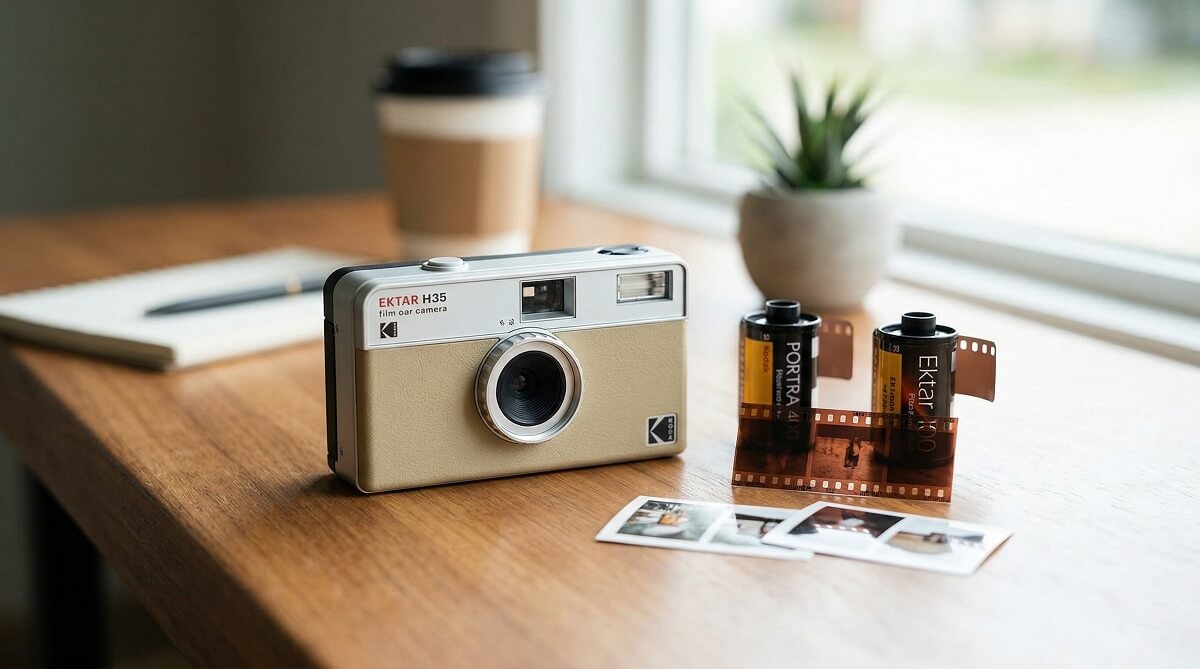
The Kodak Ektar H35 is a half-frame 35mm film camera that sells for around $49. Load a roll, point it at something, press the shutter — that’s the whole operation. Because it shoots half-frames, a standard 36-exposure roll produces 72 photos, which is legitimately useful when film is as expensive as it is right now. For casual shooters and beginners, the H35 offers an accessible way into film photography without committing to a more complex or pricier setup.
That said, the camera has a documented camera shake problem that can soften or ruin a meaningful portion of your daylight shots. The build is plastic through and through, and you have zero control over exposure settings. If you go in knowing exactly what it is — a pocketable, point-and-shoot film camera for fun — it delivers. If you’re expecting consistent, technically sharp results, it won’t meet that bar. There’s also an upgraded version, the , with a glass lens and wider aperture that addresses some of these shortcomings for about $15 more.
Who Should (and Shouldn’t) Buy the Kodak Ektar H35
Best For
- Complete beginners who want to experience film without a steep learning curve or a big upfront cost
- Casual shooters who reach for a disposable camera at parties, concerts, and trips — but want something reusable
- Anyone curious about the half-frame diptych aesthetic
- Film photographers on a tight budget who want to stretch every roll further
- People who shoot primarily with flash (indoor gatherings, portraits in close quarters)
Skip If
- Consistent sharpness matters to you — the plastic lens and shutter shock issue mean hit-or-miss results outdoors
- You want control over aperture, shutter speed, or focus
- You plan to make large prints — half-frame negatives don’t enlarge well
- You’re already shooting a decent SLR or auto-exposure point-and-shoot
- You’re buying expensive film stock like Kodak Portra — the lens quality doesn’t justify it
What Is the Kodak Ektar H35? Understanding the Half-Frame Format
The H35 shoots half-frame images — each press of the shutter uses only half a standard 35mm film frame (18x24mm instead of the full 36x24mm). The upshot: a 36-exposure roll yields 72 photos, and a 24-exposure roll gives you around 48. When a roll of Kodak Gold 200 runs $12-15 at retail, getting double the shots per roll adds up fast.
The camera was introduced in May 2022 by , which manufactures it under a Kodak trademark license. It’s not made by Kodak itself — the Kodak name is licensed. That distinction doesn’t change how it shoots, but it’s worth knowing if you’re wondering why the official Kodak.com page has almost no product information.
One quirk of half-frame shooting: when you hold the camera horizontally (the natural grip), the viewfinder shows a vertical frame. Rotate the camera 90 degrees and you get horizontal shots. Most beginners default to horizontal shooting and end up with portrait-orientation images, which happens to work well for social media and diptych pairs.
Kodak Ektar H35 vs H35N — Full Specs
The H35 and H35N share the same basic concept but differ in a few meaningful ways. Here’s the full breakdown:
| Spec | Kodak Ektar H35 | Kodak Ektar H35N |
|---|---|---|
| Lens | 22mm f/9.5 (2-element acrylic plastic) | 22mm f/8 (glass, coated) |
| Shutter Speed | 1/100s (fixed) | 1/100s fixed + bulb mode |
| Focus | Fixed (1m minimum) | Fixed (1m minimum) |
| Flash | Built-in (1x AAA battery) | Built-in (1x AAA battery) |
| Filter | None | Built-in starburst filter |
| Colors | Black, brown, sage, sand, off-white | Various (including striped patterns) |
| Weight | 100g (3.5 oz) | ~100g |
| Dimensions | 110 x 62 x 39 mm | Similar |
| Price (approx.) | ~$49 USD | ~$64.99 USD |
Prices as of March 2026 — check current pricing on Amazon for the latest figures.
Which Version Should You Buy?
The H35N’s glass lens is genuinely sharper than the original’s plastic optic. Digital Camera World’s December 2025 review rated the H35N 3.5 out of 5, noting the glass lens “makes all the difference.” The added bulb mode (for slow-shutter creative shots) and starburst filter are bonuses. For $15 more, the H35N is worth it if you plan to shoot seriously with this camera. If you’re buying it as a gift or for occasional use, the base H35 does the job fine.
Design and Build Quality — Setting Expectations
The H35 looks better than it feels. The faux-leather front panel paired with a silver top deck gives it a retro, almost rangefinder-esque appearance. It comes in five colors — black, brown, sage, sand, and off-white — and the sand and sage variants in particular draw attention. At 100 grams (3.5 oz) and 110 x 62 x 39 mm, it’s genuinely pocketable in a jacket or a loose shirt pocket.
Pick it up and the illusion breaks. The body is ABS plastic, and it feels it. As one reviewer on 35mmc.com put it, the camera “did about as well as one could with an all plastic build” — which is a polite way of saying it’s not substantial. That’s not entirely a criticism at this price. The build is on par with a step-up disposable; it won’t survive being dropped on pavement, but it also won’t disintegrate from normal handling.
The most vulnerable component is the rewind crank. Multiple reviewers mention this, and it’s worth flagging before you first load film: turn the rewind crank gently and make sure you hear the soft clicking sound as the film winds back. Don’t muscle it. A coin or washer in the rewind slot can substitute for the crank if you’re worried about breaking it during unloading.
What comes in the box: the camera, a wrist strap, and a cloth pouch. The pouch is practical for protecting the lens when not in use. Battery is not included — you’ll need one AAA for the flash.
How to Load, Shoot, and Rewind the Kodak Ektar H35
Loading Film
Open the back panel by pressing the small catch on the side. Drop a 35mm film canister into the left compartment. Pull the leader strip across and slot it into the take-up spool on the right side — you’ll feel or hear the teeth catch the film’s sprocket holes. Press the shutter and advance the film once or twice to confirm the film is moving, then close the back. The frame counter will start from 0 and increment as you shoot.
Shooting
Set the flash ring to “on” or “off” by turning the dial around the lens. For daylight outdoor shots: flash off. For indoors or low light: flash on (range is roughly 5-6 feet / 1.5-2 meters — don’t expect it to light up a room). Then just frame your shot and press the shutter.
Keep your subject at least 1 meter (about 3 feet) away. Anything closer will be out of focus. The sharpest zone is roughly 1-3 meters from the camera. Beyond that, everything softens gradually — which contributes to that dreamy, soft-edged film look many people are after.
Rewinding and Unloading
When you’ve shot the last frame (the shutter won’t fully depress anymore), press the small rewind button on the camera’s bottom. Use the top-left crank to rewind the film slowly. You’ll feel a light tension as the film pulls back into the canister, then a sudden release when it’s fully wound in. Open the back in low light or darkness if possible, remove the canister, and take it to your lab for development.
Note: some labs charge an extra fee for half-frame scanning since they need to handle the negatives differently. Ask before you drop off.
The Camera Shake Problem — What You Need to Know
This is the most important section if you’re buying the original H35 (not the H35N). Multiple independent reviewers have documented a camera shake problem with the H35 that can blur a significant portion of your outdoor daylight shots. The suspected cause is “shutter shock” — vibration introduced by the shutter mechanism itself at the moment of exposure. Nicklaus Walter of Decaf Journal (a photographer with 20 years of experience) reported the issue ruined roughly 50% of his images on one roll, calling it “a known issue for the Kodak Ektar H35.”
This is not the same as user-induced camera shake from hand movement. The 1/100s shutter speed should be fast enough to freeze normal hand motion. The problem originates in the mechanism.
What you can do about it:
- Use the flash whenever possible — flash shots are not affected by shutter shock
- Press the shutter slowly and deliberately — don’t jab at it; use a smooth, controlled press
- Hold the camera with both hands and keep your elbows tucked in
- Brace against a wall or surface for static subjects
- Consider the H35N — reviewers note the newer model appears to have improved on this issue, though it’s not entirely eliminated
When conditions line up — overcast sky, ISO 400 film, flash enabled — the H35 produces images that are genuinely charming. The issue is that outdoor daylight performance is unreliable.
Image Quality — The Realistic Picture
The H35’s plastic acrylic lens produces soft images with noticeable edge degradation. Center sharpness is decent given the price, but the corners get progressively blurrier, which some shooters use deliberately as a creative framing tool. Colors from consumer film stocks like Fujifilm 200 or Kodak Gold 200 come through well — warm, slightly nostalgic, with visible grain.
Overexposure is more common than underexposure with this camera. Bright midday scenes tend to blow out more than expected. Overcast days and soft afternoon light produce the most consistent results. suggest the sweet spot is late afternoon on a partly cloudy day.
Because each exposure uses half the normal film area, grain is more pronounced when you enlarge the images. Wallet prints and social media crops look fine. Large-format prints will show the limitations clearly.
Best Film Stocks for the Kodak Ektar H35
| Film | ISO | Why It Works | Notes |
|---|---|---|---|
| Kodak Gold 200 | 200 | Warm tones, widely available, forgiving | Great first choice |
| Fujifilm Fujicolor 200 | 200 | Balanced color, consumer-grade forgiveness | Works well across varied lighting |
| Kodak Ultramax 400 | 400 | Versatile, included in bundles | Good for mixed lighting days |
| Lomography 400 | 400 | Vibrant colors, more forgiving in varied light | Nice option for outdoor shooting |
| Kodak Portra 400 | 400 | — | Avoid — quality wasted on this lens |
ISO 100 film is generally too slow for this camera — the fixed 1/100s shutter combined with the f/9.5 aperture needs adequate light. Stick to 200-400.
How the H35 Stacks Up Against the Alternatives
| Camera | Price | Format | Control Level | Best For |
|---|---|---|---|---|
| Kodak Ektar H35 | ~$49 | Half-frame 35mm | Flash on/off only | Beginners, casual use |
| Kodak Ektar H35N | ~$64.99 | Half-frame 35mm | Flash + bulb mode | Same use, slightly sharper |
| Olympus PEN F (used) | $150-300+ | Half-frame 35mm SLR | Full manual | Serious half-frame shooters |
| Pentax K1000 (used) | $100-200 | Full-frame 35mm SLR | Full manual | Learning film properly |
| Kodak M38 | ~$20 | Full-frame 35mm | None | Truly minimal, gift-friendly |
If you want to shoot half-frame with actual creative control, the Olympus PEN F (available used on like KEH or eBay) is the gold standard. It costs more and takes more effort, but the results are in a different league. For most people reading this, though, the H35 at $49 covers the use case they’re after.
Frequently Asked Questions
How many photos does the Kodak Ektar H35 take per roll?
A 36-exposure roll yields 72 photos; a 24-exposure roll produces around 48. The half-frame format doubles the shot count by splitting each full frame into two smaller exposures.
What film does the Kodak Ektar H35 use?
Standard 35mm film. ISO 200-400 is the recommended range. Kodak Gold 200, Fujifilm Fujicolor 200, and Kodak Ultramax 400 are popular picks. Avoid ISO 100 (too slow for the fixed settings) and expensive professional films (the lens can’t do them justice).
Why are my Kodak Ektar H35 photos blurry?
The most likely cause is shutter shock — vibration from the shutter mechanism itself, not hand movement. It’s a known issue with the H35. Mitigation: use the flash, press the shutter slowly, and hold the camera steady. The H35N has an improved lens and reportedly better results in this regard.
Does the Kodak Ektar H35 need batteries?
Only for the flash. The camera operates fine without a battery for daylight shooting. The flash requires one AAA alkaline battery, which is not included.
What is the difference between the Kodak Ektar H35 and H35N?
The H35N has a glass lens (vs the H35’s plastic/acrylic) with a slightly wider aperture of f/8 (vs f/9.5), a starburst filter, and a bulb mode for long exposures. Images are sharper with the H35N. Price difference is roughly $15-$16.
Who actually makes the Kodak Ektar H35?
RETO Production Ltd manufactures it. Kodak licenses its trademark and trade dress to RETO for this product — it’s not made by Eastman Kodak Company directly.
Can I use the Kodak Ektar H35 indoors?
Yes, but you need the flash enabled. The built-in flash has an effective range of roughly 5-6 feet (1.5-2 meters) from the subject. Dimly lit rooms beyond that range will result in underexposed frames.
Do labs charge extra to develop and scan half-frame film?
Some do. Because half-frame negatives are half the size of a standard 35mm frame, labs need to handle scanning differently. Ask your lab before dropping off your roll — not all charge extra, but it’s worth confirming upfront.
Where to Buy
The Kodak Ektar H35 is available new from several US retailers. Check current prices on Amazon (available in all five colors) or look for bundles that include a roll of Kodak Ultramax 400 film. If you’re leaning toward the upgraded model, the Kodak Ektar H35N is also on Amazon.
Browse on ChubbytIps for additional buying guidance.
