


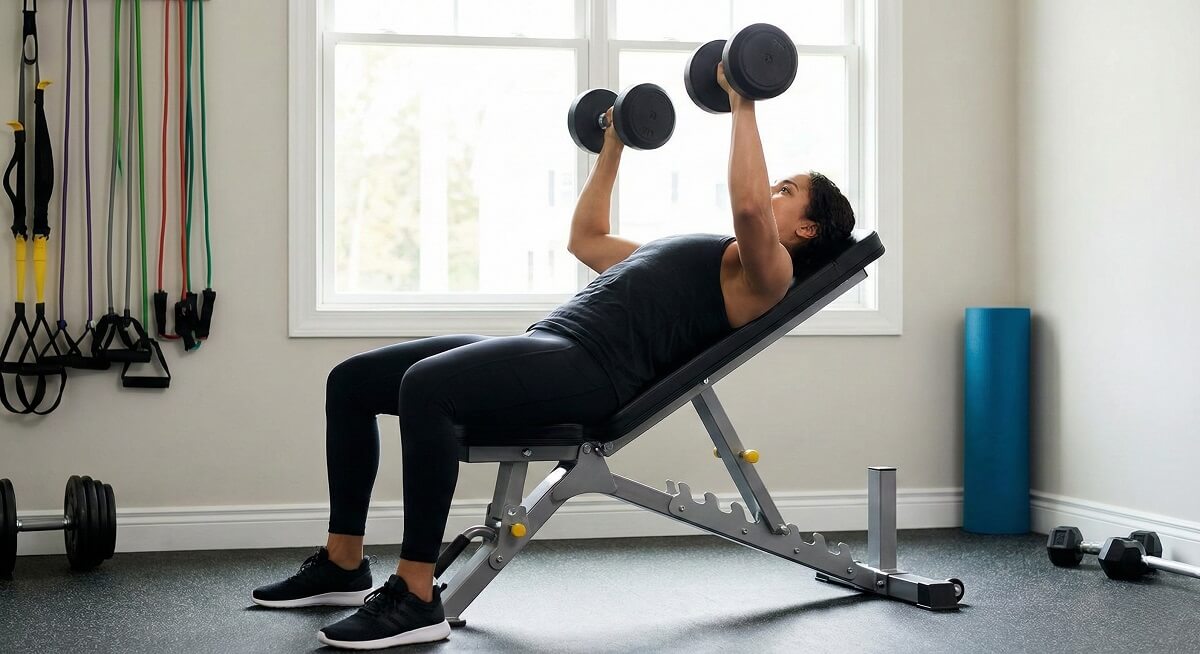
You don’t need a fully-stocked gym to build an impressive chest. A pair of dumbbells and the right exercises can deliver results that match—or even surpass—what you’d get from barbell training. This guide covers the eight most effective dumbbell chest exercises, proper form for each, and ready-to-use workouts for beginners through advanced lifters.
Whether you train at home with minimal equipment or prefer dumbbells over barbells at the gym, you’ll find everything you need here. If you’re setting up a , dumbbells are one of the smartest first investments. The key is understanding which exercises to do, how to do them correctly, and how to structure your training for consistent progress.
Research supports using dumbbells for chest development. Studies published in the Journal of Sports Science and Medicine show that dumbbell exercises can produce similar or higher pectoralis major muscle activation compared to barbell movements. The greater range of motion dumbbells allow means more stretch on the muscle fibers—and more potential for growth.
Is This Guide Right for You?
This Guide Is For You If:
- You train at home with limited equipment
- You want to correct muscle imbalances between your left and right sides
- You prefer the range of motion dumbbells offer over barbells
- You’re looking for shoulder-friendly pressing alternatives
- You want structured workouts you can follow immediately
Skip This If:
- You only care about maximizing your barbell bench press numbers
- You need powerlifting-specific barbell work
- You have no access to any dumbbells
Why Dumbbells Work for Chest Training
Greater Range of Motion
Dumbbells let you lower the weights past chest level—something a barbell physically prevents. This deeper stretch at the bottom of each rep places more tension on the chest fibers at their most lengthened position. That increased stretch can translate to better muscle growth over time.
Balanced Muscle Development
Each arm works independently when you press dumbbells. Your stronger side can’t compensate for your weaker side like it can with a barbell. This forces both sides to do equal work, which helps correct and prevent left-right imbalances that many lifters develop over time.
Shoulder-Friendly Option
Your wrists and elbows can rotate naturally during dumbbell pressing movements. This freedom of movement often reduces strain on the shoulder joint compared to the fixed grip of a barbell. If barbell pressing bothers your shoulders, dumbbells might be the answer. can make a significant difference in your training longevity.
Practical for Home Gyms
A set of adjustable dumbbells takes up far less space than a barbell, plates, and rack. Options like the Bowflex SelectTech 552 (5-52.5 lbs) or PowerBlock Elite (up to 50 lbs, expandable to 90 lbs) can replace an entire rack of fixed dumbbells while fitting in a corner of your living room.
Chest Anatomy: A Quick Overview
Understanding which muscles you’re training helps you select the right exercises and feel them working properly.
Pectoralis Major
This is the large, fan-shaped muscle that makes up the bulk of your chest. According to medical references from NCBI, it has two distinct portions:
- Clavicular head (upper chest): Attaches near your collarbone. Targeted more by incline pressing movements.
- Sternocostal head (mid/lower chest): Attaches to your sternum and ribs. Targeted more by flat and decline pressing.
The pec major’s primary functions are flexion, adduction, and internal rotation of your upper arm—exactly what happens during pressing and fly movements.
Pectoralis Minor
A smaller muscle sitting beneath the pec major. It helps stabilize your shoulder blade during pressing movements. You don’t train it directly, but it activates during most chest exercises. Understanding basic helps you get more from every workout.
Supporting Muscles
Your chest doesn’t work alone. During dumbbell chest exercises, you’ll also engage:
- Anterior deltoid: Front of your shoulder; assists in all pressing
- Triceps: Back of your upper arm; extends your elbow during presses
- Serratus anterior: Sides of your ribs; stabilizes your shoulder blade
The 8 Best Dumbbell Chest Exercises
1. Dumbbell Bench Press
Targets: Full chest, triceps, front delts
How to do it:
- Lie on a flat bench with feet flat on the floor. Hold a dumbbell in each hand at chest level, palms facing your feet.
- Press the dumbbells up until your arms are straight, without locking your elbows aggressively.
- Lower the weights slowly to the sides of your chest, keeping your elbows at roughly a 45-degree angle to your torso.
- Feel a stretch across your chest at the bottom, then press back up.
Sets/Reps: 3-4 sets of 8-12 reps
Pro tip: Squeeze your shoulder blades together and press them into the bench throughout the movement. This creates a stable base and protects your shoulders.
2. Incline Dumbbell Press
Targets: Upper chest emphasis
How to do it:
- Set your bench to a 15-30 degree incline. Steeper angles shift more work to your shoulders.
- Press the dumbbells up from shoulder level until arms are straight.
- Lower with control until dumbbells reach the upper portion of your chest.
Sets/Reps: 3-4 sets of 8-10 reps
Pro tip: Keep the dumbbells in line with your upper chest at the top—pressing them over your face shifts emphasis away from your chest.
3. Decline Dumbbell Press
Targets: Lower chest emphasis
How to do it:
- Set your bench to a 10-15 degree decline and secure your legs.
- Press dumbbells from lower chest level to straight arms above your shoulders.
- Lower with control, maintaining tension throughout.
Sets/Reps: 3 sets of 10-12 reps
Pro tip: Don’t go too steep on the decline—a slight angle is enough to shift emphasis to the lower chest without making the exercise awkward.
4. Dumbbell Floor Press
Targets: Mid-chest, triceps
How to do it:
- Lie on the floor with knees bent and feet flat. Hold dumbbells at chest level.
- Press up until arms are straight.
- Lower until your triceps touch the floor, pause briefly, then press back up.
Sets/Reps: 3-4 sets of 8-10 reps
Pro tip: No bench? No problem. The floor press is a solid alternative that also helps you build strength off the chest by eliminating momentum from the stretch reflex. Check out more if you’re training with minimal gear.
5. Dumbbell Fly
Targets: Chest isolation, inner chest
How to do it:
- Lie on a flat bench with dumbbells pressed above your chest, palms facing each other.
- Keeping a slight bend in your elbows, lower the weights out to your sides in an arc.
- Stop when the dumbbells reach shoulder level or you feel a stretch across your chest.
- Squeeze your chest to bring the weights back together above you.
Sets/Reps: 3 sets of 10-15 reps
Pro tip: Don’t go too deep. Lowering past shoulder level puts unnecessary strain on your shoulder joint without adding benefit.
6. Incline Dumbbell Fly
Targets: Upper chest isolation
How to do it:
- Set bench to 15-30 degrees.
- Perform the fly movement as described above.
Sets/Reps: 3 sets of 12-15 reps
Pro tip: Use lighter weight than flat flyes—the incline position makes the movement more challenging.
7. Crush Press (Squeeze Press)
Targets: Inner chest, triceps
How to do it:
- Lie on a bench with two dumbbells pressed together above your chest, palms facing each other.
- Press the dumbbells together hard throughout the entire movement.
- Lower to your chest while maintaining that inward pressure.
- Press back up, never letting the dumbbells separate.
Sets/Reps: 3 sets of 12-15 reps
Pro tip: Focus on squeezing the dumbbells together as hard as possible—that constant tension is what makes this exercise effective for inner chest development.
8. Dumbbell Pullover
Targets: Chest, lats, serratus
How to do it:
- Lie across a bench so only your upper back rests on the surface, hips below bench level.
- Hold one dumbbell with both hands above your chest, arms nearly straight.
- Lower the weight behind your head in an arc until you feel a deep stretch.
- Pull the weight back over your chest using your chest and lats.
Sets/Reps: 2-3 sets of 12-15 reps
Pro tip: Keep your hips low throughout—this increases the stretch on your chest and serratus.
Common Mistakes to Avoid
Poor form doesn’t just reduce your results—it increases injury risk. Research shows that up to 36% of all resistance training injuries occur at the shoulder. Here’s how to protect yourself:
Flaring Elbows Too Wide
The problem: Elbows pointing straight out to the sides (90 degrees from your torso) places excessive stress on your shoulder joint.
The fix: Keep your elbows at a 45-degree angle to your body. Think about tucking your elbows slightly toward your hips as you lower the weight.
Bouncing at the Bottom
The problem: Using momentum to reverse the weight cheats your muscles and increases injury risk.
The fix: Pause briefly at the bottom of each rep. You should feel the stretch across your chest before pressing back up.
Using Momentum
The problem: Swinging the weights or using body English to lift heavier than you can control.
The fix: Lower the weight for 2-3 seconds on every rep. If you can’t control the descent, the weight is too heavy.
Going Too Heavy Too Soon
The problem: Ego lifting leads to form breakdown and injury.
The fix: Master technique with lighter weights first. Add weight only when you can complete all prescribed reps with proper form.
Neglecting Mind-Muscle Connection
The problem: Going through the motions without focusing on your chest working.
The fix: Actively think about squeezing your chest throughout each rep. Visualize the muscle contracting as you press and stretch as you lower.
Sample Dumbbell Chest Workouts
The American College of Sports Medicine recommends 1-3 sets for beginners and 3-6 sets for advanced lifters, with 6-12 reps per set using 67-85% of your one-rep max for muscle growth. These workouts follow those evidence-based guidelines.
Beginner Workout (20-25 minutes)
| Exercise | Sets | Reps | Rest |
|---|---|---|---|
| Dumbbell Bench Press | 3 | 10-12 | 90 sec |
| Incline Dumbbell Press | 3 | 10-12 | 90 sec |
| Dumbbell Fly | 2 | 12-15 | 60 sec |
Intermediate Workout (30-35 minutes)
| Exercise | Sets | Reps | Rest |
|---|---|---|---|
| Incline Dumbbell Press | 4 | 8-10 | 90 sec |
| Dumbbell Bench Press | 3 | 8-10 | 90 sec |
| Dumbbell Fly | 3 | 10-12 | 60 sec |
| Crush Press | 3 | 12-15 | 60 sec |
Advanced Workout (40-45 minutes)
| Exercise | Sets | Reps | Rest |
|---|---|---|---|
| Incline Dumbbell Press | 4 | 6-8 | 2 min |
| Dumbbell Bench Press | 4 | 6-8 | 2 min |
| Decline Dumbbell Press | 3 | 8-10 | 90 sec |
| Incline Dumbbell Fly | 3 | 10-12 | 60 sec |
| Dumbbell Pullover | 3 | 12-15 | 60 sec |
No-Bench Home Workout
| Exercise | Sets | Reps | Rest |
|---|---|---|---|
| Dumbbell Floor Press | 4 | 8-10 | 90 sec |
| Push-ups on Dumbbells | 3 | 12-15 | 60 sec |
| Floor Fly | 3 | 12-15 | 60 sec |
How to Progress Your Dumbbell Chest Training
Doing the same workout with the same weights week after week won’t build muscle. You need —gradually increasing the challenge over time.
Week-by-Week Progression Plan
- Weeks 1-2: Establish your baseline weights. Focus on learning proper form with weights you can control for all prescribed reps.
- Weeks 3-4: Add 1-2 reps per set while keeping the same weight.
- Weeks 5-6: Increase weight by 5 lbs (total, not per dumbbell) and reset to the lower end of your rep range.
- Week 7: Deload week—reduce volume by 40-50% to recover before your next training block.
Signs You’re Ready to Add Weight
- You can complete all prescribed reps with good form
- The last rep of each set doesn’t feel maximal
- You recover well between training sessions
Equipment Recommendations
Adjustable Dumbbells for Home Training
If you’re building a home gym, offer the best value. They replace multiple pairs of fixed dumbbells while taking up minimal space.
Popular options:
- Bowflex SelectTech 552: Adjusts from 5-52.5 lbs in 2.5 lb increments. Good for beginners to intermediate lifters.
- Bowflex SelectTech 1090: Adjusts from 10-90 lbs. Better for those who need heavier weights.
- PowerBlock Elite: Goes up to 50 lbs (expandable to 90 lbs with kits). Garage Gym Reviews notes these are priced under $500 and are more durable than Bowflex options.
Prices vary, so check current listings at Amazon or the manufacturer’s website.
Bench Options
- Flat bench: Basic and affordable. Works for most pressing movements.
- Adjustable bench: Lets you do incline and decline variations. Worth the extra cost for versatility. The REP Fitness AB-5200 is highly rated for home gyms.
Frequently Asked Questions
How often should I train chest with dumbbells?
Two times per week works well for most people. The ACSM recommends 2-3 training days per week for beginners. This allows 48-72 hours of recovery between sessions—enough time for your muscles to repair and grow.
Can I build a big chest with just dumbbells?
Yes. Dumbbells provide enough resistance for muscle growth as long as you progressively increase the challenge over time. Many lifters prefer dumbbells because the greater range of motion and balanced training can lead to better overall chest development than barbell-only work.
What weight dumbbells should I start with?
According to Strength Level standards, beginner men typically start with 10-20 lbs per hand for chest pressing. Beginner women usually start with 5-10 lbs per hand. Choose a weight that lets you complete 12-15 reps with proper form—if it’s too easy, go heavier; if your form breaks down, go lighter.
Do I need a bench for dumbbell chest workouts?
No. Floor presses, push-ups on dumbbells, and floor flyes all work without a bench. However, a bench does expand your exercise options and allows for incline and decline variations that target different parts of the chest.
How long until I see results?
Strength improvements typically show up within 3-4 weeks of consistent training. Visible muscle changes usually take 8-12 weeks. Results depend on your training consistency, , and recovery.
Should I do compound or isolation exercises first?
Start with compound movements (presses) when you’re fresh—they require more energy and coordination. Finish with isolation exercises (flyes) to fatigue the chest after the heavy work is done.
Is incline or flat bench better for chest?
Both serve different purposes. Flat pressing targets the entire chest with emphasis on the mid-section. Incline pressing shifts more work to the upper (clavicular) portion. Include both for balanced development. breaks this down in more detail.
What’s the difference between dumbbells and barbells for chest?
Dumbbells offer greater range of motion, work each arm independently (correcting imbalances), and are generally easier on shoulders. Barbells allow you to lift heavier total weight and are better for testing maximal strength. For pure muscle building, both work well—use whichever you prefer and have access to.
Get Started Today
Pick one of the workouts above that matches your experience level and commit to it for the next 6-8 weeks. Track your weights and reps, focus on proper form, and progressively add challenge over time. That’s the formula for building a stronger chest.
Need equipment? Check current prices on adjustable dumbbells and benches at Amazon, Bowflex, or REP Fitness.
