


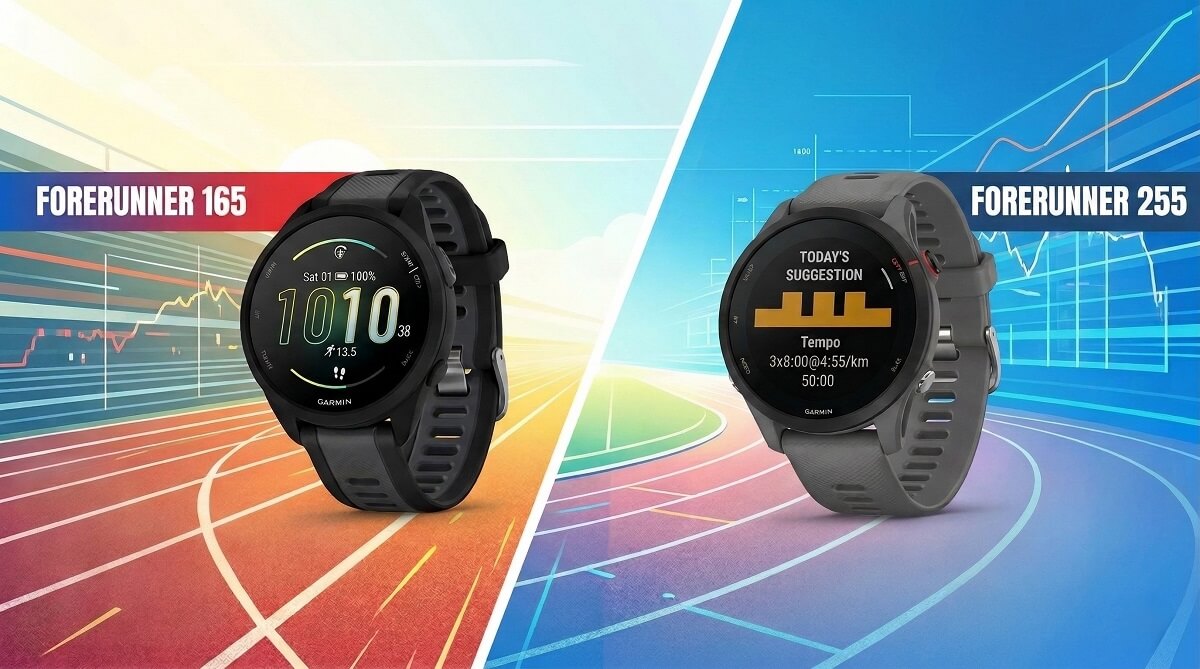
The Garmin Forerunner 255 wins for serious athletes who need multisport tracking, advanced training analytics, and marathon-distance battery life. The Forerunner 165 wins for casual runners who prioritize a gorgeous AMOLED display and simplified user experience. Both typically sell for around $199-249 depending on sales, making this less about price and more about which features matter to you.
The main tradeoff is straightforward: The 165 gives you a bright, modern touchscreen that’s enjoyable to use daily, while the 255 packs more training features like Training Status and Training Load, plus triathlon mode and 30-hour GPS battery. The 255 launched in 2022 but remains widely available, often discounted. The 165 arrived in 2024 as Garmin’s entry-level AMOLED option.
Both share core features—GPS tracking, heart rate monitoring, sleep analysis, Body Battery, and basic training metrics. Choose the 255 if you do triathlons, connect power meters, or want detailed training analytics. Pick the 165 if you mostly run or hit the gym and want a watch that’s pleasant to glance at throughout the day. As of February 2026, the FR165 sells for $199-225 at major retailers, while the FR255 frequently goes on sale for similar prices despite its original $349 launch price.
Quick Decision Guide
✅ Choose Forerunner 255 if you:
- Do triathlons or multisport training (swim-bike-run transitions)
- Want detailed training analytics (Training Status, Training Load)
- Need longer battery life (30 hours GPS vs 19 hours)
- Connect to cycling power meters or smart trainers
- Prefer two size options (255s at 41mm, 255 at 46mm)
- Do winter sports like skiing or snowboarding
- Want dual-band GPS for challenging environments
✅ Choose Forerunner 165 if you:
- Focus mainly on running, walking, or gym workouts
- Prioritize screen quality and easy-to-read display
- Prefer intuitive touchscreen controls over button-only
- Want a newer model with modern AMOLED technology
- Don’t need extensive training metrics and analytics
- Like a simplified, less overwhelming user experience
❌ Skip both if you:
- Need full smartwatch features (calls, apps, cellular)—consider Apple Watch or Samsung Galaxy Watch
- Want multi-week battery life—check out Garmin Instinct series or Fenix
- Are on a tight budget under $150—look at Garmin Forerunner 55 or Coros Pace 3
Price Comparison and Where to Buy
The Forerunner 165 launched at $249 (standard) and $299 (Music edition). As of February 2026, it’s commonly on sale for $199-225 at Amazon and Best Buy. The Forerunner 255 originally cost $349 ($399 for Music), but you’ll frequently find it discounted to $199-299 range—sometimes even matching or undercutting the 165’s price.
This pricing makes the 255 a remarkable value. You’re getting a watch that was Garmin’s upper mid-tier model from 2022, now at entry-level prices. The catch? It has a dimmer Memory-in-Pixel (MIP) display instead of the 165’s vibrant AMOLED screen. That’s the core tradeoff.
Current Pricing Breakdown
- Forerunner 165: $199-225 (sale price, regularly $249)
- Forerunner 165 Music: Around $275-299 (regularly $299)
- Forerunner 255: $199-299 (frequent sales, was $349)
- Forerunner 255 Music: $285-350 (was $399)
Both watches come in Music editions that add $50 to the base price. Music models include 4GB storage (about 500 songs), WiFi for syncing, and work with Spotify, Amazon Music, and Deezer for offline playback.
Where to buy: Check current prices at Amazon and Best Buy for the latest deals. Prices fluctuate, so it’s worth waiting for sales if you’re not in a rush.
Specifications Comparison Table
Here’s how the two watches stack up spec-by-spec:
| Feature | Forerunner 165 | Forerunner 255 | Winner |
|---|---|---|---|
| Display type | 1.2″ AMOLED touchscreen (390×390 px) | 1.3″ MIP, no touch (260×260 px) | 165 for quality |
| Battery (smartwatch) | 11 days | 14 days | 255 |
| Battery (GPS) | 19 hours | 30 hours | 255 |
| GPS type | Standard multi-GNSS | Dual-band multi-GNSS | 255 |
| Weight | 39g (1.4 oz) | 49g / 1.7 oz (46mm) | 165 |
| Size options | 43mm only | 41mm (255s) or 46mm | 255 |
| Touchscreen | Yes | No | 165 |
| Triathlon mode | No | Yes | 255 |
| Training Status | No | Yes | 255 |
| Training Load | No | Yes | 255 |
| Training Readiness | No | No | Tie |
| Power meter support | No | Yes | 255 |
| Skiing modes | No | Yes | 255 |
| Music storage | 4GB (Music version) | 4GB (Music version) | Tie |
| Water resistance | 5 ATM (50m) | 5 ATM (50m) | Tie |
| Glass protection | Chemically strengthened | Gorilla Glass 3 | 255 |
Both watches share sensors like heart rate (Elevate V4), SpO2, barometric altimeter, compass, accelerometer, and thermometer. They’re both rated for swimming (5 ATM = 50 meters), though that’s suitable for pool and casual open water swimming, not deep diving.
Display and Design: AMOLED vs MIP
Screen Technology Differences
The most obvious difference between these watches is the display. The Forerunner 165 features a 1.2-inch AMOLED touchscreen with 390×390 pixel resolution. It’s bright, colorful, and easy to read indoors or under tree cover. The always-on mode looks sharp, though it does drain the battery faster than raise-to-wake.
The Forerunner 255 uses a 1.3-inch Memory-in-Pixel (MIP) display at 260×260 resolution. This older screen technology is always-on without battery penalty and excels in direct sunlight. However, it looks noticeably dimmer and less saturated than the 165’s AMOLED. The 255 feels like reading an e-reader, while the 165 feels like a modern smartwatch.
If you’re coming from an Apple Watch or recent Samsung device, the 255’s screen will feel like a step backward. But if you spend lots of time outdoors in bright sun, the MIP display is perfectly readable without needing a backlight.
Physical Design and Build Quality
Both watches use polycarbonate cases with fiber-reinforced polymer construction. They’re sporty-looking but not particularly premium. The Forerunner 165 weighs just 39 grams and comes in one 43mm size. The Forerunner 255 weighs 49 grams in the standard 46mm size, with a lighter 39-gram option in the 255S (41mm).
The 255 gets Gorilla Glass 3 protection over its display, while the 165 uses “chemically strengthened glass” (Garmin’s term for an unnamed alternative). In practice, both should handle normal wear without scratching, but the 255 has slightly better impact protection on paper.
Band compatibility is identical—both use standard 20mm quick-release straps. The included silicone bands are comfortable and handle sweat well.
Touchscreen vs Button-Only Navigation
The Forerunner 165 adds a touchscreen, which makes navigation more intuitive for everyday use. Swiping through widgets and tapping to select feels natural if you’re used to smartphones. The 255 relies entirely on five physical buttons arranged around the bezel.
Buttons have advantages: they work with gloves, in rain, and when you’re sweaty. During workouts, some runners prefer the tactile feedback of pressing a physical lap button rather than swiping a touchscreen. The 165 includes both touchscreen and buttons, giving you options. The 255 gives you only buttons.
Winner: Forerunner 165 for display quality and modern user experience. The 255 wins for outdoor readability and battery efficiency.
Battery Life: Real-World Performance
Official Battery Claims
According to Garmin’s specifications, the Forerunner 165 lasts up to 11 days in smartwatch mode and 19 hours with GPS active. Add music playback during GPS tracking, and you’re down to about 7 hours.
The Forerunner 255 claims 14 days in smartwatch mode and 30 hours of GPS tracking (26 hours for the smaller 255S). With music, that drops to about 7 hours for GPS—same as the 165.
What Battery Life Means for Your Training
For most runners, both watches provide plenty of battery. If you run 3-4 times per week for an hour each, you’ll charge the 165 roughly once per week and the 255 every 10-12 days. Marathon runners can complete a full race on either watch without worry.
The 255 pulls ahead for ultramarathoners and adventure racers. That 30-hour GPS rating means you can track a 50-mile race or multi-day hiking trip without reaching for a charger. The 165’s 19-hour GPS battery won’t cover ultra-distance events.
Independent testing by Runner’s World and CleverHiker found the Forerunner 165 lasted about 17 hours of continuous GPS use in real conditions, slightly under Garmin’s 19-hour claim. One tester burned 21% battery during a 4-hour marathon, which projects to about 19 hours total. With always-on AMOLED display enabled in daily use, expect 5-8 days between charges rather than the advertised 11 days.
Battery Saving Features
Both watches offer battery saver modes that disable sensors and reduce screen refresh rates. The 165 can stretch to 20 days in battery saver mode. You can also choose GPS-only mode (instead of all-systems mode that uses GPS + GLONASS + Galileo simultaneously) to extend tracking time at the cost of slightly less accuracy.
The 255’s SatIQ feature automatically switches between standard and dual-band GPS based on conditions, balancing accuracy and battery life. The 165 doesn’t have this because it lacks dual-band GPS entirely.
Winner: Forerunner 255 for serious endurance athletes. The 165 provides adequate battery for typical training schedules.
GPS Accuracy and Performance
GPS Technology Explained
The Forerunner 165 uses standard multi-GNSS positioning, connecting to GPS, GLONASS, and Galileo satellite systems. This is the same GPS tech found on most running watches and provides solid accuracy in typical conditions.
The Forerunner 255 upgrades to dual-band (multi-frequency) GNSS, which can receive signals on two different frequencies from each satellite. This helps in challenging environments where signals bounce off tall buildings (urban canyons) or get blocked by dense tree cover.
Real-World Accuracy Testing
Here’s the surprise: multiple reviewers, including DC Rainmaker, found the Forerunner 165’s GPS accuracy to be excellent despite using single-band technology. In side-by-side testing against dual-band watches, the 165 matched their accuracy for distance and pace in most scenarios.
The 255’s dual-band GPS provides an edge in truly difficult conditions—think running between 30-story buildings in Manhattan or on heavily wooded trails. For suburban and rural running, the difference between single-band and dual-band is minimal in practice.
Both watches include a barometric altimeter for elevation tracking, which is more accurate than GPS-only elevation. This matters for trail running and hiking where you want reliable climb/descent data.
Winner: Forerunner 255 technically, but the 165’s GPS is highly accurate for the vast majority of runners.
Training Features: Where the 255 Pulls Ahead
What Training Features the FR165 Has
The Forerunner 165 isn’t bare-bones. You get daily workout suggestions based on your fitness level, VO2 max estimates, race time predictions for 5K through marathon, and recovery time advisories after hard efforts. Body Battery shows your energy levels throughout the day, and you get full sleep tracking with sleep scores.
Heart rate zone training works on both watches, showing which zone you’re in during workouts. HRV (heart rate variability) status tracks your recovery and stress levels. These are the core metrics that most recreational runners actually use.
Advanced Features Only on FR255
The Forerunner 255 adds three major training metrics the 165 lacks:
Training Status analyzes your recent workouts and tells you whether your training is productive, maintaining, peaking, or unproductive. Think of it as what your coach would say if they reviewed your training log. If you’re doing too many hard efforts without recovery, it’ll flag “unproductive” or “overreaching.”
Training Load tracks your acute load (last 7 days) and shows whether you’re ramping up too quickly or backing off. Load Ratio compares your current load to your 4-week average, warning you before you overtrain. Load Focus shows whether your training is balanced across low, moderate, and high-intensity efforts.
Additional metrics on 255 only: Lactate threshold detection (requires chest strap), ClimbPro for ascent planning, Performance Condition (shows how recovered you are 6-20 minutes into a run), and running power metrics (though the 165 has this too, actually).
Do You Actually Need These Features?
Be honest: will you check Training Status weekly and adjust your workouts based on Load Focus? If you’re training for a specific race with a structured plan, these metrics are genuinely useful. They help prevent overtraining and identify when you need more recovery.
If you run casually 2-3 times per week to stay fit, you probably don’t need them. The core metrics on the FR165—heart rate zones, VO2 max, recovery time—are sufficient for general fitness.
One note: even if you buy the FR165, you can see some training metrics in the Garmin Connect app if you also own a Garmin bike computer (like an Edge 840) that supports Training Load. The metrics pool across devices on your account.
Winner: Forerunner 255 for data-driven athletes following structured training plans.
Activity Tracking: Sport Profiles and Multisport
Activities Both Watches Track
The Forerunner 165 includes 25+ built-in activity profiles: Run, Track Run, Treadmill, Virtual Run, Indoor Track, Trail Run, Ultra Run, Hike, Walk (indoor and outdoor), Bike (road and indoor), Pool Swim, Open Water Swim, Cardio, Strength, HIIT, Yoga, Pilates, Breathwork, Tennis, Pickleball, Padel, Elliptical, Stair Stepper, and Floor Climb.
That covers the activities most people actually do. You can track your morning run, lunchtime strength session, and evening yoga class without issue.
What FR255 Adds
The Forerunner 255 expands to 60+ activities, adding mountain biking, skiing, snowboarding, ice skating, inline skating, and team sports like soccer, basketball, hockey, football, lacrosse, rugby, cricket, softball, and baseball. It also includes niche activities like boxing, mixed martial arts, archery, and SUP (stand-up paddleboarding).
More significantly, the 255 offers multisport and triathlon modes. These let you record swim-bike-run as a single activity with transitions tracked automatically. Press the lap button when you exit the water and hop on your bike—the watch knows you’re switching sports and starts tracking accordingly.
The Multisport/Triathlon Advantage
If you do triathlons or brick workouts (bike immediately followed by run), the 255 is essential. The 165 can track swimming, biking, and running individually, but not as a single connected workout. You’d need to stop one activity, save it, and start a new one—losing your transition times.
For duathlons, multisport races, or training sessions where you switch activities, the 255’s multisport mode saves hassle and provides cleaner workout data.
Winner: Forerunner 255 for multisport athletes and triathletes. The 165 works fine for single-sport training.
Sensor Connectivity and Accessories
What External Sensors Each Watch Supports
Both watches connect to external heart rate chest straps (like the Garmin HRM-Pro or Polar H10) via ANT+ and Bluetooth. They also support running foot pods for treadmill pace/distance and can pair with Bluetooth headphones for music.
The Forerunner 255 adds connectivity for cycling power meters, smart trainers (for Zwift, TrainerRoad, etc.), Garmin Varia radar devices, and the Running Dynamics pod. It also works with extended display mode, letting you use the watch as a remote display for your Garmin bike computer.
Why Power Meter Support Matters
If you cycle seriously or train indoors, power meters provide precise effort measurement. The 255 can display your watts, track power zones, and record power data to Garmin Connect. The 165 cannot—a puzzling omission given that even Garmin’s sub-$200 bike computers support power meters.
This limits the 165 for cyclists who want one device for both running and cycling training. You can still track bike rides (speed, distance, heart rate), but you can’t see or record power data.
Winner: Forerunner 255 for cyclists and indoor training enthusiasts.
Heart Rate Accuracy: A Known Concern
Optical HR Sensor Technology
Both watches use the Garmin Elevate V4 optical heart rate sensor on the back of the watch case. This sensor shines light into your wrist and measures blood flow changes to calculate heart rate. It’s convenient because it’s built-in, but wrist-based HR has inherent limitations compared to chest straps.
User Reports on HR Accuracy Issues
Here’s where we need to be honest: multiple Garmin forum threads report optical heart rate accuracy problems on the Forerunner 165, 255, 265, 955, 965, Fenix 7, and Epix Pro models. Users report the watch showing 100-120 bpm when their actual heart rate (measured with a chest strap) is 160-180 bpm. Other users see slow response times, where the watch takes minutes to register that heart rate has increased during intervals.
These issues appear to have worsened after firmware v16.xx updates. Garmin released a public beta fix in January 2025 addressing HR zone problems, but forum discussions suggest the issues aren’t fully resolved for all users.
Best Practices for Better HR Accuracy
To improve optical HR accuracy on either watch:
- Wear the watch snug but not too tight (about two fingers’ width above your wrist bone)
- Clean the sensor regularly to remove sweat residue and oils
- Give the watch 10-15 minutes to settle before intense workouts
- Avoid cadence lock (when the watch reads your running cadence as heart rate—common at 160-180 steps per minute)
For interval training, tempo runs, or any workout where accurate HR matters, consider pairing a chest strap. The Garmin HRM-Pro or HRM-Dual, or third-party options like the Polar H10, provide significantly more accurate readings. Both watches support external HR monitors seamlessly.
Reality check: Optical HR limitations affect both watches similarly. If precise heart rate data drives your training decisions, budget for a chest strap regardless of which watch you choose.
Smartwatch Features: Both Are Limited
What Smart Features You Get
Both watches handle smartphone notifications (texts, calls, app alerts), though you can’t answer calls from the watch itself. Music editions store about 500 songs from Spotify, Amazon Music, or Deezer for phone-free listening. Garmin Pay lets you tap to pay at NFC terminals, and the Connect IQ store offers watch faces and simple apps.
Safety features include incident detection (notifies emergency contacts if the watch detects a fall or impact) and LiveTrack (lets people follow your run in real-time via a shared link). Both watches sync to the Garmin Connect app for detailed workout analysis and route planning.
What You Don’t Get
Don’t expect Apple Watch or Samsung Galaxy Watch smart features here. Neither Garmin can make or receive phone calls (even Music editions don’t have speakers or mics for calls). There’s no voice assistant, no cellular connectivity, and the app ecosystem is minimal—Connect IQ apps are basic utilities, not full smartphone apps.
Music must be downloaded in advance; you can’t stream. Third-party app integration is limited to fitness services. If you need a full smartwatch that happens to track running, you want an Apple Watch or Galaxy Watch, not a Forerunner.
Tie: Both have identical basic smart features—adequate for fitness-focused users but not smartwatch replacements.
FR255 vs FR265: Where Do These Watches Fit in 2026?
Where Does FR165 and FR255 Fit in the Lineup?
The Forerunner 265 replaced the 255 in March 2023, adding an AMOLED screen and Training Readiness feature. Garmin still sells the 255 alongside the newer 265, creating some overlap. The 165 arrived in February 2024 as the entry-level AMOLED option, slotting below the 265.
Current Garmin Forerunner lineup (simplified):
- FR55 ($200): Basic runner’s watch
- FR165 ($249): Entry AMOLED for runners
- FR255 ($349, often $199-249 on sale): Multisport with MIP display
- FR265 ($450, sometimes $300-350 on sale): Multisport with AMOLED and Training Readiness
- FR965 ($600): Premium with maps and full features
Quick FR265 Comparison
The Forerunner 265 combines the 165’s AMOLED screen with the 255’s advanced features, plus adds Training Readiness (a morning score showing how recovered you are for training). It uses slightly improved Elevate V5 heart rate sensors.
The 265 typically sells for $450, though sales sometimes drop it to $300-350. That’s $200+ more than the 165 or the sale price 255.
When FR265 Makes Sense Over Both 165 and 255
Choose the Forerunner 265 if you want everything: AMOLED screen, Training Readiness, Training Status, Training Load, multisport modes, and long battery. It’s the watch for serious athletes who also want a modern display.
Stick with the FR165 if you don’t need advanced training metrics and want to save $200. Grab the FR255 if you need those training features and multisport but don’t care about AMOLED—especially when you can find it for $199-249 on sale.
Who Should Buy Each Watch
Forerunner 165 Is Perfect For:
- New runners building base fitness and learning about training metrics without overwhelming complexity
- Casual fitness enthusiasts who run 2-3 times per week and complement with gym workouts or yoga
- Upgraders from basic trackers (Fitbit, Garmin Vivosmart) wanting a proper GPS watch
- Display priority users who value screen quality and readability over feature count
- Simplicity seekers who find too many metrics and settings overwhelming
- Non-multisport athletes who stick to running, walking, and gym activities without triathlons
Forerunner 255 Is Perfect For:
- Triathletes and multisport athletes needing seamless swim-bike-run transitions
- Serious marathoners training with structured plans who benefit from Training Status and Load analysis
- Data-driven runners who review training analytics weekly and adjust plans accordingly
- Cyclists who want power meter connectivity for bike training
- Winter sports enthusiasts needing ski and snowboard tracking
- Ultramarathoners needing 30-hour GPS battery for ultra-distance events
- Athletes “growing into” features who want room to expand their training as they progress
Consider Alternatives If:
- Budget under $150: , Coros Pace 3
- Need maps and navigation: Garmin Forerunner 265, 965, or Fenix series
- Want smartwatch + fitness: Apple Watch SE/Ultra, Samsung Galaxy Watch 6
- Need multi-week battery: Garmin Instinct 2, Fenix 7, Enduro
Frequently Asked Questions
Which is better, Forerunner 165 or 255?
Neither is objectively “better”—it depends on your training needs. The FR255 is better for serious multisport athletes who want Training Status, Training Load, triathlon mode, and 30-hour GPS battery. The FR165 is better for casual runners who prioritize a beautiful AMOLED display and simplified user experience. Both typically sell for $199-249 on sale, so price isn’t the deciding factor.
Does the Forerunner 165 have an AMOLED screen?
Yes, the FR165 features a 1.2-inch AMOLED touchscreen with 390×390 pixel resolution. It’s bright, colorful, and easy to read indoors or in shade. The always-on mode looks sharp but reduces battery life. The FR255 uses a dimmer Memory-in-Pixel (MIP) display that excels in direct sunlight but looks less modern.
Can the Forerunner 165 track triathlons?
No, the FR165 lacks multisport mode. It can track swimming, biking, and running individually, but not as a single triathlon activity with transitions. You’d need to stop one activity, save it, and start the next, losing your transition times. The FR255 includes dedicated triathlon and multisport modes that handle transitions automatically.
Is the Forerunner 255 still worth buying in 2026?
Yes, especially at sale prices of $199-249. The 255 launched in 2022 and was partially replaced by the FR265 in 2023, but it remains an excellent value. You get nearly identical features to the FR265 minus the AMOLED screen and Training Readiness. For athletes who don’t care about display technology, the 255 at $200 is one of the best deals in GPS watches.
What’s the battery life difference?
The FR255 lasts 14 days in smartwatch mode and 30 hours with GPS active. The FR165 lasts 11 days in smartwatch mode and 19 hours with GPS. In real-world testing, reviewers found the 165 delivered about 17 hours of GPS runtime (vs the claimed 19) and 5-8 days of smartwatch use with always-on AMOLED (vs claimed 11 days). The 255’s battery claims are accurate to real-world use.
Does the Forerunner 165 have Training Status and Training Load?
No, the FR165 lacks Training Status, Training Load, and Training Readiness features. You need the FR255, FR265, or higher models for these advanced training analytics. The FR165 does provide basic metrics like VO2 max, recovery time, Body Battery, and daily workout suggestions, which are sufficient for recreational runners.
Can I connect a heart rate chest strap to both watches?
Yes, both support external heart rate monitors via ANT+ and Bluetooth. Compatible straps include the Garmin HRM-Pro, HRM-Dual, Polar H10, Wahoo TICKR, and most other ANT+ or Bluetooth HR straps. Given reported optical HR accuracy issues, a chest strap is recommended for interval training or any workout where precise heart rate data matters.
Which watch is more accurate for GPS?
The FR255 has dual-band GPS which is technically more accurate in challenging conditions like urban canyons or dense forests. However, independent reviewers found the FR165’s single-band GPS to be excellent in most real-world scenarios. Unless you regularly run between tall buildings or under heavy tree cover, you likely won’t notice a difference in GPS accuracy between the two watches.
Do both watches support Garmin Pay?
Yes, both include Garmin Pay for contactless payments at NFC-enabled terminals. You can add credit cards to your Garmin account and pay with a tap of your watch at retailers that accept contactless payments.
Should I get the Music edition?
Get the Music edition if you want to run without your phone and listen to music or podcasts. Music editions add 4GB storage (about 500 songs), WiFi for syncing playlists, and cost $50 more on both models. You’ll need premium subscriptions to Spotify, Amazon Music, or Deezer to download content. If you always carry your phone on runs, save the $50 and get the standard edition.
Final Verdict and Recommendations
Both the Garmin Forerunner 165 and 255 are excellent GPS running watches at similar price points when on sale. The FR255 wins on features, battery life, and versatility—it’s the watch for athletes who do triathlons, follow structured training plans, or want detailed analytics. The FR165 wins on display quality and modern user experience—it’s the watch for runners who want essential features in an enjoyable package.
The core difference comes down to this: Do you need Training Status, Training Load, multisport mode, 30-hour GPS battery, and power meter connectivity? If yes, get the 255. Do you value a bright AMOLED touchscreen and simplified metrics? Get the 165.
Our Recommendations:
Best for most runners: Forerunner 165
The gorgeous AMOLED display makes this watch enjoyable to use every day. You get all essential running features—GPS tracking, heart rate zones, VO2 max, training suggestions, sleep tracking—without overwhelming complexity. The touchscreen feels modern and intuitive. At $199-225 on sale, it’s excellent value for recreational runners and fitness enthusiasts.
Best for serious athletes: Forerunner 255
Training Status and Training Load help prevent overtraining and optimize your schedule. Multisport mode is essential for triathletes. The 30-hour GPS battery handles ultra-distance events. Power meter connectivity matters for cyclists. When you can find it for $199-249 on sale (frequently), it’s arguably the best value in GPS sports watches—you’re getting an upper mid-tier watch at entry-level prices.
Best overall (budget allowing): Forerunner 265
The FR265 combines the 165’s AMOLED screen with the 255’s training features, plus adds Training Readiness. At $450 (sometimes $300-350 on sale), it costs $200+ more than these models. Worth it if you’ll actually use Training Readiness and want the best of both worlds.
Neither watch is a wrong choice. The 165 vs 255 decision isn’t about which is “better”—it’s about matching features to your actual training needs and preferences.
Where to Buy
Check current prices:
- Garmin Forerunner 165 on Amazon
- Garmin Forerunner 255 on Amazon
- Garmin Forerunner 165 at Best Buy
- Garmin Forerunner 255 at Best Buy
What to look for: Both watches go on sale regularly. The FR255 often drops to $199-249 (down from $349), while the FR165 sees $50 discounts to $199. Watch for bundle deals that include a heart rate chest strap. Check whether you want the Music edition ($50 extra) or standard model.
Disclosure: ChubbytIps earns commission from purchases through retailer links at no extra cost to you. We only recommend products we’d buy ourselves.
