


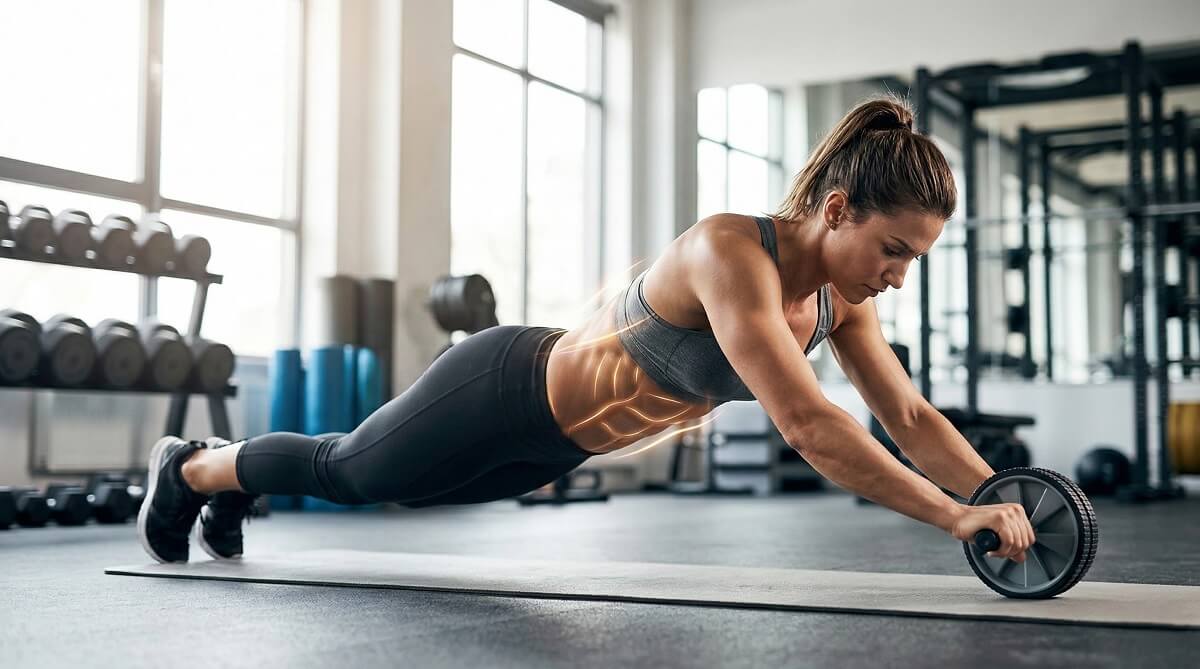
Ab rollers deliver real results if you use them correctly. This simple piece of equipment engages more core muscles than traditional crunches, while also working your shoulders, back, and arms. with ab rollers has been validated by research — a 2006 study published in Physical Therapy showed that ab wheel devices activate your core muscles significantly more effectively than standard floor exercises, with over 100% greater activation in some muscle groups compared to basic crunches.
The main appeal? You get a comprehensive core workout without expensive gym equipment. Ab rollers typically cost $15-40 and take up minimal space in your home. But they’re not beginner-friendly right out of the gate. Poor form can strain your lower back, so you’ll need to start with modifications and build up gradually. If you can’t for at least 30 seconds, you’re probably not ready for an ab roller yet.
The catch: ab rollers alone won’t give you visible abs. You’ll need to combine them with and cardio to reduce body fat. But for building core strength, improving stability, and working multiple muscle groups at once, ab rollers are among the most efficient tools available. They burn approximately 4.8 calories per minute while engaging 15-20 different muscles simultaneously.
Who Should (and Shouldn’t) Use an Ab Roller
✅ An ab roller is right for you if:
- You have basic core strength (can hold a plank for 30+ seconds)
- You want to strengthen your entire core, not just your abs
- You’re looking for affordable, portable workout equipment
- You need better posture and lower back support
❌ Skip the ab roller if:
- You have active lower back injuries or chronic pain
- You’re brand new to core training (start with and dead bugs first)
- You have shoulder mobility issues or rotator cuff problems
- You expect visible abs without changing your diet
What Is an Ab Roller?
An ab roller is a wheel with handles on each side. That’s it. The design hasn’t changed much in decades because it doesn’t need to. You grip the handles, roll forward while keeping your core engaged, then roll back to the starting position. The simple rolling motion forces your stabilizer muscles to work overtime, which is what makes this tool so effective.
You’ll find two main types: single-wheel and double-wheel designs. Single wheels are narrower (around 2 inches wide) and more challenging because they require better balance. Double wheels or wider wheels (3-4 inches) offer more stability, making them better for beginners. Some newer models include features like automatic rebound springs, elbow support pads, and ergonomic handles with foam padding.
Most ab rollers cost between $15 and $40. Budget models around $15-20 work fine for basic rollouts. Mid-range options at $25-35 typically offer better grip quality and durability. Premium models pushing toward $40-50 might include or resistance settings, though these features aren’t necessary for effective workouts.
Science-Backed Benefits of Using an Ab Roller
Research supports what fitness trainers have known for years — ab rollers deliver measurable results. Here’s what the science actually shows.
Activates More Muscles Than Traditional Crunches
A 2006 study by Escamilla et al. published in Physical Therapy tested 21 participants using surface EMG to measure muscle activation during various ab exercises. The researchers found that ab wheel rollouts produced among the highest muscle activation for the upper rectus abdominis, lower rectus abdominis, internal obliques, and latissimus dorsi compared to traditional exercises.
Research from the American Council on Exercise (ACE) showed that ab roller rollouts produce EMG activation of the rectus abdominis over 100% greater than baseline measurements for traditional crunches. That’s not a typo — more than double the activation.
The ab roller engages your rectus abdominis (the six-pack muscle), obliques, and transverse abdominis simultaneously. But it doesn’t stop there. Your lats, deltoids, and triceps work as stabilizers throughout the movement. Depending on your form and range of motion, you’re working 15-20 different muscle groups at once.
Builds Functional Core Strength
Ab rollers train what fitness professionals call “anti-extension” — your core’s ability to prevent your back from arching. This matters more than traditional ab exercises for real-world activities. When you lift a heavy box, bend to pick something up, or twist to grab something behind you, your core needs to stabilize your spine through dynamic movements.
train your abs in isolation. Ab rollers force your entire core to work as a coordinated system, which transfers better to athletic performance and daily activities. This is functional strength, not just muscle size.
Improves Posture and Reduces Lower Back Pain
Strong core muscles provide better support for your spine. Ab rollers strengthen your spinal erector muscles along with your abs, which helps maintain proper spinal alignment. Many people with find that regular ab roller training counteracts the forward-slouching posture from sitting all day.
Important caveat: this only works with proper form. Poor form — especially letting your back arch — can actually cause lower back pain. You need to maintain a slightly rounded back position throughout the movement, which teaches proper spinal control.
Time-Efficient Full-Body Workout
Ab rollers engage your upper and lower body simultaneously. While your core does the primary work, your shoulders, arms, chest, and even legs (if you’re doing standing rollouts) contribute to the movement. This makes ab roller sessions more efficient than spending 20 minutes doing isolated .
A solid ab roller workout takes 10-15 minutes. You’re getting comprehensive core training plus upper body stabilization work in less time than most traditional ab routines. The dynamic movement also elevates your heart rate more than static exercises, adding a cardiovascular component.
Enhances Balance and Stability
Rolling out with an ab wheel forces your body to coordinate multiple muscle groups while maintaining balance. This improves proprioception — your body’s awareness of its position in space. Better proprioception translates to improved balance in other activities.
The instability of the wheel also builds joint stability, particularly in your shoulders. Your rotator cuff muscles work to stabilize the shoulder joint throughout the movement, which can reduce injury risk in other activities that stress your shoulders.
Burns More Calories Than Static Ab Exercises
Ab rollers burn approximately 4.8 calories per minute, which works out to roughly 288 calories per hour of continuous exercise (though you won’t actually do an hour straight). This is similar to the calorie burn from crunches — about 55 calories per 10 minutes for a 160-pound person.
The difference is that ab rollers engage significantly more muscle mass. More muscle engagement means higher metabolic demand, which contributes to overall fat loss when combined with a proper diet. Ab rollers won’t spot-reduce belly fat, but they contribute more to your total daily calorie expenditure than isolated ab exercises.
Portable and Affordable
Most ab rollers cost $15-40. Compare that to a gym membership at $30-60 per month, and you’ve paid for your ab roller in the first month. The equipment fits in a backpack or suitcase, so you can maintain your routine while traveling.
Ab rollers don’t need electricity, batteries, or maintenance. A decent model can last years with regular use. This makes them one of the best value investments for home fitness equipment.
What Muscles Do Ab Rollers Actually Work?
Ab rollers engage more muscles than the name suggests. Here’s the breakdown:
Primary muscles:
- Rectus abdominis — The “six-pack” muscle running down the front of your abdomen
- External and internal obliques — Side abs that handle rotation and lateral flexion
- Transverse abdominis — Deep core stabilizer that acts like a natural weight belt
Secondary muscles:
- Latissimus dorsi — Lats in your back help control the rollout
- Deltoids — Shoulders stabilize throughout the movement
- Triceps — Back of arms work to control arm extension
- Erector spinae — Lower back muscles maintain spinal position
- Hip flexors — Help control pelvic position
- Glutes — Engaged to prevent hip sagging
The exact number of muscles engaged depends on your form and range of motion. Conservative estimates put it at 15 different muscle groups, while some sources cite up to 20 when accounting for all stabilizers.
How to Use an Ab Roller Correctly (Avoid These Mistakes)
Proper Form: Step-by-Step
- Start position: Kneel on a with the ab roller in front of you. Grip the handles with both hands, shoulder-width apart. Engage your core before you start moving.
- Roll out: Extend your arms forward while keeping your back straight or slightly rounded. Don’t let your hips sag or your back arch.
- Key cue: Think about rounding your back slightly, like you’re doing a crunch. This protects your lower back.
- Full extension: Roll out only as far as you can maintain core tension. For beginners, this might be just a few inches. That’s fine.
- Roll back: Pull yourself back to the starting position using your core and lats, not just your arms. This is the hardest part.
- Breathing: Exhale as you roll out, inhale as you roll back in.
Common Mistakes That Cause Injury
- Arching your back — This is the biggest mistake and the main cause of lower back strain. Keep your core tight and back slightly rounded.
- Going too far too soon — Start with partial rollouts. You don’t need to touch your nose to the floor on day one.
- Using only arms — Your core should pull you back, not your arms. If your arms are exhausted but your core isn’t, you’re doing it wrong.
- Locked elbows — Keep a slight bend in your elbows to protect your joints.
- Rolling on carpet — Use a hard surface or yoga mat. Carpet provides too much resistance and can throw off your form.
Progression for Beginners
Don’t start with full kneeling rollouts if you’re new to this. Follow this progression:
Level 1: Wall rollouts — Stand facing a wall, place the roller on the wall at shoulder height, and roll up the wall. This lets you control the difficulty with your body angle.
Level 2: Incline rollouts — Use a bench or sturdy box at 30-45 degrees. Roll out on the incline surface. Gravity provides less resistance than flat ground.
Level 3: Kneeling rollouts (partial range) — Start on your knees but only roll out 6-12 inches. Focus on maintaining tension and proper form.
Level 4: Kneeling rollouts (full extension) — Once partial rollouts feel manageable, gradually extend your range until your arms are nearly straight.
Level 5: Standing rollouts — Advanced move. Stand with feet shoulder-width apart and roll from standing position. This requires exceptional core strength.
Ab Roller Workout: Sets, Reps, and Frequency
How Many Reps Should You Do?
Beginners: 2-3 sets of 5-8 reps
Intermediate: 3-4 sets of 10-12 reps
Advanced: 3-4 sets of 15-20 reps
Focus on quality over quantity. Proper technique matters more than high reps. If you can’t maintain tension in your core or your back starts arching, stop the set. Each rep should take 4-6 seconds — slow and controlled.
How Often Should You Train With an Ab Roller?
Train with an ab roller 2-3 times per week. Your core muscles need 48 hours to recover between sessions. Training every day won’t get you results faster — it’ll just lead to overtraining and potential injury.
You can do other on off days. Planks, dead bugs, and bird dogs complement ab roller training without overtaxing the same muscles. Listen to your body. Muscle soreness is normal, especially when you’re starting out. Sharp pain is not.
Sample Workout Routine
Basic 15-Minute Routine:
- Warm-up (5 minutes): Planks (30 seconds x 3 sets) and dead bugs (10 reps per side x 2 sets) to activate your core
- Ab roller (8 minutes): 3 sets of 8-10 reps with 60-90 seconds rest between sets
- Cool-down (2 minutes): Child’s pose and cobra stretch to release tension in your lower back
As you progress, increase reps before adding sets. Once you’re comfortable with 4 sets of 15 reps, work on increasing your range of motion or moving to a more challenging variation.
Comparison: Ab Roller vs Other Core Exercises
| Exercise | Muscles Worked | Difficulty | Equipment Cost | Space Needed | Injury Risk |
|---|---|---|---|---|---|
| Ab Roller | Core, shoulders, back, arms | Intermediate-Advanced | $15-40 | Minimal | Medium (if poor form) |
| Crunches | Rectus abdominis primarily | Beginner | $0 | Minimal | Low |
| Planks | Entire core | Beginner-Intermediate | $0 (mat optional) | Minimal | Very Low |
| Hanging Leg Raises | Lower abs, hip flexors | Advanced | Pull-up bar needed | Bar space | Low-Medium |
| Cable Crunches | Abs, obliques | Intermediate | Gym access | Cable machine | Low |
Ab Roller vs Planks: Which Is Better?
and ab rollers serve different purposes. Planks build isometric endurance — your ability to hold a stable position under load. They’re excellent for beginners and safer to learn because you’re not moving through space.
Ab rollers provide dynamic movement and greater muscle activation. The research shows higher EMG readings for ab rollers compared to planks. But ab rollers require the foundational strength you build from planks.
The best approach uses both exercises. Build your foundation with planks for 4-8 weeks, then add ab rollers to your routine. Keep doing planks as part of your warm-up or on days when you’re not using the ab roller.
Ab Roller vs Traditional Crunches
The 2006 EMG study and ACE research both showed significantly higher muscle activation for ab rollers compared to traditional crunches. Ab rollers work multiple planes of movement and engage your core as a complete system rather than isolating one muscle group.
Crunches are easier to learn and have lower injury risk, making them better for complete beginners. But once you have basic core strength, ab rollers prove more effective for building strength and burning calories due to full-body engagement.
The verdict: ab rollers are more effective, but they require proper technique and baseline fitness. Start with crunches if you’re new to fitness, progress to planks, then move to ab rollers.
Choosing the Right Ab Roller: What to Look For
Key Features to Consider
Wheel width:
- Wider wheels (3-4 inches): More stable, better for beginners
- Narrower wheels (2 inches): More challenging, requires better balance, for advanced users
Handle design:
- Foam padding: Provides comfort for longer sessions
- Ergonomic grip: Reduces hand fatigue during high-rep sets
- Angled handles: Better wrist alignment for some users, though not essential
Wheel material:
- Rubber wheels: Quieter operation, better grip on hard floors, less likely to slip
- Plastic wheels: More durable, slides smoothly, typically found on budget models
Weight capacity:
Most ab rollers support 300-400 pounds. Check the manufacturer’s specs if you’re heavier or planning to use the roller with added weight (advanced technique).
Features on 2026 Models
Newer ab roller models include features like automatic rebound mechanisms with built-in springs that help control the movement. Some come with elbow support pads for additional stability. You’ll also find models with timers and knee pads included in the package.
These features aren’t necessary for effective workouts. A basic $15 ab roller works just as well for building core strength. Premium features mostly add convenience, not effectiveness. If you’re on a budget, stick with a simple model that has comfortable handles and a stable wheel.
Reality Check: What Ab Rollers Can’t Do
You Won’t Get Visible Abs From Ab Rollers Alone
Ab definition requires low body fat percentage — typically 12-15% for men and 18-22% for women. Ab rollers build the muscle, but reveals it. You can have the strongest core in your gym and still no visible abs if you’re carrying too much body fat.
Nutrition is roughly 80% of the equation for visible abs. You need to be in a calorie deficit to reduce body fat. Ab rollers contribute to your daily calorie burn and build the muscle underneath, but they won’t create a six-pack on their own.
They Don’t Spot-Reduce Belly Fat
No exercise targets fat in specific areas. This is a fundamental principle of fat loss that many fitness products ignore. When your body burns fat, it does so systemically based on genetics and hormones, not based on which muscles you’re exercising.
Ab rollers burn calories, which contributes to overall fat loss. But they don’t “melt” belly fat any more than bicep curls melt arm fat. Overall fat loss comes from maintaining a caloric deficit through proper nutrition combined with both and strength training.
Results Take Time and Consistency
Core strength improvements appear within 2-4 weeks of consistent training (3-4 sessions per week). You’ll notice better stability, improved posture, and the ability to do more reps or extend further.
Visible muscle definition takes 2-6 months, depending on your starting body fat percentage. If you’re starting at 25% body fat, you’ll need to lose fat for several months before seeing ab definition, even with perfect training. Be patient and focus on strength gains rather than aesthetics in the short term.
Who Should Use an Ab Roller?
✅ Best For:
Home workout enthusiasts
Ab rollers require minimal space and cost. You can travel with them easily. They provide a complete core workout without needing a gym membership or bulky equipment.
Athletes looking for functional strength
The dynamic movement pattern improves rotational power and force transfer between your upper and lower body. This translates directly to athletic performance in sports that require core stability and power generation.
People with desk jobs
If you sit most of the day, ab rollers counteract forward-slouching posture by strengthening often-weak core muscles. A 10-15 minute session several times per week can make a noticeable difference in how your back feels.
Intermediate to advanced fitness levels
Ab rollers provide a natural progression from basic planks. They add a new challenge to your existing routine and build impressive core strength that transfers to other lifts and activities.
❌ Not Ideal For:
Complete fitness beginners
Ab rollers are too challenging without base strength. Start with for 4-8 weeks to build foundational core strength before attempting ab roller work.
People with active lower back injuries
Ab rollers can aggravate existing back conditions if you don’t have proper form. Get medical clearance from a doctor or physical therapist before using an ab roller if you have chronic back pain or recent injuries.
Those with shoulder problems
Ab roller exercises require significant shoulder mobility and stability. If you have rotator cuff issues, shoulder impingement, or limited shoulder range of motion, ab rollers might worsen these conditions. Consider alternative core exercises that don’t stress your shoulders.
Anyone expecting quick visible abs
Unrealistic expectations lead to disappointment and giving up. Focus on strength gains and improved function initially. Visible abs come from consistent training plus proper nutrition over several months, not from any single piece of equipment.
Safety Tips and Injury Prevention
Start Slow and Progress Gradually
- First week: Wall rollouts only, 2-3 sessions with 2-3 sets of 8-10 reps
- Week 2-3: Incline rollouts using a bench or sturdy box
- Week 4+: Kneeling rollouts with partial range of motion
- Month 2+: Full kneeling rollouts once you can maintain perfect form
Resist the urge to skip steps. Building strength gradually prevents injury and creates better long-term results.
Warning Signs to Stop Immediately
- Sharp pain in your lower back — different from muscle fatigue
- Pinching sensation in your shoulders or pain radiating down your arms
- Neck strain or pain from looking up or down
- Inability to maintain form — back arching or hips sagging
Muscle soreness the next day is normal. Pain during the exercise is not. Learn the difference and respect your body’s signals.
When to See a Professional
If you have pre-existing back conditions, consult a physical therapist before starting ab roller training. They can assess your form and determine if modifications are needed.
Persistent pain that doesn’t improve after rest means something’s wrong. Don’t push through it. See a healthcare provider.
If you’re uncertain about proper form, consider working with a qualified trainer for 1-2 sessions. The investment in learning correct technique pays dividends in injury prevention and better results.
Frequently Asked Questions
Do ab rollers actually work?
Yes, research shows ab rollers effectively engage core muscles more than traditional crunches. The 2006 study by Escamilla et al. found significantly higher muscle activation compared to standard ab exercises, and ACE research showed over 100% greater activation than baseline for traditional crunches. However, effectiveness depends on proper technique and consistent use.
How long does it take to see results from an ab roller?
Core strength improves within 2-4 weeks of consistent training (3-4 times per week). Visible abdominal definition takes 2-6 months and depends heavily on your diet and starting body fat percentage. Focus on strength gains first — the ability to do more reps or extend further — before expecting visible changes.
Can ab rollers reduce belly fat?
Ab rollers help burn calories and build muscle, but they don’t specifically target belly fat. No exercise spot-reduces fat from specific areas. Fat loss requires a caloric deficit through . Ab rollers contribute to overall calorie burn (approximately 4.8 calories per minute), but they aren’t a magic solution for spot reduction.
How many reps should I do with an ab roller?
Beginners should do 2-3 sets of 5-8 reps. Intermediate users can handle 3-4 sets of 10-12 reps. Advanced users typically perform 3-4 sets of 15-20 reps. Focus on quality over quantity — proper form matters more than high reps. Each rep should take 4-6 seconds with controlled movement.
Is an ab roller better than planks?
Both have value for different reasons. Planks build isometric core endurance and are more beginner-friendly with lower injury risk. Ab rollers provide dynamic movement and activate more muscles simultaneously, with research showing higher EMG readings. The best approach uses both exercises in your routine for comprehensive core development. Build your foundation with planks, then add ab rollers as you progress.
Can ab rollers hurt your back?
Poor technique can strain your lower back. The key is maintaining a slightly rounded back position and engaging your core throughout the movement. Don’t let your back arch — this is the most common cause of injury. If you have existing back problems, consult a healthcare professional before using an ab roller. Start with modified versions like wall rollouts to learn proper technique before progressing.
What’s the best ab roller for beginners?
Look for models with wider wheels (3-4 inches) for better stability. Double-wheel designs offer more balance than single narrow wheels. Features like automatic rebound mechanisms or resistance bands can help control the movement during the learning phase. Basic models from reputable brands in the $20-30 range work well for most beginners — you don’t need premium features to get results.
Do I need anything else besides an ab roller?
A yoga mat or knee pad is recommended for comfort, especially during kneeling rollouts. Some people benefit from using the ab roller on a hard, smooth surface rather than carpet for better control. No other equipment is necessary, though you might want to include complementary exercises like in your warm-up routine.
How much do ab rollers cost?
Most ab rollers range from $15-40. Budget models start around $15-20 and work fine for basic rollouts. Mid-range options cost $25-35 and typically offer better grip quality and durability. Premium models with additional features like automatic rebound or elbow support pads can reach $40-50, though these features aren’t essential for effective workouts.
Final Verdict: Are Ab Rollers Worth It?
Ab rollers deliver on their promise if you approach them realistically. They’re an effective, affordable tool for building core strength and working multiple muscle groups simultaneously. The $15-40 investment is worthwhile for most people with basic fitness experience.
The research backs up the effectiveness. The 2006 EMG study and ACE research both showed significantly higher muscle activation compared to traditional exercises. You’re getting more muscle engagement per rep, which translates to better strength gains and more efficient workouts.
But ab rollers aren’t magic. They won’t give you visible abs without proper nutrition. They’re not suitable for complete beginners who lack basic core strength. And they can cause injury if you use poor technique or progress too quickly.
Key takeaways:
- Research-backed effectiveness for core activation
- Requires proper technique and gradual progression
- Won’t create visible abs without proper nutrition
- Best for intermediate to advanced fitness levels
- Excellent value for
Action steps:
- Assess your current fitness level honestly. Can you hold a plank for 30+ seconds? If not, build that foundation first.
- Start with wall or incline rollouts if you’re new to ab rollers. Don’t skip the progression steps.
- Focus on technique before increasing reps or range of motion. Quality over quantity always.
- Be patient — core strength improves in weeks, visible results take months.
- Combine ab roller training with proper nutrition for best results. You can’t out-train a bad diet.
Ready to add an ab roller to your routine? Check current prices and customer reviews on Amazon. Look for models with wider wheels if you’re starting out, and focus on getting one with comfortable grips. Remember to start with modifications and focus on proper form to get the most from this simple but effective tool.
