


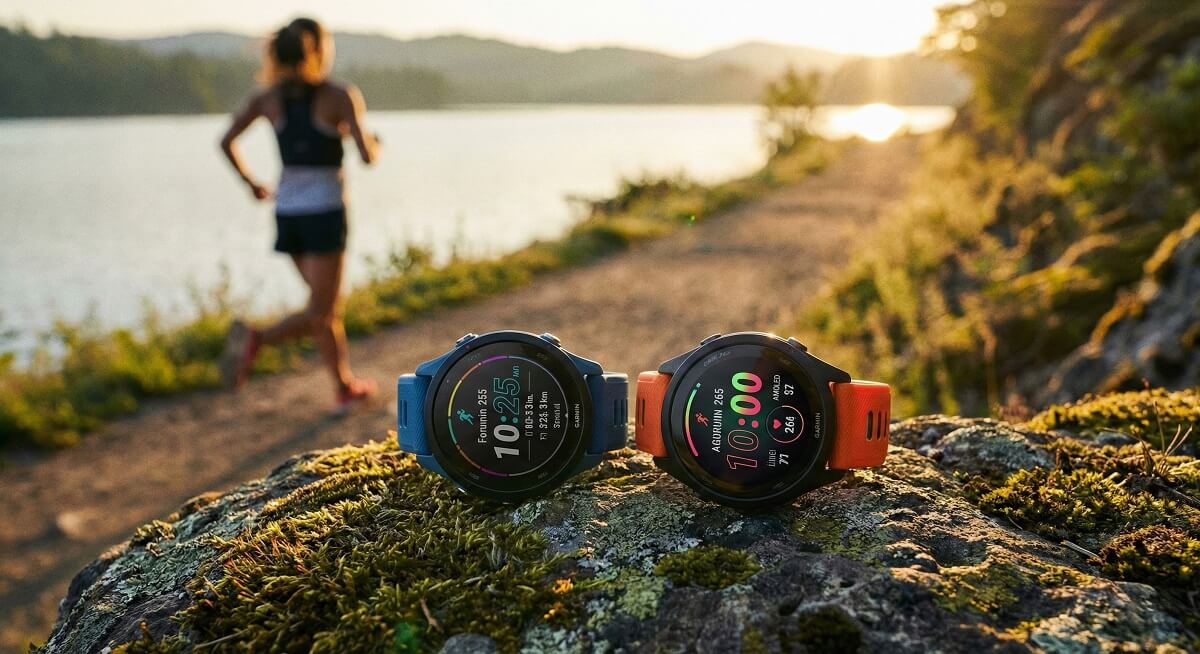
The Garmin Forerunner 265 delivers a stunning AMOLED touchscreen and premium smartwatch experience for $449, while the Forerunner 255 offers nearly identical training features with longer battery life at $199-$279 (current sale prices). The display is the primary difference — everything else is remarkably similar, especially after the FR255 received Training Readiness in a March 2025 firmware update.
Quick verdict: Choose the FR265 if you run frequently in low-light conditions or want a modern touchscreen interface. Pick the FR255 if you prioritize maximum GPS battery life (30 hours vs. 20 hours) or want to save $100-200 for race entries and running shoes. Both watches pack identical core training metrics, multisport modes, and Garmin’s excellent GPS tracking.
Here’s what matters: The FR255 now has Training Readiness (previously FR265-exclusive), closing the software gap between these watches. Your decision boils down to display preference, battery requirements, and budget. Let’s break down the details.
Quick Decision Checklist
✅ Choose Forerunner 265 if you:
- Run frequently before sunrise or after sunset (bright AMOLED helps visibility)
- Want a modern smartwatch experience with touchscreen navigation
- Value Training Readiness insights displayed prominently on the watch face
- Don’t mind charging every 10-13 days instead of 14 days
- Need music storage (it’s standard; FR255 requires Music edition)
- Can budget an extra $100-150 for the premium display
✅ Choose Forerunner 255 if you:
- Run ultras or multi-day events requiring 30-hour GPS battery life
- Prefer always-on displays that stay readable in bright sunlight without draining battery
- Don’t need touchscreen functionality (button navigation works perfectly)
- Want to save $100-200 for other gear or race registrations
- Run primarily during daytime hours with good natural light
- Already own heart rate chest straps for advanced metrics
Forerunner 255 vs 265: Specifications Comparison
| Feature | Forerunner 255 / 255S | Forerunner 265 / 265S | Winner |
|---|---|---|---|
| Display Type | MIP (Memory-In-Pixel), always-on | AMOLED touchscreen | FR265 (subjective) |
| Display Resolution | 260×260 (46mm) / 218×218 (41mm) | 416×416 (46mm) / 360×360 (42mm) | FR265 |
| Touchscreen | No (buttons only) | Yes (can disable during workouts) | FR265 |
| Battery (Smartwatch Mode) | 14 days (46mm) / 12 days (41mm) | 13 days (46mm) / 15 days (42mm) | Tie |
| Battery (GPS Mode) | 30 hours (46mm) / 26 hours (41mm) | 20 hours (46mm) / 24 hours (42mm) | FR255 |
| Weight | 49g (46mm) / 39g (41mm) | 47g (46mm) / 39g (42mm) | FR265 (marginal) |
| Training Readiness | Yes (as of March 2025 firmware) | Yes (since launch) | Tie |
| Multi-Band GPS | No (All-Systems mode only) | Yes (with SatIQ auto-switching) | FR265 |
| Music Storage | Only on Music edition (+$50) | Standard on all models | FR265 |
| Price (MSRP) | $349 / $399 (Music) | $449 | FR255 |
| Current Street Price (Feb 2026) | $199-$279 | $299-$449 | FR255 |
| Water Rating | 5 ATM (50m) | 5 ATM (50m) | Tie |
| Release Date | June 2022 | March 2023 | — |
Pricing data as of February 2026. Amazon and Best Buy frequently run sales on both models.
The #1 Difference: Display Technology (AMOLED vs MIP)
If you’ve researched these watches, you know the display is the headline feature. The Forerunner 265 sports a vibrant AMOLED touchscreen with 416×416 pixel resolution on the 46mm model — the same display tech found in premium smartwatches. The Forerunner 255 uses a traditional MIP (memory-in-pixel) display with 260×260 resolution and button-only navigation.
Why the Display Matters for Runners
Your running watch display does two jobs: show real-time data during workouts and display metrics when you check stats later. The FR265’s AMOLED screen excels indoors and in low light — think early morning runs, evening training, or treadmill sessions at the gym. Colors pop, text is crisp, and the touchscreen makes navigating menus faster than button-mashing.
The FR255’s MIP display takes the opposite approach. It’s always on without battery penalty, incredibly readable in direct sunlight, and works perfectly with gloves (no touchscreen). For runners who train primarily during daylight hours, the MIP screen delivers exactly what you need: clear data fields that don’t wash out at noon on a sunny trail.
Real-World Display Performance
Multiple reviewers, including DC Rainmaker’s extensive testing, confirm both displays work well in their intended environments. The FR265’s AMOLED shines (literally) in darkness and indoor lighting. The FR255’s MIP display wins in bright outdoor conditions without requiring always-on mode to drain the battery.
One practical consideration: The FR265’s always-on AMOLED mode cuts battery life to about 5 days in smartwatch mode. Most users run it in gesture mode (wake on wrist raise), which brings battery life back to 13 days but means you can’t glance at the time without moving your wrist.
Touchscreen: Convenience or Complication?
The FR265’s touchscreen speeds up daily navigation — scrolling through widgets, responding to notifications, and adjusting settings. During workouts, you can disable touch to prevent accidental taps from sweat or jacket sleeves. Button navigation still works anytime.
The FR255 sticks with buttons exclusively. Five physical buttons control everything, which some runners prefer for reliability. No worrying about touchscreen responsiveness with wet fingers or winter gloves. The interface takes longer to learn initially, but muscle memory kicks in after a week.
Training Readiness: The Software Advantage (Now on Both Watches)
Important update: The Forerunner 255 received Training Readiness in a firmware update (beta version 22.12 in December 2024, production rollout in March 2025). This was previously a FR265-exclusive feature, but Garmin reversed that decision after user feedback.
What Is Training Readiness?
Training Readiness gives you a single score (0-100) each morning that answers: “How ready am I to train hard today?” The algorithm weighs six factors:
- Sleep quality from last night
- Recovery time from your last workout
- HRV Status (heart rate variability trend over 7 days)
- Acute Load (your training intensity over the past week)
- Sleep History (comparing last 3 nights)
- Stress History (3 days of daytime stress data)
The score updates throughout the day. Wake up with a score of 55 (decent), have a relaxing morning, and it might climb to 65 by lunchtime. Crush a hard interval workout, and it drops to 20 — your body needs recovery before the next tough session.
How Useful Is It for Real Runners?
Training Readiness works best as a gut check rather than absolute law. Consistently low scores (under 30) for multiple days signal genuine overtraining or inadequate recovery. High scores (75+) for extended periods might mean you’re undertrained or on vacation.
Use it to: catch overtraining patterns before they cause injury, validate your instinct that you’re too tired for speedwork, or confirm you’re well-rested before a race. Ignore it when: tapering for a goal race (scores often drop but that’s intentional), fighting off a cold (it’ll tell you what you already know), or following a structured training plan that intentionally pushes into fatigue.
Living Without Training Readiness
Both watches still offer Body Battery, HRV Status, Recovery Time, and Training Status. These metrics cover 80% of what Training Readiness shows. High-mileage athletes and runners coming back from injury benefit most from the holistic Training Readiness score. Casual runners and marathon trainers following preset plans might not miss it.
Since both watches now have this feature (after the firmware update), it’s no longer a deciding factor between them.
Battery Life: Longer Runs, Longer Life
Battery specs tell part of the story, but real-world usage reveals the practical differences.
Smartwatch Mode Battery
The FR255 (46mm model) lasts 14 days in smartwatch mode with typical use — notifications on, one workout per day, GPS tracking for 30-60 minutes. The FR265 (46mm) lasts 13 days under similar conditions. Both small models (255S and 265S) actually get longer life because smaller displays use less power, with the 265S reaching 15 days.
Practically speaking: You’ll charge either watch weekly or bi-weekly depending on workout frequency. The one-day difference between 13 and 14 days rarely matters unless you’re traveling without a charger.
GPS Tracking Battery: Where It Matters
GPS mode reveals the real battery gap. The FR255 (46mm) runs 30 hours in GPS-only mode, while the FR265 manages 20 hours. For most runners, this difference is invisible — a 4-hour marathon drains about 20-25% battery on either watch, leaving plenty of reserve.
Ultra runners and adventure racers care deeply about this gap. A 100-mile race taking 24+ hours fully depletes the FR265 but leaves the FR255 with battery to spare. The FR255’s 30-hour GPS runtime lets you track multi-day backpacking trips or ultra-distance events without battery anxiety.
Music playback cuts both watches’ GPS battery roughly in half. The FR265 gets about 7 hours GPS + music, the FR255 gets 6.5 hours. Long enough for a marathon with tunes, but challenging for ultras.
Real-World Battery Testing
DC Rainmaker’s half marathon test showed the FR265 draining at 5.54% per hour with GPS active, translating to roughly 18 hours of continuous tracking — close to Garmin’s official 20-hour claim. The FR255’s 30-hour GPS claim similarly proves conservative; many users report exceeding it in optimal conditions.
Multi-Band GPS and Battery Impact
The FR265 includes multi-band (dual-frequency) GPS with SatIQ auto-switching. Multi-band mode drains battery faster (14 hours GPS vs. 20 hours standard), but SatIQ intelligently switches to multi-band only when needed — in urban canyons or dense tree cover. This saves battery while maintaining accuracy.
The FR255 lacks multi-band GPS entirely, using All-Systems mode (GPS + GLONASS + Galileo on single frequency). Extensive testing shows All-Systems mode delivers excellent accuracy for 95% of running scenarios. You’d only miss multi-band if you regularly run in Manhattan between skyscrapers or similar extreme environments.
Price and Value Analysis (2026 Update)
Pricing has shifted significantly since both watches launched.
Current Street Prices (February 2026)
The Forerunner 255 originally sold for $349 (non-Music) and $399 (Music edition). As of February 2026, frequent sales bring it down to $199-$279 on Amazon and Best Buy. The $199 price point appeared multiple times during 2025 sales events.
The Forerunner 265 launched at $449 for both sizes (music included standard). Recent sales have dropped it to $299-$349, though $449 remains common at full price. Amazon hit a low of $300 in December 2025.
Note: Prices fluctuate weekly. Check current pricing at Amazon and Best Buy before purchasing.
What You Get for the Extra $100-150
At typical sale prices ($249 for FR255, $349 for FR265), you’re paying roughly $100 extra for:
- AMOLED touchscreen display (1.6x higher resolution)
- Multi-band GPS with SatIQ auto-switching
- Music storage included (vs. $50 extra for FR255 Music edition)
- Slightly refined UI and graphics
- 2 grams lighter weight (47g vs. 49g in 46mm size)
- Curved glass vs. flat glass
Training Readiness used to be on this list, but both watches now have it after the firmware update.
Is the 265 Worth the Premium?
The answer depends on where you run and what you value. If you train before dawn or after sunset consistently, the AMOLED display transforms the experience — no more squinting at dim MIP screens with a flashlight app. The touchscreen convenience and modern aesthetic also matter to runners who wear their watch 24/7 as a smartwatch.
If you run primarily during daylight hours and care about GPS battery life for long races, the FR255 delivers 95% of the FR265’s functionality at 60-70% of the cost. That $100-150 savings covers race entries, running shoes, or other gear.
For budget-conscious athletes: The FR255 at $199-$249 represents exceptional value. You’re getting a watch that competed with $600+ models just 2-3 years ago.
Design, Fit, and Wearability
Size Options and Fit
Both watches come in two case sizes. The FR255 offers 41mm (255S) and 46mm models, while the FR265 sizes up to 42mm (265S) and 46mm. Despite the similar measurements, the FR265S reportedly feels slightly smaller on the wrist than the FR255S due to design subtleties.
Choose the smaller size if your wrist measures under 165mm circumference. The larger 46mm size suits wrists 165mm and up. Both sizes have identical features — only the display size and battery capacity differ.
Build Quality and Materials
Both watches use fiber-reinforced polymer bezels and Corning Gorilla Glass 3 display protection. The FR265 features slightly curved glass at the edges, while the FR255 uses flat glass across the entire display. The curved glass gives the FR265 a more premium appearance but doesn’t significantly affect durability.
The FR265’s “RUN” button (top-right) is slightly larger and more prominent than the FR255’s equivalent start/stop button. This makes it marginally easier to tap mid-run, though both work fine with gloves.
All-Day Comfort
At 47-49g for the large models and 39g for the small ones, both watches qualify as lightweight. You’ll barely notice either during runs or all-day wear. The standard silicone straps work well for most users, though they can trap sweat. Both watches support standard QuickFit bands, so you can swap in aftermarket NATO straps or leather bands for non-workout wear.
Water Resistance
Both watches carry 5 ATM water resistance ratings (50 meters depth). This covers pool swimming, open water swimming, showering, and rain without issues. Neither is suitable for scuba diving or high-pressure water sports. Garmin recommends drying the watch and your wrist after swimming to prevent skin irritation.
GPS Accuracy and Tracking Performance
Both watches deliver excellent GPS accuracy in typical running environments.
GPS Technology Differences
The FR265 uses Sony’s latest GPS chipset with multi-band (dual-frequency) capability. Multi-band mode accesses both L1 and L5 satellite frequencies, improving accuracy in challenging environments — urban canyons, dense forests, or areas with tall buildings. SatIQ automatically switches between standard and multi-band modes based on conditions, saving battery when multi-band isn’t needed.
The FR255 uses the same chipset but accesses only single-frequency signals in All-Systems mode (GPS + GLONASS + Galileo). This works excellently for open-area running, road routes, and most trail environments.
Real-World Accuracy Testing
DC Rainmaker’s GPS testing found both watches “spot-on” in various conditions. The FR265’s multi-band mode showed marginal improvements in urban environments with tall buildings, but the differences measured in meters, not meaningful distance errors. On open roads, trails, and tracks, both watches tracked identically.
The practical takeaway: Unless you regularly run between skyscrapers in major cities, you won’t notice GPS accuracy differences between these watches. Both nail distance, pace, and route tracking for normal running scenarios.
Track Mode and Interval Accuracy
Both watches support Track mode, which uses GPS but knows you’re running 400m loops. This improves lap distance accuracy and pace calculations during interval workouts. Neither watch perfectly nails every 400m split (GPS inherently varies by a few meters), but both stay consistent enough for training purposes.
Music Storage and Smartwatch Features
Music Playback Comparison
The Forerunner 265 includes music storage on all models — 4GB dedicated to music out of 8GB total storage. The Forerunner 255 requires purchasing the Music edition, which costs $50 more ($399 vs. $349 MSRP). Both support offline playback from Spotify, Amazon Music, and Deezer after syncing playlists via Wi-Fi.
Music storage means phone-free runs with Bluetooth headphones. Pair your watch to wireless earbuds, download playlists overnight, and leave your phone at home. Battery life takes a hit (roughly 50% reduction in GPS mode), but long training runs become more enjoyable with music or podcasts.
Smartwatch Functionality
Neither watch aims to replace an Apple Watch or Samsung Galaxy Watch. Both deliver notifications from your phone, but you can’t respond to messages or take calls (no speaker or microphone). They show weather, calendar events, and smart notifications — enough to keep you informed without pulling out your phone.
Garmin Pay works on both watches for contactless payments. Tap your watch at checkout instead of pulling out a credit card — handy for post-run coffee stops.
The FR265’s touchscreen makes navigating widgets and settings faster than the FR255’s button-only interface. For checking weather or reading notifications, the touchscreen wins. For mid-run adjustments, buttons remain more reliable.
Training and Performance Features
Both watches pack identical core training metrics after the FR255 received firmware updates in 2025.
Shared Training Metrics (Both Watches)
- VO2 Max: Estimated cardiovascular fitness based on pace and heart rate
- Training Status: Productive, Maintaining, Overreaching, or other states
- Training Load: Weekly workout stress and recovery balance
- Training Readiness: Holistic recovery score (now on both models)
- Race Predictor: Estimated finish times for 5K through marathon
- PacePro: Splits strategy based on GPS elevation and your goal time
- Body Battery: Energy level monitoring throughout the day
- HRV Status: Heart rate variability trends (recovery indicator)
- Sleep Tracking: Sleep stages, Sleep Score, and quality analysis
- Recovery Time: Hours until next hard workout recommended
- Running Dynamics: Cadence, vertical oscillation, ground contact time (from wrist)
Both watches also support structured workouts, interval training, custom data screens, and breadcrumb navigation for following routes.
Multisport and Triathlon Support
Both watches handle triathlons with automatic transition detection. Start a triathlon activity, and the watch tracks your swim, bike, and run legs as one continuous workout, noting transition times between disciplines. Pool swimming and open water swimming work on both models, with automatic stroke detection and distance tracking.
Running power (measured from wrist) helps gauge effort on hilly terrain. Both watches calculate power in real-time without needing a chest strap or foot pod, though a chest strap improves accuracy.
Who Should Buy the Forerunner 255?
The Forerunner 255 makes sense for:
Budget-Focused Runners
At $199-$279 (current sale prices), the FR255 delivers premium features at mid-range pricing. You’re getting a watch that competed with $500+ models when launched. The savings let you invest in quality running shoes, coaching, or race entries.
Ultra Runners and Adventure Racers
That 30-hour GPS battery life becomes crucial for 100-mile races or multi-day tracking. The FR265’s 20-hour limit might require mid-race charging or cutting GPS tracking short. The FR255 handles ultra-distance events and multi-day backpacking trips without battery anxiety.
Daytime Runners
If you train primarily during daylight hours, the always-on MIP display stays perfectly readable in bright sunlight without draining battery. No need to pay extra for AMOLED when your running schedule doesn’t require it.
Traditionalists Who Prefer Buttons
Some runners simply prefer button-only navigation. More reliable with gloves, no accidental touch inputs, and muscle memory makes navigation second nature after a week. If you’ve used Garmin watches before, the FR255 feels familiar and comfortable.
First-Time Garmin Buyers
Testing the Garmin ecosystem at a lower price point makes sense if you’re not sure about committing to Garmin’s training platform. The FR255 gives you the full Garmin Connect experience and advanced metrics without the premium AMOLED cost.
Who Should Buy the Forerunner 265?
The Forerunner 265 suits:
Early Morning and Night Runners
Training before sunrise or after sunset makes the AMOLED display invaluable. The screen stays bright and readable in darkness without needing backlight activation. You can glance at pace and heart rate without pressing buttons or waving your wrist aggressively to trigger the backlight.
Data-Driven Athletes
If you check metrics frequently and value Training Readiness displayed prominently on watch faces, the FR265’s interface makes data consumption faster and more pleasant. The higher-resolution display fits more information on screen clearly.
Modern Smartwatch Fans
The touchscreen, AMOLED display, and refined UI make the FR265 feel like a contemporary smartwatch rather than a traditional sports watch. If you wear your watch 24/7 and appreciate modern aesthetics, the FR265 fits that lifestyle better.
Music-Dependent Runners
Music storage comes standard on all FR265 models. If phone-free music matters to you, the FR265 saves you the $50 upcharge for the FR255 Music edition, narrowing the price gap.
Runners Upgrading from Older Garmins
Coming from a Forerunner 235 or 245? The FR265 represents a bigger leap forward with its modern display and UI. The FR255 feels like a spec bump; the FR265 feels like a generation jump.
Alternatives Worth Considering
Before finalizing your decision, consider these alternatives at similar price points:
COROS Pace 3 ($229)
Excellent GPS accuracy, nylon band, and exceptional battery life (38 hours GPS). Lighter than both Garmins at 30g. Lacks Garmin’s extensive training metrics ecosystem but costs less.
Polar Pacer Pro ($299-$349)
Different training metrics philosophy (Polar’s Training Load Pro vs. Garmin’s approach). Similar battery life to FR255. Consider if you prefer Polar’s ecosystem or already use Polar products.
Garmin Forerunner 165 ($249)
Budget AMOLED option released in 2024. Lacks Training Readiness, multiband GPS, and multisport modes but offers AMOLED at FR255 pricing. Good for single-sport runners who want modern display tech.
Garmin Forerunner 965 ($649)
Premium upgrade with full color maps, larger AMOLED display, and titanium bezel. Worth considering if you run trails regularly and need navigation features. Maps are the primary upgrade over the FR265.
Frequently Asked Questions
Is the Forerunner 265 waterproof?
Both the FR255 and FR265 have 5 ATM water resistance ratings (50 meters depth). This makes them safe for swimming, showering, and running in rain. Neither is suitable for scuba diving or high-pressure water sports. Always rinse the watch after swimming in salt water or chlorinated pools.
Can you answer phone calls on either watch?
No. Neither watch has a speaker or microphone. You can see incoming call notifications and decline calls from your wrist, but you’ll need your phone to actually answer and talk. Both watches are designed as fitness-first devices, not full smartwatches.
Which watch has better heart rate accuracy?
Both use Garmin’s Elevate v4 optical heart rate sensor with identical accuracy. In testing, both track steady-state heart rate well but can lag during rapid changes (sprint intervals). Pairing either watch with a chest strap (like Garmin HRM-Pro) dramatically improves accuracy for interval workouts and provides additional running dynamics metrics.
Will the Forerunner 255 get more features from firmware updates?
Garmin continues supporting the FR255 with firmware updates — Training Readiness arrived in March 2025, nearly 3 years after launch. Check Garmin’s forums for the latest firmware version. However, hardware limitations mean the FR255 won’t get touchscreen functionality or multi-band GPS.
How long do these watches typically last?
Garmin watches typically last 3-5 years with regular use. The FR255’s MIP display potentially outlasts AMOLED screens, which can degrade or develop burn-in over time. Battery capacity degrades in all rechargeable devices, usually dropping to 70-80% capacity after 2-3 years of daily charging cycles.
Can I use both watches for triathlons?
Yes. Both watches support triathlon mode with automatic transition detection and tracking. They’ll track your swim (pool or open water), bike, and run as a single multi-sport activity, logging transition times between disciplines automatically.
Which watch is better for beginners?
The FR255 offers better value for beginners on a budget. The FR265’s touchscreen provides slightly easier navigation for new users. Both deliver the same training insights, so choose based on budget and display preference.
Do either watches support offline maps?
No. Neither the FR255 nor FR265 includes full color topographic maps. Both support breadcrumb navigation (GPS track lines) for following pre-loaded routes. For full maps with street names and POI markers, upgrade to the Forerunner 965 or Fenix series.
What size watch should I get?
Measure your wrist circumference. Under 165mm (6.5 inches)? Choose the smaller 41-42mm models (255S or 265S). Wrists 165mm and larger? The 46mm models balance display size and comfort better. Both sizes offer identical features — only display size and battery capacity differ.
Can I swim in the ocean with these watches?
Yes. Both watches support open water swimming activities with GPS tracking. The 5 ATM water resistance handles ocean waves and saltwater exposure. Always rinse the watch with fresh water after swimming in salt water to prevent corrosion and remove salt deposits from the charging port.
Final Verdict: Which Garmin Should You Choose?
Here’s the honest bottom line after comparing specs, testing data, and real-world use cases:
For most runners in 2026: The Forerunner 255 offers the best value, especially at current discounted prices of $199-$279. You’re getting 95% of the FR265’s functionality with longer GPS battery life and significant cost savings. The firmware update bringing Training Readiness to the FR255 eliminated the last major software advantage the FR265 held.
Pay extra for the FR265 if: You run frequently in darkness (early morning or night training), want the modern touchscreen smartwatch experience, or need music storage without paying for the FR255 Music edition. The AMOLED display is genuinely excellent for low-light conditions and indoor training.
The deciding factors are:
- When you run: Dawn/dusk runners benefit more from AMOLED; midday runners don’t need it
- Race distance: Ultra runners need the FR255’s 30-hour GPS battery
- Budget: $100-150 savings buy quality shoes or race entries
- Interface preference: Touchscreen vs. buttons-only navigation
Both watches deliver Garmin’s excellent training ecosystem, accurate GPS, and comprehensive metrics. You can’t make a wrong choice — just pick the one that fits your running schedule, battery needs, and budget.
Ready to Make Your Choice?
Check current pricing and availability:
Prices updated February 2026. Both watches backed by Garmin’s standard 1-year warranty with optional extended coverage available.
