


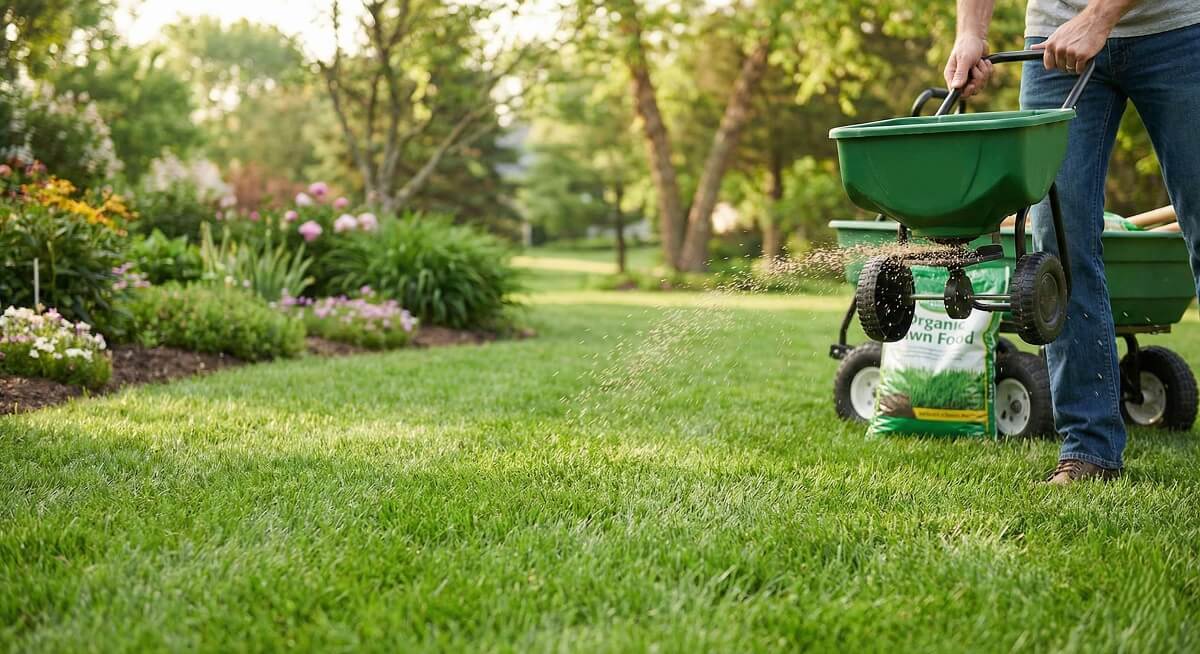
Most established lawns need fertilizer 1-4 times per year, depending on your grass type and lawn goals. Cool-season grasses (Kentucky bluegrass, fescue, ryegrass) should be fertilized primarily in fall, with an optional spring feeding. Warm-season grasses (Bermuda, St. Augustine, Zoysia) need feeding during their active growing season from late spring through early fall.
If you’re only fertilizing once per year, do it in September for cool-season lawns or April for warm-season lawns. For the healthiest, greenest grass, most homeowners fertilize 2-4 times annually following a seasonal schedule. Cornell University recommends 1-2 applications per year for most lawns, while Penn State Extension suggests two feedings—mid-to-late spring and late summer/early fall.
The right frequency depends on your grass type, soil quality, and how much time you want to invest in lawn care. This guide breaks down exactly when and how often to fertilize based on your specific situation.
Quick Fertilization Guide by Grass Type
Cool-Season Grasses (Northern Lawns)
Grass types: Kentucky bluegrass, tall fescue, fine fescue, perennial ryegrass
- Minimum (1x/year): September only
- Standard (2x/year): April + September
- Premium (3-4x/year): April, June, September, November
Warm-Season Grasses (Southern Lawns)
Grass types: Bermuda, St. Augustine, Zoysia, Centipede, Bahia
- Minimum (1x/year): April only
- Standard (2x/year): April/May + June/July
- Premium (3-4x/year): April, June, August, September
✅ Fertilize If You Notice:
- Grass yellowing or pale color
- Slow growth or thin patches
- Increased weeds or pest problems
- Soil test reveals nutrient deficiencies
❌ Skip Fertilizing If:
- Grass is dormant (brown in winter)
- Heavy rain is forecasted within 24 hours
- During heat waves or drought
- You haven’t done a soil test (you may not need it)
Why Lawn Fertilization Matters
Grass needs a consistent supply of nutrients to grow strong and healthy. The three primary nutrients are nitrogen (N), phosphorus (P), and potassium (K)—the numbers you see on fertilizer bags like “32-0-4” represent the percentage of each nutrient.
Nitrogen promotes leaf growth and that vibrant green color. Phosphorus supports root development, and potassium helps grass withstand stress from heat, drought, and foot traffic. When your soil lacks these nutrients, grass struggles to compete with weeds and becomes more susceptible to pests and diseases.
Properly fertilized lawns can increase water retention by up to 100%, according to lawn care research. This means your grass stays healthier during dry spells and requires less watering overall. Regular fertilization also strengthens root systems, making grass more resilient to environmental challenges.
However, more isn’t always better. Frank Rossi, associate professor of horticulture at Cornell University, says you don’t want to fertilize your lawn more than twice yearly. Over-fertilizing can damage roots, cause scorching, and create environmental problems like nutrient runoff into waterways.
Understanding Your Grass Type
Your fertilization schedule hinges on whether you have cool-season or warm-season grass. These two categories have different growing patterns and nutrient needs throughout the year.
Cool-Season Grasses
Cool-season grasses thrive in temperatures between 60-75°F and are most common in northern states. They include Kentucky bluegrass, tall fescue, fine fescue, and perennial ryegrass. These grasses have two active growing periods: spring (April-May) and fall (September-November).
During summer heat, cool-season grasses slow down or go semi-dormant. This means fall is the most important time to fertilize—it helps grass store nutrients for winter and promotes strong root development for the following spring. A spring feeding provides additional support as grass greens up after winter.
Warm-Season Grasses
Warm-season grasses prefer temperatures between 75-90°F and are found primarily in southern and coastal regions. Common types include Bermuda grass, St. Augustine, Zoysia, Centipede, and Bahia grass. These grasses actively grow from late spring through summer.
Fertilize warm-season grasses during their peak growing season—late spring through early fall. They go dormant in winter and turn brown, so fertilizing during dormancy wastes product and can actually harm the grass by encouraging growth when it should be resting.
Not sure which type you have? Cool-season grasses tend to stay green year-round (though they may brown during extreme heat or drought). Warm-season grasses naturally turn brown and go dormant in winter.
How Often Should You Fertilize Your Lawn?
The answer depends on your lawn goals, grass type, and how much effort you want to invest. Here’s a breakdown of each approach.
Once Per Year (Minimum Maintenance)
If you’re only fertilizing once annually, timing is everything. For cool-season grasses, apply fertilizer in September when grass is actively storing nutrients for winter. For warm-season grasses, fertilize in April as they’re coming out of dormancy and beginning active growth.
This minimal approach won’t give you a golf-course lawn, but it will maintain basic grass health and prevent severe nutrient deficiencies. Use a slow-release fertilizer to provide longer-lasting nutrition—products like Milorganite feed lawns for 8-10 weeks per application.
Annual cost for 5,000 sq ft lawn: $27-$40 (one bag of fertilizer)
Twice Per Year (Standard Approach)
Penn State Extension recommends two applications per year for most lawns—one in mid-to-late spring and another in late summer/early fall. This is the sweet spot for maintaining healthy, attractive grass without over-investing time or money.
For cool-season grasses, fertilize in April (when temperatures consistently reach 55-60°F) and again in September. For warm-season grasses, apply fertilizer in late April or May (when temps hit 70°F) and again in June or July.
This schedule provides nutrients during both active growing periods and helps grass recover from summer stress. You’ll notice better color, fewer weeds, and improved drought tolerance compared to the once-yearly approach.
Annual cost for 5,000 sq ft lawn: $54-$80 (two applications)
Three to Four Times Per Year (Premium Care)
For lawn enthusiasts aiming for the darkest green, thickest turf, a 4-application schedule maximizes results. Cornell recommends applying fertilizer every 6-8 weeks during the growing season for high-maintenance lawns.
Cool-season 4-application schedule:
- Early spring (April) – Wake-up feeding
- Late spring (May-June) – Maintenance nutrition
- Late summer (August-September) – Recovery from heat stress
- Late fall (November) – Winterizer for spring green-up
Warm-season 4-application schedule:
- Spring (April) – Initial feeding as grass greens up
- Late spring (May-June) – Support peak growth
- Summer (July-August) – Maintain color and strength
- Early fall (September) – Final feeding before dormancy
Important: With this frequent schedule, use slow-release fertilizers to avoid burning your lawn. Cornell recommends fertilizers with at least 30% slow-release nitrogen on non-sandy soils, and 60% slow-release on sandy soils.
Annual cost for 5,000 sq ft lawn: $109-$160 (four applications)
Factors That Affect Fertilization Frequency
Your ideal schedule may vary based on these factors:
- Soil type: Sandy soils drain quickly and may need more frequent, lighter applications. Clay soils hold nutrients longer.
- Grass clippings: Returning clippings to your lawn can reduce nitrogen fertilizer needs by 25-50%, according to Cornell research. If you’re mulching clippings, you can fertilize less often.
- Shade: Lawns in heavy shade need much less nitrogen than full-sun areas. Over-fertilizing shaded grass promotes disease.
- Soil test results: Your soil may already be nutrient-rich. Always test before starting a fertilization program—you might not need as much as you think.
- Rainfall: Heavy rain can wash away nutrients, requiring additional applications in wet climates.
Seasonal Fertilization Schedule
Here’s a detailed month-by-month guide to help you time applications correctly.
Spring Fertilization (March-May)
Spring is when grass wakes up from winter dormancy. For cool-season grasses, apply a light feeding in early-to-mid spring once soil temperatures consistently reach 55-60°F. This typically happens in April for most northern regions.
For warm-season grasses, wait until temperatures consistently hit 70°F—usually late April or May in southern states. Fertilizing too early wastes product because dormant grass can’t absorb nutrients effectively.
Application tips: Mow your lawn a day or two before fertilizing. Apply when grass is dry, then water lightly afterward to help nutrients reach soil level.
Summer Fertilization (June-August)
Summer is peak growing season for warm-season grasses. Fertilize every 6-8 weeks to maintain color and vigor. For cool-season grasses, summer fertilization is optional—use a light application with slow-release nitrogen, or skip it entirely during heat waves.
Never fertilize during droughts or extreme heat. This stresses grass further and can cause permanent damage. Wait for cooler temperatures or adequate rainfall before applying fertilizer.
Fall Fertilization (September-November)
Fall is the most critical time for cool-season grasses. As temperatures cool down, grass shifts energy to root growth rather than leaf production. Fertilizing in early fall (around Labor Day) through late fall (Thanksgiving) promotes strong root systems that lead to thicker, healthier lawns the following spring.
For warm-season grasses, apply a final feeding in early fall—at least 30 days before the first expected frost. This helps grass store nutrients before going dormant. Late fall fertilization can harm warm-season grasses by encouraging growth when they should be preparing for winter.
Winter Fertilization (December-February)
Generally, skip fertilizing in winter. Cool-season grasses grow very slowly or not at all, and warm-season grasses are fully dormant. Cornell extension advises against applying any fertilizer between December 1 and April 1 in New York and similar climates.
The exception is a late fall “winterizer” application for cool-season grasses, applied in November before the first deep freeze. This supports nutrient storage and leads to faster spring green-up.
Signs Your Lawn Needs Fertilization
Not sure if your lawn actually needs fertilizer? Look for these indicators:
- Yellowing or pale grass: This is the classic sign of nitrogen deficiency. Healthy grass should be a rich, medium-to-dark green color.
- Slow or stunted growth: If your grass isn’t growing as fast as it should during the growing season, it likely lacks essential nutrients.
- Increased weed problems: Weak, undernourished grass can’t compete with weeds. Dense, well-fed turf naturally crowds out most weeds.
- Thin or patchy areas: While this can indicate other problems (disease, pests, compaction), nutrient deficiency is a common cause.
- Pest susceptibility: Healthy, well-nourished grass is more resistant to insect damage and recovers faster from pest problems.
- Soil test results: A soil test is the most accurate way to determine if you need fertilizer and which nutrients are lacking.
Get a Soil Test First
Before starting any fertilization program, get a soil test from your state extension office. Basic tests cost $12-$30 and tell you exactly which nutrients your soil needs. You might find your soil is already nutrient-rich, saving you time and money on unnecessary fertilization.
Soil testing services by state:
- Kansas State Extension: $12.50-$25 depending on test package
- Ohio State Extension: $18 per sample
- Cornell (New York): $2-$5 for pH testing
- Maryland Extension: Less than $15 for basic lawn tests
Contact your local county extension office for sample bags and instructions. Tests should be repeated every 2-3 years to monitor nutrient levels over time.
How Much Fertilizer to Apply
Fertilizer bags display three numbers (N-P-K ratio) representing the percentage of nitrogen, phosphorus, and potassium. A 32-0-4 fertilizer contains 32% nitrogen, 0% phosphorus, and 4% potassium.
The standard recommendation is to apply 1 pound of nitrogen per 1,000 square feet per application. To calculate how much fertilizer you need, divide 100 by the first number (nitrogen percentage), then multiply by your lawn’s square footage divided by 1,000.
Example: For a 5,000 sq ft lawn using 32-0-4 fertilizer:
100 ÷ 32 = 3.125 lbs fertilizer per 1,000 sq ft
3.125 × 5 = 15.6 lbs total fertilizer needed
Popular Fertilizer Products Comparison
| Product | N-P-K | Coverage | Weight | Price | Best For |
|---|---|---|---|---|---|
| Scotts Turf Builder Lawn Food | 32-0-4 | 5,000 sq ft | 12.5 lbs | ~$27 | Quick greening, all grass types |
| Milorganite Organic | 6-4-0 | 2,500 sq ft | 32 lbs | ~$20 | Slow-release, organic option |
| Scotts Turf Builder (Large) | 32-0-4 | 15,000 sq ft | 37.5 lbs | ~$62 | Larger lawns, cost efficiency |
Prices as of February 2026 at Home Depot. Prices may vary by location and retailer.
Use a broadcast spreader for even application. Check the fertilizer bag for recommended spreader settings for your spreader model. If your spreader isn’t listed, calibrate it by measuring how much product it distributes over a known area.
Common Fertilization Mistakes to Avoid
Even experienced homeowners make these errors. Here’s what to watch out for:
1. Over-Fertilizing
Applying too much fertilizer causes fertilizer burn—brown, scorched patches that may take weeks to recover. It also increases your lawn’s susceptibility to disease and creates environmental problems. Excess nitrogen runs off into waterways, contributing to algae blooms and water pollution.
Penn State Extension warns that “more is not better” when it comes to fertilization. Stick to recommended application rates and frequencies for your grass type.
2. Fertilizing Dormant Grass
Grass can’t use nutrients when it’s dormant. Fertilizing brown, dormant warm-season grass in winter or cool-season grass during summer heat stress wastes money and potentially harms grass by forcing growth when it should be resting.
3. Ignoring Soil Tests
Many homeowners fertilize on a schedule without knowing if their soil actually needs nutrients. A $15-$25 soil test can save you hundreds of dollars in unnecessary fertilizer over time.
4. Fertilizing Before Heavy Rain
Applying fertilizer right before a storm washes nutrients away before grass can absorb them. Check the forecast and skip fertilizing if heavy rain is expected within 24 hours.
5. Wrong Timing for Grass Type
Fertilizing cool-season grass in July or warm-season grass in November ignores natural growth patterns. Follow timing recommendations based on your specific grass type.
6. Using Summer Fertilizer in Fall
Different seasons require different N-P-K ratios. Fall fertilizers typically have higher nitrogen content to promote root growth, while some summer products focus on stress resistance. Use the right product for the season.
7. State Fertilizer Regulations
Some states restrict fertilizer application dates or phosphorus content to protect water quality. Maryland, Florida, Connecticut, and Maine have specific blackout dates when fertilization is prohibited. Check your local regulations before fertilizing.
DIY vs Professional Lawn Fertilization
Should you fertilize yourself or hire a professional service? Here’s an honest cost comparison.
DIY Fertilization Costs
Based on February 2026 pricing for Scotts Turf Builder and Milorganite:
| Lawn Size | 1x/Year | 2x/Year | 4x/Year |
|---|---|---|---|
| 2,500 sq ft | $14-$20 | $28-$40 | $55-$80 |
| 5,000 sq ft | $27-$40 | $54-$80 | $109-$160 |
| 10,000 sq ft | $54-$80 | $109-$160 | $218-$320 |
Initial equipment costs: Broadcast spreader ($30-$100 one-time purchase)
Time investment: 15-30 minutes per application for most residential lawns
Professional Lawn Care Services
TruGreen and similar professional services cost $450-$2,000 annually, with most homeowners paying around $1,000 per year for a 5,000 sq ft lawn. This includes 7-9 visits covering fertilization, weed control, and sometimes aeration.
Per-application pricing ranges from $65-$225 per treatment. Basic plans start around $640/year for fertilizer and weed control only. Comprehensive plans with aeration, overseeding, and pest management run $1,200-$1,500 annually.
Which Should You Choose?
DIY makes sense if:
- You’re comfortable with basic lawn care tasks
- You have time for 2-4 applications per year
- You want to save $400-$1,900 annually compared to professional service
- You enjoy maintaining your own lawn
Professional service is worth considering if:
- You have a large lawn (over 10,000 sq ft)
- You lack time for regular maintenance
- You want comprehensive service beyond just fertilization
- You prefer guaranteed results backed by professional expertise
The reality? DIY fertilization costs 10-25 times less than professional services. If you’re willing to spend 2-3 hours total per year on fertilization, you’ll save significant money while still achieving excellent results.
Frequently Asked Questions
Can you over-fertilize a lawn?
Yes. Over-fertilizing causes fertilizer burn (brown, scorched patches), damages root systems, and makes grass more susceptible to disease. It also creates environmental problems by washing excess nutrients into waterways. Stick to recommended application rates—typically no more than 1 pound of nitrogen per 1,000 square feet per application.
Should I mow before or after fertilizing?
Mow your lawn one or two days before applying fertilizer. This ensures grass is evenly cut at the right height, allowing fertilizer to reach soil level more easily. Wait at least 24 hours after fertilizing before mowing again to give grass roots time to start absorbing nutrients.
Do I need to water after applying fertilizer?
It depends on the fertilizer type. Most granular fertilizers benefit from light watering after application to help nutrients penetrate the soil. However, slow-release organic fertilizers like Milorganite don’t require immediate watering—they’ll activate naturally with the next rain or watering session. Check your fertilizer bag for specific instructions.
What happens if I fertilize too early in spring?
Fertilizing before grass begins active growth promotes shoot (leaf) growth at the expense of root development. This creates weak, shallow-rooted grass that struggles during summer heat and drought. Wait until soil temperatures consistently reach 55-60°F for cool-season grass or 70°F for warm-season grass before applying spring fertilizer.
How do I know if my lawn needs fertilizer?
Look for yellowing grass, slow growth, thin patches, or increased weed problems. The most accurate method is a soil test from your county extension office ($12-$30), which identifies specific nutrient deficiencies. Don’t assume your lawn needs fertilizer—test first to avoid wasting money on unnecessary applications.
Can I use grass clippings instead of fertilizer?
Grass clippings provide some nutrients, but they don’t replace fertilizer entirely. According to Cornell research, returning clippings reduces nitrogen fertilizer needs by 25-50%. So if you’re mulching clippings, you can fertilize less frequently or use lighter applications, but you’ll still need some supplemental fertilization for optimal lawn health.
What’s the difference between slow-release and regular fertilizer?
Slow-release fertilizers release nutrients gradually over 8-10 weeks, providing steady nutrition without rapid growth spurts. Regular (quick-release) fertilizers deliver nutrients immediately but only last 2-4 weeks. Slow-release is better for most homeowners because it requires fewer applications, reduces mowing frequency, and minimizes the risk of fertilizer burn.
Are there fertilizer blackout dates in my state?
Yes, some states restrict fertilizer application to protect water quality. Florida, Maryland, Connecticut, and Maine have specific blackout dates when fertilization is prohibited. Maryland and Florida also limit applications to twice yearly at reduced rates in certain areas. Check with your local extension office or state agriculture department for current regulations in your area.
How long does fertilizer take to work?
Quick-release fertilizers show results within 3-7 days—you’ll notice greener grass relatively quickly. Slow-release fertilizers take 7-14 days to show visible results but provide longer-lasting benefits. The most important benefits (stronger roots, improved drought tolerance, pest resistance) develop over weeks and months, not days.
Should I fertilize if my lawn has weeds?
Yes, but address the weed problem separately. Fertilizing strengthens grass so it can compete better with weeds, but it won’t eliminate existing weed problems. Use a weed-and-feed product that combines fertilizer with herbicide, or treat weeds first, wait a week, then fertilize. Dense, healthy grass is your best long-term weed prevention strategy.
Bottom Line: How Often Should You Fertilize?
For most homeowners, fertilizing 1-2 times per year delivers the best balance of results and effort. Cool-season lawns benefit most from fall fertilization (September), with an optional spring application if you want extra greening. Warm-season lawns need feeding during their active growing season—April through early fall.
Cornell and Penn State both recommend 1-2 applications annually for standard lawns. More frequent feeding (3-4 times yearly) creates premium results but requires more time and investment. Less frequent feeding (once yearly) maintains basic lawn health but won’t give you that golf-course appearance.
The most important step? Get a soil test before starting any fertilization program. A $15-$25 test tells you exactly what your lawn needs and can save you hundreds of dollars in unnecessary fertilizer over time.
Ready to create your lawn fertilization schedule? Start by getting a soil test from your to determine your lawn’s specific nutrient needs. Then choose a fertilization plan that matches your grass type, climate, and goals.
