


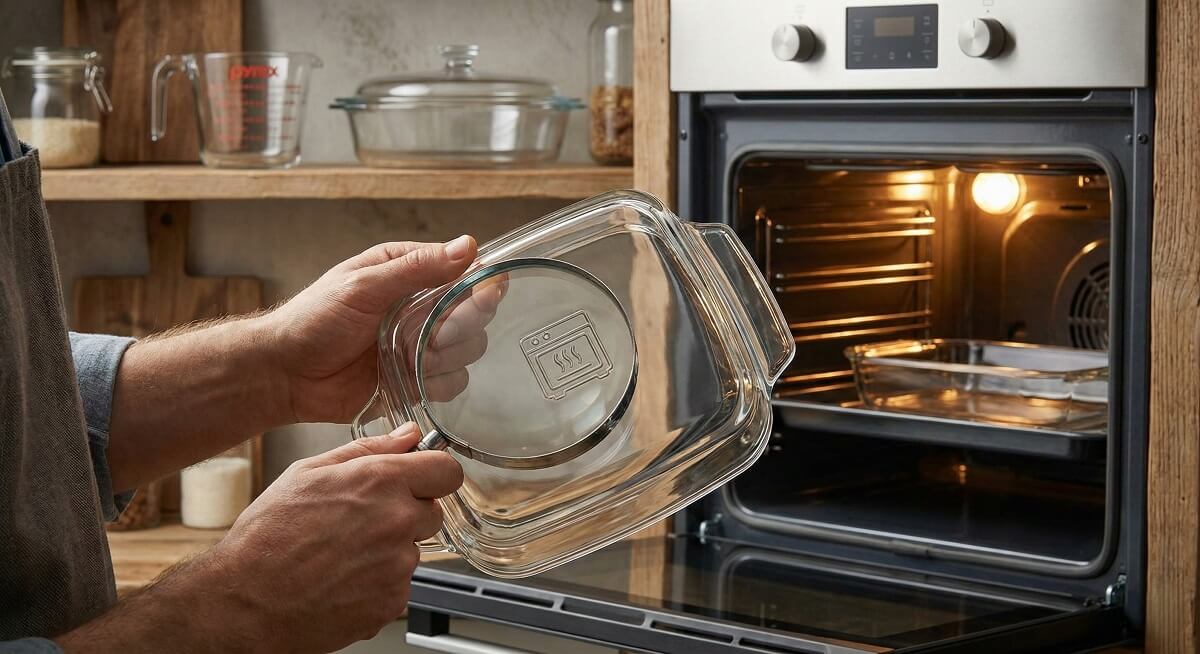
The quickest way to know if glassware is oven safe: check the bottom of the dish for an oven-safe symbol (looks like a small oven with wavy lines) or the words “oven safe.” If there’s no marking, assume it’s NOT safe for oven use.
Not all glass can handle oven temperatures. Only tempered glass and borosilicate glass are designed for heat. Regular glass—like drinking glasses, mason jars, and decorative dishes—can crack or shatter starting at around 302°F (150°C). If you’re setting up your kitchen with the right , knowing which materials are safe is fundamental.
Even oven-safe glass has limits. According to Pyrex’s official guidelines, the recommended maximum temperature is 425°F, and sudden temperature changes (thermal shock) can break any glass, regardless of the label.
Quick Safety Check: Can Your Glass Go in the Oven?
Safe to Use When:
- Marked “oven safe” on the bottom or sides
- Made by trusted bakeware brands (Pyrex, Anchor Hocking, CorningWare)
- Dish is at room temperature before going in
- Oven is fully preheated first
- Temperature stays at or below 425°F
- No visible chips, cracks, or deep scratches
Do NOT Use When:
- No oven-safe marking or symbol
- It’s a drinking glass, mason jar, or decorative item
- Coming directly from the fridge or freezer
- You’re using the broiler setting
- The dish has any chips, cracks, or visible damage
- You can’t identify the brand or material
3 Ways to Check If Your Glass Is Oven Safe
1. Look for the Oven-Safe Symbol
Most oven-safe glassware has a marking on the bottom or side of the dish. The symbol typically looks like a bowl or dish with wavy lines above it (representing heat), or a small oven icon. Some products simply display the text “Oven Safe” or include a temperature rating.
Where to look:
- Bottom of the dish (most common location)
- Embossed on the side near the rim
- On a sticker (which may have been removed)
Keep in mind that symbols can vary. International products may use different icons than U.S. brands. If you see any marking with heat waves or an oven shape, that’s usually a good sign—but verify the temperature limit.
2. Check for Trusted Brand Names
Certain brands are known specifically for oven-safe glass bakeware. If you spot one of these logos, you can feel more confident about oven use:
- Pyrex: Safe up to 425°F (per official Corelle Brands guidelines)
- Anchor Hocking: Safe up to 425°F (per Anchor Hocking’s FAQ)
- CorningWare: Ceramic glass, typically safe to 450°F
- OXO Good Grips: Borosilicate glass, safe to 450°F
A word of caution: just because a brand makes oven-safe products doesn’t mean all their products are oven-safe. Pyrex makes storage containers with plastic lids—the glass may be fine, but the lids definitely aren’t. Always check each individual item.
3. Consult the Manufacturer
When in doubt, go straight to the source:
- Check the original packaging if you still have it
- Visit the manufacturer’s website (most have searchable product catalogs)
- Contact customer service directly
Anchor Hocking’s customer service can be reached at 1-800-562-7511. Pyrex products (owned by Corelle Brands) have support available through pyrexhome.com. Both companies maintain detailed FAQ sections with safety guidelines.
Understanding Glass Types: Which Ones Handle Heat?
Tempered Glass (Soda-Lime Glass)
Most glass bakeware sold in the U.S. today is made from tempered soda-lime glass. This includes modern Pyrex and Anchor Hocking products.
According to Scientific American, tempered glass is about four times stronger than ordinary annealed glass. While regular glass breaks at around 6,000 PSI, tempered glass can withstand approximately 24,000 PSI. The tempering process—heating to over 1,100°F and then rapidly cooling—creates compression on the outer surface that makes it far more durable.
Tempered glass is generally safe for oven use between 350-450°F. When it does break, it shatters into small, relatively harmless pieces rather than dangerous shards.
Borosilicate Glass
Borosilicate glass contains boron trioxide, which gives it superior heat resistance and better thermal shock tolerance. It can handle temperature swings of up to about 330°F (165°C)—roughly three times what tempered soda-lime glass can manage.
You’ll find borosilicate glass in laboratory equipment, some European Pyrex products, and specialty bakeware brands like OXO. It’s generally safe up to 450-500°F.
The catch? Borosilicate glass is more expensive to manufacture, which is why most U.S. consumer products switched away from it in the 1980s.
Regular Glass (NOT Oven Safe)
Standard non-tempered glass—the kind used for drinking glasses, mason jars, picture frames, and most decorative items—cannot handle oven heat. It begins to fail at around 302-392°F (150-200°C).
Regular glass breaks because different parts expand at different rates when heated. The stress causes cracks that can quickly turn into complete failure. Never put these items in the oven:
- Drinking glasses or glass coffee mugs
- Mason jars (designed for canning, not dry oven heat)
- Decorative glass bowls or dishes
- Glass Tupperware lids (the container might be fine, but lids rarely are)
- Any glass with no oven-safe marking
Glass Types at a Glance
| Glass Type | Oven Safe? | Max Temp | Thermal Shock Resistance | Common Products |
|---|---|---|---|---|
| Tempered (soda-lime) | Yes | 350-450°F | Moderate (55-60°C differential) | Modern Pyrex, Anchor Hocking |
| Borosilicate | Yes | Up to 500°F | High (165°C differential) | Lab glass, European Pyrex, OXO |
| Regular (annealed) | No | Breaks at 302°F | Poor | Drinking glasses, mason jars |
The PYREX vs. pyrex Mystery: Why Capitalization Matters
If you’ve heard rumors about “old Pyrex” being better than “new Pyrex,” there’s actually some truth to it—and the difference is in the letters.
PYREX (all uppercase): The original formula, made from borosilicate glass. Corning introduced it in 1915, and it became the gold standard for heat-resistant glass. Today, PYREX in all caps is used for laboratory glassware manufactured by Corning. According to Corning’s official explanation, this distinction is intentional.
pyrex (lowercase): In 1975, Pyrex introduced the lowercase branding for consumer kitchenware. Beginning in the 1980s, U.S. production of these consumer products shifted from borosilicate to tempered soda-lime glass. When Corning sold its consumer division to World Kitchen LLC in 1998, the switch was complete.
The soda-lime version is cheaper to manufacture and actually more resistant to drops and impacts. However, as noted on Wikipedia’s Pyrex entry, Consumer Reports testing in 2011 confirmed that borosilicate glass is less susceptible to thermal shock breakage than tempered soda-lime glass.
How to tell which you have: If your Pyrex dish is vintage (pre-1998 in the U.S.) and has “PYREX” stamped in all capitals, it’s likely borosilicate. Modern products with “pyrex” in lowercase are tempered soda-lime. European Pyrex products (since 2007) are still made with borosilicate.
What Causes Glass to Break in the Oven?
Thermal Shock
This is the primary reason glass bakeware fails. Thermal shock happens when glass experiences a rapid temperature change that causes different parts to expand or contract at different rates.
Common thermal shock scenarios:
- Putting a cold dish from the fridge directly into a hot oven
- Setting a hot dish on a cold or wet countertop
- Adding cold liquid to a hot dish
- Running cold water over hot glassware
- Putting a hot dish directly into the refrigerator
Exceeding Temperature Limits
Even though the oven itself might go higher, most glass bakeware maxes out at 425°F. Going beyond that increases stress on the glass. Particular danger zones:
- Broiler: Never use glass under the broiler. The direct, intense radiant heat can shatter any glass—even tempered.
- Stovetop: Glass bakeware is for ovens only. Placing it on a burner (even by accident) is a recipe for disaster.
- Toaster ovens: Many manufacturers advise against using glass in toaster ovens because the heating elements are very close to the cookware.
Pre-Existing Damage
Micro-fractures from previous impacts, scratches from metal utensils, and chips on edges all weaken glass over time. A dish that’s been dropped, banged against the sink, or scraped with a fork may look fine but could fail unexpectedly under heat.
7 Tips to Prevent Glass from Shattering
Following proper handling procedures keeps your bakeware safe and extends its lifespan. cover more kitchen safety essentials.
- Always preheat your oven first. Don’t put glass in during the preheat cycle when temperatures fluctuate rapidly. Wait until the oven reaches the target temperature.
- Let refrigerated dishes warm up. Give cold dishes 20-30 minutes on the counter before putting them in the oven. Room temperature glass handles heat much better.
- Add liquid when baking dry foods. If you’re roasting chicken or other foods that don’t cover the entire dish, add a bit of water, broth, or sauce to the bottom. This prevents hot spots.
- Don’t baste with cold liquids. Use room-temperature or warm liquids when basting roasts or casseroles.
- Place hot dishes on proper surfaces. When removing glass from the oven, set it on a dry cloth, potholder, silicone trivet, or wooden cutting board—never on a wet towel, cold granite, or metal rack.
- Use silicone or wooden utensils. Metal spoons and spatulas can scratch glass, creating weak points that may fail later.
- Inspect before each use. Get in the habit of checking for chips, cracks, or deep scratches. If you find any damage, retire the dish.
Popular Glass Bakeware Brands Compared
| Brand | Glass Type | Max Oven Temp | Broiler Safe? | Approx. Price (4-pc set) |
|---|---|---|---|---|
| Pyrex (USA) | Tempered soda-lime | 425°F | No | $23-35 |
| Anchor Hocking | Tempered soda-lime | 425°F | No | $25-40 |
| CorningWare | Ceramic glass | 450°F | Check model | $30-50 |
| OXO Good Grips | Borosilicate | 450°F | No | $35-55 |
Note: Prices are approximate as of February 2026. Check current prices at Amazon, Target, or Walmart for the most accurate information.
Can You Use Glass Bakeware in an Air Fryer?
Generally, yes—if the glass is oven-safe and the air fryer temperature stays within the glass’s limits.
Most air fryers max out around 400°F, which is below the 425°F limit for Pyrex and Anchor Hocking products. However, there are some additional considerations:
- Size matters: Make sure the glass dish fits without touching the heating element or blocking air circulation.
- Thermal shock still applies: Don’t put cold glass into a preheated air fryer. Let it warm to room temperature first.
- Check both manuals: Verify your glass is rated for the temperature AND that your air fryer manufacturer approves glass use.
- Airflow is key: Don’t use glass that blocks the air vents or fills the basket completely. Air fryers need circulation to work properly.
When to Replace Your Glass Bakeware
With proper care, quality glass bakeware can last for years—even decades. But no glass lasts forever. Replace your glass dishes if you notice:
- Visible chips or cracks: Even tiny ones can expand under heat.
- Deep scratches: Surface scratches from metal utensils weaken the glass structure.
- Cloudiness or discoloration: This can indicate material degradation.
- A history of thermal shock: If a dish has experienced extreme temperature changes (even without breaking), it may have invisible micro-fractures.
- Unknown origin: Thrift store finds and hand-me-downs with no clear markings should be used with extra caution—or not at all.
The good news: glass bakeware is affordable. A quality set from Pyrex or Anchor Hocking costs $25-40 and will serve you well for years if treated properly. for specific product recommendations.
Frequently Asked Questions
Can I put any Pyrex in the oven?
Most Pyrex glassware is oven-safe up to 425°F, but always verify the specific product. Remove any plastic lids before baking—they’re not heat-safe. Also check that the dish doesn’t have chips or cracks.
At what temperature does glass break in the oven?
Regular non-tempered glass can break starting at around 302-392°F. Oven-safe tempered glass handles 350-450°F but can still break from thermal shock (sudden temperature changes) even at lower temperatures.
Can I put a glass dish in the oven while it’s preheating?
It’s not recommended. During preheating, ovens often spike to high temperatures before stabilizing. Preheat fully first, then add your glass dish for the safest results.
Are mason jars oven safe?
No. Mason jars are designed for canning (wet heat in boiling water) and are not made to withstand the dry, intense heat of an oven. They can crack or even explode.
Can I use glass bakeware in an air fryer?
Yes, if the glass is oven-safe and your air fryer stays below 400°F. Make sure the dish fits without blocking airflow, and let cold dishes come to room temperature first.
Can glass go under the broiler?
No. The broiler’s direct, intense radiant heat can shatter any glass—even tempered, oven-safe glass. Use metal pans for broiling.
How do I know if my old Pyrex is borosilicate?
Vintage Pyrex from before 1998 (in the U.S.) with “PYREX” stamped in all capitals was likely made from borosilicate glass. Modern “pyrex” products with lowercase lettering are tempered soda-lime glass. European Pyrex is still borosilicate.
What should I do if glass breaks in the oven?
Turn off the oven immediately and let it cool completely—don’t try to clean while hot. Tempered glass breaks into many small pieces. Wear thick gloves and carefully sweep or vacuum everything. Check the food for glass fragments before consuming.
If your glass doesn’t have an oven-safe marking and you can’t verify it with the manufacturer, the safest choice is to use a different dish. Oven-safe glass bakeware is widely available and affordable—check current prices at Amazon, Target, or Walmart. Browse more on ChubbytIps for help with other cookware questions.
