


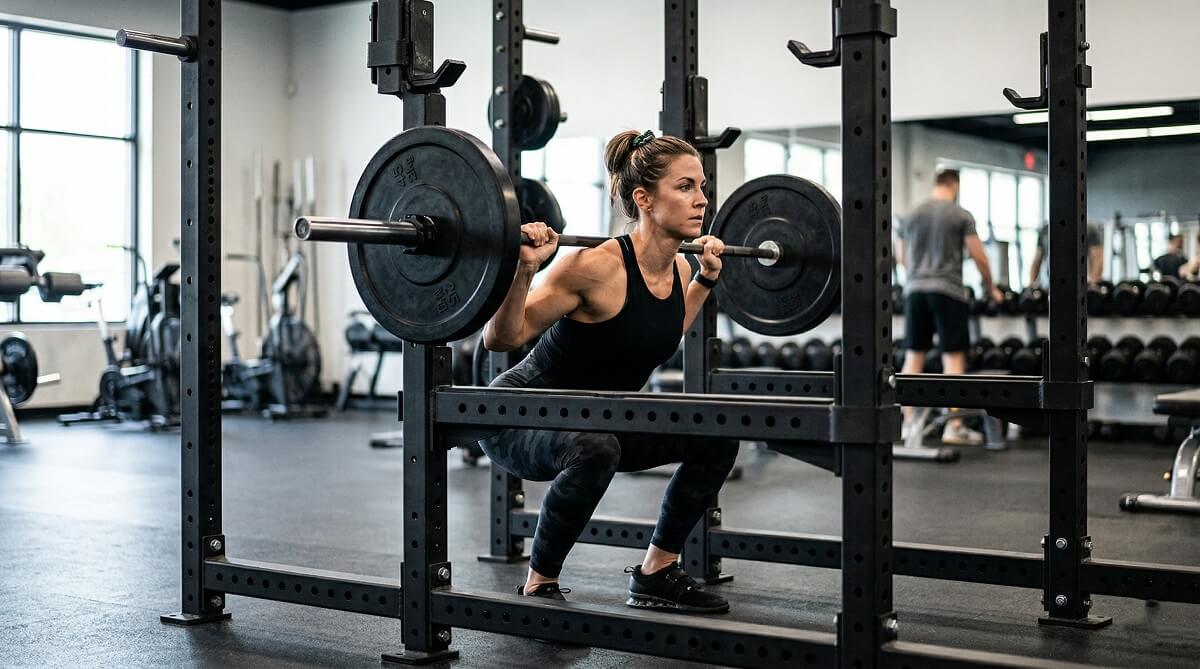
The squat rack is the most versatile piece of equipment in any gym — but only if you know how to configure it for your body. Three things determine whether you use it safely or dangerously: bar height, safety bar placement, and collars. Get those three right, and the rest follows naturally.
Whether you’re training at a commercial gym for the first time or setting up a barbell in your garage, this guide walks you through exactly how to adjust the rack, load the bar, and perform the most common movements on it. are available on ChubbytIps if you want to keep building from here.
Quick version: if the bar feels awkward to unrack, your hooks are too high. If you’re training solo without a spotter, the safety bars are not optional — they’re the entire reason the rack exists. Set them every single time.
Who Should (and Shouldn’t) Use a Squat Rack
✅ Best For
- Anyone learning to squat, bench press, or overhead press with a barbell
- Solo lifters who train without a spotter
- Home gym owners who want one piece of equipment that covers most barbell movements
- Beginners who want to progress from bodyweight to loaded barbell work
❌ Skip the Squat Rack If
- You’re doing conventional deadlifts from the floor (do those outside the rack — the feet get in the way)
- You’re only doing machine-based or bodyweight workouts for now
- You haven’t practiced the movement pattern with just the bar first
What Kind of Squat Rack Are You Working With?
Not all squat racks are the same, and the type you’re using changes a few of the setup details. Here’s a quick breakdown of the three main styles you’ll find in gyms and home setups:
Power Rack (Full Cage)
Four uprights arranged in a box shape, fully enclosed on the sides. Built-in safety arms run across both sides of the cage. This is the safest setup for solo lifting — if you miss a squat or can’t complete a bench press, the bar drops onto the safety arms inside the cage. Most commercial gyms have at least one of these.
Half Rack / Squat Stand
Two uprights with J-hooks for the bar and separate spotter arms you set manually. More space-efficient than a full cage, which makes them popular for home gyms. Weight capacity varies — entry-level half racks typically handle 400–600 lbs, while quality units reach 800 lbs or more. The Fringe Sport Garage Series (a popular home option at $349) is rated at 600 lbs, for example.
Two-Piece Squat Stand
Two independent uprights with no connecting crossbar. The most compact and affordable option, but also the least stable. These work for lighter loads in supervised settings; if you plan to lift heavy or train solo, anchor them to the floor or step up to a half rack instead.
| Rack Type | Example | Weight Capacity | Best For |
|---|---|---|---|
| Two-piece squat stand | Fringe Sport Indy Econ | 400 lbs | Beginners, light loads, supervised sessions |
| Half rack / garage rack | Fringe Sport Garage Series | 600 lbs | Home gym, solo training, moderate loads |
| Power cage (full) | Fitness Reality 810XLT | 800 lbs | Heavy lifting, solo training, commercial use |
| Commercial power rack | Fringe Sport Osprey (3×3) | 1,000+ lbs | Commercial gyms, competitive lifters |
Capacity data from manufacturer specs (Fringe Sport, Fitness Reality) as of March 2026. Check current specs before purchase.
If you’re still deciding between a home cage and a commercial gym membership, can help you weigh the long-term value of each.
Step 1: Set Your Bar Height (J-Hook Placement)
This is where most beginners go wrong. J-hooks set too high force you onto your toes to unrack — a bad start to any heavy set. Too low and you’re doing an awkward full squat just to pick the bar up before your actual squat begins.
Finding the Right Height
Stand inside the rack with your feet flat on the floor. The bar should sit at roughly upper chest height — below your shoulders, not at chin or neck level. When you get under the bar and stand up to unrack it, you should only rise about 2–3 inches. That slight movement tells you the hooks are dialed in.
A good rule of thumb: set the hooks so the bar rests at the same level as the meaty part of your upper chest (think: just below your collarbone). You want a partial squat to unrack, not a full one, and not zero range of motion either.
How to Move J-Hooks
On most racks with twist-lock hooks (common in commercial gyms):
- Grip the J-hook with both hands
- Twist the hook outward (away from the rack upright) — this releases the locking pin
- Pull the hook straight out of the hole
- Count the holes from your reference point and move to your target position
- Insert the hook sideways, then twist inward to lock it flat
On racks with pin-style hooks (Rogue, REP Fitness, and others), you simply pull the locking pin, slide the hook to the new hole, and reinsert the pin. Either way, once adjusted, give each hook a firm tug before loading any weight — a hook that’s not fully seated can slip under load.
Pro tip: Note the hole number on each side so you don’t have to re-measure every session. Most racks number every other hole; write your number down in your training log.
Bar Height Quick Reference by Exercise
| Exercise | J-Hook Height Target |
|---|---|
| Back squat / front squat | Just below shoulder height (upper chest level when standing flat-footed) |
| Bench press | Low enough to unrack with a slight elbow bend (arms not fully extended) |
| Overhead press (OHP) | Chin height or just above shoulder level |
| Rack pulls / partial deadlift | Mid-thigh or just below knee, depending on training goal |
A quick note on hole spacing: most racks have holes spaced 2 inches apart, which works fine for squats and overhead press. Some higher-end racks feature “Westside spacing” in the bench press zone — according to YourWorkoutBook’s hole spacing guide, this means 1-inch (25mm) hole-to-hole spacing, a system developed at Westside Barbell in Columbus, Ohio. That tighter spacing matters most for bench press, where precise hook height can mean the difference between a clean unrack and getting the bar snagged on re-rack. Not essential for beginners, but worth knowing if you’re comparing racks.
Step 2: Set Your Safety Bars
Safety bars (also called spotter arms, safeties, or catchers) exist for one reason: so you don’t get pinned under a barbell if you miss a rep. For solo training, skipping this step is not an option.
Safety Bar Height for Squats
Here’s how to find the right position:
- Step inside the rack (without any weight on the bar yet)
- Descend to your lowest comfortable squat depth — the point you’d be at on a real working set
- Have a training partner note where the bar is at that depth, or mark the height yourself
- Set the safety bars roughly 2 inches below that point
At that height, if you can’t complete a rep, you can lower the bar onto the catchers intentionally and walk out from under it. As MyArsenal Strength’s power rack squat guide puts it: “the spotter bars should be about 2 inches below your lowest squat position” — low enough that they don’t interrupt your movement, high enough that they actually catch the barbell before it reaches the floor.
Safety Bar Height for Bench Press
Lie on the bench and lower an unloaded bar to your chest. Set the safety arms just below that contact point — when your natural arch is engaged, the safeties should catch the bar just below chest level if you can’t press. Always test this with an empty bar before loading any weight.
How to Insert Safety Bars (Twist-Style)
- Hold the safety arm parallel to the upright (sideways) to align it with the hole
- Insert it fully into the hole
- Rotate the arm down into horizontal position — it should lock flat
On pin-style racks, simply insert the safety arm into both uprights at the same hole number on each side. Check that both arms are at the same height before loading the bar.
Step 3: Load the Bar and Lock On Your Collars
Know Your Barbell’s Starting Weight
Before you add a single plate, know what you’re starting from. A standard men’s Olympic barbell weighs approximately 44 lbs (20 kg) — the International Weightlifting Federation (IWF) certified standard, as confirmed by Eleiko, the official IWF equipment supplier. Some US-market bars are sold as 45 lbs — close enough for most training purposes. Women’s Olympic barbells are 15 kg / 33 lbs per the IWF’s official equipment specifications.
The bar alone is the starting point for your total weight calculation. If your gym has a 45 lb bar and you add two 25 lb plates on each side, your total is 45 + (25 × 4) = 145 lbs.
Loading the Bar Evenly
Always load the same amount of weight on both sides. Uneven loading puts asymmetric stress on the bar and creates a tipping risk. If you’re adding multiple plates, alternate sides rather than fully loading one side first — a bar loaded on one end only can tip off the rack or flip off the J-hooks.
Use Collars Every Time — No Exceptions
Collars (also called clamps or clips) prevent plates from sliding off the bar during a lift. A plate shifting even a few inches on one side during a squat changes your balance and can cause injury. Spring collars are fine for most training; locking collars are more secure for heavy lifts and dynamic movements.
Even on a “light” warm-up set, use collars. The habit matters more than the weight. for recommendations on collars and other barbell accessories.
Step 4: Executing the Squat
Setup done — now the actual movement. Here’s what to do from bar to rerack.
Getting Under the Bar
Step under the bar and grip it with both hands at an even width — use the knurling marks on the bar as your symmetry guide. The bar should rest across your upper traps for a high-bar squat (the most common beginner position), or slightly lower across your rear delts for low-bar. Either way, the bar should never be resting on your neck.
Take a deep breath in, brace your core like you’re about to get punched, then stand up to lift the bar off the hooks. Take one or two small steps back — enough to clear the hooks — and no more. You want to rerack the bar with minimal walking back in, so don’t drift too far from the rack.
The Descent and Drive
With feet shoulder-width apart and toes pointing out slightly (15–30 degrees), push your knees out in the same direction as your toes as you sit down into the squat. Keep your chest up and your core tight throughout. Aim to reach parallel — hip crease at or below knee level — before driving back up through your heels.
Reracking the Bar
Walk the bar back into the rack — toward the uprights, not forward away from them. Feel both J-hooks make contact with the bar simultaneously before releasing your grip. Lower the bar evenly onto both hooks at the same time. If you release one side first, you risk the bar rolling off or the hooks twisting.
Once the bar is secured, step away from the rack. Don’t reach back to adjust plates while still in the rack space.
More Exercises You Can Do on a Squat Rack
The rack earns its floor space by covering far more than just squats. According to REP Fitness and multiple independent exercise guides, a full power rack supports over a dozen distinct barbell movements. Here are the most useful ones for general training:
Bench Press
Pull a flat bench inside the rack so the bar sits directly over your chest when you lie down. Set the J-hooks at a height where you can unrack with a slight elbow bend — arms not fully locked out. Set the safety arms just below chest height and test the position with an empty bar before adding weight.
Overhead Press (OHP)
Set the bar slightly above shoulder height, step under it, and grip the bar just outside shoulder width. Unrack to the front of your shoulders and press directly overhead to full lockout. The rack keeps the bar accessible at the right height so you don’t have to clean it from the floor every set.
Pull-Ups (If Your Rack Has a Pull-Up Bar)
Most full power cages and many half racks include a pull-up bar. For beginners, loop a resistance band over the bar and place one foot or knee in the band for assisted pull-ups. for a step-by-step path from zero to full pull-ups. One note: if you’re doing kipping pull-ups or other dynamic movements, the rack should be bolted to the floor — unanchored racks can tip under that kind of loading.
Rack Pulls
Set the J-hooks at knee height and place the bar across them. Perform a partial deadlift pull from that elevated position. Rack pulls are useful for building upper back and trap strength, and they’re a good entry point for people building toward full conventional deadlifts. Standard deadlifts from the floor are done outside the rack, where the rack feet won’t get in the way.
Barbell Rows
Position the J-cups low enough to pull the barbell from a standing hinge. Grab the loaded bar, push your hips back, and row it toward your lower chest or upper abdomen depending on the variation you’re training. The cage handles reracking between sets without any floor setup. for step-by-step breakdowns of each movement.
| Exercise | Hook Height | Safety Bar Setting | Notes |
|---|---|---|---|
| Back squat | Below shoulder height | ~2″ below lowest squat depth | Walk out 1-2 steps; rerack by walking back in |
| Bench press | Unrack with slight elbow bend | Just below chest contact point | Test with empty bar first |
| Overhead press | Just above shoulder height | Not always needed; use at chin height if available | No forward foot travel needed |
| Rack pulls | Knee height | N/A (bar stays on hooks) | Pull from stationary position |
| Pull-ups | N/A (uses pull-up bar) | N/A | Anchor rack before kipping |
Safety Rules and Gym Etiquette
The Non-Negotiables
- Always set the safety bars when training alone. There are no exceptions to this. Even if you’re “going light today.”
- Always use collars. A plate sliding off mid-squat changes the weight distribution instantly and dangerously.
- Load both sides equally. Check the plates on each side before every set.
- Rerack your weights — strip all plates and return them before leaving. Every single time.
Gym Courtesy
If someone is between sets and you want to work in, ask first — most lifters are happy to share. During busy hours, keep rest times reasonable and don’t use the rack as a storage shelf between exercises if others are waiting. Write down your hook and safety settings so you can reset quickly when swapping with a training partner.
If a Lift Goes Wrong
If you miss a squat or lose a bench press, don’t try to save it with a desperate movement. Lower the loaded bar onto the spotter arms, duck out from under it, and regroup. That’s the entire purpose of the safeties. In a full power cage with the arms correctly positioned, no further action is needed — the barbell sits on the catchers until you strip the plates off.
After any equipment issue, re-check both your J-hook positions and both safety bar positions before reloading. Hooks can occasionally rotate out of position after heavy contact.
Frequently Asked Questions
What height should I set the squat rack bar?
Just below shoulder height — upper chest level when you’re standing flat-footed inside the rack. You should need only a slight rise to clear the hooks when unracking. If you’re going up on your toes, the hooks are too high.
Do I need a spotter if I’m using a squat rack?
Not if your safety bars are correctly positioned. That’s the main function of the safety arms — they act as a mechanical spotter for solo training. Set them every time, test the height with an empty bar, and you’re covered.
What’s the difference between a squat rack and a power rack?
A power rack (or full cage) has four uprights arranged in a box, fully enclosing you during the lift with built-in safety arms on both sides. A squat rack or half rack has two uprights and an open front — more space-efficient but requires setting the safety arms manually. Both work well; the full cage is generally safer for heavy solo lifting.
Can beginners use a squat rack?
Yes — and it’s one of the best pieces of equipment for newcomers to learn on, precisely because the safety system catches you if something goes wrong. Start with just the bar to learn the setup and movement pattern before adding weight. has beginner-friendly walkthroughs for other foundational lifts as well.
Can you do deadlifts in a squat rack?
You can do rack pulls (partial deadlifts from knee height) inside the rack. Conventional deadlifts from the floor are typically done outside the rack — the rack feet get in the way at floor level and there’s no benefit to being inside the cage for a deadlift.
How do I set up a squat rack for bench press?
Pull a flat bench inside the rack, position yourself so the bar is directly over your chest, and set the J-hooks at a height where you can unrack with a slight elbow bend. Set safety arms just below where the bar would touch your chest. Always test with an empty bar before loading.
What is a J-hook?
The J-hook (or J-cup) is the curved bracket attached to the rack uprights that the barbell rests on between sets. Most quality J-cups have a UHMW plastic lining on the contact surface to protect the bar’s knurling and finish from scratches.
Should I use a barbell pad when squatting?
A barbell pad reduces discomfort on the upper traps during back squats — a reasonable choice when you’re starting out and your back hasn’t yet adapted to direct bar contact. Most experienced lifters move away from the pad over time as the upper back toughens up, but using one early on isn’t a problem. Start with it if you need it, drop it when you’re ready.
Ready to Set Up Your Own Rack?
Entry-level squat racks for home gym use start around $187–$320 as of March 2026. The CAP Barbell FM-8000F is one of the most accessible options at the low end, while the Fitness Reality 810XLT offers a full power cage with 800 lb capacity for around $240–$320. Check current prices on Amazon — both fluctuate with sales. for more detailed equipment comparisons.
