


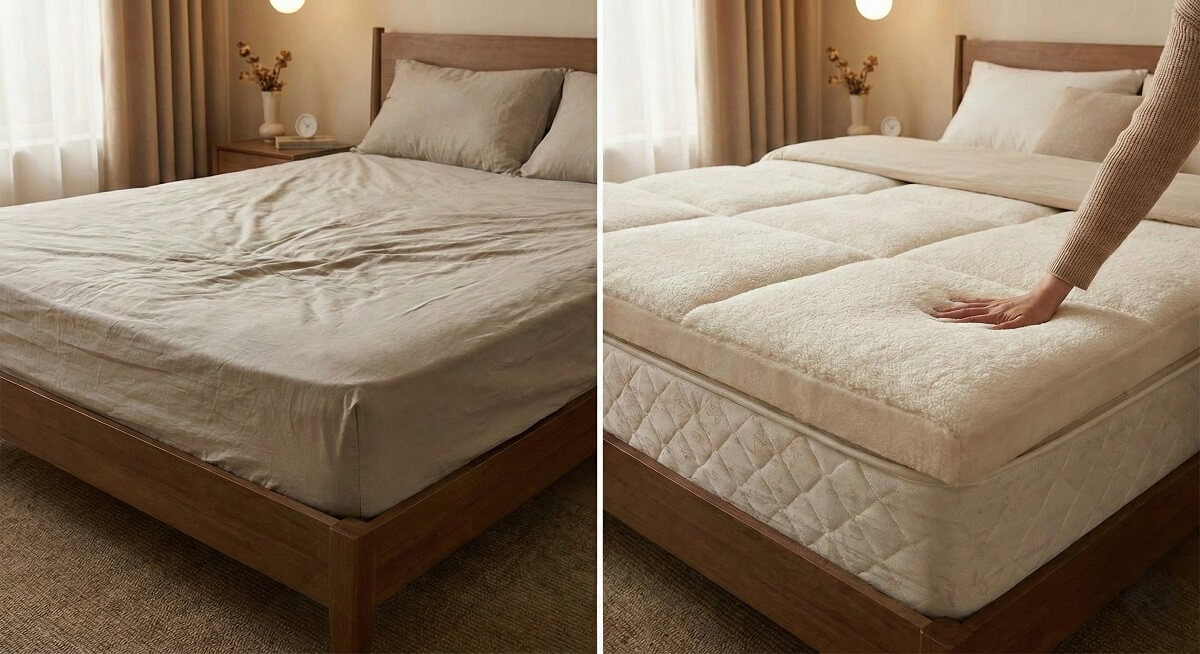
If your mattress has started sagging, you might be wondering whether a topper can save it. The short answer: yes, but only temporarily. A quality 3-4 inch memory foam topper can smooth out minor dips and make your bed comfortable again for another year or two. Think of it as buying time before you need a full replacement. If you’re also dealing with other sleep issues, you might want to check out our for more practical solutions.
Here’s the honest truth though. Toppers mask the sagging, they don’t repair it. The underlying structure of your mattress—whether that’s worn-out foam or weakened coils—stays damaged. If your mattress has deep indentations over 1.5 inches or you’re waking up with back pain, no topper will restore proper spinal support.
From a cost perspective, toppers make sense for certain situations. A decent memory foam topper runs $50-150, while a new mattress costs $500-2000 or more. If your mattress has mild surface sagging but the support core is still intact, that $100 investment could extend its useful life significantly.
Who Should (and Shouldn’t) Try a Mattress Topper
A Topper Makes Sense If:
- Your mattress is less than 7-8 years old with mild sagging (under 1.5 inches deep)
- Budget is tight and a new mattress isn’t feasible right now
- The sagging is limited to surface comfort layers, not the support core
- You want to extend mattress life by 1-2 years while saving for replacement
Skip the Topper and Replace Your Mattress If:
- Your mattress is 8+ years old with deep body impressions
- Springs are poking through or you can hear coils squeaking
- You wake up with consistent back, hip, or shoulder pain
- The sagging exceeds 1.5-2 inches deep (you can measure with a yardstick laid across the bed)
Why Mattresses Sag (And Why It Matters for Your Topper Choice)
The Natural Breakdown Process
Every mattress will sag eventually. Foam compresses under repeated pressure from your body weight. Springs lose tension over time. The areas where you sleep most—typically under your hips and shoulders—bear the brunt of this wear and develop indentations first.
According to Sleep Foundation, most mattresses last between 7 and 10 years, though this varies significantly by type. Innerspring mattresses have the shortest lifespan at around 5.5-6.5 years, while latex mattresses can last 10-15 years or more with high-quality construction. We covered more about in a separate guide.
Factors That Speed Up Sagging
Several things can make your mattress sag faster than expected:
- Poor quality materials: Low-density foam breaks down faster under pressure
- Inadequate foundation: Slats too far apart or a worn box spring can cause premature sagging
- Sleeping in the same spot: Concentrating your weight in one area accelerates compression
- Body weight: Heavier sleepers put more pressure on foam and springs, leading to faster wear
Do Mattress Toppers Actually Help With Sagging?
What a Topper Can Do
A mattress topper adds a new layer on top of your existing mattress, creating a smoother sleep surface above the dips and indentations. A thick memory foam topper can fill in shallow sags and provide additional cushioning, making your bed feel more supportive and comfortable.
For people with mild sagging, the difference can be dramatic. Where you once felt like you were sleeping in a hole, a good topper creates a flatter surface that lets you sleep without rolling toward the center of the bed.
What a Topper Cannot Do
According to Good Housekeeping, “toppers won’t resuscitate a bed that’s past its prime or fix a sagging mattress. Nor will they help align the spine if you suffer from back pain.”
This is a critical point. A topper can’t:
- Repair broken-down foam or weakened springs
- Restore proper spinal alignment if the core support is gone
- Provide adequate support on severely sagging mattresses (over 1.5 inches deep)
- Last as long as a new mattress would
The Realistic Assessment
A topper is like putting a bandage on a bigger problem. For minor surface sagging, that bandage works well and can extend your mattress’s useful life by 1-2 years. For severe structural sagging, you’re just delaying the inevitable purchase of a new mattress while potentially making your sleep quality and back health worse.
Best Mattress Topper Types for Sagging Beds
Memory Foam Toppers
Memory foam is the most popular choice for addressing sagging because it contours to your body and fills in dips. The foam compresses where you need cushioning and provides support around the indentations in your mattress.
For sagging issues, density matters more than thickness. According to Sleep Advisor, look for toppers with 4-5 lb/ft³ density foam. This “Goldilocks” range provides durability and contouring without the excessive heat retention of ultra-dense foam.
The downside: standard memory foam can sleep hot. If you’re a warm sleeper, look for gel-infused or open-cell foam options. This is similar to the cooling considerations we discuss in our .
Latex Toppers
Latex offers firmer support and more bounce than memory foam. Natural latex is especially durable and can last longer than memory foam options. However, latex doesn’t contour as closely, which means it may bridge over sags rather than filling them in.
Best for: sleepers who prefer a firmer feel and want maximum durability from their topper.
Gel-Infused and Cooling Toppers
These combine memory foam with cooling technology—either gel beads, graphite, or copper infusion. They provide the contouring benefits of memory foam while addressing the heat retention issue.
Premium options like the Saatva Graphite Memory Foam topper ($295) use graphite-infused foam specifically designed to sleep cooler than standard memory foam.
Mattress Topper Thickness Guide for Sagging
Not all sags require the same solution. Here’s how to match your topper thickness to your mattress condition:
| Your Mattress Condition | Recommended Thickness | What to Expect |
|---|---|---|
| Minor surface wear (under 1 inch sag) | 2 inches | Light surface smoothing, subtle comfort boost |
| Moderate sagging (1-1.5 inches) | 3 inches | Noticeable improvement, fills most dips |
| Significant sagging (1.5-2 inches) | 4 inches | Maximum coverage, extends bed life 1-2 years |
| Severe sagging (over 2 inches) | Consider replacement | Topper unlikely to provide adequate support |
The Sleep Foundation notes that a “nearly 4-inch profile” is suggested for “addressing indentations and impressions that make your sleep surface feel uneven.”
Other Fixes to Try (Beyond Toppers)
Rotate Your Mattress
If you haven’t been rotating your mattress, start now. Swapping the head and foot every 3-6 months distributes wear more evenly and can prevent sagging from getting worse. This won’t reverse existing damage, but it’s free and helps preserve whatever support your mattress still has.
Check Your Foundation
Sometimes the problem isn’t the mattress itself—it’s what’s underneath. Slats that are too far apart (more than 3 inches) can allow the mattress to dip between them. An old box spring may have lost its structural integrity. A solid platform bed or bunkie board provides more consistent support. For more furniture maintenance tips, browse our .
The Pillow-Under-Mattress Hack
For a budget temporary fix, some people place flat pillows under the mattress directly beneath the sagging areas. This can prop up dips from below. The downside: pillows compress over time and need frequent adjustment. It’s more of a stopgap than a solution, but it costs nothing if you have spare pillows.
Mattress Support Boards
Products like bunkie boards and high-density foam support inserts can add firmness underneath a sagging mattress. These work best combined with a topper—the support board firms up the base while the topper smooths the surface.
When to Stop Fixing and Buy a New Mattress
Warning Signs Your Mattress Is Beyond Saving
- Sagging deeper than 2 inches
- Springs poking through the surface
- Mattress is 8-10+ years old
- Persistent back, neck, or hip pain that improves when you sleep elsewhere
- Visible structural damage, lumps, or significant unevenness
The Cost Math
Before you invest in a topper, run the numbers:
- Quality topper cost: $50-150 (budget to mid-range)
- Expected topper benefit: 1-2 years of improved comfort
- New mattress cost: $500-2000+ depending on type and quality
- New mattress lifespan: 7-10 years
If your mattress is already 7+ years old and severely sagging, a topper may only delay replacement by a few months. In that case, saving the $100-150 toward a new mattress makes more financial sense.
How to Prevent Future Mattress Sagging
Use Proper Support
Your mattress needs adequate foundation support. Platform beds work well, or use a slatted frame with slats no more than 3 inches apart. Make sure your frame can handle the combined weight of the mattress plus sleepers.
Rotate Regularly
Get in the habit of rotating your mattress head-to-foot every 3-6 months. This distributes wear across the entire surface rather than concentrating it in your usual sleeping area. Note: most modern mattresses should not be flipped, only rotated—they’re designed with specific top and bottom layers.
Use a Mattress Protector
A waterproof protector keeps moisture, body oils, and spills from seeping into your mattress. These substances can break down foam over time, accelerating wear. A good protector costs $30-60 and can extend your mattress life considerably. Related: learn to keep it in top shape.
Vary Your Sleep Position
If possible, avoid sleeping in the exact same spot every single night. Even small variations in position can help distribute wear more evenly across the mattress surface.
Frequently Asked Questions
Will a mattress topper fix my sagging mattress?
It can help temporarily by creating a smoother surface above the sags, but it won’t repair the underlying damage. Think of it as a comfort boost that buys you time, not a permanent fix.
How thick should a mattress topper be for a sagging bed?
For minor sagging (under 1 inch), a 2-inch topper works. For moderate sagging (1-1.5 inches), go with 3 inches. For deeper sags up to 2 inches, you’ll need a 4-inch topper. Beyond that, replacement is usually the better option.
Is memory foam or latex better for a sagging mattress?
Memory foam typically works better because it contours more closely and fills in dips. Latex provides firmer support but may bridge over sags rather than conforming to them. For most sagging issues, memory foam with 4-5 lb/ft³ density is the better choice.
Can a sagging mattress cause back pain?
Yes. Sagging prevents proper spinal alignment because your body sinks unevenly into the mattress. This puts stress on your back, hips, and shoulders. If you wake up sore regularly and feel better after sleeping elsewhere, your mattress is likely the cause. For more sleep-related health topics, check our .
How long will a topper extend my mattress life?
Typically 1-2 years, depending on how severe the sagging is and the quality of the topper. It’s a bridge solution while you save for a replacement, not a permanent fix.
Should I flip my mattress to fix sagging?
Only if it’s designed to be flipped (double-sided). Most modern mattresses are one-sided and shouldn’t be flipped—you’d be sleeping on the support layer, not the comfort layer. Rotating head-to-foot every 3-6 months helps prevent uneven wear but won’t reverse existing sags.
Are cheap mattress toppers worth it?
Low-density foam toppers (under 3 lb/ft³) compress quickly and won’t provide lasting support—they typically last only about 6 years. Spending a bit more on 4-5 lb/ft³ density foam pays off in durability and effectiveness. Budget toppers start around $40-60, while quality mid-range options run $80-150.
What’s the best budget fix for a sagging mattress?
A 3-inch memory foam topper with medium density (4-5 lb/ft³) offers the best value, typically costing $80-150. For an even cheaper temporary fix, try placing flat pillows under the mattress in the sag zones, though this requires frequent adjustment.
If your mattress shows minor sagging but is otherwise in decent shape, a quality topper can extend its life and restore your sleep comfort. Check current prices on Amazon for memory foam toppers, or read Sleep Foundation’s expert reviews for specific product recommendations.
