


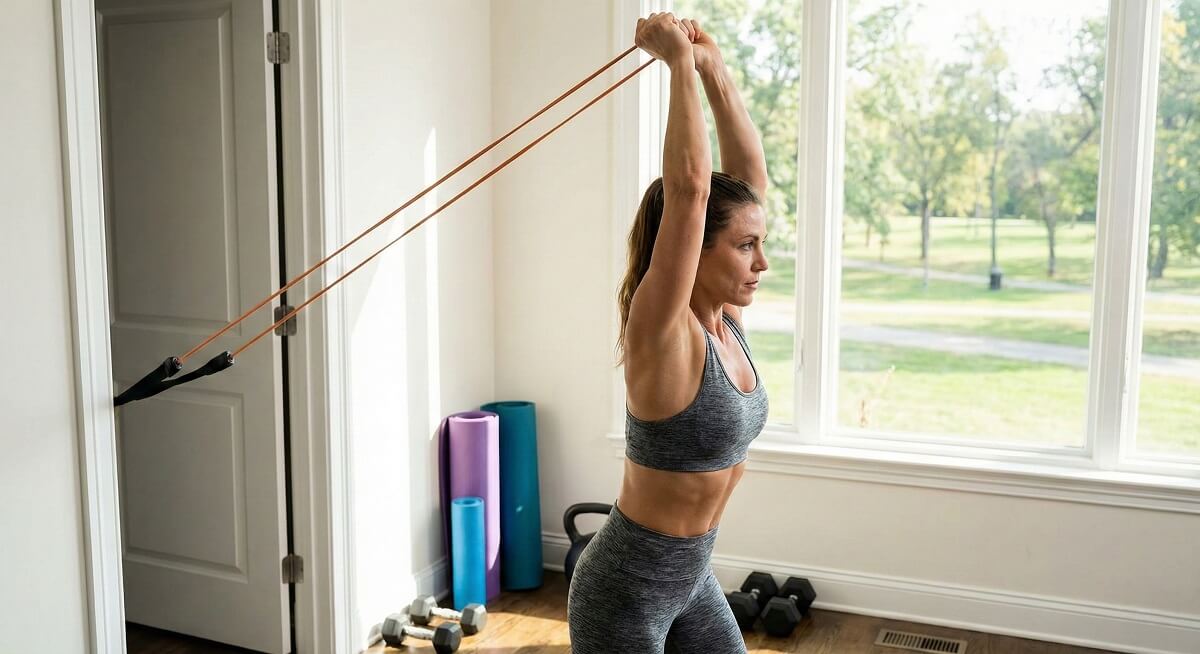
Resistance bands deliver constant tension that makes every rep count for tricep training. Unlike dumbbells where gravity does half the work on the way down, bands fight you through the entire movement—especially at lockout where your triceps are strongest. Research published in SAGE Open Medicine found that elastic resistance training produces comparable strength gains to conventional weights across multiple studies.
The 8 exercises in this guide target all three tricep heads using different anchor positions and movement angles. You can build a complete arm workout with nothing but a single band and a doorway—or expand your routine with for a full arm session. Whether you’re training at home, in a hotel room, or adding variety to your gym routine, these band exercises deliver real results when done with proper form.
Who Should (and Shouldn’t) Use Bands for Triceps
Best For
- Home exercisers without access to cable machines
- Travelers who need portable workout equipment
- Beginners building foundational arm strength
- Anyone dealing with joint issues who needs low-impact training
- Lifters looking to add volume without heavy loads
- Budget-conscious trainers (quality sets cost $10-40)
Skip If
- You only train for maximal strength and need very heavy loads
- You have latex allergies (check for latex-free options)
- You’re unwilling to learn proper anchoring technique
Why Resistance Bands Work for Tricep Training
Bands create something called linear variable resistance. In plain terms: the further you stretch a band, the harder it pulls back. This means the exercise gets toughest at the point where your triceps are in their strongest position—full extension.
With a dumbbell, the hardest part of a tricep extension is usually the middle of the movement. At the top, you’re just holding weight in place. Bands flip that script. Your triceps work hardest right at lockout, which matches their natural strength curve.
There’s another benefit worth knowing: constant tension. When you lower a dumbbell, gravity assists the movement. Bands don’t give you that break. Your muscles stay engaged through the entire range of motion, which increases time under tension—a key factor for muscle growth.
A systematic review of 8 randomized controlled trials found no significant difference in strength gains between elastic resistance and conventional weights. The takeaway? Bands aren’t a compromise. They’re a legitimate training tool that pairs well with .
Quick Tricep Anatomy
Your triceps have three heads, and understanding them helps you pick the right exercises:
- Long head: The biggest portion. It attaches to your shoulder blade and runs down the back of your arm. Overhead movements target it best because the stretch position engages this head more.
- Lateral head: The outer portion that creates the “horseshoe” shape when developed. Pushdowns and kickbacks hit this area well.
- Medial head: Sits underneath the other two and works during almost any elbow extension.
All three heads share one job: straightening your arm at the elbow. The triceps make up roughly 60% of your upper arm mass, so if you want arms that look strong, these muscles deserve your attention.
Equipment You’ll Need
Types of Bands
Loop bands form a continuous circle. They’re versatile and work well for most tricep exercises. Tube bands with handles feel more like cable machines and offer better grip comfort for pushdowns and extensions.
Resistance Levels
Most brands use color coding, though colors vary between manufacturers. Here’s a general guide based on the TheraBand standard:
| Color | Resistance | Best For |
|---|---|---|
| Yellow | 1-6 lbs | Rehab, light warm-up |
| Red | 2-7 lbs | Beginners, isolation work |
| Green | 2-10 lbs | Light-medium tricep exercises |
| Blue | 3-14 lbs | Standard tricep training |
| Black | 4-18 lbs | Intermediate to advanced |
| Silver/Gold | 10-40 lbs | Advanced, compound movements |
For tricep work, most people do well starting with a medium resistance band and having a lighter option for high-rep finishers.
Anchor Options
You’ll need something to attach your band to for certain exercises. A door anchor (usually included with band sets) works well. Pull-up bars, sturdy furniture, or squat rack uprights also work. Just make sure your anchor point won’t shift during the exercise.
What It Costs
Budget 5-band sets start around $10. Sets with handles, door anchors, and carrying cases run $20-40. Some stackable sets let you combine bands for up to 150 pounds of resistance. You don’t need to spend much to get started.
8 Best Tricep Exercises with Resistance Bands
1. Overhead Tricep Extension
Primary target: Long head
Setup: Step on the middle of the band with one or both feet. Hold the other end behind your head with both hands, elbows pointing toward the ceiling.
Execution: Keeping your upper arms still, extend your hands straight up until your arms are fully locked out. Squeeze your triceps at the top, then lower with control.
Pro tip: Research shows overhead tricep movements produce about 28% more muscle growth than neutral-position exercises. Make this a staple in your routine.
Sets/Reps: 3-4 sets of 10-15 reps
2. Band Pushdown
Primary target: All three heads
Setup: Anchor the band above head height—a door anchor at the top of a closed door works well. Face the anchor and grab the band with both hands, elbows pinned to your sides.
Execution: Push your hands straight down until your arms are fully extended. Squeeze at the bottom, then return to the starting position with your arms at 90 degrees.
Pro tip: At the bottom of the movement, rotate your wrists slightly so your palms face the floor. This increases the tricep squeeze.
Sets/Reps: 3-4 sets of 12-15 reps
3. Tricep Kickback
Primary target: Lateral head
Setup: Step on the band with your left foot. Hold the other end in your right hand. Hinge at your hips until your torso is nearly parallel to the floor. Bring your right elbow up so your upper arm is parallel to your body.
Execution: Keeping your upper arm locked in place, extend your hand backward until your arm is straight. Squeeze, then lower with control.
Pro tip: If you’re swaying or using momentum, you’re going too heavy. This exercise works best with lighter resistance and strict form.
Sets/Reps: 2-3 sets of 12-15 reps per arm
4. Close-Grip Banded Push-Up
Primary target: All three heads (compound movement)
Setup: Loop the band across your upper back, holding each end under your palms. Get into a with hands directly under your shoulders or slightly closer together.
Execution: Lower yourself until your chest nearly touches the floor, keeping elbows tucked close to your body. Push back up against the band resistance.
Pro tip: The band adds the most resistance at the top—exactly where regular push-ups feel easiest. If you can do 30+ regular push-ups, these will humble you.
Sets/Reps: 3 sets of 8-12 reps
5. Cross-Body Pressdown
Primary target: Long head
Setup: Anchor the band high on your right side. Stand facing slightly away and grab the band with your left hand, starting with your hand near your right shoulder.
Execution: Press your hand down and across your body toward your left hip. The band will cross your torso like a seatbelt. Return with control.
Pro tip: Keep your torso completely still. The only movement should come from extending your elbow.
Sets/Reps: 3 sets of 10-12 reps per arm
6. Single-Arm Overhead Extension
Primary target: Long head (unilateral)
Setup: Step on one end of the band. Grab the other end with the same-side hand and bring it behind your head, elbow pointing up.
Execution: Extend your arm straight up, keeping your elbow close to your head. Lower slowly and repeat.
Pro tip: Start with your weaker arm and match the reps on your stronger side. This prevents strength imbalances from developing.
Sets/Reps: 3 sets of 10-12 reps per arm
7. Lying Band Skull Crusher
Primary target: All three heads
Setup: Anchor the band low behind your head (under a bench leg or heavy object works). Lie on your back holding the handles with arms extended toward the ceiling.
Execution: Keeping your upper arms still, bend only at the elbows to lower your hands toward your forehead. Extend back to the starting position.
Pro tip: Tilt your upper arms slightly back (toward your head) to keep tension on the triceps throughout the movement.
Sets/Reps: 3 sets of 10-12 reps
8. Tricep Pull-Apart
Primary target: All three heads (burnout finisher)
Setup: Hold the band in front of your chest with arms straight, hands about shoulder-width apart.
Execution: Keeping your arms straight, pull your hands apart by squeezing your triceps. Think about trying to straighten your elbows as hard as possible. Return slowly.
Pro tip: Use a lighter band here and aim for high reps. This works great as a finisher to completely fatigue your triceps.
Sets/Reps: 2 sets of 20-30 reps
Exercise Comparison at a Glance
| Exercise | Primary Head | Anchor | Difficulty | Best For |
|---|---|---|---|---|
| Overhead Extension | Long | Floor | Beginner | Mass building |
| Band Pushdown | All | High | Beginner | Foundation |
| Kickback | Lateral | Floor | Intermediate | Definition |
| Close-Grip Push-Up | All | None | Intermediate | Strength |
| Cross-Body Pressdown | Long | High | Intermediate | Isolation |
| Single-Arm Extension | Long | Floor | Beginner | Symmetry |
| Skull Crusher | All | Low | Intermediate | Size |
| Pull-Apart | All | None | Beginner | Endurance |
Common Mistakes That Kill Your Results
Letting your elbows flare or drift: Your upper arms should stay locked in position during isolation exercises. If your elbows move, your shoulders start helping and your triceps do less work.
Using momentum: Swinging the band or jerking through reps might let you use heavier resistance, but it reduces the actual work your triceps perform. Slow, controlled reps build more muscle.
Choosing the wrong resistance: Too heavy and you’ll compensate with bad form. Too light and you won’t challenge your muscles enough. You should be able to complete your target reps with good form while the last 2-3 reps feel genuinely difficult.
Skipping the squeeze at lockout: The top of each rep is where bands provide the most resistance. If you’re rushing through this position, you’re missing the exercise’s main benefit.
Poor anchor setup: A band slipping mid-set isn’t just annoying—it’s a safety issue. Test your anchor point with light tension before starting your working sets. If it moves at all, find a better option.
Sample Workouts for Different Goals
For Muscle Size (Hypertrophy Focus)
Higher reps with moderate rest periods maximize time under tension.
| Exercise | Sets | Reps | Rest |
|---|---|---|---|
| Overhead Tricep Extension | 4 | 12-15 | 60 sec |
| Band Pushdown | 3 | 12-15 | 60 sec |
| Cross-Body Pressdown | 3 | 12-15 each | 45 sec |
| Tricep Pull-Apart | 2 | 20-25 | 30 sec |
For Strength and Lockout Power
Lower reps with heavier bands and longer rest build raw strength.
| Exercise | Sets | Reps | Rest |
|---|---|---|---|
| Close-Grip Banded Push-Up | 4 | 6-10 | 90-120 sec |
| Lying Skull Crusher | 4 | 8-10 | 90 sec |
| Band Pushdown | 3 | 8-10 | 90 sec |
Quick 10-Minute Arm Pump
Circuit-style training when you’re short on time or want a finisher.
| Exercise | Reps | Notes |
|---|---|---|
| Band Pushdown | 15 | Immediately to next |
| Overhead Extension | 12 | Immediately to next |
| Tricep Kickback | 10 each arm | Rest 60 sec, repeat 3x |
How to Progress Over Time
Your triceps will adapt to the same stimulus. Here’s how to keep making gains:
Add reps before adding resistance: If your target is 12 reps and you hit it cleanly, aim for 13-15 before moving to a heavier band. This builds endurance and ensures you’re truly ready to progress.
Move to heavier bands: When you can complete all sets at the top of your rep range with solid form, it’s time for more resistance.
Slow down the eccentric: The lowering phase of each rep offers growth potential. Try a 3-second count on the way down to increase time under tension without changing equipment.
Reduce rest periods: Cutting rest from 90 to 60 seconds, or 60 to 45, increases workout density and metabolic stress.
Add drop sets: After your last set, immediately grab a lighter band and continue until failure. This exhausts muscle fibers that weren’t fully tapped during your regular sets.
Sample 4-Week Progression
| Week | Change |
|---|---|
| Week 1 | Learn exercises with moderate band, 3 sets of 10 |
| Week 2 | Increase to 3 sets of 12-15 |
| Week 3 | Add 1 set to main exercises (4 sets) |
| Week 4 | Move to heavier band, return to 3 sets of 10 |
Frequently Asked Questions
Can you actually build muscle with resistance bands?
Yes. A meta-analysis of 8 studies found no significant difference in strength gains between elastic resistance and conventional weights. Bands provide sufficient stimulus for muscle growth when you use appropriate resistance and train with progressive overload.
How often should I train triceps with bands?
Two to three times per week works well for most people. Allow at least 48 hours between sessions targeting the same muscle group to ensure adequate recovery.
What resistance band should I start with?
Begin with a light-to-medium band for isolation exercises like kickbacks and extensions. For compound movements like banded push-ups, you might need a medium-to-heavy band. Having multiple resistance levels lets you match the right band to each exercise.
Are bands better than cables for triceps?
They’re different, not necessarily better. Cables provide consistent resistance throughout the movement, while bands get harder as they stretch. Both can build muscle effectively. Bands offer portability that cables can’t match.
Can I do a full arm workout with just bands?
Absolutely. Combine these tricep exercises with band curls for biceps and for shoulders. One band set can train your entire upper body.
How do I know when to move to a heavier band?
When you can complete all your target reps with good form and the last few reps no longer feel challenging, it’s time to progress. If you’re hitting 15 reps easily when your target was 12, you need more resistance.
Do bands work the same muscles as cable machines?
Same muscles, different resistance curve. Both exercises train elbow extension, but bands provide increasing resistance as you straighten your arm, while cables stay constant. This makes bands particularly effective for targeting the lockout portion of tricep movements.
What’s the best warm-up before band tricep work?
Start with 5 minutes of light cardio to raise your body temperature. Then do arm circles (30 seconds each direction), cross-body arm swings (30-40 seconds), and overhead tricep stretches (20-30 seconds per arm). A few light sets of your first exercise also helps prepare the joints.
Start Building Stronger Triceps
You don’t need a fully-equipped gym to develop impressive triceps. A resistance band, a door anchor, and the exercises in this guide give you everything required to build stronger, more defined arms.
Start with the basics—overhead extensions and pushdowns—and add exercises as you get comfortable. Focus on form over resistance, progress gradually, and stay consistent. Your triceps will respond.
Pick up a resistance band set and give these movements a try. You might find that bands become a permanent part of your arm training toolkit. For more , browse our fitness section.
