


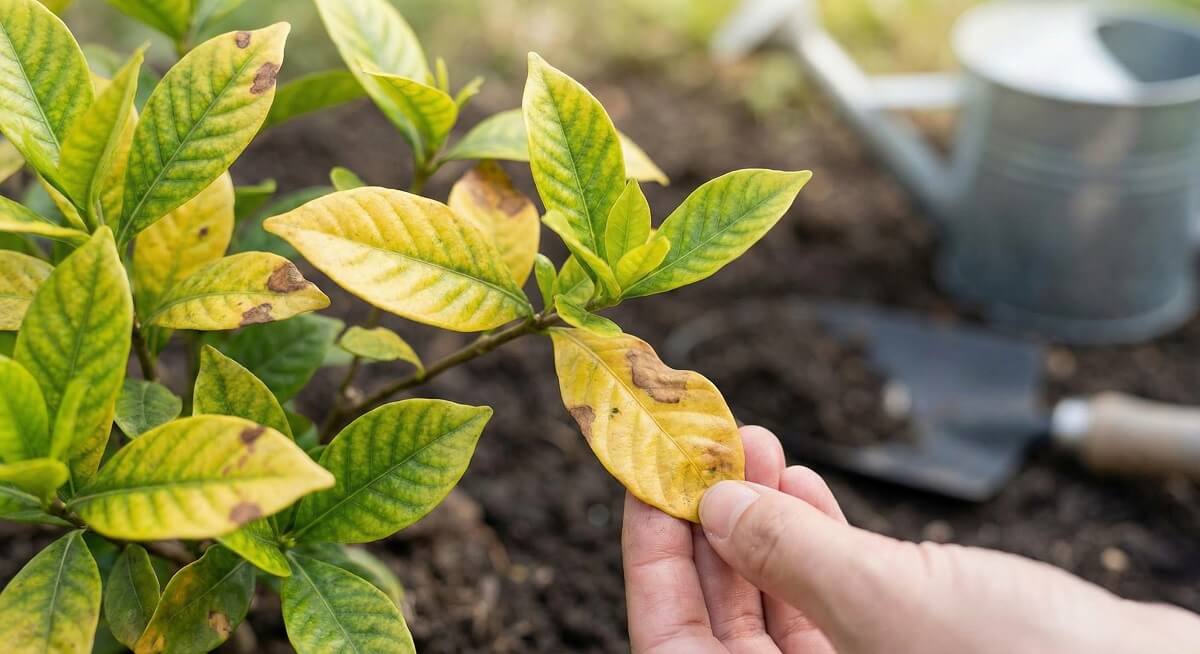
If you’re concerned about yellowing leaves on your gardenia, you’re not alone—it’s one of the most common problems gardenia owners face. The good news is that yellow leaves are usually fixable once you identify the cause. Most cases trace back to one of three main issues: iron deficiency (chlorosis), improper soil pH, or watering problems.
The key is accurate diagnosis. A gardenia with yellow leaves between the veins while the veins stay green likely has iron deficiency. If the entire leaf turns pale yellow uniformly, you’re looking at nitrogen deficiency. When yellow leaves come with wilting and leaf drop, overwatering or root rot is the culprit. With proper treatment, you’ll typically see new growth emerge green within 2-3 weeks, though complete recovery takes 4-6 weeks.
This guide walks you through the diagnosis process and provides specific, science-backed solutions from university extension services. We’ll cover the seven most common causes, what products actually work, and how to prevent the problem from returning. If you’re also dealing with other plant issues, check our for more help.
Quick Diagnosis: What’s Causing Your Gardenia’s Yellow Leaves?
Before diving into detailed solutions, use this visual checklist to identify your gardenia’s specific problem. Look closely at the pattern of yellowing to narrow down the cause:
✅ Match Your Symptoms
- Yellow between veins, veins stay green: Iron deficiency (chlorosis)—most common, especially with new growth
- Entire leaf turns pale yellow uniformly: Nitrogen deficiency—typically affects older leaves first
- Yellow leaves + wilting + leaf drop: Overwatering or root rot—check soil moisture
- Yellow older leaves only in spring: Normal leaf renewal—no action needed
- Yellow leaves + brown crispy tips: Underwatering or low humidity
- Yellow leaves + stunted growth: Wrong soil pH (too alkaline)—test your soil
- Yellow leaves + visible spots or insects: Pest or disease problem—inspect leaf undersides
Understanding Gardenia Growing Needs
Before troubleshooting yellow leaves, it helps to understand what gardenias need to thrive. These plants have specific requirements, and yellow leaves often signal that one of these conditions isn’t being met.
Ideal Soil Conditions
Gardenias are acid-loving plants that require acidic soil with a pH between 5.0 and 6.5, according to the University of Florida IFAS Extension. This isn’t just a preference—it’s critical for nutrient availability. When soil pH climbs above 7.0 (alkaline), essential nutrients like iron become locked up in forms the plant can’t access, even if those nutrients are present in the soil.
Proper drainage is equally important. Gardenias need soil that retains some moisture but doesn’t stay waterlogged. Heavy clay soils or containers without drainage holes spell trouble.
Water Requirements
The standard recommendation is about 1 inch of water per week. The goal is to keep the soil consistently moist but never soggy. Stick your finger into the soil near the plant base—if the top inch feels dry, it’s time to water.
Container-grown gardenias outdoors typically need more frequent watering than those planted in the ground, especially during hot weather. In-ground plants benefit from a 2-3 inch layer of mulch to help retain moisture.
Light and Climate
Gardenias grow best in USDA hardiness zones 8-11, though some hardy varieties like ‘Kleim’s Hardy’ can tolerate zone 7. They prefer partial shade—morning sun with protection from harsh afternoon heat works well in warmer regions.
Your climate zone affects which problems you’re likely to encounter:
- Zone 8 (Northern Florida, parts of Texas, Georgia): Occasional hard freezes can cause yellowing. Morning sun with afternoon shade recommended.
- Zone 9 (Central Florida, coastal areas): Frost protection may be needed during cold snaps.
- Zones 10-11 (South Florida, coastal California): Heat stress above 100°F can cause leaf yellowing and drop.
Nutrient Needs
Gardenias are heavy feeders, particularly for nitrogen and iron. They also need adequate magnesium. The University of Florida recommends fertilizing 2-3 times per year: once in early spring (February-March), again in early fall (September-October), and optionally during summer for a boost. For more on , we have a dedicated guide.
Top 7 Causes of Yellow Gardenia Leaves (And How to Fix Each)
1. Iron Deficiency (Chlorosis)
Symptoms: The classic sign is interveinal chlorosis—yellow tissue between the veins while the veins themselves remain green. This pattern typically appears on new, young leaves first.
Why it happens: Iron deficiency in gardenias rarely means there’s no iron in the soil. More often, the soil pH is too high (alkaline), which locks up iron in a form plants can’t absorb. As Utah State University Extension and other sources note, when soil pH exceeds 7.0, iron becomes unavailable even though it’s present.
How to diagnose: Test your soil pH with a simple test kit. You can find basic 3-in-1 soil testers (pH, moisture, light) at Home Depot or Amazon. For more detailed analysis, your local county extension office usually offers soil testing services for a small fee.
Solution: You need a two-pronged approach—correct the pH and supplement with iron.
Quick fix (foliar spray): Mix a 0.5% ferrous sulfate solution (2 ounces of ferrous sulfate in 3 gallons of water) and spray the foliage in the evening or on a cloudy day to prevent leaf burn. This provides rapid greening but needs to be repeated every two weeks until the plant recovers.
Long-term fix (soil treatment): Apply iron supplement products like chelated iron or iron sulfate to the soil. Chelated iron products (such as Grow More Iron Chelate available on Amazon) work well in alkaline soils because the iron stays available to plants even when pH is high. For soils with pH above 7.0, look for EDDHA chelated iron formulations.
At the same time, work on lowering your soil pH to the 5.0-6.5 range (covered in the next section).
Timeline: With proper treatment, new growth typically shows healthy green color within 2-3 weeks. Don’t expect existing yellow leaves to turn green again—they won’t. Focus on the new growth as your success indicator. Complete recovery usually takes 4-6 weeks.
2. Wrong Soil pH (Too Alkaline)
Symptoms: General yellowing across the plant, poor overall growth, and symptoms of multiple nutrient deficiencies appearing at once.
Why it happens: If your native soil contains limestone, shells, or is naturally alkaline, gardenias will struggle. High pH doesn’t just lock up iron—it affects the availability of other nutrients like manganese and zinc.
How to diagnose: Use a soil pH test kit. The ideal range for gardenias is 5.0-6.5, with most experts recommending the lower end (5.0-6.0) for optimal health.
Solution: Lower soil pH using sulfur-based amendments. Your options include:
- Elemental sulfur: Slow-acting but long-lasting. Work it into the soil around the plant.
- Iron sulfate: Faster-acting than elemental sulfur and provides iron at the same time.
- Aluminum sulfate: Works quickly but use with caution—too much aluminum can be toxic to plants.
Follow package directions carefully for application rates. These vary based on your starting pH, how much you need to lower it, and your soil type.
For container-grown gardenias, the simplest solution is to repot using a quality acidic potting mix formulated for azaleas, camellias, and rhododendrons.
Timeline: Soil pH adjustment isn’t instant. Expect 4-6 weeks for the amendments to take effect. Test your pH monthly to monitor progress.
3. Overwatering and Root Rot
Symptoms: Yellow leaves accompanied by wilting (even when soil is wet), leaf drop, and in severe cases, brown mushy roots instead of firm white ones.
Why it happens: Gardenias need consistent moisture, but “wet feet” (waterlogged roots) lead to root rot. This is especially common in heavy clay soils, containers without drainage holes, or when automatic irrigation systems deliver too much water. The brown leaf tips are often a giveaway that roots aren’t happy. Learn more about for container and in-ground plants.
How to diagnose: Check soil moisture 2-3 inches below the surface. If it’s constantly soggy, overwatering is likely. For container plants, gently tip the plant out and inspect the roots. Healthy roots should be white or light tan and firm. Brown, mushy, or smelly roots indicate rot.
Solution: If root rot has set in and roots are extensively damaged, the plant may not be salvageable. However, if you catch it early with only minor root damage, you can take action:
- Reduce watering frequency immediately
- Improve drainage by working organic matter (compost) into heavy soils
- Pull mulch back from the plant base to allow better air circulation
- For containers, ensure drainage holes are clear and consider repotting in fresh, well-draining soil
Timeline: If the plant is salvageable, you should see improvement in 2-4 weeks once proper watering resumes and drainage improves.
4. Underwatering
Symptoms: Yellow leaves with brown, crispy tips and edges. The soil feels dry several inches down, and leaves may curl.
Why it happens: Inconsistent watering, extended hot weather, or insufficient irrigation frequency. This is more common in container-grown gardenias and in sandy soils that don’t retain moisture well.
How to diagnose: Check soil moisture. If the top 2-3 inches are bone dry and the soil has pulled away from the sides of the container, underwatering is your problem.
Solution:
- Establish a consistent watering schedule—gardenias need about 1 inch of water per week, adjusted for weather
- Water deeply rather than frequently and shallowly, encouraging deep root growth
- Apply 2-3 inches of organic mulch (pine bark, wood chips) around the plant to help retain soil moisture
- Consider installing a drip irrigation system for consistent moisture delivery if you’re often away or forget to water
Timeline: Recovery is relatively quick—within 1-2 weeks of proper watering, you should see improvement in new growth.
5. Nitrogen Deficiency
Symptoms: Uniform pale yellowing of older leaves (not just between veins). New growth may look fine initially, but older leaves progressively turn yellow.
Why it happens: Nitrogen is mobile in plants, so when supplies run low, the plant pulls nitrogen from older leaves to support new growth. This can result from insufficient fertilization, nutrient-depleted soil, or over-mulching (which ties up nitrogen as organic matter decomposes).
How to diagnose: The pattern matters—nitrogen deficiency affects older, lower leaves first while new growth stays green (at least initially). This distinguishes it from iron deficiency, which shows up in new growth.
Solution: Apply a fertilizer with a higher first number (nitrogen) in the N-P-K ratio. Look for products formulated for acid-loving plants like:
- Miracle-Gro Azalea, Camellia, Rhododendron Plant Food (available at both Amazon and Home Depot)
- Dr. Earth Organic Acid Lovers Fertilizer
- Formulas with a 2-1-1 or similar ratio work well
Follow label instructions for application rates. During the growing season (spring through summer), feed your gardenia every 4-6 weeks. Avoid fertilizing in fall or winter when the plant is dormant.
Timeline: New growth should show improvement within 2-3 weeks as the plant takes up nitrogen. Existing yellow leaves won’t recover, so watch for healthy new foliage as your indicator of success.
6. Magnesium Deficiency
Symptoms: Similar to iron deficiency—yellowing between leaf veins while veins stay green—but typically affects older, lower leaves first rather than new growth.
Why it happens: Magnesium deficiency can occur in sandy soils where nutrients leach away easily. Interestingly, soil pH below 5.5 can contribute to magnesium deficiency, which creates a challenge since gardenias prefer acidic soil in the 5.0-6.5 range.
How to diagnose: A soil test is the only reliable way to confirm magnesium deficiency versus iron deficiency, since the symptoms look similar.
Solution: If a soil test confirms low magnesium, you can use Epsom salt (magnesium sulfate) to correct it. However—and this is important based on research from NC State Extension and University of Minnesota Extension—only use Epsom salt if soil testing confirms a deficiency. Studies from Auburn University and Delaware Valley College show that adding Epsom salt without a confirmed deficiency doesn’t improve plant health and can actually cause problems by preventing calcium uptake.
If your soil test shows magnesium deficiency, dissolve 1 tablespoon of Epsom salt in 1 gallon of water and apply to the soil. Alternatively, use a balanced fertilizer that includes micronutrients including magnesium.
Timeline: Similar to other nutrient deficiencies—look for improvement in new growth within 2-3 weeks.
7. Pests and Diseases
Symptoms: Yellow leaves accompanied by visible insects, sticky residue on leaves, webbing, spots, or mold growth.
Common culprits: According to Clemson University and NC State Extension sources:
- Aphids: Small soft-bodied insects that cluster on new growth
- Whiteflies: Tiny white flying insects on leaf undersides
- Spider mites: Cause stippling and fine webbing
- Scale insects: Appear as small bumps on stems and leaves
- Fungal diseases: Cause spots, mold, or general decline
How to diagnose: Inspect your plant carefully, especially the undersides of leaves. Look for insects, eggs, webbing, or unusual spots.
Solution: Start with the least toxic approach and escalate if needed.
Organic options:
- Insecticidal soap: Effective against aphids, whiteflies, scales, and spider mites. Spray thoroughly, especially leaf undersides. Repeat three times at 5-7 day intervals. Only apply when temperatures are below 90°F and spray late in the day.
- Horticultural oil: Works similarly to insecticidal soap
- Neem oil: Good for aphids and safer for beneficial insects
Chemical options (if organic methods fail):
- For aphids specifically: Products containing pymetrozine or pyriproxyfen
- For general pest control: Products with pyrethrin, bifenthrin, or permethrin
Always follow label instructions for application rates and safety precautions.
Treatment Options at a Glance
This quick-reference table summarizes the main causes, their visual symptoms, and treatment approaches:
| Problem | Visual Symptom | Quick Fix | Product Type | Recovery Time |
|---|---|---|---|---|
| Iron deficiency | Yellow between veins, veins green (new growth) | Foliar iron spray + soil acidifier | Chelated iron, iron sulfate | 2-3 weeks (new growth) |
| pH too high | General yellowing, poor growth | Soil acidifier | Sulfur, iron sulfate | 4-6 weeks |
| Overwatering | Wilting + yellow + leaf drop | Reduce water, improve drainage | Organic matter for soil | 2-4 weeks (if salvageable) |
| Underwatering | Brown crispy tips + yellow | Increase water, add mulch | Mulch, irrigation system | 1-2 weeks |
| Nitrogen lack | Pale yellow overall (older leaves first) | High-nitrogen fertilizer | Acid-loving plant fertilizer | 2-3 weeks |
| Magnesium lack | Yellow between veins (older leaves first) | Epsom salt (if soil test confirms) | Epsom salt or balanced fertilizer | 2-3 weeks |
| Pests | Spots + yellow + visible insects | Insecticidal soap or neem oil | Organic pest control | Varies |
How to Prevent Yellow Leaves on Gardenias
Prevention is easier than treatment. Once you’ve corrected the current problem, follow these practices to keep your gardenia healthy:
Start with Proper Soil
If you’re planting a new gardenia or repotting, use acidic potting mix formulated for azaleas, camellias, and rhododendrons. For in-ground planting, test your soil pH before planting and amend if necessary to reach the 5.0-6.5 range.
Work plenty of organic matter (compost, pine bark) into the planting area to improve both drainage and moisture retention.
Establish a Consistent Watering Routine
Gardenias appreciate consistency. Water deeply when the top inch of soil feels dry—this usually translates to about 1 inch of water per week, but adjust based on weather. During hot spells, you may need to water more frequently. In cooler weather or rainy periods, reduce watering.
A 2-3 inch layer of organic mulch helps maintain even soil moisture and reduces watering frequency. Keep mulch a few inches away from the plant stem to prevent rot. Our covers the best options.
Follow a Fertilization Schedule
Based on University of Florida Extension guidance, fertilize gardenias 2-3 times per year:
- Early spring (February-March): Apply acid-loving plant fertilizer to support new growth
- Optional mid-summer: Another application if you want to boost flowering
- Early fall (September-October): Final feeding before dormancy
During active growing season (spring and summer), you can fertilize every 4-6 weeks if needed. Never fertilize in late fall or winter when plants are dormant.
Use products specifically formulated for acid-loving plants. These contain the right nutrient ratios and often include iron and other micronutrients gardenias need.
Test Soil pH Annually
Make it a habit to test your soil pH once a year, preferably in early spring. This allows you to catch pH drift before it causes problems. If you notice pH creeping upward, apply a soil acidifier proactively.
Monitor for Early Warning Signs
Check your gardenias regularly—weekly during growing season is ideal. Look for early signs of stress like slight color changes or the first appearance of pests. Problems caught early are much easier to fix than advanced issues.
Keep notes about what you observe and when you apply treatments. This “garden journal” approach helps you identify patterns and remember what works.
Understand Normal Leaf Drop
Some yellowing of older leaves in spring is completely normal. Gardenias shed older foliage to make way for new growth. If only a few of the oldest leaves turn yellow and drop in spring, and the plant otherwise looks healthy with vigorous new growth, you don’t need to worry.
When to Remove Yellow Leaves
You don’t need to rush to prune every yellow leaf you see. Most yellow leaves will drop naturally once the plant has pulled available nutrients from them. However, there are times when pruning makes sense:
Remove yellow leaves if:
- They show signs of disease (spots, mold, unusual patterns)
- They’re infested with pests
- You want to improve the plant’s appearance
How to prune: Use clean, sharp pruning shears. Make the cut where the leaf stem (petiole) meets the branch. Don’t tear or rip leaves off—this can damage the plant.
When to prune: If you’re removing only a few yellow leaves, any time is fine. For more extensive pruning, wait until milder weather in spring or fall. Avoid heavy pruning just before summer heat, as new growth will be vulnerable to burning. Also avoid pruning late in fall or winter when plants are dormant.
Disposal: If yellow leaves fell due to disease or pest problems, dispose of them in the trash—not in compost—to prevent spreading issues.
Frequently Asked Questions
Should you remove yellow leaves from a gardenia?
Yellow leaves will typically fall off on their own, so removal isn’t necessary unless they show signs of disease or pest infestation. If you want to improve the plant’s appearance, you can prune yellow leaves where they meet the stem. For disease-affected leaves, remove them immediately and dispose of them in the trash to prevent spread.
What does an overwatered gardenia look like?
An overwatered gardenia shows yellow leaves accompanied by wilting (even though the soil is wet), premature leaf drop, and in severe cases, brown mushy roots instead of firm white ones. Brown tips on leaves are another giveaway indicator that roots aren’t happy in waterlogged conditions. If the soil feels constantly soggy 2-3 inches below the surface, overwatering is likely your problem.
Are coffee grounds good fertilizer for gardenias?
Fresh coffee grounds can help acidify soil since they have a pH around 5.0-6.0, which aligns with what gardenias prefer. However, used coffee grounds are actually closer to neutral pH and work more as a nitrogen source than an acidifier. While you can add coffee grounds to your gardenia’s soil, don’t rely on them as your primary acidification method—use proven soil amendments like sulfur instead.
Is Epsom salt good for yellow leaves on gardenias?
Only if a soil test confirms magnesium deficiency. According to NC State Extension and University of Minnesota Extension, scientific evidence for routine Epsom salt use is weak. Studies from Auburn University and Delaware Valley College show no yield or health improvements in plants from Epsom salt unless they actually have confirmed magnesium deficiency. Adding too much magnesium can prevent adequate calcium uptake, potentially making problems worse. Always test your soil first.
How do I test my soil pH?
You have two main options. For a quick home test, use a 3-in-1 soil meter that measures pH, moisture, and light (available at Home Depot, Amazon, and garden centers). These give you an instant reading by inserting the probe into the soil. For more detailed analysis, contact your local county extension office—they typically offer comprehensive soil testing services for $10-25 that tell you exact pH plus nutrient levels.
What’s the best fertilizer for gardenias?
Look for fertilizers specifically formulated for acid-loving plants like azaleas, camellias, and rhododendrons. Good options include Miracle-Gro Azalea, Camellia, Rhododendron Plant Food (water-soluble), Dr. Earth Organic Acid Lovers Fertilizer, and Scotts Osmocote for acid-loving plants. The key is choosing a formula that maintains or lowers soil pH while providing nitrogen, iron, and other micronutrients gardenias need. Check current pricing at your local garden center or online retailers.
How much water do gardenias need?
The standard guideline is about 1 inch of water per week, but adjust based on weather and whether your plant is in a container or in the ground. The goal is to keep soil consistently moist but never waterlogged. Test moisture by sticking your finger 2-3 inches into the soil—if it feels dry, it’s time to water. Container-grown gardenias outdoors need more frequent watering than in-ground plants, especially during hot weather.
Can you fix root rot in gardenias?
It depends on how advanced the rot is. If you catch it early when only some roots are affected and others remain white and firm, you have a chance. Reduce watering immediately, improve drainage, and pull mulch back from the base. However, if most roots are brown and mushy, the plant likely isn’t salvageable. Root rot caught late is one of the few gardenia problems that’s difficult to reverse.
Why do my gardenia leaves turn yellow in spring?
If only older, lower leaves turn yellow in spring while new growth looks healthy and vigorous, this is normal leaf renewal. Gardenias naturally shed some older foliage to make way for fresh growth. This is different from problem yellowing, which affects multiple leaves, shows specific patterns (like interveinal chlorosis), or comes with other symptoms like wilting or stunted growth.
What pH level do gardenias need?
Gardenias require acidic soil with a pH between 5.0 and 6.5, according to the University of Florida IFAS Extension. Most experts recommend aiming for the lower end of this range (5.0-6.0) for optimal health. When pH rises above 7.0, essential nutrients like iron become locked in forms the plant can’t access, leading to deficiency symptoms even though the nutrients are present in the soil. Test your soil pH annually and adjust as needed using sulfur-based amendments.
Get Your Gardenia Back to Green
Yellow leaves on gardenias are concerning, but they’re usually fixable once you identify the cause. Start with the quick diagnostic checklist at the top of this article to narrow down your problem, then follow the specific treatment plan for your situation.
Remember that recovery takes time—most treatments show results in 2-3 weeks with new growth, while complete recovery takes 4-6 weeks. Don’t expect existing yellow leaves to turn green again. Watch the new growth as your success indicator.
For the most accurate diagnosis, consider having your soil tested through your local county extension service. They can tell you exactly what your soil needs and save you from guessing. You can find your local extension office through the USDA or your state’s land-grant university website. For more gardening tips, browse our .
When shopping for treatment products, check current availability and pricing at major retailers. Home Depot, Amazon, and your local garden center typically stock the soil amendments, fertilizers, and iron supplements mentioned in this guide.
