


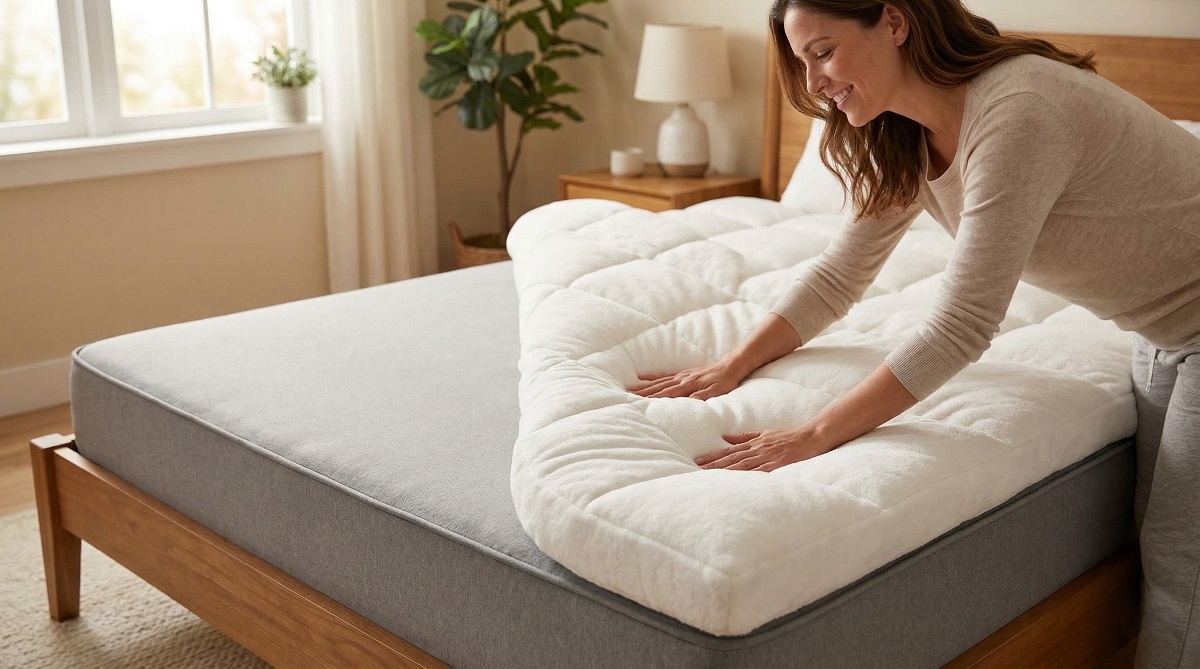
If you’re waking up with aches and pains from a mattress that feels more like concrete than comfort, you’re not alone. A too-firm mattress can leave you tossing and turning all night, putting pressure on your shoulders and hips instead of letting them sink in naturally.
The good news is you don’t have to spend $500-$2,000 on a new mattress. The most effective solution is adding a mattress topper (2-4 inches thick), which costs $100-$300 and can reduce firmness by 1-2 points on a 10-point scale. You can also try free methods like letting a new mattress break in naturally over 30-90 days, or checking if your bed foundation is making your mattress feel firmer than it actually is. For more sleep improvement tips, check out our .
Below, you’ll find 7 proven methods ranging from completely free (the break-in period) to moderate investment (changing your foundation). Before you try any of these, make sure your mattress is actually worth softening. If it’s 8+ years old, sagging, or visibly damaged, putting that $200 toward a new mattress makes more sense than trying to salvage an old one.
Should You Soften Your Mattress or Replace It?
✅ Try Softening Your Mattress If:
- Your mattress is less than 7 years old
- It’s structurally sound with no sagging or damage
- You’re on a budget ($100-$300 vs $1,000+ for new)
- The firmness issue is mild to moderate, not causing severe pain
- You’re still within the sleep trial period (30-365 days depending on brand)
- You’re a renter or planning to move soon (toppers are portable)
❌ Buy a New Softer Mattress Instead If:
- Mattress is 8+ years old (past typical lifespan for most types)
- Visible sagging deeper than 1.5 inches or body impressions
- Springs poking through or damaged materials
- Severe, chronic pain affecting your daily life
- You’ve tried a topper with no improvement
- Your weight or sleeping position has changed significantly
How to Know If Your Mattress Is Too Firm
Before you invest time or money into softening your sleep surface, you’ll want to confirm it’s actually the problem. Here are the telltale signs your mattress is too firm for your body:
- Waking up with back, neck, or shoulder pain that wasn’t there before bed
- Stiff joints in the morning that take time to loosen up
- No body contouring when you lie down—you stay on top of the mattress rather than sinking in slightly
- Tossing and turning throughout the night trying to find a comfortable position
- Numbness in limbs from pressure points cutting off circulation
- Better sleep elsewhere—you notice you sleep better on softer mattresses at hotels or friends’ homes
Here’s a quick self-assessment: Lie on your mattress in your normal sleeping position. If you’re a side sleeper, your hips and shoulders should sink in slightly while your spine stays aligned. If you’re lying flat with no contouring and it feels like sleeping on the floor, your mattress is too firm. Understanding your is essential for long-term comfort.
7 Methods to Make Your Mattress Softer
These methods range from completely free to moderate investment. I’ve listed them starting with the most effective solution, so you can work your way down if the first option doesn’t fit your situation.
Method 1: Add a Mattress Topper (Most Effective)
Adding a mattress topper is hands-down the fastest and most effective way to soften a firm bed. A topper is essentially an extra cushioning layer that sits on top of your mattress, providing the softer feel you want without replacing the entire sleep surface.
As of February 2026, quality mattress toppers range from $100-$400 depending on material and thickness, according to Amazon’s current pricing. Here’s what works best:
Memory Foam Toppers
Best for: Pressure relief and body contouring, especially if you’re a side sleeper
Memory foam toppers are the most popular option because they’re both effective and affordable. A 3-inch memory foam topper can reduce your mattress firmness by 1-2 points on a 10-point scale. That means a firm mattress (rated 7-8) can feel like a medium-firm (5-6) with the right topper. If you’re interested in learning more about bedding materials, explore our .
Price range: $100-$200 for a 3-inch queen-size topper. Budget options from brands like Linenspa start around $40-$50, while premium options can reach $250+.
Pros:
- Affordable and widely available
- Significant firmness reduction
- Easy to install (just unroll and let expand)
- Helps with pressure points
Cons:
- Can sleep hot (look for gel-infused versions if you’re a hot sleeper)
- Initial off-gassing smell that fades after a few days
- Takes 24-48 hours to fully expand
Latex Toppers
Best for: Responsive support with cooling properties
Latex toppers provide a softer sensation while maintaining more bounce and responsiveness than memory foam. They’re particularly good if you sleep hot or want that “sleeping on top of the bed” feeling rather than sinking in deeply.
Price range: $200-$400 for a 3-inch queen-size topper. Natural latex costs more than synthetic, but both work well.
Pros:
- More durable than memory foam (lasts 4-5 years vs 3-4 years)
- Naturally breathable and cooling
- Eco-friendly options available (natural latex)
- Hypoallergenic
Cons:
- More expensive upfront
- Medium firmness reduction (less dramatic than memory foam)
- Heavier and harder to move
Down/Feather Toppers
Best for: Ultra-plush, cloud-like softness
If you want that luxury hotel bed feel with maximum softness, down and feather toppers deliver. These are the least supportive option but give you the most immediate “soft” sensation.
Price range: $150-$350 for quality options
Pros:
- Incredibly soft and luxurious feel
- Naturally temperature-regulating
- Lightweight and easy to move
Cons:
- Requires regular fluffing to maintain loft
- May flatten over time (2-3 year lifespan)
- Not suitable if you need firm support
- Not hypoallergenic
Wool Toppers
Best for: Year-round temperature regulation
Wool toppers offer a middle ground—more plush than your stiff mattress but not as dramatically cushioned as memory foam or down. The real benefit here is temperature control, as wool naturally wicks moisture and regulates heat in both summer and winter.
Price range: $200-$300
Pros:
- Excellent temperature regulation
- Naturally hypoallergenic and antimicrobial
- Durable and long-lasting
- Eco-friendly natural material
Cons:
- Less softness than memory foam or down
- More expensive than basic foam options
- May require spot cleaning only (check care instructions)
Thickness Guide: How Much Softer Will Your Bed Get?
The thickness of your topper directly affects how much more comfortable your sleep surface will become:
- 2 inches: Subtle softness increase, good for fine-tuning
- 3 inches: Moderate softness (recommended for most people)
- 4 inches: Significant transformation, feels like a different mattress
Most people find 3 inches hits the sweet spot between noticeable plushness and maintaining support. Choose a thicker option if your bed is extremely stiff, but keep in mind that very thick toppers can make it harder to get in and out of bed.
How to Choose the Right Topper for Your Sleep Position
- Side sleepers: Memory foam or down toppers (maximum cushioning for hips and shoulders)
- Back sleepers: Latex or memory foam (balanced support without excessive sinkage)
- Stomach sleepers: Latex (responsive support to prevent lower back sagging)
- Hot sleepers: Latex or gel-infused memory foam (better airflow)
- Budget-conscious: Memory foam (best value for money)
Method 2: Break In Your New Mattress (Free)
If your mattress is brand new, patience might be all you need. New mattresses feel firmer initially and take time to break in naturally as the materials compress and conform to your body.
Break-in timeline by mattress type:
- Memory foam: 60-90 days (takes the longest)
- Innerspring: 30-60 days
- Hybrid: 30-60 days
- Latex: 30-45 days (breaks in fastest)
This isn’t just anecdotal—it’s why most mattress brands require a 30-day minimum trial period before accepting returns. They know the mattress needs time to soften up.
How to Speed Up the Break-In Process
- Sleep on it consistently: Your body weight and heat naturally compress the materials over time
- Walk on the mattress: Gently walk on the surface for 10-15 minutes daily (avoid the edges to prevent damage)
- Warm the room: For memory foam mattresses, keep your bedroom at 68-72°F to help the foam soften faster. Learn more about for better sleep.
When This Approach Works
- Your mattress is brand new (less than 30 days old)
- It’s a quality bed from a reputable brand (inexpensive mattresses may not soften much)
- You’re willing to wait 1-3 months for results
When to Skip This Strategy
- Your sleep surface is already several months old and hasn’t softened
- You’ve been sleeping on it regularly with no improvement
- You need immediate relief from aches or discomfort
Method 3: Check and Change Your Bed Foundation
Here’s something most people don’t realize: the wrong foundation can make any bed feel significantly harder. If you’re sleeping on a solid platform bed, your mattress has zero give underneath it, which amplifies its stiffness.
Foundation Types and Their Effect on Firmness
Solid Platform Bed
Effect: Makes mattress feel FIRMER
Why: No give or flex—the solid surface provides maximum support with zero cushioning
If your mattress sits on a solid wood or metal platform, switching to a box spring or slatted base can make it feel noticeably softer without changing the mattress itself.
Box Spring
Effect: Makes mattress feel SOFTER
Why: The springs provide cushioning and flex that absorbs some of your body weight
Box springs are particularly good for innerspring mattresses. As of February 2026, a quality box spring costs $100-$300 depending on size, which is comparable to buying a topper.
Slatted Base
Effect: Depends on slat spacing and type
Optimal slat spacing: 3 inches apart for good support with some flex
Sprung slats (curved wooden slats with some give) create a softer feel than solid flat slats. If you have a slatted base, check for:
- Broken or missing slats (creates uneven firmness)
- Slats spaced too far apart (more than 3 inches)
- Solid slats that could be replaced with sprung slats
Quick Foundation Check
Remove your mattress and inspect what’s underneath. Press down on the foundation—does it have any give, or is it completely solid? If it’s solid and your mattress feels too firm, switching to a box spring or sprung slatted base can make a noticeable difference. For more bedroom setup tips, visit our .
Method 4: Adjust Room Temperature (For Memory Foam Only)
If you have a memory foam mattress, you can make it softer just by warming up your bedroom. Memory foam is temperature-sensitive—it gets firmer in cold temperatures and softer in warm temperatures.
According to the Sleep Foundation, keeping your bedroom between 60-67°F is optimal for sleep quality. But if your memory foam mattress is too firm, you might want to raise that to 68-72°F as a compromise. Check out our for more details.
How to Soften Memory Foam with Heat
- Raise your thermostat by 2-5 degrees before bed
- Use a heated mattress pad ($50-$150) for dual benefits: warmth plus a slight cushioning layer
- Place a hot water bottle under your covers 30 minutes before sleep to warm up your sleeping area
Important Limitations
- Only works for memory foam and some hybrid mattresses with memory foam layers
- Not practical in hot climates or during summer months
- May conflict with the ideal sleep temperature (60-67°F)
- Heated pads add to your initial investment
This method works best as a supplement to other solutions rather than a standalone fix. It can help, but it won’t transform an extra-firm mattress into a soft one.
Method 5: Use Your Sleep Trial Period (Exchange or Return)
If you bought your mattress from one of the major online brands, you likely have a generous sleep trial period. This is a risk-free window where you can return or exchange your mattress if it’s not working out.
Most brands offer trial periods ranging from 30 days to a full year. Here’s what the major USA mattress brands offer as of February 2026 (verified from Casper, Purple, Nectar, Saatva, and Helix official sites):
| Brand | Trial Length | Mandatory Break-In | Return Fee |
|---|---|---|---|
| Casper | 100 nights | 30 days | Free |
| Purple | 100 nights | 21 days | Free |
| Nectar | 365 nights | 30 days | Free |
| Saatva | 365 nights | None (though break-in recommended) | $99 |
| Helix | 120 nights | 30 days | Free (max 2 returns per household) |
How to Use Your Sleep Trial
- Check your purchase date and trial expiration (look for your order confirmation email)
- Contact customer service—many brands will send you a free topper to try first before processing a return
- Initiate your return or exchange before the deadline
- Most brands will pick up your old mattress for free (you don’t have to haul it anywhere)
When This Method Works
- You’re still within your trial period
- You bought from a reputable online brand with a trial policy
- You’ve given the mattress the required break-in time (usually 30 days minimum)
Keep in mind that most sleep trial policies only apply to purchases made directly from the brand’s website, not from Amazon or other third-party retailers. Check your specific purchase terms. For comparisons of different mattress brands, browse our .
Method 6: Flip or Rotate Your Mattress
Flipping or rotating your mattress can help redistribute the filling materials and potentially reveal a softer sleeping surface. However, this method has some important limitations.
Which Mattresses Can Be Flipped?
- Double-sided mattresses: Can be flipped (uncommon in modern mattresses)
- Single-sided mattresses: Can only be rotated head-to-foot (this is most modern mattresses)
Important: Check your manufacturer’s guidelines before flipping. Most mattresses made in the last 10-15 years are single-sided with a designated top and bottom. Flipping them puts you on the wrong side, which won’t be comfortable and may void your warranty.
Rotation Schedule
Even if you can’t flip your mattress, rotating it head-to-foot every 3-6 months helps even out wear and prevents permanent body impressions. This can make your mattress feel more consistent, but it won’t dramatically change firmness.
Why This Method Has Limited Effectiveness
- Most modern mattresses are NOT flippable
- Rotation only provides temporary relief by moving you to a less-worn area
- Won’t significantly change the actual firmness of the mattress
- Flipping a single-sided mattress may void your warranty
Think of this as a maintenance technique rather than a solution. It’s worth doing regularly, but don’t expect it to transform a firm mattress into a soft one.
Method 7: Upgrade Your Bedding
While upgrading your bedding won’t change your mattress firmness, it can significantly affect how the firmness feels. Softer sheets, better pillows, and the right mattress protector can all influence your overall comfort.
Choose Softer Sheets
The fabric that touches your skin matters more than you might think. Here’s what works:
Best sheet materials for softness:
- Sateen cotton: Silky smooth with a subtle sheen, feels softer than percale
- Bamboo: Soft, breathable, and temperature-regulating
- Jersey knit: T-shirt soft and stretchy
- Percale cotton: Crisp but soft (not as plush as sateen)
Thread count: Aim for 300-500. This is the sweet spot for softness and durability. Higher thread counts aren’t necessarily better—many “1000-thread-count” sheets use low-quality cotton and feel stiff.
Avoid scratchy or stiff fabrics like low-quality polyester blends, which can amplify the firm feel of your mattress.
Match Your Pillow to Your Sleep Position
The right pillow works with your mattress to keep your spine aligned:
- Side sleepers: Thick, soft pillow (reduces pressure on your shoulders pressed against the firm mattress)
- Back sleepers: Medium loft pillow
- Stomach sleepers: Thin, soft pillow
For detailed pillow recommendations, see our .
Rethink Your Mattress Protector
Thick waterproof mattress protectors can make your mattress feel firmer by adding a stiff barrier layer. If you’re using one, try switching to:
- A thin, breathable protector
- A quilted protector with some padding
- No protector at all if you don’t have spill concerns
Cost and Effectiveness
Investment: $100-$300 total (quality sheets $50-$150 + pillows $30-$100 each)
This is the same cost as a topper, but bedding upgrades work best for beds that are only slightly too stiff. If your sleep surface is significantly uncomfortable, a topper will provide better results for the same money.
When This Method Works
- Your mattress is only slightly too firm (not severely uncomfortable)
- You’re combining it with other methods for cumulative effect
- You need new sheets and pillows anyway
Mattress Topper Comparison: Which Type Is Right for You?
Here’s a side-by-side comparison to help you choose the right mattress topper for your needs:
| Topper Type | Avg. Price (3″ Queen) | Firmness Reduction | Best For | Key Pros | Key Cons |
|---|---|---|---|---|---|
| Memory Foam | $100-$200 | High (1-2 points) | Pressure relief, side sleepers | Affordable, very effective, easy to find | Can sleep hot, off-gassing smell initially |
| Latex | $200-$400 | Medium (0.5-1 point) | Responsive support, hot sleepers | Durable, breathable, eco-friendly options | More expensive, less dramatic softening |
| Down/Feather | $150-$350 | High (plush feel) | Luxury softness, hotel-bed feel | Ultra-soft, lightweight, temperature-neutral | Flattens over time, needs fluffing, not hypoallergenic |
| Wool | $200-$300 | Medium | Temperature regulation, year-round use | Natural material, moisture-wicking, hypoallergenic | Less soft than foam or down, pricey |
Prices as of February 2026 for queen-size, 3-inch toppers. Budget options start lower; premium brands may cost more.
Cost-Benefit Analysis: Soften vs Replace
If you’re wondering whether it’s worth investing in solutions to soften your existing mattress or just buying a new one, here’s how the numbers break down:
Option 1: Soften Your Existing Mattress
- Cost: $0-$300 (free break-in period to topper + foundation change)
- Time to results: Immediate (topper) to 90 days (break-in)
- Best if: Mattress is less than 7 years old and structurally sound
- Warranty: Usually stays intact (toppers don’t void warranties)
- Lifespan extension: Can add 3-5 years of comfort to your mattress
Option 2: Buy a New Softer Mattress
- Cost: $500-$2,000+ for quality mattress
- Time to results: Immediate delivery, but 30-90 day break-in period
- Best if: Mattress is 8+ years old, sagging, or damaged
- Benefit: Fresh start with the right firmness, new warranty
- Full replacement: New materials, no wear and tear
Calculate Your Break-Even Point
If your mattress is 6+ years old and you’d spend $200-$300 on a topper and foundation changes, consider this: You’re getting close to the end of its lifespan anyway. That $200-$300 could go toward a new $800-$1,000 mattress instead, giving you better support, fresh materials, and a new warranty.
On the other hand, if your mattress is only 2-3 years old and in great shape aside from being too firm, spending $150 on a quality topper makes perfect sense. You’ll get 3-5 more years of comfortable sleep for a fraction of a new mattress cost.
When to Replace Instead of Soften
Don’t bother trying to soften your mattress if:
- It’s 8-10+ years old (most mattresses last 7-10 years depending on type)
- There’s visible sagging or body impressions deeper than 1.5 inches
- Springs are poking through or you can see damaged materials
- You’re experiencing severe, chronic pain that doesn’t improve with a topper
- You’ve already tried multiple softening methods with no relief
- Your body weight or health needs have changed significantly
According to the Sleep Foundation, memory foam mattresses typically last 7-10 years, while innerspring mattresses last 5-8 years. If your mattress is past its prime, investing in softening solutions is like putting expensive tires on a car that’s about to break down. For guidance on when to replace vs. repair household items, check our .
Understanding Mattress Firmness: What the Numbers Mean
Mattress firmness is rated on a scale of 1-10, where 1 is extra soft and 10 is extra firm, according to the Sleep Foundation’s firmness guide. However, firmness is subjective—what feels firm to one person might feel medium to another, depending on body weight and sleeping position.
The Firmness Scale Explained
| Firmness Rating | Feel | Best For |
|---|---|---|
| 1-2 | Extra Soft | Very light sleepers (under 100 lbs), rare preference |
| 3-4 | Soft | Side sleepers, lightweight individuals (under 130 lbs) |
| 5-6 | Medium to Medium-Firm | Most versatile, suits majority of sleepers |
| 7-8 | Firm | Back/stomach sleepers, heavier individuals (over 230 lbs) |
| 9-10 | Extra Firm | Very heavy sleepers, specific medical needs |
Firmness Recommendations by Weight and Sleep Position
The Sleep Foundation provides detailed recommendations based on body weight and sleeping position. Here’s what works best:
| Weight Range | Side Sleepers | Back Sleepers | Stomach Sleepers |
|---|---|---|---|
| Under 130 lbs | Soft (3-4) | Medium-Soft (4-5) | Medium (5-6) |
| 130-230 lbs | Medium-Soft (4-5) | Medium-Firm (6) | Medium-Firm (6-7) |
| Over 230 lbs | Medium-Firm (6-7) | Firm (7-8) | Firm (7-8) |
If your mattress firmness doesn’t match these recommendations for your body type and sleep position, that’s a strong indicator you need to either soften it (if it’s too firm) or consider replacing it with a better-matched option. Explore our to find options that match your needs.
Why Weight and Position Matter
Side sleepers need softer mattresses to cushion their hips and shoulders, which bear most of their body weight in this position. A too-firm mattress creates pressure points that lead to pain and numbness.
Back and stomach sleepers need firmer support to prevent their midsection from sagging, which can throw the spine out of alignment and cause lower back pain.
Heavier individuals need firmer mattresses because they sink into softer surfaces more, which can cause improper spinal alignment. Lighter individuals need softer surfaces because they don’t compress the mattress as much.
Frequently Asked Questions
Will a mattress topper void my warranty?
No, using a mattress topper generally does not void mattress warranties, according to the Sleep Foundation’s warranty guide. Toppers are considered normal use and are even recommended by many manufacturers as a solution for minor firmness issues. However, cutting into, modifying, or removing your mattress cover typically does void the warranty. Check your specific warranty terms to be certain, but you can safely add a topper without concern in almost all cases.
How much softer will a 3-inch topper make my mattress?
A 3-inch memory foam topper typically reduces mattress firmness by 1-2 points on a 10-point scale. For example, a firm mattress rated 7-8 can feel like a medium-firm 5-6 with a quality topper. The exact change depends on the topper material (memory foam creates the most dramatic softening, while latex creates a more moderate change) and the density of the foam. Higher-density toppers (4+ lbs per cubic foot) provide more support while softening.
What’s the best mattress topper for a firm bed?
For maximum softening effect, a 3-4 inch memory foam topper with 3-4 lb density works best. Side sleepers should choose memory foam or down toppers for pressure relief on shoulders and hips. Hot sleepers should opt for latex or gel-infused memory foam for better temperature regulation. If budget is your main concern, memory foam offers the best value—you’ll get significant softening for $100-$200 versus $200-$400 for latex. For more sleep accessories, browse our .
Does a firm mattress get softer over time?
Yes, most mattresses naturally soften over 30-90 days of regular use as materials compress and conform to your body. Memory foam takes the longest to break in (60-90 days), while latex breaks in fastest (30-45 days). Innerspring and hybrid mattresses typically take 30-60 days. After the initial break-in period, mattresses continue to soften very gradually over years as the materials compress from regular use. This is normal wear, not damage.
Can I make a memory foam mattress softer?
Yes, you can make memory foam softer in two ways. First, memory foam is temperature-sensitive—warming your bedroom to 68-72°F or using a heated mattress pad makes the foam feel softer (cold temperatures make it firmer). Second, and more effectively, add a memory foam or down topper for immediate softening. The topper method works better because temperature changes alone won’t dramatically transform an extra-firm mattress, but they can help as a supplemental approach.
How long does a mattress topper last?
Quality mattress toppers last 3-5 years on average. Memory foam and latex toppers last longest at 4-5 years with proper care. Down and feather toppers typically need replacement sooner, around 2-3 years, as they compress and lose loft. To extend your topper’s lifespan, rotate it every 6 months (head to foot), use a breathable protector, and follow the manufacturer’s cleaning instructions. Replace your topper when you notice permanent body impressions, loss of support, or when it no longer provides the comfort it did when new.
Is it better to soften my mattress or buy a new one?
If your mattress is less than 7 years old and structurally sound (no sagging, damage, or worn materials), softening it with a topper is more cost-effective. You’ll spend $100-$300 versus $1,000+ for a quality new mattress. However, if your mattress is 8+ years old, has visible sagging or damage, or causes severe chronic pain that doesn’t improve with a topper, invest in a new mattress instead. Think of it this way: softening solutions work great for the wrong firmness level, but they can’t fix an old, worn-out mattress.
What happens if I sleep on a mattress that’s too firm?
Sleeping on an overly firm mattress can cause pressure point pain (especially in shoulders, hips, and lower back), spinal misalignment, and poor sleep quality. You’ll likely wake up with stiffness, aches, or numbness in your limbs from restricted circulation. Over time, chronic sleep on a too-firm mattress may lead to persistent back and neck pain, joint stiffness, and daytime fatigue from consistently poor sleep. If you experience severe pain that doesn’t improve after trying softening methods for a few weeks, consult a doctor or physical therapist—you may need a different mattress or have an underlying condition.
The Bottom Line on Softening Your Firm Mattress
Making your firm mattress softer doesn’t require a complete replacement in most cases. The most effective solution is adding a 3-inch memory foam or latex topper, which costs $100-$300 and can transform your mattress comfort in a single day. If your mattress is brand new, give it 30-90 days to break in naturally before making any purchases.
Don’t overlook your bed foundation—switching from a solid platform to a box spring can make your mattress feel significantly softer at about the same cost as a topper. For memory foam mattresses specifically, warming your room to 68-72°F provides additional softening.
The key decision point is your mattress age and condition. If it’s less than 7 years old and structurally sound, softening it for $100-$300 makes excellent financial sense compared to buying a new mattress for $1,000+. But if your mattress is already 8+ years old or showing signs of damage and sagging, put that money toward a new mattress instead—you’ll get better long-term value.
Your Next Steps
- Assess your mattress age and condition (check for sagging, damage, or wear)
- If it’s new (under 30 days), give it time to break in naturally
- If it’s older but still in good shape, shop for a quality mattress topper
- Check your foundation—consider switching to a box spring if you’re on a solid platform
- Combine methods for best results (topper + foundation change + warmer room for memory foam)
Start with the most cost-effective solution for your situation, and remember that you can always try a topper first—most come with their own return policies if it doesn’t solve the problem. For more home improvement advice, visit .
Ready to make your firm mattress more comfortable? Check current prices for top-rated mattress toppers on Amazon or browse sleep trials and return policies directly from brands like Casper, Purple, and Nectar.
