


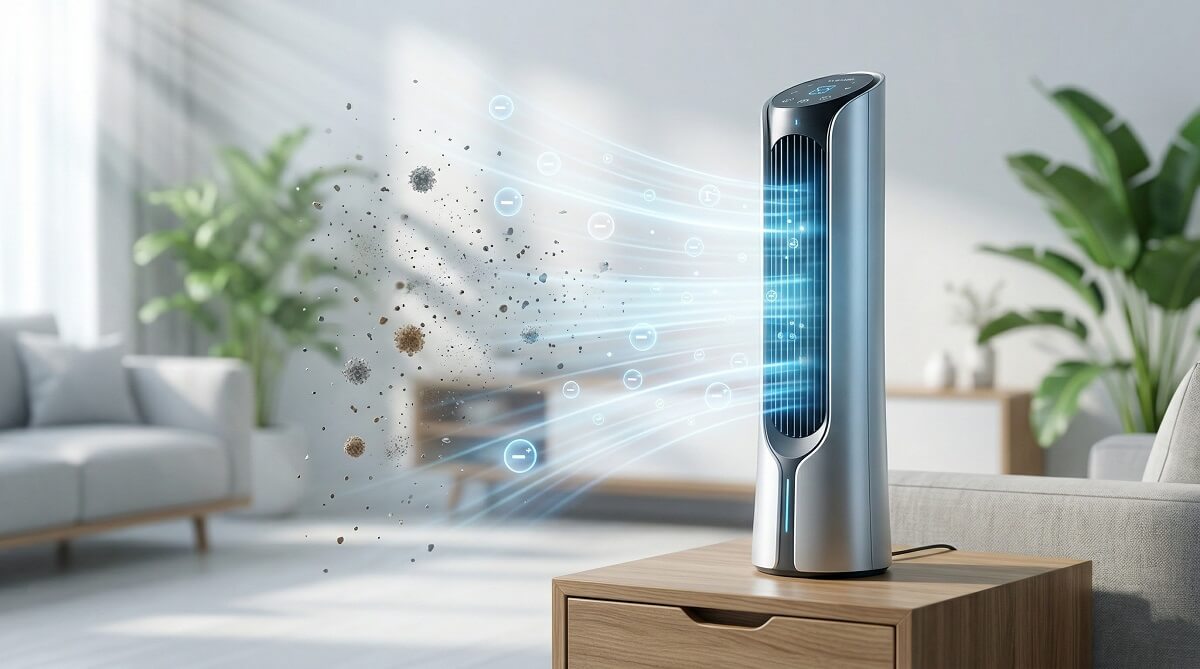
Ionic air purifiers work by releasing negatively charged ions that attach to airborne particles — dust, dander, pollen — causing them to clump together and fall out of the air. No fan, no filter, almost no noise. For a lot of people, that sounds like a dream. And for small-space, light-duty air freshening, it mostly delivers.
The catch is ozone. Some ionic purifiers generate ozone (O3) as a byproduct of the ion-generation process, and the EPA is not subtle about this: ozone is a lung irritant. At high concentrations, it causes chest pain, coughing, and shortness of breath. The agency specifically recommends against using ozone-generating devices in occupied spaces. Not every ionic purifier produces harmful levels — but some do, and you need to know how to tell them apart before you buy.
The short answer: look for CARB certification (California Air Resources Board), which limits ozone emissions to 0.050 parts per million. If a model passes that standard, it’s a reasonable pick for a bedroom or home office. If it doesn’t carry that certification, keep looking. And if you have asthma or serious respiratory issues, a HEPA filter purifier is the safer bet regardless.
Who Should (and Shouldn’t) Buy an Ionic Air Purifier
✅ Best For
- Light users who want background air freshening in a bedroom or home office
- People who are done buying, tracking down, and replacing filters every few months
- Anyone sensitive to fan noise — ionic units run virtually silent
- Small spaces: studio apartments, single rooms, dorm rooms, closets
- Supplemental use alongside a HEPA purifier in adjacent rooms
❌ Skip If
- You have asthma, COPD, or other respiratory conditions (ozone risk, even at low levels, isn’t worth it)
- You need to clean the air in a space larger than 500 square feet — ionic units lose effectiveness quickly in bigger rooms
- You’re dealing with wildfire smoke, chemical odors, or VOCs — HEPA with activated carbon handles these far better
- You want independently tested, measurable performance data — most ionic purifiers have very low or unpublished CADR ratings
How Ionic Air Purifiers Work
The basic mechanism isn’t complicated. An ionic purifier uses high voltage to generate negatively charged oxygen ions (O2⁻). Those ions float into the room and attach to airborne particles — dust, pet dander, pollen, mold spores — giving those particles a negative charge. Oppositely charged surfaces (walls, floors, the collection plates inside the unit) attract the now-charged particles. They stick. They fall. The air gets cleaner.
Two design approaches dominate the market. Collection plate units pull particles onto internal metal plates you wipe clean periodically — no replacement parts, takes a couple of minutes per month. Open-field ionizers (like the Clarifion plug-in) send ions out into the room and let particles settle on nearby surfaces; you’ll need to vacuum or wipe down the area around the unit regularly. Both styles have their place depending on your setup.
The ozone piece: ion generation can split O2 into individual oxygen atoms, which then combine with other O2 molecules to form O3 — ozone. Whether this happens, and at what level, depends on the unit’s design. CARB-certified models have been tested to ensure they stay below 0.050 ppm. Models that aggressively market “ozone cleaning” or lack certification may exceed that threshold.
Ionic vs. HEPA — The Real Performance Gap
HEPA filters trap 99.97% of particles 0.3 microns and larger inside a dense fiber mesh. That’s a tested, standardized claim backed by decades of industrial and medical use. Ionic purifiers don’t have an equivalent standard. There’s no regulated CADR (Clean Air Delivery Rate) requirement for ionic-only devices, which makes comparison shopping genuinely difficult.
The numbers make this concrete. According to Tom’s Guide, the Winix 5500-2 — a HEPA purifier with an optional ionizer — carries CADR ratings of 232 for smoke, 243 for dust, and 246 for pollen. The Envion Ionic Pro TA500, a popular ionic-only unit, has an estimated CADR of around 80–85. That’s a roughly 3x gap in verified cleaning power, for similar price points.
Where ionic units genuinely compete: silence, zero ongoing filter costs, and coverage of small spaces where a full-size HEPA unit would be overkill. For a bedroom nightstand or a home office corner, a CARB-certified ionic purifier is a legitimate option. For anything larger or more serious, a HEPA-first purifier will serve you better.
There’s also a middle path worth knowing about: combo units like the Winix 5500-2 and Coway Airmega include both True HEPA filtration and an optional ionizer mode. You get the filtration baseline you can trust, with the ionizer as an optional supplement — and you can turn it off entirely if you prefer.
Ionic Air Purifier Models Worth Considering
Here’s a practical look at the units people actually buy, based on real user data and independent testing where available.
Envion Ionic Pro 500 (TA500) — Best Known Collection-Plate Ionic
The TA500 covers a manufacturer-claimed 500 square feet using a collection-plate design. In reality, it performs best in rooms up to 200–225 square feet. There’s no filter to buy — just slide out the metal plates and wipe them down every few weeks. With a 4.3-star rating from 246 verified Best Buy customers, the most common praise is quiet operation (there’s genuinely no fan sound) and the ease of seeing results — after a month of use, those collection blades come out grey with captured debris, which is satisfying proof that it’s doing something.
Availability has become an issue as of early 2026; the TA500 appears limited or discontinued at major retailers. The Ionic Pro Platinum TA750 — the larger model at $399.95 — remains available but represents a significant investment for ionic-only technology.
Verdict: A solid pick if you find it at a reasonable price. Don’t expect HEPA performance — expect quiet, filter-free operation in a single room.
Clarifion — Best Plug-In Ionic for Travel and Supplements
The Clarifion is about the size of a large thumb drive — 2.5″ x 3.5″ — and plugs directly into a standard outlet. It covers roughly 270 square feet, emits a soft blue glow, and makes no sound at all. At approximately $39.97 per unit on Amazon, it’s the most accessible entry point into ionic air purification.
The honest framing: this is an open-field ionizer, meaning particles settle onto nearby surfaces rather than being captured inside the unit. You’ll want to vacuum or wipe down the area near the outlet periodically. And the sponsored “reviews” floating around online should be taken with skepticism — objective testing data for the Clarifion is limited.
Verdict: Reasonable for a bedroom supplement or travel use. Not a replacement for a real purifier.
Winix 5500-2 — Best Overall If You Want Ionic Features With HEPA Reliability
The Winix 5500-2 isn’t a pure ionic purifier — it’s a True HEPA + activated carbon unit with PlasmaWave ionization as an optional layer. According to Tom’s Guide, CADR ratings hit 232 (smoke), 243 (dust), and 246 (pollen) — cleaning a 360 sq ft room effectively. Wirecutter named it an “Also Great” pick in their 2026 air purifier roundup.
The PlasmaWave ionizer can be turned off entirely if you want to run pure HEPA. For most people, that’s the right call: run HEPA as the baseline, use the ionizer as an optional boost in clean-air conditions, skip it if anyone in the household has respiratory sensitivities.
Note: The 5500-2 was discontinued in mid-2025 and has been replaced by the Winix 5510, available on Amazon at around $179.99 (as of January 2026). The 5500-2 may still be findable at clearance pricing.
Verdict: The smartest buy in this space. You’re paying for proven filtration with ionic as a bonus, not the other way around.
OION Technologies B-1000 — Budget Permanent-Filter + UV-C
The B-1000 combines a permanent filter, UV-C light, and ionization — no replacement filter costs, rated for up to 600 square feet (manufacturer claim). Independent testing data is limited, and the Amazon product page was unavailable during our research period. Approach with appropriate caution — verify CARB certification before purchasing.
Verdict: Worth considering if priced low and CARB-certified; check current availability before buying.
Ionic Air Purifiers at a Glance
| Model | Coverage | Filter Type | CADR | Approx. Price | Best For |
|---|---|---|---|---|---|
| Envion Ionic Pro TA500 | 500 sq ft (claim); ~225 sq ft real | Collection plate (washable) | ~80–85 | Limited availability | Quiet, small rooms |
| Clarifion | 270 sq ft | None (open-field) | Not published | ~$39.97/unit | Plug-in supplement |
| Winix 5510 (successor to 5500-2) | 360 sq ft | True HEPA + carbon + optional ionizer | 232–246 (HEPA mode) | ~$179.99 | Best overall |
| OION B-1000 | 600 sq ft (claim) | Permanent + UV-C + ionizer | Not published | Check current pricing | Budget, filter-free |
| Ionic Pro Platinum TA750 | 350–650 sq ft | HEPA + ionization | Not published | $399.95 | Larger ionic-first rooms |
Prices as of March 2026. Check current pricing at retailers before purchasing.
The Ozone Question — What You Actually Need to Know
The EPA’s guidance on ionizers is worth reading directly. Their Indoor Air Quality page on ozone generators states that many electronic air cleaners — including ionizers, plasma devices, and units marketed with similar terms — can generate high amounts of ozone. Ozone at elevated concentrations causes chest pain, coughing, shortness of breath, and throat irritation. People with asthma are particularly vulnerable.
The agency’s position: at concentrations low enough to be safe, ozone has little practical ability to remove indoor contaminants. At concentrations high enough to be effective against pollutants, it poses a health risk. There’s no sweet spot where it’s both safe and effective at cleaning.
This doesn’t mean every ionic purifier is dangerous. It means you need to verify certification. The California Air Resources Board (CARB) requires air cleaning devices sold in California to undergo emissions testing. Electronic air cleaners — including ionizers — must emit no more than 0.050 ppm of ozone. Their publicly searchable certification database lets you check any specific model before buying. CARB certification has become an informal national standard because California’s requirements are stricter than federal minimums.
Red flags to watch for:
- Models that advertise ozone as a cleaning or sterilizing feature
- Claims to kill viruses, bacteria, or mold via “activated oxygen” or “superoxide”
- No CARB certification listed in product specs
- School district purchase horror stories — like the Sacramento City Unified School District’s $6 million purchase of uncertified ionizer units, which according to EPA documentation resulted in documented complaints from teachers and parents about air quality
Cleaning and Maintaining an Ionic Purifier
One of the genuine appeals of ionic purifiers is low maintenance. For collection-plate models like the Envion Ionic Pro:
- Slide out the metal collection plates (usually unlocks from the top)
- Wipe with a damp cloth — takes about 2 minutes
- Let them air-dry completely before reinserting
- Frequency: once a month in normal conditions; every two weeks in dusty or pet-heavy homes
For open-field ionizers like the Clarifion, the particles settle onto nearby surfaces rather than being captured internally. Wiping down the wall and floor area near the outlet periodically keeps things tidy.
One useful signal: if your collection plates come out grey or coated after a few weeks, the unit is doing its job. That residue is captured particulate matter — dust, dander, pollen — that would otherwise be floating around your room.
Pro tip: run ionic purifiers in rooms with windows closed. Open windows bring in fresh particles faster than the unit can process them, and you lose most of the benefit.
Frequently Asked Questions
Are ionic air purifiers safe to use?
Most CARB-certified models are safe for continuous use in occupied spaces. The certification limits ozone output to 0.050 ppm — below levels considered harmful. The issue is with non-certified models or those that actively market ozone as a cleaning feature. Always verify CARB certification before purchasing, especially if anyone in your household has asthma or other respiratory conditions.
Do ionic air purifiers help with allergies?
They can reduce airborne allergens — dust, pollen, pet dander — in small spaces. But the clinical evidence is weaker than for HEPA filters. If allergy relief is your primary goal, a HEPA purifier with published CADR ratings is the more reliable choice. An ionic unit can supplement a HEPA setup in adjacent rooms where you don’t want the noise.
What’s the difference between an ionizer and a HEPA filter?
A HEPA filter physically traps particles inside a dense fiber mesh — tested to capture 99.97% of particles 0.3 microns and larger. An ionizer uses charged ions to make particles fall out of the air, where they settle on surfaces or collection plates. HEPA has standardized performance metrics (CADR ratings); most ionizers don’t. HEPA generally outperforms ionic-only units on measurable particle removal.
Do ionic air purifiers remove pet dander?
Yes — ionic units do capture pet dander on collection plates or cause it to settle on surfaces. Effectiveness depends on room size vs. unit capacity. For homes with multiple pets or large spaces, a HEPA purifier will handle the volume more reliably.
How often do I need to clean an ionic air purifier?
For collection-plate models: about once a month under normal conditions. Every two weeks in dusty homes or with heavy pet traffic. It’s a 2-minute job — wipe the plates, let them dry, reinsert. Open-field ionizers require periodic wipe-downs of the surfaces near the unit.
Can I leave an ionic air purifier running all night?
Yes — especially CARB-certified models. The near-silent operation makes them well-suited to bedroom use. Many owners report running them continuously. Just ensure windows are closed to get meaningful results.
What did the EPA say about ionizers?
The EPA warns that many ionizers and similar electronic air cleaning devices can generate high amounts of ozone, a known lung irritant. They found ionizers to be less effective than HEPA or electrostatic precipitators for particle removal. Their guidance advises against using ozone-generating devices in occupied spaces. The full guidance is available at epa.gov.
Is the Clarifion worth buying?
For light freshening in a small room — a bedroom, a home office — the Clarifion is a low-stakes $40 option. It’s genuinely quiet and compact. Don’t expect heavy-duty particulate removal or measurable allergy relief. Also note that the most prominent “reviews” online are sponsored posts, so factor that into your research. For unsponsored air purifier reviews, check our broader roundup.
Ready to pick one? Check current prices on Amazon or Best Buy. If HEPA performance is a priority alongside ionic features, the Winix 5510 is worth a serious look. For allergy-first shopping, our air purifier buying guide walks through the HEPA options that have earned independent testing credentials.
