


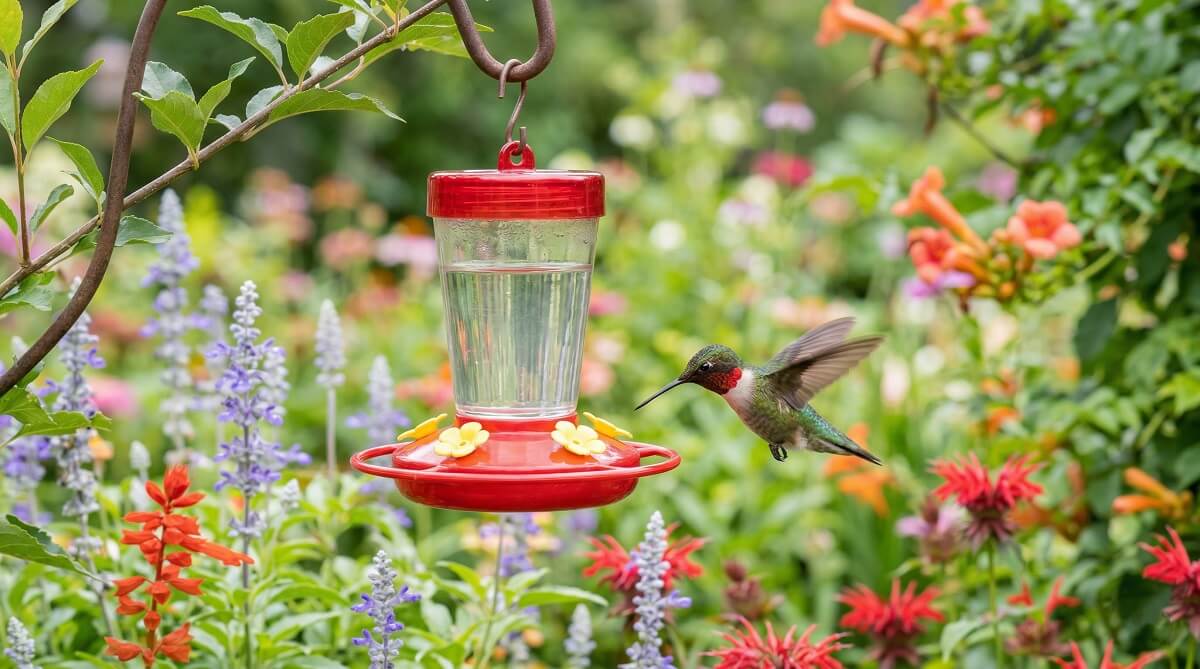
Hummingbirds find feeders the same way they find flowers: by sight. Their vision picks up bold, warm colors — especially red and orange — from surprising distances, and they scan your yard from above as they patrol their territory. A well-placed, brightly colored feeder in an open spot is the clearest invitation you can give them.
Once a hummingbird visits your feeder two or three times, it locks the location into a remarkable spatial memory. According to , hummingbirds return to the same breeding and feeding sites year after year — meaning a bird that stops by this spring may well be back every season for years to come.
Your side of the equation is straightforward: use a red feeder, keep the nectar fresh, and place it where they can actually see it. That’s most of the work. The rest is patience — and knowing a bit about how these birds think.
Quick Guide: Will Hummingbirds Find Your Feeder?
✅ Good Setup If:
- Your feeder is red or has red accents — it stands out against most backgrounds
- It’s in an open spot with clear sightlines from above, not buried in dense shrubs
- You’re in or near a hummingbird migration corridor (most of the contiguous US qualifies)
- You have native tubular flowers nearby to amplify the visual signal
- You can commit to changing nectar every 2–5 days in warm weather
❌ Adjust If:
- Your feeder is all-clear or dominated by yellow — yellow attracts bees and wasps instead
- The feeder is tucked in heavy shade under dense canopy — hard to spot from above
- You’re adding red food coloring to the nectar — wildlife rehabilitators have raised concerns about potential health effects; use a red feeder instead
- You’re expecting results overnight — first-time feeders in new areas can take 1–3 weeks to be discovered
The Science of How Hummingbirds Spot a Feeder
Color Vision: Their Biggest Advantage
A hummingbird’s eyes are built for one purpose: finding food fast. They pick up red, orange, and yellow hues with high sensitivity — colors associated with nectar-rich flowers in nature. When your red feeder hangs in an open yard, it registers as a bright, high-contrast target against green foliage or blue sky.
Unlike most mammals, birds can also perceive wavelengths beyond the human visible range, including ultraviolet light. This broader color spectrum means hummingbirds may detect patterns and signals in flowers — and feeders — that are entirely invisible to us. Researchers continue to study exactly how this UV sensitivity shapes their foraging decisions, but the practical takeaway is clear: color matters far more than scent.
As the National Park Service notes directly: “Hummingbirds are not attracted by smell, so choose plants with brightly-colored flowers.” The same logic applies to feeders. Fragrant herbs in your garden won’t draw hummingbirds to a feeder — but a splash of red will.
Aerial Patrol: How They Actually Search
Hummingbirds don’t wander randomly. They establish feeding territories and patrol them on predictable circuits, flying above the landscape and scanning below. A feeder in an open area — say, 4–6 feet off the ground with a clear approach angle — is far easier to spot during these fly-overs than one tucked into a wall of shrubbery.
The combination of excellent far-distance acuity and constant active scanning means a well-placed red feeder in a migration corridor can attract its first visitor surprisingly quickly. In some yards, it happens within a day or two. In areas with less established traffic, it might take a few weeks.
Smell Plays No Part
Many gardeners add fragrant plants hoping to lure hummingbirds, but the birds’ sense of smell is minimal compared to their visual capabilities. Scent-heavy flowers like lavender and jasmine attract butterflies and bees — not hummingbirds. The birds zero in on color and shape: tubular flowers in red or orange, feeders with bold red ports. If your goal is specifically hummingbirds, visual cues are everything.
Memory: Why They Come Back Every Year
Spatial Memory That Maps Hundreds of Locations
Consider what a hummingbird has to track: dozens of flowers and feeders spread across its territory, each one visited on rotation. Managing that schedule efficiently requires spatial memory that rivals — and in some ways surpasses — what you’d expect from a bird with a brain the size of a pea.
Once a hummingbird visits your feeder a few times, it maps the location precisely. has shown they track not just where each food source is, but also how recently they visited and how much nectar was available — effectively managing a mental schedule of their entire feeding circuit. This is part of why they feed approximately every 12–16 minutes throughout the day: they’re running a continuous rotation, not stumbling onto food sources by accident.
The practical upside: once a hummingbird knows your feeder exists, it will return reliably — as long as the nectar is there when they check.
Year-to-Year Return: Migration Memory
The spatial memory that hummingbirds use to manage their summer territories carries through to migration. The National Park Service reports that “hummingbirds return to their breeding and feeding sites year after year.” For migratory species, that means a bird that found your feeder last May can — and often does — show up at the same address the following spring.
This makes the first year of hummingbird feeding the hardest. Once you’ve established a reputation as a reliable nectar stop, your yard becomes part of a bird’s annual route. Gardeners who’ve fed hummingbirds for several years often report the birds arriving within days of when they put the feeders out — right on schedule.
How to Make Your Feeder Easier to Find
Color Cues That Work
Red is the most effective signal color, and most commercial hummingbird feeders are designed with this in mind. If your feeder is clear or neutral-colored, add a few feet of red surveyor’s tape or a red ribbon nearby — even that simple trick gives hummingbirds a visual target to investigate.
Planting native tubular flowers near your feeder compounds the effect. Bee balm, cardinal flower, salvia, and trumpet vine are all strong attractors for the eastern ruby-throated hummingbird. , red-flowering currant and penstemon work well for rufous and Anna’s hummingbirds. The flowers draw birds to the general area; once there, they’ll discover the feeder.
One color to avoid: yellow. Yellow feeder parts attract bees and wasps, which can crowd out the hummingbirds you’re trying to bring in. If your feeder has yellow flower-shaped ports, you can often pop them out — the birds can still reach the nectar with their long bills.
Placement: Where to Hang It
The most important thing about feeder placement is visibility from above. Hummingbirds scout from the air, so a feeder in a relatively open spot — near a window, on a shepherd’s hook in the yard, or hanging from a porch with a clear view — works better than one tucked into a corner or under a dense tree canopy.
Partial shade is ideal: enough sun for the birds to spot the feeder, but not so much direct afternoon sun that the nectar spoils in hours. Near a window or covered porch has the additional benefit of letting you actually see the birds up close, which is most of the fun.
Proximity to perches also helps. Hummingbirds spend more time perching than most people realize — they sit and watch their territory, then dash out to feed. Placing the feeder near a shrub or small tree where they can rest gives them a comfortable base of operations.
How Long Before They Show Up?
In established hummingbird territory during peak migration, a new feeder can attract its first visitor within a day or two. In areas where hummingbirds are less common or where you’re setting up for the first time, expect to wait 1–3 weeks. A few tips to speed up discovery:
- Time your feeder setup 1–2 weeks before hummingbirds typically arrive in your area. Check HummingbirdCentral.com for historical sighting maps by region.
- Tie bright red ribbon or surveyor’s tape near the feeder as an additional visual cue
- Add native red or orange flowers in the same area — multiple attractors create a stronger signal
- Keep the nectar fresh even before birds arrive; fermented nectar will deter them if they do investigate
Nectar Quality: What Keeps Them Coming Back
The Only Recipe You Need
Hummingbird nectar is simple: 4 parts water to 1 part plain white granulated sugar. Dissolve the sugar in warm water, let it cool, and fill the feeder. That’s it.
Do not substitute honey — it ferments quickly and can promote dangerous fungal infections in hummingbirds. Do not use artificial sweeteners; they provide no calories and can harm the birds. And do not add red food coloring to the nectar. Wildlife rehabilitators, including naturalist Julie Zickefoose, have cited concerns about potential links between artificial red dye and impaired egg hatching and an increased rate of bill and skin tumors in hummingbirds. A red feeder provides all the visual signal needed — the nectar itself should stay clear.
How Often to Change It
Fresh nectar is one of the most important factors in keeping hummingbirds visiting regularly:
- 90°F+ summer days: Change nectar every 1–2 days; heat accelerates fermentation and mold growth
- Mild summer temperatures (70–85°F): Every 2–3 days
- Cooler weather (spring/fall): Every 4–7 days
Signs it needs changing: cloudy appearance, dark spots inside the feeder, visible mold, or a fermented smell. When in doubt, dump it. A hummingbird that visits a spoiled feeder may not come back quickly.
Clean the feeder with hot water and a bottle brush each time you change the nectar. Never use bleach — residue can be harmful. A diluted white vinegar rinse works well for stubborn mold, followed by thorough rinsing.
Why Hummingbirds Might Skip Your Feeder
If you’ve had a feeder up for several weeks during peak season and nothing has arrived, one of these is usually the reason:
| Problem | Likely Cause | Fix |
|---|---|---|
| No visits at all | Feeder not visible enough; wrong timing | Move to more open spot; check migration maps for your region |
| Brief visits, then they leave | Old or fermented nectar | Change nectar more frequently; clean feeder thoroughly |
| Bees/wasps monopolizing the feeder | Yellow parts on feeder; hot weather dearth | Remove yellow components; set up a decoy bee feeder nearby with 2:1 sugar water |
| One bird chasing all others away | Territorial male (common with rufous) | Add a second feeder completely out of sight from the first |
| Birds stopped coming mid-summer | Migration or territory shift | Leave feeder up 2–3 weeks after last sighting for late migrants |
Which Hummingbirds Will Visit — By US Region
Roughly 26 hummingbird species visit the United States each year, with about 17 that actually breed here, according to the National Park Service. Which ones show up in your yard depends heavily on where you live:
| Region | Primary Species | Typical Feeder Season |
|---|---|---|
| Eastern US | Ruby-throated hummingbird | March (Gulf Coast) to May (New England); depart by October |
| Pacific Coast / California | Anna’s hummingbird (year-round); rufous (spring/fall migrant) | Year-round for Anna’s; February–March for rufous migrants |
| Mountain West (CO, UT, ID, MT, WY) | Broad-tailed, rufous, black-chinned, calliope | Late April–May arrival; depart by September |
| Southwest (AZ, NM, TX) | Black-chinned, broad-tailed, rufous, Costa’s, buff-bellied | Year-round in parts; peak spring migration February–March |
| Pacific Northwest (OR, WA) | Rufous (primary migrant); Anna’s in lower elevations | March–April through August–September |
| Alaska | Rufous hummingbird | May–August (the northernmost range of any hummingbird) |
If you’re not sure which species visit your yard, let you search sightings by county — a quick way to confirm what’s actually in your area before you invest in multiple feeders.
Should You Set Up a Hummingbird Feeder?
✅ Good Fit If:
- You’re in a region where hummingbirds migrate seasonally — most of the contiguous US qualifies
- You’re willing to maintain the feeder consistently (cleaning every refill; changing nectar every 2–5 days in summer)
- You enjoy watching wildlife and want a reason to spend more time near a window or porch
- You’re also interested in native plants — feeders work best as part of a broader wildlife-friendly yard
❌ Think Twice If:
- You can’t commit to regular cleaning — dirty feeders spread mold and bacteria, and can harm the birds you’re trying to help
- You’re hoping the feeder alone will “support” hummingbirds long-term — according to Dr. Doug Tallamy (University of Delaware), roughly 80% of a hummingbird’s diet is insects and spiders, not nectar. Feeders are a supplement; native plantings are what actually sustain them.
- You live in a high-rise with no nearby green space — without a migration corridor or flowers in the area, the visual signal from one feeder may not be enough
Frequently Asked Questions
How do hummingbirds find a feeder for the first time?
They find it by sight — specifically, by scanning for bold, warm colors during their territorial patrol flights. A red feeder in an open spot is a clear visual target. Native flowers nearby can draw them to the general area, after which they’ll investigate the feeder. Smell plays no role in this process.
How long does it take for hummingbirds to find a new feeder?
In areas with established hummingbird traffic during peak migration season, a new feeder can attract a visitor within a day or two. In quieter areas or early in the season, it can take 1–3 weeks. Timing your setup 1–2 weeks before the species in your region typically arrives gives you the best window.
Can hummingbirds smell nectar?
No. Hummingbirds have a very limited sense of smell and do not use scent to locate food. Their foraging is driven entirely by visual cues — color, shape, and contrast. This is why a red feeder works and why fragrant plants alone won’t bring them to your yard.
Do hummingbirds remember where feeders are?
Yes — remarkably well. After a few visits, a hummingbird maps a feeder’s location precisely and incorporates it into its regular feeding circuit. The National Park Service reports that hummingbirds return to the same feeding sites year after year, including after their annual migrations to Central America and back.
What color feeder is best for attracting hummingbirds?
Red is the most effective color, followed by orange. Hummingbirds associate these warm tones with nectar-rich flowers. Avoid yellow, which draws bees and wasps. The feeder body or ports should be red — the nectar itself should stay clear (no red dye).
Why won’t hummingbirds come to my feeder?
The most common reasons: the feeder isn’t visible enough (too shaded or hidden), the nectar has gone bad, or the timing is off (feeder out before or after migration). Try moving the feeder to a more open spot, adding red ribbon as a visual cue, checking the regional migration timing for your area, and refreshing the nectar if it’s been more than a few days.
When should I put out my hummingbird feeder?
Put it out 1–2 weeks before hummingbirds are expected to arrive in your area. In the Southeast (Texas, Florida, Gulf Coast), that means having it ready by late February or early March. In the Northeast and upper Midwest, mid-April is a good target. The Mountain West sees birds from late April into May. Check HummingbirdCentral.com for historical sighting maps.
Do I need to add red dye to hummingbird nectar?
No — and you shouldn’t. Wildlife rehabilitators have raised concerns that artificial red food coloring may be linked to health problems in hummingbirds, including issues with eggs and bill abnormalities. A red feeder provides all the visual signal the birds need. Keep the nectar clear: just 4 parts water to 1 part plain white sugar.
Ready to Set Up Your Feeder?
Saucer-style feeders are easy to clean and tend to deter bees better than tube feeders — and most hummingbird feeders last for years with basic care. Check current prices and options on Amazon. For feeder variety and expert advice, or visit your local Wild Birds Unlimited.
Once your feeder is up: keep the nectar fresh, give it a few weeks, and watch. These birds have been navigating thousands of miles by sight for millions of years. With a little patience, they’ll find you.
