


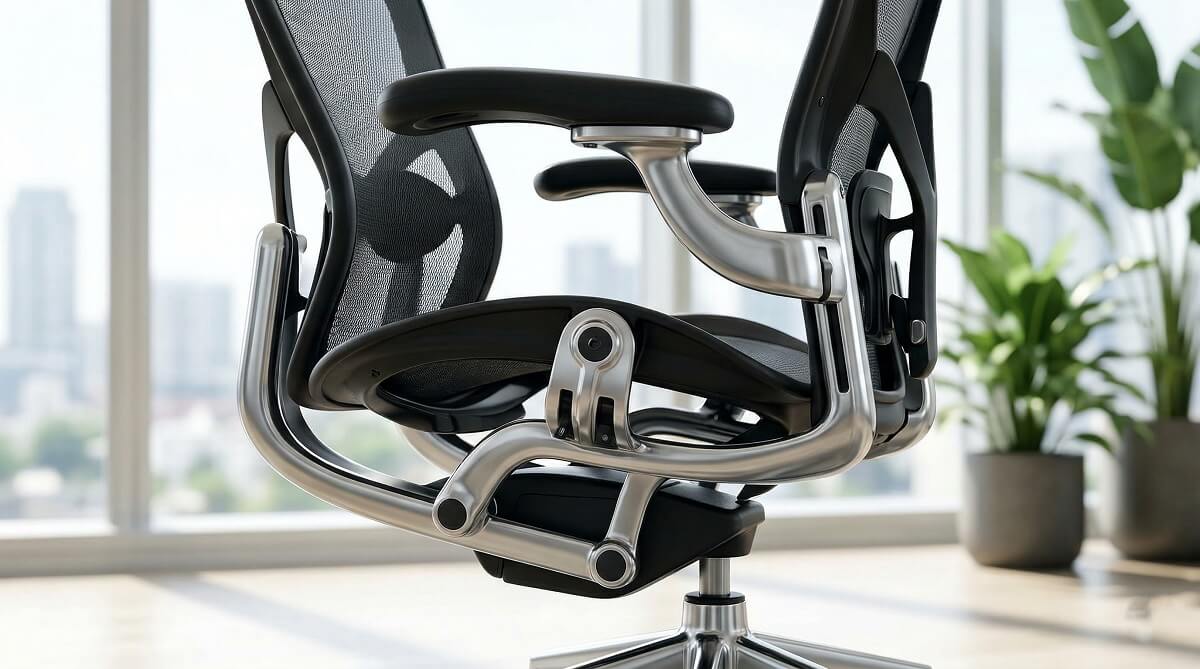
Office chairs span an enormous price range — from $50 basic models to $1,800+ flagship ergonomic chairs. The gap isn’t just branding. A Herman Miller Aeron, for instance, starts around $1,400 for a base configuration and can reach up to $1,895 fully loaded (as of early 2026). Meanwhile, the IKEA MARKUS sits at $180–$230. Both are chairs. Neither is overpriced — they’re just built for very different use cases.
The short version: expensive office chairs cost more because of how long they took to design, what materials are inside them, how many ways you can adjust them to fit your body, and how long they’re built to last. A premium ergonomic chair is genuinely engineered differently from a budget seat — and for people sitting 6–8 hours a day, that difference shows up in back health, focus, and longevity.
That said, not everyone needs a $1,400 chair. If you sit fewer than three hours a day, a solid $200–$300 option probably covers your needs. This article breaks down exactly where the money goes at each price level, so you can decide what’s right for your situation — without overspending or under-buying.
Should You Spend More on an Office Chair?
Before diving into the details, here’s a quick read on where you probably fall:
✅ Spend more if you:
- Sit at a desk 5 or more hours per day
- Have existing back, neck, hip, or shoulder issues
- Want a chair that holds up for 10+ years without replacing
- Work from home full-time and your chair is your primary seat all day
❌ Stick to budget if you:
- Sit fewer than 3 hours daily at your desk
- Need to outfit a shared or temporary workspace with multiple seats
- Are still growing and will need a different fit in a few years
- Are building a guest workspace that rarely gets used
What You Actually Pay For in a Pricier Chair
Most people assume the price premium on a high-end office chair is mostly brand markup. Some of it is — but most of it isn’t. Here’s where the money actually goes.
1. Years of Research and Development
Designing a genuinely ergonomic chair takes longer than most people expect. The design phase alone — from concept to first prototype — typically runs 8 to 12 months, according to furniture industry professionals. Production then adds another 3 to 4 months before the chair ever reaches a store. Some chairs take even longer: projects at major companies like Haworth have run as long as five years from initial research to launch.
That five-year investment involves biomechanics researchers, industrial designers, human factors engineers, and repeated rounds of user testing with people across different body types and heights. Every hour of that work gets built into the price tag. Entry-level chairs skip most of this — they copy proven shapes at reduced scale and materials, which is why they cost less but fit fewer people well.
2. Better Materials Throughout
The foam in a $100 chair compresses flat within a year or two of regular use. The mesh on a cheap office chair stretches and sags. Premium chairs use different stuff — high-tension woven mesh that maintains its elasticity for years, high-density foam that holds its shape under daily load, and frames made from aircraft-grade aluminum or reinforced steel rather than hollow plastic.
Those material upgrades aren’t cosmetic. They’re the reason a mid-1990s Herman Miller Aeron from an office liquidation sale still works properly today. The mesh hasn’t bagged out. The tilt mechanism still clicks cleanly. The base hasn’t cracked. You won’t find a 30-year-old $80 desk chair performing the same way.
3. More Adjustment Points
Cheap office chairs typically give you one adjustment: seat height. Maybe a basic seat tilt. That’s it.
Move up to a mid-range seat and you get 4–6 points of adjustment — height, seat depth, armrest height, lumbar support, and a recline angle. High-end ergonomic work chairs add even more: 4D armrests (height, depth, width, and angle), adjustable seat pan depth, independent lumbar height and depth, tilt tension, forward seat tilt, and sometimes a headrest.
Each of those adjustment mechanisms has to be engineered, prototyped, tested for durability, and manufactured to tight tolerances. Four-way adjustable armrests cost more to build than fixed arms because there are more moving parts, more precision required, and more points of potential failure to guard against. You’re not paying for the feature itself — you’re paying for it to keep working for 12 years.
4. Safety and Durability Certification (BIFMA)
BIFMA — the Business and Institutional Furniture Manufacturers Association — runs the most recognized safety and durability standard for commercial office seating in North America. The key standard for office chairs is ANSI/BIFMA X5.1, which puts chairs through structural integrity tests, load capacity tests, stability tests, and durability simulations that replicate years of real-world use.
BIFMA certification is technically voluntary — but it’s effectively required for US corporate and government procurement. If a chair doesn’t pass it, major buyers won’t touch it. That certification process costs manufacturers money, and chairs that pass it are typically better built. Most entry-level chairs never go through this testing. for other desk-health upgrades that pair well with a certified seat.
5. Long Warranties as a Confidence Signal
Warranty length is one of the most honest indicators of a chair’s expected lifespan. Here’s what the market currently looks like:
| Chair | Price (2026) | Warranty | Weight Capacity |
|---|---|---|---|
| Herman Miller Aeron (base) | ~$1,400–$1,895 | 12 years, all parts, 24/7 | Up to 350 lbs (Size C) |
| Steelcase Leap | $1,100–$1,376 | 12 years, multi-shift, 24/7 | 400 lbs |
| Steelcase Series 1 | ~$490–$507 | 12 years, lifetime limited | 400 lbs |
| IKEA MARKUS | $180–$230 | 10 years limited | 242 lbs |
| Typical budget chair | $50–$150 | 1 year or less | 200–250 lbs |
When a manufacturer offers a 12-year warranty on everything — including parts and labor — they’re betting the chair will outlast it. When a manufacturer offers 90 days, they’re telling you something different.
6. You’re Buying One Chair, Not a Thousand
Office chairs are low-volume items compared to most consumer goods. Companies don’t sell millions of them the way they sell shirts or earbuds. When you’re buying a single seat as an individual, you’re paying full retail price — no economies of scale. According to furniture design expert Patty Johnson of Rhode Island School of Design, offices and commercial buyers can receive up to 50% off list price through bulk agreements. Remote workers and home office buyers don’t get that discount — and the price reflects it.
Office Chair Price Tiers: What to Expect at Each Level
Prices below are based on current retail data as of early 2026. Availability and pricing change frequently — check retailer sites for up-to-date figures.
| Tier | Price Range | What You Get | Typical Lifespan | Example Chairs |
|---|---|---|---|---|
| Budget | $50–$150 | Basic height adjustment, 1-year warranty, plastic base, minimal padding | 1–3 years | Amazon Basics, OFM Essentials, generic brands |
| Mid-Range | $150–$400 | 4–6 adjustments, better foam/mesh, lumbar support, 2–5 year warranty | 5–8 years | IKEA MARKUS (~$200), Staples Hyken (~$160), ErgoTune Supreme (~$399) |
| Upper Mid | $400–$700 | 8+ adjustments, quality mesh, BIFMA tested, 5–7 year warranty | 7–10 years | Steelcase Series 1 (~$490), Branch Verve, Secretlab NeueChair (~$499) |
| Premium | $800–$1,400+ | Full ergonomic suite, 12-year warranty, precision tilt mechanisms, commercial-grade | 12–20+ years | Herman Miller Aeron (~$1,400+), Steelcase Leap ($1,100+) |
goes deeper into specific models if you want detailed comparisons across each tier.
The Cost-Per-Year Argument
Sticker shock on a $1,400 chair is understandable. But the more useful number is cost per year — which changes the comparison significantly.
- Herman Miller Aeron ($1,400 ÷ 12 years): ~$117/year
- Steelcase Series 1 ($500 ÷ 10 years): ~$50/year
- IKEA MARKUS ($200 ÷ 7 years): ~$29/year
- Budget chair ($100 ÷ 2 years): ~$50/year (and you repeat the purchase)
The Aeron costs about the same per year as the Steelcase Series 1 — but you’re sitting in a significantly more adjustable, better-supported chair every day. The MARKUS is the real value story: decent ergonomics, long lifespan for the price, and a 10-year warranty that most chairs twice its price can’t match.
None of these calculations factor in what bad seating costs over time — physical therapy, chiropractor visits, or lost productivity from discomfort. Those aren’t hypothetical. Studies referenced in ergonomics literature consistently link sustained poor seating posture to musculoskeletal disorders including lower back pain, neck strain, and carpal tunnel syndrome. That doesn’t mean you need a $1,400 work chair to avoid those outcomes — but it’s worth putting the numbers in context. for a broader look at the setup beyond the chair.
The Option Most People Overlook: Refurbished Ergonomic Chairs
If you want premium ergonomics without the premium price, the refurbished market is worth a serious look. A certified refurbished Herman Miller Aeron typically runs $300–$600 depending on size and seller — roughly a third to half the cost of buying new.
Certified refurbishers like Crandall Office Furniture and OfficeLogixShop replace worn components with original or equivalent parts, test the chair’s mechanisms, and back their work with warranties — Crandall, for instance, offers a 12-year warranty on their refurbished Aerons. You get the same seat mesh, the same tilt mechanism, the same PostureFit SL support — just cleaned up and put back into service.
The Herman Miller Aeron was first launched in 1994. The fact that chairs from 30 years ago are still being professionally refurbished and resold says something about the original build quality. include coverage of the refurbished market if you want to dig further.
What to Look for When You’re Shopping
Regardless of your budget, a few things are worth checking before you buy:
Warranty Length
Treat warranty length as a proxy for build quality. Under 2 years: proceed carefully. Five-plus years: reasonable for mid-range. Twelve years: the commercial standard for premium chairs.
Weight Capacity
Budget chairs often cap at 200–250 lbs. The Steelcase Series 1 and Leap support up to 400 lbs. Verify this matches your needs before purchasing — weight limits aren’t just a comfort issue, they affect the chair’s actual durability under load.
BIFMA Certification
Look for chairs that explicitly list ANSI/BIFMA X5.1 compliance. It’s not a guarantee of comfort, but it means the chair has been tested to survive real-world use. Most chairs in the $400+ range carry it; few below $200 do.
Return Policy
Ergonomics is personal. A chair that works great for one person can be completely wrong for someone else. Look for a return window long enough to actually test the chair — at least 30 days, ideally more. TechRadar’s 2026 office chair roundup notes that firm, supportive seating typically outperforms soft cushioning for back health — a useful benchmark when you’re testing a new seat.
Where to Buy
For new chairs, check manufacturer direct sites (hermanmiller.com, steelcase.com), Amazon, and retailers like Office Depot or Best Buy. For refurbished options, Crandall Office Furniture, OfficeLogixShop, and Chairorama are well-regarded sources.
Frequently Asked Questions
How much should I spend on an office chair?
For people sitting 6+ hours daily, aim for at least $300–$500 to get meaningful ergonomic adjustability and a chair that will last. If you sit fewer than 3–4 hours a day, $150–$250 (like the IKEA MARKUS) is often sufficient. You don’t need to spend $1,000+ unless you have specific back issues or want top-tier adjustability and a 12-year warranty.
Is a $1,000+ chair worth it for a home office?
For someone working from home full-time with a history of back pain or sitting discomfort — yes, it often is. Spread over a 12-year lifespan, a $1,400 Aeron costs under $120 a year. The question is whether upfront cash outlay is a constraint. If it is, the refurbished market or something like the Steelcase Series 1 (~$500) often hits 80% of the benefit at 35% of the cost.
Why is the Herman Miller Aeron so expensive?
A few reasons work together: extensive R&D (the Aeron launched in 1994 after years of ergonomics research), proprietary materials like 8Z Pellicle mesh, a 12-year all-parts-and-labor warranty, and relatively low production volume. Herman Miller also caters heavily to the commercial market where organizations buy in bulk — the list price for individuals isn’t the price most corporate buyers actually pay.
What’s the difference between a task chair and an ergonomic chair?
Task chairs are typically simpler — lower backs, fewer adjustments, designed for short-duration use or conference rooms. Ergonomic chairs are built for extended sitting: more adjustment points, better lumbar support, higher-quality materials, and full-shift warranties. The terms overlap, but “ergonomic chair” generally signals more investment in fit and support.
Do cheap office chairs cause back pain?
They can contribute to it, but it’s less about price and more about fit and adjustability. A $100 chair with no lumbar support and fixed armrests forces you to adapt your posture to the chair, rather than adjusting the chair to your body. Over 8 hours a day, that adds up. A well-fitted mid-range chair with adjustable lumbar support does much better than an expensive chair that doesn’t fit your proportions.
How long should a good office chair last?
Budget chairs typically hold up 1–3 years under daily use. Mid-range chairs last 5–8 years. Premium ergonomic chairs from brands like Herman Miller and Steelcase are built and warranted for 12 years, and frequently last 15–20 years with normal care. The Herman Miller Aeron from the 1990s is a well-documented example — chairs from that era are still sold refurbished today.
Is mesh or foam better in an office chair?
Both have legitimate use cases. High-quality mesh breathes better, which matters if you run warm or sit for long periods in warm environments. It also maintains its support better over time than foam, which gradually compresses. Quality foam (high-density) provides a more cushioned feel and can work well in cooler offices or for people who prefer a softer seat. Cheap foam is generally inferior to quality mesh — but cheap mesh is also worse than quality foam. The material grade matters as much as the type.
Can I buy a refurbished ergonomic chair?
Yes — and for many buyers, it’s the smartest move in this category. Certified refurbished Aeron and Steelcase Leap chairs are available for $300–$600 from reputable sellers, often with warranties of 3–12 years. Look for refurbishers who specify what was replaced, what was tested, and what the warranty covers. Crandall Office Furniture, OfficeLogixShop, and Chairorama are established names in this space.
Ready to find a chair that fits your budget and your back? Check current prices on Amazon or browse directly on hermanmiller.com and steelcase.com — both offer free trial periods and direct customer support. For more , browse the ChubbytIps buying guide section.
