


The short answer: for most people in most rooms, a PTC ceramic heater delivers the best combination of fast warm-up, self-regulation, and practical running cost. If you spend hours in one spot—a desk, a recliner, a garage workbench—an infrared/radiant heater is actually the smarter pick because it heats you directly instead of warming the whole room. And if you want steady, fan-free warmth for long sessions in a bedroom or living room, an oil-filled radiator is worth the slower startup.
Here’s something that surprises a lot of people: every plug-in electric space heater is technically 100% efficient at converting electricity to heat. That’s physics—electrical energy doesn’t disappear; it all becomes warmth. So when you’re comparing heaters on “efficiency,” what you’re really asking is: which one delivers heat where I need it, without running longer than necessary? That depends on the room, your habits, and how smart the controls are.
Running cost is the other half of the equation. At the national average rate of about $0.17 per kWh (2025 annual average, per EIA data via NEADA), a standard 1,500W portable heater costs roughly $2.04 per day if you run it 8 hours. Whether that’s worth it depends on whether you’re actually lowering your central thermostat—if you are, you may come out ahead. If you’re not, you’re just adding to the bill.
Which Space Heater Is Right for You?
✅ Best For
- PTC ceramic heaters — rooms up to 300 sq ft, fast heat-up needed, budget under $80
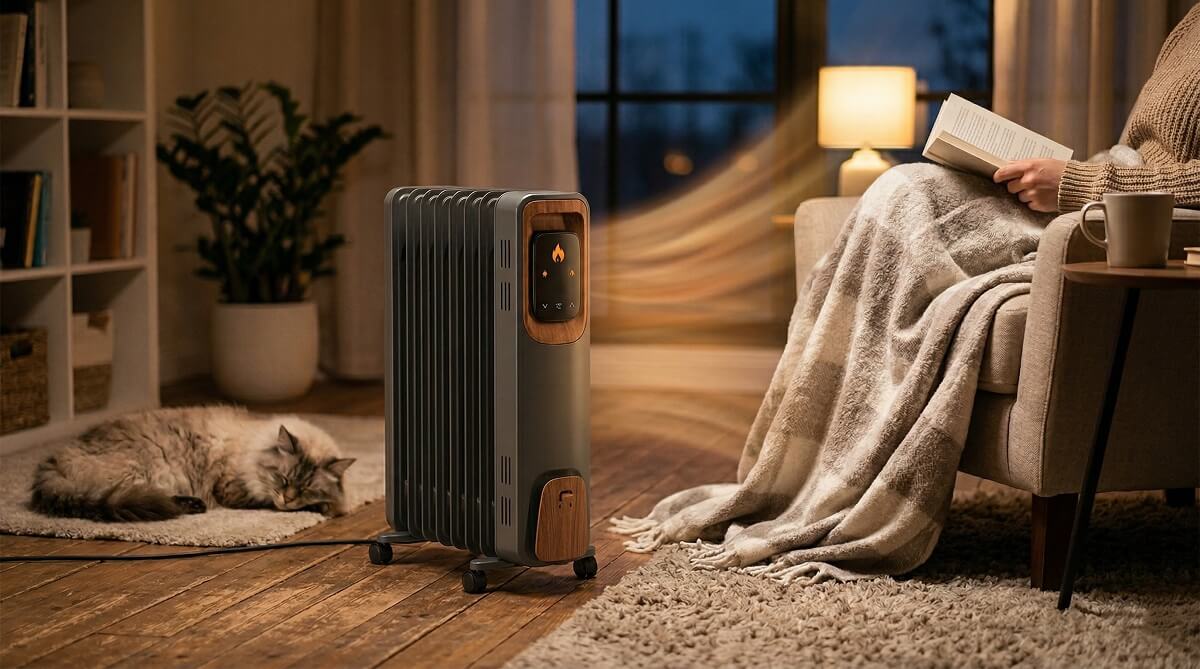
- Oil-filled radiators — long sessions (3+ hours), quiet operation required, bedrooms and home offices
- Infrared heaters — staying in one spot, garages, workshops, desk setups, or partial outdoor spaces
- Micathermic panels — living rooms, wall-mount preferred, silent operation
❌ Skip a Space Heater If
- You’re trying to heat more than one or two rooms — central heat is more economical at scale
- You plan to keep your main thermostat at the same level — you’ll just increase your total electricity usage
- You need round-the-clock, unattended heat without safety features like auto shut-off and tip-over protection
How “Energy Efficiency” Actually Works for Space Heaters
The 100% Efficiency Rule — and Why It Can Be Misleading
All electric resistance heaters obey the first law of thermodynamics: energy cannot be destroyed. Every watt of electricity that goes in becomes heat that comes out. A $25 coil heater and a $150 ceramic heater drawing the same 1,500W produce the same number of BTUs—around 5,118 per hour.
This is also why space heaters are not certified under the ENERGY STAR program. According to Save on Energy (Ontario’s Independent Electricity System Operator), ENERGY STAR certification doesn’t apply because “any electric heater is 100% efficient at converting electricity to heat.” Two models with identical wattage will always consume the same amount of electricity over the same period, assuming equivalent settings.
The real efficiency question is: does the heat reach you usefully? A room heater with a thermostat that cycles off once the space hits your target temperature wastes less energy than one that runs at full tilt nonstop. A fan-equipped ceramic model distributes warmth faster. An infrared unit skips the air entirely and warms your body directly—using less total electricity when you only need personal warmth.
The One Exception: Portable Heat Pumps
If you want to break the 100% rule, you need a heat pump. Instead of generating heat from scratch, heat pumps move existing heat energy from one place to another—the same principle as an air conditioner running in reverse. A portable heat pump can deliver 2 to 4 units of heat for every unit of electricity it uses, a metric called the Coefficient of Performance (COP). That’s genuinely more efficient than any resistance heater.
The catch: portable heat pump units are considerably more expensive upfront, require adequate ambient temperature to operate effectively, and are harder to find than standard plug-in heaters. The Dyson Purifier Hot+Cool HP1 is one of the more widely reviewed options that incorporates heat pump-adjacent technology, though it primarily uses resistive heating.
The 5 Main Types of Space Heaters Compared
All five types have real-world use cases. None is universally superior. Here’s how they stack up on the factors that matter to most buyers:
| Heater Type | Warm-Up Speed | Best Room Size | Noise | Typical Price | Standout Strength |
|---|---|---|---|---|---|
| PTC Ceramic | Fast (<15 min) | Up to 300 sq ft | Low–Medium | $30–$100 | Versatile everyday use |
| Oil-Filled Radiator | Slow (20–30 min) | 150–300 sq ft | Silent | $50–$150 | Quiet, retains heat after shutting off |
| Infrared / Radiant | Near-instant | Personal to small room | Very quiet | $40–$200 | Spot heat, no air circulation needed |
| Micathermic Panel | Medium | Medium rooms | Silent | $80–$200 | Slim, wall-mountable, fanless |
| Convection (Fan) | Fast | Small–medium | Medium | $25–$80 | Budget-friendly, quick heat blast |
PTC Ceramic Heaters
PTC stands for Positive Temperature Coefficient—a type of ceramic heating element that self-regulates. As the element heats up, its electrical resistance rises, which naturally reduces power draw and prevents overheating. This is why ceramic models are the go-to recommendation for everyday use.
Most run at either 750W (low) or 1,500W (high), include an adjustable thermostat, and use a fan to circulate warm air across the room. Dreo’s 1500W PTC model is among the top-selling options on Amazon. The Lasko 751320 (approximately $79.99 MSRP) is a reliable pick in independent reviews for its oscillating tower design, cool-touch housing, and 7-hour auto-off timer.
Oil-Filled Radiators
Oil-filled radiators warm up slowly, but they have something fan-based models don’t: diathermic oil that stores thermal energy and keeps radiating warmth after the power cuts out. If you’re sitting in the same area for three or four hours and don’t need rapid heat-up, this design uses less electricity over the session because it cycles off more often once the oil reaches temperature.
No fan also means near-total silence—an advantage in bedrooms and home offices where background noise matters.
Infrared and Radiant Heaters
According to the U.S. Department of Energy, radiant heaters “are a more efficient choice when you will be in a room for only a few hours and can stay within the line of sight of the heater.” They emit infrared radiation that warms objects and bodies directly—similar to sunlight—rather than heating the air in the room.
The Dr. Infrared Heater DR-968 (approximately $159 at major retailers) uses a dual-heating system—infrared quartz tubes plus a PTC element—to combine direct radiant warmth with convection airflow. It’s frequently cited in tested review roundups as a top pick for larger spaces.
Micathermic Panels
Micathermic heaters use sheets of mica mineral to produce both radiant and convective heat without a fan. The result is silent operation, a slim footprint (many wall-mount), and even heat distribution across the room. A reasonable choice when you want to warm a living room for several hours without fan noise, though these units are less common and typically cost more than entry-level ceramic alternatives.
How Much Does a Space Heater Cost to Run?
The Running Cost Formula
The math is straightforward:
Cost = Watts ÷ 1,000 × Hours × Electricity rate ($/kWh)
Using the 2025 national average rate of approximately $0.17/kWh:
- 1,500W × 8 hours × $0.17 = $2.04 per day
- 1,500W × 4 hours × $0.17 = $1.02 per day
- 750W × 8 hours × $0.17 = $1.02 per day
Monthly costs (30 days) at those same rates: roughly $61, $31, and $31 respectively. Rates vary by state—see the table below.
Wattage and Room Size — Quick Reference
| Room Size | Recommended Wattage | Est. Daily Cost (8 hrs, $0.17/kWh) | Est. Monthly Cost |
|---|---|---|---|
| Personal / desk (~50 sq ft) | 500W | $0.68 | ~$20 |
| Small room (~100 sq ft) | 1,000W | $1.36 | ~$41 |
| Medium room (~150 sq ft) | 1,500W | $2.04 | ~$61 |
| Large room (~200 sq ft) | 2,000W | $2.72 | ~$82 |
Rule of thumb: roughly 10 watts per square foot, per manufacturer guidance cited by Save on Energy (Ontario IESO). Costs calculated at $0.17/kWh — look up your local rate for a more accurate figure.
Your Electricity Rate Changes the Math Significantly
The national average residential electricity rate in 2025 was approximately $0.17/kWh, but it varies widely by state. According to Choose Energy’s February 2026 state-by-state data:
- Hawaii: ~$0.40/kWh (more than 2× the national average — petroleum-dependent grid)
- Louisiana: ~$0.12/kWh (among the lowest in the nation — natural gas abundance)
- National average: ~$0.18/kWh (trending slightly higher in 2026)
A Hawaii resident running a 1,500W heater for 8 hours pays roughly $4.80/day; a Louisiana resident pays around $1.44/day. That’s a significant gap, and it matters when deciding whether a space heater makes sense economically versus other heating options.
Does a Space Heater Actually Save Money?
Only if you adjust your central thermostat. The approach that works: lower your main thermostat by 5–7°F and use a space heater to keep the room you’re in at a comfortable temperature. Every degree you drop your central heat setting reduces your overall heating bill by roughly 1% per hour.
If you keep the central heat running at the same level and add a space heater on top, you’ll pay more — not less.
Features That Reduce Running Costs
Beyond heater type, the controls determine how much electricity you actually use. Here’s what to look for:
- Programmable thermostat — cycles the heater off once your target temperature is reached; prevents constant full-power operation. This single feature makes a bigger difference than heater type in many cases.
- Adjustable heat settings — running at 750W instead of 1,500W when the room is already partly warm can halve your running cost in that stretch.
- Auto shut-off timer — prevents all-night or all-day running when you’ve left the room or fallen asleep. Look for at least a 4-hour option, ideally 8–12 hours.
- Eco or energy-saving mode — available on many newer ceramic models; automatically reduces output by 30–50% once the target temperature is maintained.
- Oscillation — helps ceramic models distribute warm air more evenly, reducing the tendency to overheat one zone while leaving others cold—which can reduce how long the heater needs to run.
Safety Is Not Optional
The U.S. Department of Energy notes that the Consumer Product Safety Commission estimates more than 1,700 residential fires every year are associated with space heater use, resulting in more than 80 deaths and 160 injuries nationwide. That’s a real number, and most of those incidents are preventable.
Non-negotiable features to look for:
- UL or ETL listing — confirmed by an accredited safety testing lab; don’t skip this.
- Tip-over auto shut-off — the heater cuts power automatically if knocked over.
- Overheat protection — shuts off if internal temperature exceeds safe limits.
- Cool-touch housing — especially important if you have children or pets.
Practical operating rules:
- Plug directly into a wall outlet — never use an extension cord or power strip (neither is rated for sustained heater wattage).
- Maintain at least 3 feet of clearance from furniture, curtains, bedding, and any other combustibles.
- Don’t run it unattended for extended periods unless it has a reliable auto-shutoff timer.
- Never use combustion-based heaters (propane, kerosene) indoors without proper ventilation — carbon monoxide risk is serious.
Top Space Heater Picks by Use Case
Best Everyday Whole-Room Heater — Vornado MVH (2025)
The Vornado MVH (2025 model) uses Vornado’s signature Vortex Heat Circulation to move warm air throughout the room, not just push it in one direction. It operates at 1,500W with 3 heat settings, includes an adjustable thermostat, tip-over protection, and auto shut-off. Backed by a 5-year limited warranty—longer than most competitors in this price range. Lab-tested and included in Consumer Reports’ 2026 space heater roundup. Available for approximately $62 at major retailers (check current pricing on Amazon or at Walmart); prices vary.
Best for Large Rooms / Infrared — Dr. Infrared Heater DR-968
The DR-968 uses a dual-heating approach: infrared quartz tubes for direct radiant warmth, combined with a PTC fan-assisted element for air circulation. The wood cabinet style makes it less industrial-looking than most portable heaters, and it runs quietly. Bob Vila’s tested review named it a top overall pick for energy efficiency. Approximate retail price is around $159 (check current Amazon pricing).
Best Oscillating Ceramic Tower — Lasko 751320
The Lasko 751320 is a 23-inch ceramic tower that oscillates, has a 7-hour auto-off timer, remote control, and cool-touch housing. The self-regulating ceramic element handles overheat prevention automatically. At approximately $79.99 MSRP, it’s a solid mid-range option that regularly appears in “best of” lists from tested review sources. Check current pricing at Amazon or Walmart.
Best Budget Pick — Vornado MVH or Comparable Entry-Level Ceramic
If you want the most heater for the least money, look for a 1,500W ceramic model with at minimum: a thermostat, tip-over protection, and ETL/UL listing. Avoid the absolute cheapest coil heaters—they often lack thermostats and run at full power regardless of room temperature. The Vornado MVH at ~$62 is reasonable for what you get; entry-level Dreo models start around $40–50.
Best for Bedrooms (Quiet) — Oil-Filled Radiator
If silence matters—for sleeping, focused work, or recorded calls—an oil-filled radiator is the right call. No fan means no white noise. The De’Longhi and Pelonis lines are frequently cited in independent reviews. Expect to pay $80–$130 for a quality 1,500W model.
Who Should (and Shouldn’t) Use a Space Heater
✅ Good Candidates
- Remote workers heating a home office while keeping the rest of the house cooler
- Renters who can’t control central heat settings (or where central heat is unreliable)
- Households with one person who runs colder than everyone else — targeted heat for one room
- Supplementing a cold basement, garage workshop, or poorly insulated addition
- Off-season use: a chilly morning or evening when firing up the furnace seems excessive
❌ Not the Right Tool If
- You’re trying to heat three or more rooms — the running costs add up faster than central heat
- You won’t lower the main thermostat to compensate
- You expect a space heater to replace a furnace — they’re supplemental by design
- You’re in a drafty space with poor insulation — most of the heat will escape before it warms you
Frequently Asked Questions
What is the most energy-efficient type of space heater?
For most everyday situations, a PTC ceramic heater is the practical answer — it heats up fast, self-regulates to avoid wasting power, and most models include thermostats and timers. If you’re heating one person in one spot for a few hours, an infrared heater is more efficient because it heats you directly rather than the whole room. Oil-filled radiators are the better option for long, steady sessions where quiet operation matters.
Do space heaters save money compared to central heating?
They can, but only if you lower your central thermostat. The typical strategy: drop your main thermostat 5–7°F and heat just the room you’re using with a space heater. If you leave both running at full output, you’re using more energy, not less.
How much electricity does a 1,500-watt space heater use per day?
At the 2025 national average rate of ~$0.17/kWh, running a 1,500W heater for 8 hours costs approximately $2.04. Your actual cost depends on your local electricity rate — which ranges from around $0.12/kWh in Louisiana to $0.40/kWh in Hawaii.
Are space heaters Energy Star certified?
No. Space heaters are not included in the ENERGY STAR program because all electric resistance heaters are already 100% efficient at converting electricity to heat. Two heaters with the same wattage will always use the same amount of energy over the same period — there’s no efficiency gap to certify.
Is it safe to leave a space heater on overnight?
Generally, the Consumer Product Safety Commission advises against leaving space heaters unattended. If you need heat while sleeping, choose a model with a reliable auto shut-off timer and proper safety certifications (UL/ETL). Some oil-filled radiators are designed for extended use, but even those should have tip-over protection and overheat shutoff. The Department of Energy estimates more than 1,700 house fires per year are linked to space heaters — most involving unattended use or nearby combustibles.
What wattage space heater do I need for my room?
A widely used rule of thumb is 10 watts per square foot. That means a 150 sq ft room needs around 1,500W, a 100 sq ft room around 1,000W, and a personal desk space around 300–500W. Don’t oversize — a heater that’s too powerful for the space will short-cycle constantly, which is both less efficient and harder on the unit.
Are infrared heaters better than ceramic heaters?
Neither is objectively better — they serve different use cases. Infrared heaters are more efficient when you stay in one spot and can face the heater directly; they heat you without warming the whole room. Ceramic heaters are better for warming a whole room quickly and work even when people move around. For a bedroom or living room, ceramic usually wins. For a desk, garage, or outdoor-ish space, infrared is often the stronger option.
Can a space heater replace a furnace?
For a single room, possibly — though you’d want a model rated for that square footage and would need to run it continuously. For a whole house, no. The economics don’t work: running multiple 1,500W heaters continuously costs significantly more than a gas furnace heating equivalent space. Space heaters are supplemental heating tools, not whole-home solutions.
Why isn’t my space heater keeping the room warm?
A few common causes: the heater is undersized for the room (check the 10W/sq ft rule); there are drafts from windows, doors, or poor insulation pulling the heat out; the heater is blocked or positioned against a wall instead of pointing into the room; or the thermostat is set too low. Try sealing gaps around windows and doors first — insulation improvements help any heater perform better.
What’s the most efficient space heater for a large room?
For rooms over 200 sq ft, look for a 1,500W ceramic tower with oscillation (to spread heat evenly), a programmable thermostat, and an eco mode. The Dr. Infrared DR-968’s dual-heating design also works well in larger spaces. If the room has poor insulation, no heater will be particularly efficient — address the envelope first.
Ready to pick a heater? See current prices and availability on Amazon. February and March are typically the best months to buy — post-winter clearance often brings prices down significantly on last season’s stock, per Consumer Reports buying timing data.
