


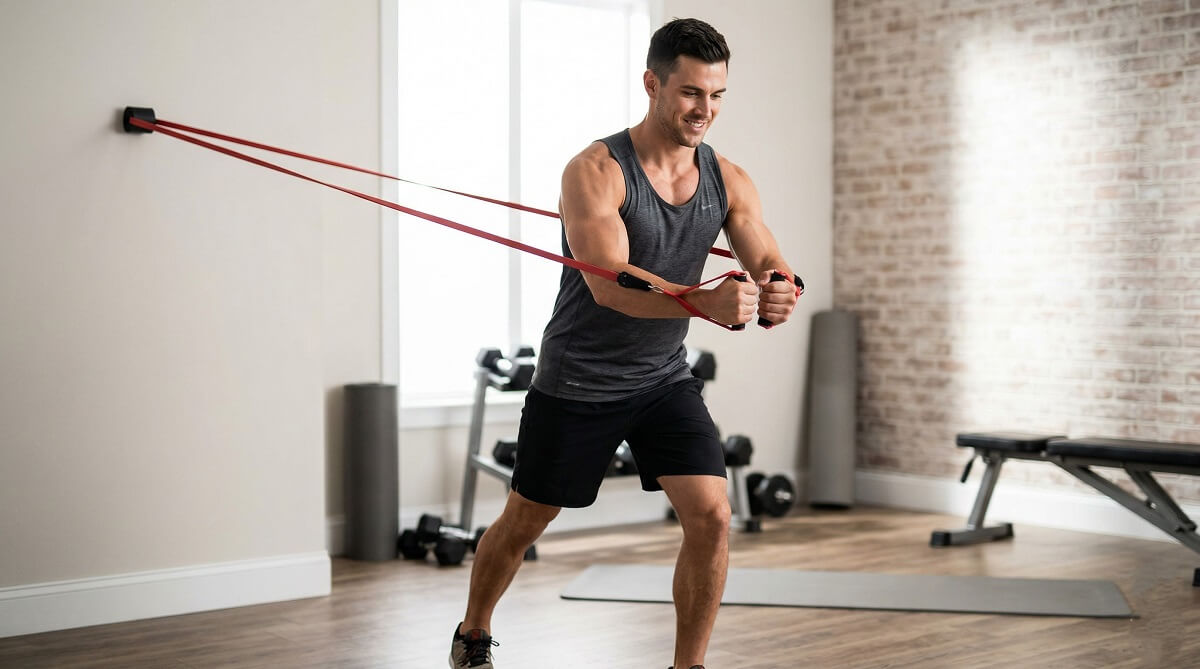
Yes, elastic bands build real chest muscle — and the research backs that up. A 2019 meta-analysis published in SAGE Open Medicine found that elastic resistance training produces strength gains comparable to conventional weights across diverse populations, from healthy teenagers to adults in their 80s. You don’t need a bench press or a gym membership to develop your pecs.
For home trainers, travelers, and anyone who wants an effective chest workout without hauling iron, bands are a legitimate tool — not a compromise. The problem is that most guides throw a list of exercises at you without explaining how to structure them or how to keep making progress. This guide gives you both: the exercises and a framework to actually use them.
You’ll get 7 chest exercises with step-by-step instructions, two ready-to-use workout plans (beginner and intermediate), and practical tips for making bands harder as you get stronger. A solid band set costs less than $30 and fits in a backpack — there’s very little standing between you and a productive chest day.
Who Should (and Shouldn’t) Use Bands for Chest Training
✅ Best For
- Home gym users who don’t have a bench, barbell, or cable machine
- Travelers — bands pack flat and clear airport security without a second glance
- People with shoulder sensitivity — bands move naturally with your joints instead of locking you into a fixed path
- Beginners building a foundation before moving to heavier free weights
- Anyone who wants to add progressive resistance to push-ups without buying more gear
- Budget-conscious trainers — a full set of loop bands costs under $15 on Amazon
❌ Skip If
- You’re training specifically for powerlifting or maximum bench press numbers — bands alone won’t replicate the loading patterns you need for competition
- You have a latex allergy and can’t find non-latex alternatives (they do exist, but confirm before buying)
- You need loading above 200 lbs — most consumer band sets top out well below that
How Resistance Bands Train Your Chest Differently Than Weights
Knowing why loop bands produce results changes how you train with them. Here’s what makes them different from dumbbells and machines.
Accommodating Resistance
Unlike a dumbbell, which weighs the same at every point in the lift, a band gets harder as you stretch it. Certified trainer Mathew Forzaglia, NFPT-CPT, describes it this way: “Bands add accommodating resistance, which means you can overload weight on one side of the range of motion versus the other. When bench pressing with a band, at the bottom of the movement the resistance is minimal, while at the top it’s at its max. This is a great technique for building strength and explosive power.”
For chest work, this means your muscles face the most resistance exactly when they’re in the strongest position to handle it — at the top of the press, not the bottom. That’s different from free weights, where the hardest point is usually mid-range. Both approaches have merit; combining them over time gives you the most complete training stimulus.
You Work the Full Rep — Both Directions
Loop bands push back against you on the way down as much as on the way up. A controlled return (eccentric phase) is where a significant amount of muscle development actually happens. With a dumbbell, it’s tempting to let gravity do the lowering work. With a band, the elastic tension keeps pulling your arms back to the start, so you have to actively resist it.
Practical takeaway: count 2 seconds pressing out, 3 seconds returning. That controlled return makes every rep more productive.
What You’ll Need Before Starting
Band Types for Chest Work
| Band Type | Best For | Typical Resistance Range |
|---|---|---|
| Large loop band | Push-ups, floor press, dips | 10–150 lbs depending on thickness |
| Tube band with handles | Standing chest press, flys, crossovers | 10–50 lbs per tube |
| Flat therapy band | Warm-up, pullovers, light isolation | 1–30 lbs |
Note: there’s no universal color-to-resistance standard across brands, as Healthline notes. Always test the tension before committing to a set of reps.
Picking the Right Resistance Level
A simple rule: the last two reps of each set should feel genuinely hard while your form stays clean. If you can cruise through 12 reps without much effort, the band is too light. If your form breaks down by rep 7, it’s too heavy.
- Push-ups: Medium to heavy loop band (the band adds resistance at the top of the push-up)
- Floor press: Medium to heavy (you want challenge through full range)
- Chest fly / crossovers: Light to medium (these are isolation moves; focus is on stretch and squeeze, not max load)
- Standing incline press: Medium (pressing at an angle, upper chest emphasis)
Optional but Useful Accessories
- Door anchor: Opens up standing flys, crossovers, and high-to-low cable work without a cable machine. Most band sets include one.
- Dip station or parallel bars: For banded dips if you want lower chest emphasis
- Loop band set (set of 5): Check current prices on Amazon (Fit Simplify — #1 best-seller) — typically under $15; a full set with handles runs under $30
7 Chest Exercises with Resistance Bands
These exercises cover the full chest — upper fibers, mid-chest, lower fibers, and the inner pec squeeze. Work through them in order during a session, or pick 3–5 that suit your equipment and goals. Need help choosing bands? See for recommendations.
1. Banded Push-Up
Targets: Pec major (mid and upper), triceps, anterior deltoid
Why it’s the starter: No anchor needed, works multiple muscles, and the band adds meaningful resistance at exactly the point where a standard push-up gets easiest — the top of the rep.
How to do it:
- Thread a large loop band across your upper back and grip each end under your palms — the band should sit below your shoulder blades.
- Get into a plank position with hands shoulder-width apart, body straight from head to heels.
- Lower your chest toward the floor, keeping elbows at about 45 degrees from your torso (not flared straight out).
- Stop when your chest is 1–2 inches from the floor, then press up firmly. You’ll feel the band tension peak near the top.
- Lower with control — don’t let the band snap you down.
Sets/reps: 3–4 sets × 8–12 reps
Progression: Move hands closer together (diamond push-up grip) to shift more work to the inner chest
2. Floor Press
Targets: Mid-chest, triceps
Why it works: The floor limits your range of motion at the bottom (protecting your shoulders) while the band makes the top of the rep demanding. A solid pressing exercise when you don’t have a bench.
How to do it:
- Sit on the floor with your knees bent, feet flat. Thread a loop band under your upper back and hold one end in each hand.
- Lie back so the band is pressed against the floor by your shoulder blades.
- Start with elbows on the floor, bent at about 45 degrees, hands pointing toward the ceiling.
- Press your hands straight up until arms are nearly locked out — squeeze your chest at the top.
- Lower your elbows back to the floor under control.
Sets/reps: 3–4 sets × 10–15 reps
Progression: Fold the band in half (overlapping it) to shorten it and increase tension
3. Standing Chest Press
Targets: Mid-chest, front deltoid
Why it works: Mimics the function of a cable press or chest-height machine press — functional horizontal pushing strength. Requires an anchor point at chest height.
How to do it:
- Attach or loop your band to an anchor point at chest height (door anchor, pole, or power rack upright).
- Face away from the anchor and hold one end in each hand, arms bent at your sides.
- Step forward until you feel resistance. Take a split stance (one foot forward) for stability.
- Press your hands forward at chest height until arms are nearly straight. Squeeze chest at the end of the movement.
- Return slowly — don’t let the band pull your arms back uncontrolled.
Sets/reps: 3 sets × 10–12 reps
Progression: Step further from the anchor to increase band stretch and resistance
4. Chest Fly
Targets: Pec major (inner and outer fibers), pec minor
Why it works: The fly isolates the chest more than pressing movements, providing that deep stretch at the bottom of the rep. Good for developing both pec thickness and the visible separation between chest sections.
How to do it:
- Set your band anchor at chest height. Stand facing away from it, holding one end in each hand.
- Step forward until you feel tension. Arms should extend out to your sides with a slight bend at the elbows — never fully locked out.
- Keeping that slight elbow bend constant, arc your arms forward and together as if you’re hugging a large barrel.
- Bring your hands together at chest height in front of you. Hold for 1–2 seconds and squeeze your pecs.
- Slowly open your arms back to the starting position, feeling the stretch in your chest.
Sets/reps: 3 sets × 10–12 reps
Progression: Add a 2-second pause at peak contraction before opening back up
5. Standing Incline Press
Targets: Upper pec fibers, anterior deltoid
Why it works: Pressing at an upward angle shifts emphasis to the upper portion of your chest — the hardest area to develop without an incline bench. This version requires no bench and no fixed anchor point.
How to do it:
- Place the center of the band under your back foot. Take a staggered stance with your other foot forward.
- Hold one end in each hand at shoulder height with elbows bent.
- Press your hands forward and upward at roughly a 45-degree angle — you should be pressing toward where a ceiling meets a wall.
- Extend arms fully, then return slowly to the starting position.
Sets/reps: 3 sets × 10–12 reps
Progression: Hold the top position for 1–2 seconds before lowering
6. High-to-Low Crossover
Targets: Lower pec fibers, serratus anterior, inner chest
Why it works: Pulling the band from high to low angles the tension down toward your lower pecs — an area most people underdevelop. This is the band equivalent of the high cable crossover you’d do at the gym.
How to do it:
- Anchor the band at shoulder height or higher. Stand facing away from it, holding one end in each hand.
- Take a slight forward lean and split stance. Arms should extend slightly back and up at the start.
- Pull both arms down and forward, bringing your hands together in front of your hips (or slightly lower). Cross one wrist over the other at the peak for a stronger contraction.
- Hold the crossed position for 1 second, then return arms up and back under control.
Sets/reps: 3 sets × 10–12 reps
Progression: Alternate which arm crosses on top each rep for balanced development
7. Single-Arm Press
Targets: Pec major (one side at a time), core anti-rotation muscles
Why it works: Training each arm independently catches left-right strength imbalances early and forces your core to work overtime to prevent rotation. If one side feels noticeably harder, it’s a sign your dominant side has been compensating during bilateral exercises.
How to do it:
- Anchor the band at chest height. Stand sideways to the anchor, holding the band in the hand facing the anchor.
- Take a staggered stance with the foot opposite your working arm forward.
- Press your hand forward at chest height until your arm is nearly straight. Keep your torso square — resist any urge to rotate toward the press.
- Return slowly, feeling the band pull your arm back. Don’t let it rotate you.
- Complete all reps on one side before switching.
Sets/reps: 3 sets × 10–12 reps per arm
Progression: Slow the return phase to a 3–4 second count for extra time under tension
How to Build a Real Chest Workout From These Exercises
Having a list of exercises is the starting point. Using them in a logical order — compound movements first, isolation last — is what turns them into a productive session. According to ACSM’s Exercise is Medicine guidelines, each major muscle group should be trained at least 2 times per week, with most evidence supporting 2–3 sessions for muscle development. Leave at least 48 hours between chest sessions to allow recovery.
Beginner Routine (3 exercises, 2–3 days/week)
| Order | Exercise | Sets | Reps | Rest |
|---|---|---|---|---|
| 1 | Banded Push-Up | 3 | 8–10 | 60–90 sec |
| 2 | Floor Press | 3 | 10–12 | 60–90 sec |
| 3 | Chest Fly | 3 | 10–12 | 60–90 sec |
Total time: approximately 25–30 minutes including warm-up.
Intermediate Routine (5 exercises, 2–3 days/week)
| Order | Exercise | Sets | Reps | Rest |
|---|---|---|---|---|
| 1 | Banded Push-Up | 4 | 10–12 | 60–90 sec |
| 2 | Standing Chest Press | 3 | 10–12 | 60–90 sec |
| 3 | Standing Incline Press | 3 | 10–12 | 60 sec |
| 4 | High-to-Low Crossover | 3 | 10–12/side | 60 sec |
| 5 | Single-Arm Press | 2 | 10–12/arm | 60 sec |
Total time: approximately 40–50 minutes.
How to Keep Progressing Once Bands Feel Easy
Progressive overload is the core principle behind any strength training — you need to keep increasing the challenge over time to keep stimulating adaptation. With bands, you have several options:
- Step further from the anchor — more distance = more stretch = more tension
- Shorten the band — fold a loop band in half to start at higher baseline tension
- Add a pause — hold the peak contraction for 1–3 seconds before releasing
- Slow the eccentric — lower in 3–4 seconds instead of 1–2
- Stack bands — use two bands simultaneously for more resistance
- Increase reps — before moving to a heavier band, push to 15–20 reps with clean form
A Few Safety Points Worth Knowing
Elastic bands are generally forgiving on joints, but they do require basic upkeep and some common-sense handling.
- Inspect before each session — check for nicks, fraying, or discoloration. A band that snaps mid-rep is unpleasant at best.
- Don’t over-stretch — avoid stretching any band more than 2.5 times its resting length.
- Secure your anchor — make sure whatever you’re anchoring to won’t give way mid-rep. A door should be fully closed and the anchor placed over the hinge side.
- Control the return — releasing a band at high tension while your hand is through the loop is a fast way to hurt yourself. Always lower with control.
- Replace worn bands — if a band looks significantly faded, stretched out, or shows surface cracks, it’s past its useful life.
Frequently Asked Questions
Are resistance band chest exercises as effective as weights?
For most training goals, yes. A 2019 systematic review and meta-analysis published in SAGE Open Medicine analyzed 8 studies with 224 participants and found that elastic resistance training produces similar strength gains to conventional resistance training across diverse populations. The difference in outcomes between methods was not statistically significant. For general fitness, muscle building, and maintenance, bands hold up well. For maximum strength sport preparation (powerlifting, Olympic lifting), you’ll eventually want barbells in the mix.
What resistance level should I start with?
If you’re new to band training, start lighter than you think you need. A medium-resistance band (typically color-coded yellow or green depending on brand, around 10–25 lbs) is a reasonable starting point for most push and fly movements. The last 2 reps of a 12-rep set should be challenging — if they’re not, step further from the anchor or try a heavier band.
Can I do these exercises without a door anchor?
Yes. The banded push-up, floor press, and standing incline press all work without any anchor — just the band under your back or foot. For flys and crossovers, a sturdy pole, power rack upright, or bedpost at the right height will work in place of a door anchor.
How many days per week should I train my chest with bands?
Per ACSM guidelines, each major muscle group should be trained at least 2 times per week, with most evidence pointing to 2–3 sessions for muscle development. Leave at least 48 hours between chest sessions to allow recovery. A Monday/Thursday or Tuesday/Friday split works well.
Do these exercises work the same way for women?
Completely. Chest anatomy is the same regardless of sex — pectoralis major, pectoralis minor, serratus anterior — and these exercises develop those muscles the same way. Resistance levels may differ based on strength baseline, but the exercises, form cues, and progression methods are identical.
What’s the difference between a chest press and a chest fly?
A press is a compound movement where your elbows bend significantly. It works your chest, triceps, and shoulders together. A fly keeps the elbows mostly straight, isolating the chest through an arc motion. Both have a place in a complete chest workout — do pressing movements first, isolation work (flys, crossovers) after.
Can resistance bands fully replace the bench press?
For general fitness goals — muscle tone, upper body strength, posture improvement — yes, bands can cover the job. If your goal is to build a maximum bench press number or prepare for strength sports, you’ll need the barbell eventually. But for the vast majority of people working out at home or traveling, bands are a complete chest training solution.
How long do resistance bands last before they need replacing?
With regular use, quality latex bands typically last 1–3 years depending on usage frequency, storage conditions, and whether they’re regularly inspected. Store them away from direct sunlight and sharp objects. Inspect before each session — visible cracking, discoloration, or unusual stretch are signs it’s time for a replacement.
Ready to start? A complete set of resistance loop bands — everything you need for all seven exercises above — is available on Amazon for under $15, or check sporting goods stores like Dick’s or REI for in-person options. Pick a day, set aside 30 minutes, and give the beginner routine a run.
