


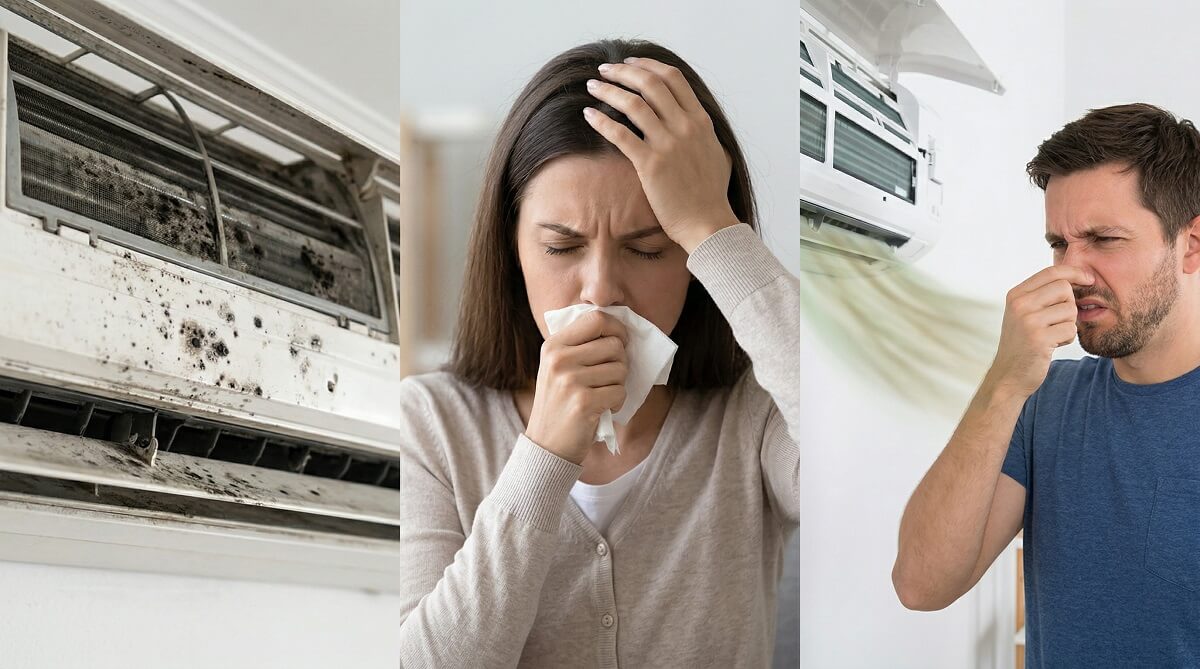
The smell usually hits first — a musty, earthy odor that appears whenever the AC kicks on and fades once it shuts off. That’s the most common early sign that mold has taken up residence inside your cooling system. By the time you can see it, it’s typically been growing for a while, tucked behind coils, in the drain pan, or along the ductwork where you can’t easily look.
The practical concern isn’t the mold itself — it’s what the unit does with it. Every time your air conditioner runs, it circulates air across those contaminated surfaces and distributes spores throughout your home. For most healthy adults, short-term exposure causes mild irritation. For people with asthma, allergies, or compromised immune systems, it’s a more serious problem.
The fix is usually straightforward once you identify the issue. This guide covers the seven warning signs to look for, what causes mold to grow in AC units, the real health risks, and your options — from cleaning it yourself to knowing when a professional is the right call.
Quick Check: Do You Have a Mold Problem?
✅ Take Action If You Notice:
- A musty or earthy smell every time the AC runs (not just at startup)
- Visible black, green, or white fuzzy spots on vent covers, coils, or the drain pan
- Sneezing, congestion, or itchy eyes that improve when you leave the house
- Water pooling near the unit or standing water in the drain pan
- You own a Midea U or U+ window AC (check the recall below)
❌ Probably Not Mold If:
- The smell only appears at first startup after months of storage and clears in a few minutes (that’s dust burning off the heat elements)
- Spots on the outside casing are rust-colored (corrosion) or chalky white (mineral deposits from water)
- Symptoms don’t improve at all when the AC is turned off and you stay home
7 Symptoms of Mold in an Air Conditioner
1. A Persistent Musty or Earthy Odor
This is the classic tell. Mold produces microbial volatile organic compounds (mVOCs) as part of its metabolic process, and many of those compounds have a distinctly musty, damp, or earthy smell. If the odor appears when the AC turns on and fades when it shuts off, the source is almost certainly inside the unit.
A smell that’s present all the time, regardless of whether the AC is running, suggests mold elsewhere in the house — possibly near the return air vents or in the ductwork. If it’s specifically tied to the AC cycle, start there.
2. Visible Spots on Vents or Accessible Parts
Black, dark green, or white fuzzy patches are the visual confirmation most people look for. Check these locations first:
- Supply and return vent covers — removable and easy to inspect
- Evaporator coil fins (if visible through the air handler access panel)
- Condensate drain pan — the shallow tray beneath the evaporator coil
- Air handler cabinet interior and blower assembly
- Window AC filter and front panel
Mold doesn’t always look dramatic. Early growth can appear as a faint gray or greenish discoloration on surfaces that should be clean. If it wipes off and comes back, it’s mold or mildew — not dirt.
3. Allergy-Like Symptoms That Track With AC Use
According to the Centers for Disease Control and Prevention (CDC), common symptoms of mold exposure include stuffy nose, sore throat, coughing or wheezing, burning eyes, and skin rash. These can feel indistinguishable from a seasonal allergy flare-up.
The diagnostic clue is the pattern: do symptoms worsen when you’re home with the AC running, and improve when you’re away or when you turn the system off? If the answer is yes, the AC is a strong suspect. People with asthma, existing mold allergies, chronic lung disease, or compromised immune systems (including those undergoing chemotherapy or who have had an organ transplant) are at higher risk of a more significant reaction.
4. Water Pooling Near the Unit or in the Drain Pan
Standing water in or around the unit functions as both a symptom and a forecast. The condensate drain pan should collect water and channel it out via the drain line continuously — if you see standing water, the drain line is partially or fully blocked.
Mold can begin developing within 24 to 48 hours of persistent moisture exposure under the right temperature conditions, which is why pooled water in an AC isn’t something to watch and wait on. That’s also precisely the failure mode behind the largest AC recall of recent years: in June 2025, the U.S. Consumer Product Safety Commission recalled approximately 1.7 million Midea U and U+ window air conditioners because water was pooling and not draining fast enough, creating conditions for mold growth. Midea received at least 152 reports of mold, including 17 reports of consumers experiencing respiratory symptoms, according to the CPSC recall notice.
If you own a Midea U or U+ window AC unit sold between March 2020 and May 2025, check whether your model is included in the recall at MideaUrecall.expertinquiry.com.
5. Reduced Airflow or Longer Cooling Cycles
Mold and mildew accumulation on the evaporator coil fins and filter media restricts the airflow the system needs to function efficiently. When airflow drops, the unit has to run longer to reach your set temperature, which drives up energy use and accelerates wear on the compressor and fan motor.
If your AC seems to be working harder than it used to — or your electricity bill has crept up without a corresponding change in usage habits — restricted airflow from mold buildup is one of the more common culprits.
6. Ice Forming on the Evaporator Coils
When airflow is severely restricted, the refrigerant in the evaporator coils gets too cold and moisture in the air freezes on the coil surface. The visible result is ice formation on or around the indoor unit. This creates a feedback loop: melting ice drips into the drain pan, the pan overflows or the drain line can’t keep up, and you end up with more moisture and more conditions favorable to mold growth.
Ice on the coils isn’t always mold-related — low refrigerant is another cause — but it always warrants a closer inspection of the filter and coil cleanliness.
7. Dark or Discolored Dust Around Vent Openings
Normal household dust accumulates as a uniform gray coating on vent grilles. Mold spores mixed into that dust tend to produce irregular dark patches — black or greenish-gray — particularly on the leading edges of supply vents where air velocity is highest. If vent dust looks darker or more irregularly distributed than you’d expect, that’s worth a closer look inside the vent and at the nearest duct section.
What Causes Mold to Grow Inside an AC Unit?
Mold needs three things: moisture, an organic food source (dust particles work fine), and moderate temperatures. Air conditioners naturally deal with all three as part of their basic operation. The difference between a clean system and a moldy one usually comes down to drainage and maintenance.
Clogged Condensate Drain Line
The most common root cause. The condensate drain line carries moisture extracted from your indoor air to a floor drain or outside. Algae, mold, and mineral deposits build up inside the line over time. A partial blockage causes slow drainage and standing water in the pan. A full blockage can trigger a safety float switch that shuts the unit down — or worse, water overflow into the air handler or ceiling.
Dirty or Overloaded Air Filters
A clogged filter does two harmful things simultaneously: it slows the airflow the evaporator coil needs to stay above freezing, leading to excess condensation, and it provides a moisture-saturated surface covered in organic dust — exactly what mold spores need to establish themselves. Filter replacement is the single easiest mold-prevention measure available.
High Indoor Humidity
Most HVAC professionals recommend keeping indoor relative humidity below 50% — and certainly below 60%, above which mold has the moisture it needs to grow even without a drainage problem. If your home runs chronically humid (common in coastal areas or poorly ventilated homes), the AC alone may not be able to dehumidify quickly enough, especially during extended high-humidity weather.
Leaky or Uninsulated Ductwork
Gaps in duct seams or missing duct insulation allow warm, humid air from attic spaces or crawl spaces to enter the system. That warm air hits cold duct surfaces, condenses, and creates wet spots — which become mold spots. Duct mold is harder to spot and generally requires professional remediation when found.
Oversized or Short-Cycling Units
An AC unit that’s too large for the space it’s cooling will reach the set temperature quickly and shut off before completing a full dehumidification cycle. The result: the coil stays damp between cycles, and moisture never fully drains. This is a real problem with improperly sized window ACs in smaller rooms.
Infrequent Maintenance
Dust, debris, and biological matter accumulate in the coils, blower wheel, and drain pan over time. Without periodic cleaning, you’re essentially giving mold a pre-built habitat. Annual professional tune-ups and quarterly filter changes are the minimum maintenance schedule for a mold-resistant system.
Health Effects of Mold Exposure From Your AC
Who Is Most at Risk
Healthy adults with no respiratory conditions typically experience mild, temporary symptoms from AC mold exposure — or none at all. The people who face a more serious risk are those with:
- Asthma or existing mold allergies
- Chronic obstructive pulmonary disease (COPD) or emphysema
- Compromised immune systems (chemotherapy patients, organ transplant recipients, people with HIV)
- Infants and elderly individuals with weaker respiratory defenses
Common Short-Term Symptoms
The CDC lists these as the standard symptoms of mold exposure for otherwise healthy individuals:
- Nasal congestion and stuffy nose
- Sore or irritated throat
- Coughing or wheezing
- Burning, itchy, or watery eyes
- Skin rash
More Serious Reactions With Prolonged Exposure
For high-risk groups or anyone exposed to high mold concentrations over weeks or months, the picture gets more serious: difficulty breathing, asthma attacks, sinus infections, bronchitis, and — in rare cases for severely immunocompromised individuals — opportunistic lung infections.
The Practical Diagnostic Test
Before assuming seasonal allergies or a cold, try this: turn the AC off for 24 hours and see if symptoms improve. Or spend a day away from home and notice whether you feel better. If the pattern tracks with AC use and indoor time, mold in the HVAC system deserves a serious look.
As the New York State Department of Health notes, “it is hard to say how much mold will cause health problems as some people are more sensitive to mold than others.” If you have ongoing symptoms and suspect mold, talk to your doctor — they can help rule out other causes and assess whether your exposure level warrants further investigation.
DIY Cleaning vs. Calling a Professional: How to Decide
When DIY Is a Reasonable Option
You can handle the cleaning yourself if all of these apply:
- Mold is visible only on accessible surfaces — vent covers, the drain pan edge, the front filter
- The affected area is small (under about 10 square feet is the NY State DOH’s threshold for DIY-appropriate jobs)
- You don’t have asthma, severe mold allergies, or a compromised immune system
- The AC still cools effectively — coils aren’t iced over and airflow seems normal
Step-by-Step DIY Mold Cleaning
- Turn off the unit and cut power at the circuit breaker — don’t just use the remote or thermostat
- Put on an N95 respirator mask and rubber gloves before you start disturbing anything
- Remove and clean vent covers — soak in warm soapy water, scrub, rinse, dry completely before reinstalling
- Flush the condensate drain line — pour a cup of distilled white vinegar into the drain pan access point, wait 30 minutes, then flush with water; or use a wet/dry vac on the outdoor end of the drain line
- Clean the condensate pan — wipe with a diluted bleach solution (1 cup of bleach to 5 gallons of water, per NY State DOH guidance) or use an HVAC-approved pan treatment tablet
- Replace the air filter — don’t reinstall the old one
- Clean accessible coil surfaces — use a commercial no-rinse evaporator coil cleaner (available at hardware stores); spray on, let it foam and drip into the pan
- Let everything dry fully — at least a few hours — before restoring power
Important: Don’t spray undiluted bleach directly on metal evaporator coils. Bleach is corrosive to aluminum fins and copper tubing. Stick to diluted solutions on the pan and drain line only; use coil-specific cleaners on the coil itself.
When to Call an HVAC Professional
Some situations are beyond what a homeowner should tackle alone:
- Mold found inside the air handler, on the blower wheel, or visible inside ductwork
- Growth covering more than 10 square feet total
- Symptoms persist after you’ve cleaned all accessible surfaces
- The unit is under a recall (such as the 2025 Midea situation) — contact the manufacturer for a repair technician
- You’re in a rental and the landlord is responsible for HVAC maintenance — document the problem in writing and request remediation
What Professional Mold Remediation Costs
Costs vary widely depending on scope. According to Bob Vila’s mold remediation cost breakdown:
| Scope of Work | Typical Cost Range |
|---|---|
| Air duct mold cleaning only | $600 – $2,000 |
| Full HVAC/AC system mold remediation | $3,000 – $10,000 |
| Per sq ft of duct mold cleaning | $0.48 – $1.13/sq ft |
| General mold remediation (average) | $1,223 – $3,753 |
These figures are as of early 2026 and will vary by location and the extent of growth. Get at least two quotes from licensed contractors before committing to full ductwork remediation.
How to Prevent Mold From Coming Back
A Realistic Maintenance Schedule
- Every 1–3 months: Replace the air filter (monthly in homes with pets or heavy dust; every 3 months for most other situations)
- Every 3 months: Pour distilled white vinegar down the condensate drain to prevent algae buildup
- Annually: Schedule a professional AC tune-up before the cooling season — coils, blower, drain pan, and refrigerant check
- After long dormancy: Inspect and clean before first use of the season
Control Indoor Humidity
Keeping indoor humidity below 50% — and definitely below 60% — removes one of the three things mold needs to grow. A simple plug-in hygrometer (under $20 at most hardware stores) gives you a continuous readout. If your home runs above 55% regularly, a standalone dehumidifier for high-humidity rooms is a practical investment.
Do UV Germicidal Lamps Work?
UV-C lamps installed near the evaporator coil — sometimes called UVGI (ultraviolet germicidal irradiation) systems — work by disrupting the DNA of mold spores and bacteria before they can reproduce. Mike Lea, co-owner of Lea Heating & Air Conditioning, puts it plainly: “The best way to prevent mold growth is to install a UV lamp that consistently shines on the coil.”
They’re a legitimate tool, but not a replacement for basic maintenance. A UV lamp won’t unclog your drain line or replace a dirty filter. Think of it as a second layer of defense once you’ve got the fundamentals covered.
Check the Midea Recall If You Have a Window AC
If you purchased a window air conditioner between 2020 and 2025 from brands including Midea, Frigidaire, Mr. Cool, Keystone, Insignia, Danby, Perfect Aire, Comfort Aire, or Sea Breeze, check whether your model is covered by the June 2025 CPSC recall. The recall covers units in 8,000, 10,000, and 12,000 BTU sizes sold at Costco, Home Depot, Best Buy, and Amazon.
Remedies include a free repair (drain plug installation or a repair kit) or a full or prorated refund based on purchase date. Contact Midea at 888-345-0256 (Mon–Fri, 8 a.m.–5 p.m. ET) or visit MideaUrecall.expertinquiry.com for more information.
Mold Risk by AC Type: What to Expect
Not all AC units are equally vulnerable — the design of your system determines where mold is most likely to form and whether you can clean it yourself.
| AC Type | Most Common Mold Location | DIY Cleanable? | Key Note |
|---|---|---|---|
| Window AC | Drain pan, front filter, internal housing | Yes (usually) | Check if covered by 2025 Midea recall |
| Central AC (split system) | Evaporator coil, drain line, ductwork | Partially | Ductwork mold requires professional |
| Mini-split (ductless) | Blower wheel, coil fins | Yes (with guidance) | Blower wheel mold is common; requires disassembly |
| Portable AC | Internal water reservoir, filter | Yes | Empty reservoir after every use; clean filter monthly |
Frequently Asked Questions
What does mold in an air conditioner smell like?
Earthy, musty, or similar to wet cardboard or a damp basement. The smell is strongest right when the unit turns on, as the fan pushes air over the contaminated surfaces. If it clears within a few minutes of startup, it may be dust burning off; if it persists whenever the AC runs, mold is the more likely culprit.
Can I run my AC if I think there’s mold in it?
No. Operating a moldy unit circulates spores through your home. Turn it off until you can inspect and clean it — or have it inspected by a professional. For Midea recall units, visit the recall website for instructions on safe inspection before continued use.
Is black mold in an AC more dangerous than other types?
The term “black mold” usually refers to Stachybotrys chartarum, but as Restoration 1 notes (and the broader scientific literature supports), there is no solid evidence that it’s more toxic than other common mold types found in AC systems like Cladosporium or Aspergillus. All indoor mold warrants the same response: remove it, fix the moisture source.
How fast can mold grow inside an AC unit?
Under the right conditions — warmth, moisture, and organic material — mold can begin developing within 24 to 48 hours of moisture exposure. The CDC recommends cleaning up and drying out any flooded area within that same window specifically to prevent mold establishment. A clogged drain pan that sits over a weekend gives mold everything it needs.
Can I use bleach to clean mold from my AC?
A diluted bleach solution — 1 cup of bleach per 5 gallons of water, per NY State DOH guidance — is appropriate for the drain pan and condensate line. Don’t spray undiluted bleach on metal evaporator coil fins; it corrodes aluminum. Use a coil-specific cleaner for the evaporator coil itself.
How much does professional AC mold removal cost?
For duct mold cleaning alone, expect roughly $600 to $2,000. Full HVAC system mold remediation typically runs $3,000 to $10,000 depending on system size and extent of growth, according to Bob Vila’s cost analysis. Get multiple quotes, and ask specifically whether the estimate includes the drain line, coils, blower assembly, and ductwork.
Is my Midea window AC part of the 2025 recall?
Midea recalled about 1.7 million U and U+ window AC units in June 2025 due to a drainage defect that allowed water to pool and mold to grow. Affected brands include Midea, Frigidaire, Mr. Cool, Keystone, Insignia, Comfort Aire, Danby, Perfect Aire, LBG Products, and Sea Breeze. The units ranged from 8,000 to 12,000 BTU and were sold from March 2020 through May 2025. Check your model number at MideaUrecall.expertinquiry.com or call 888-345-0256.
Do UV lights really prevent AC mold?
UV-C germicidal lamps installed near the evaporator coil can slow or prevent mold and bacteria growth by disrupting spore DNA. HVAC professionals often recommend them as a supplement to regular maintenance. They’re most effective in combination with clean filters, clear drain lines, and proper humidity control — not as a standalone fix.
Should I test my home for mold if the AC has it?
Generally no. The New York State Department of Health advises that mold testing is “not recommended, nor is it required by any regulatory agency.” If you can see or smell mold, the right response is to fix the moisture source and clean the mold — not spend money on testing that won’t change those basic steps.
Can mold in my AC cause headaches?
Yes, headache is listed by the NY State DOH as one of the documented symptoms of indoor mold exposure, alongside nasal and sinus congestion, eye irritation, cough, and throat irritation. If you’re experiencing recurring headaches at home and they ease when you’re elsewhere, indoor air quality — including the AC — is worth investigating.
Next Steps
If your AC shows any of the warning signs above, the first move is to turn it off and do a physical inspection. Clean what’s accessible, replace the filter, and flush the drain line. If the problem is beyond the visible surface — or if you own an affected Midea unit — check the CPSC recall page or call a licensed HVAC technician for a proper inspection.
