


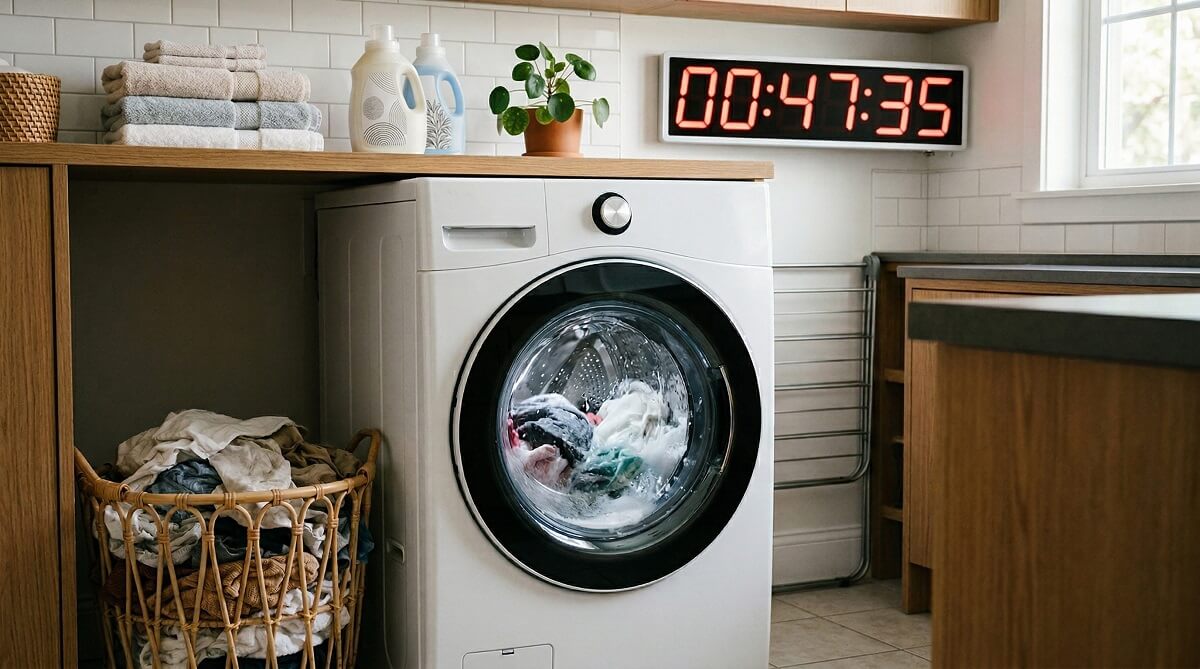
The short answer: a standard wash cycle takes 50–80 minutes on most modern washing machines. If you’re in a hurry, a Quick Wash can finish in 15–40 minutes for small, lightly dirty loads. Factor in the dryer and you’re looking at roughly 1.5 to 2 hours total per load from start to finish.
Four things determine the actual time: the cycle you select, how big the load is, how dirty your garments are, and whether you have a top loader or a front loader. Front loaders tend to run considerably longer than top loaders — in Consumer Reports testing, front-load washers clocked 70–120 minutes per cycle on normal soil settings. Top loaders generally wrap up in 50–80 minutes.
Below is a complete breakdown of every common wash program with verified times from major US brands — Whirlpool, Maytag, LG, and Frigidaire — plus answers to why your machine sometimes runs longer than the display says.
How Long Does Each Wash Cycle Take?
The table below pulls verified data from Whirlpool, Maytag, and LG’s official support pages. Times vary slightly by model and load size.
| Cycle | Typical Time Range | Best Used For |
|---|---|---|
| Quick Wash / Speed Wash | 15–40 min | Small loads, lightly soiled items |
| Normal / Regular | 50–80 min | Everyday clothes |
| Colors | ~45 min | Colorful fabrics to preserve appearance |
| Whites | 65–75 min | White fabrics with hot water |
| Delicate / Gentle | 42–80 min | Sheer fabrics, lingerie, wool, sweaters |
| Permanent Press | 34–60 min | Synthetic blends, dress shirts |
| Bulky / Bedding | 55–105 min | Sheets, blankets, comforters |
| Heavy Duty | 60–135 min | Heavily soiled work clothes, tough stains |
| Sanitize | 90–120 min | Killing bacteria — baby items, sick-household laundry |
| Rinse & Spin | 20–25 min | Extra rinse without a full wash |
| Drain & Spin | ~10 min | Remove excess water from soaked items |
Quick Wash — 15 to 40 Minutes
Quick Wash (sometimes labeled Speed Wash) is the fastest full-wash option on most machines. Whirlpool and Maytag both list this setting at 15–40 minutes; LG’s Speed Wash finishes in as little as 15 minutes. The trade-off is that Quick Wash uses shorter, more intense agitation periods — it works well for a few lightly dirty items, but it won’t pull the grime out of a week’s worth of gym clothes or heavily soiled work wear.
One thing many people overlook: overloading the drum on Quick Wash means garments won’t tumble freely, and they come out half-clean. Keep the load small — a handful of shirts, a few pairs of socks — and the program does its job.
Normal Cycle — 50 to 80 Minutes
This is what most households run for the bulk of their laundry. Whirlpool puts the Normal setting at 50–60 minutes; Maytag and Frigidaire say 60–80 minutes; LG’s front-load Normal program runs about 57 minutes for a standard load. The wide range reflects real differences in machine design, water temperature, and how full the drum is.
A packed drum runs longer than a half-full one. An unbalanced load — more on that below — can push the timer well past 80 minutes. Using non-HE detergent in an HE washer creates extra suds, which trigger additional rinse passes and stretch the total time.
Heavy Duty — 60 Minutes to Over 2 Hours
Heavy Duty is built for the dirty stuff — work clothes caked in grease, muddy jeans, heavily stained items. According to Whirlpool, this setting runs anywhere from 1 hour to 2 hours 15 minutes. LG’s Heavy Duty program clocks about 100 minutes. The extended run time comes from hot or warm water and high spin speeds working harder to break down ground-in dirt.
Save it for items that genuinely need it. Running a Heavy Duty program on a load of lightly worn T-shirts wastes energy, can be rough on fabrics, and ties up the machine for twice as long as Normal would.
Sanitize — 90 to 120 Minutes
Sanitize is the longest standard setting on most machines. Whirlpool lists it at 90 minutes to just under 2 hours; Maytag says 90–120 minutes; LG’s Sanitary program runs 105 minutes. The extra time exists because this mode uses the hottest water available — hot enough to eliminate 99.9% of common household bacteria, as verified by both Whirlpool and Maytag testing against K. pneumoniae, P. aeruginosa, and S. aureus.
Reach for Sanitize for baby clothes, anything from a household dealing with illness, gym gear that keeps smelling funky no matter what, and pet bedding. Everyday laundry doesn’t need it.
Delicate / Gentle — 42 to 80 Minutes
Delicate uses low agitation and cool water to protect fragile fabrics. Times vary more than people expect: Whirlpool runs 45–80 minutes, Maytag 45–80 minutes, LG 42 minutes. Despite the slower, gentler action, Delicate isn’t always the shortest program — the reduced water temperature and lower agitation can actually lengthen some runs.
Check your garment’s care tag before defaulting to Delicate. Some fabrics labeled “gentle” do fine on Normal with cold water, which could save you 20–30 minutes.
Front Loader vs. Top Loader: Which One Finishes Faster?
Top loaders are generally the quicker option. They use more water, which lets clothes float and tumble freely — the washing process moves faster even if it’s less efficient on resources. A standard top-loader Normal program wraps up in 50–80 minutes.
Front loaders use significantly less water. That’s good for your utility bill, but the trade-off is extended run times. According to Consumer Reports, front-load washers run 70–120 minutes per setting on normal soil. At full capacity, some models run considerably longer — independent testing recorded a maximum of 278 minutes for one front loader at capacity.
| Machine Type | Normal Cycle Range | Water Use | Spin Speed |
|---|---|---|---|
| Top Loader (agitator) | 50–80 min | Higher | Moderate |
| Top Loader (HE impeller) | 60–80 min | Medium | High |
| Front Loader | 70–120 min | Lower | Very high |
One area where front loaders have an edge: they spin faster, pulling more moisture out of laundry before it reaches the dryer. A shorter drying pass can offset the longer wash — so the complete routine (wash + dry) often takes similar total time either way.
Why Does My Washer Take Longer Than the Display Says?
Few things are more frustrating than a washer that shows 4 minutes on the timer and then runs for another 30. Several things cause this — and most are fixable.
Unbalanced Load
According to Whirlpool’s product support documentation, an unbalanced load triggers a self-correction routine: the washer refills with water and gently rotates the drum back and forth to redistribute the laundry. This loop can repeat multiple times, adding 20–30 minutes or more to the cycle.
The fix: spread items evenly around the drum when loading, rather than dropping everything in one pile. Avoid washing a single heavy item alone — one large towel or a solitary denim jacket shifts to one side every spin. If the machine is already stuck on a timer that keeps climbing, pause it, open the door, and redistribute the load by hand.
Low Water Pressure
Your washer fills to a specific level before it begins washing. If pressure is low — from kinked hoses, a partially closed supply valve, or clogged inlet valve screens — the machine waits longer to hit that fill target. Check that both the hot and cold supply valves behind the unit are fully open and that the hoses aren’t bent or pinched.
Too Much Detergent (Excess Suds)
Using regular detergent in a high-efficiency (HE) washer, or simply overdoing the amount, produces excess suds. The machine detects this and runs extra rinse passes to clear them. As Whirlpool notes, “excessive suds may also lengthen wash times.” Use HE-labeled detergent in HE machines and follow the dosing instructions — extra soap doesn’t mean cleaner laundry.
Heavy or Dense Load
Towels, denim, and thick bedding absorb water and resist spinning dry. The machine may run additional spin sequences to extract enough moisture before moving on. A full drum of towels takes longer than a mixed load of light clothing on the same setting — that’s just how the physics works out.
Which Wash Cycle Should You Actually Use?
Running Normal for everything works fine most of the time. Matching the program to the load can save time and be easier on your fabrics:
| What You’re Washing | Recommended Setting | Why |
|---|---|---|
| Everyday shirts, pants, underwear | Normal | Balanced cleaning for average soil levels |
| One shirt you need tonight (small, barely dirty) | Quick Wash | Gets it done in 15–40 min; keep the load small |
| Gym clothes, sweaty workout gear | Normal (warm or hot water) | Odor removal needs a full wash pass |
| Heavily soiled work clothes, muddy items | Heavy Duty | Hot water + extended agitation breaks down ground-in dirt |
| Towels and sheets | Normal or Bulky | Bulky uses more water and lower spin for large items |
| Baby clothes | Sanitize or Delicate | Sanitize for bacteria removal; Delicate for fragile fabrics |
| Wool, silk, lingerie | Delicate / Hand Wash | Low agitation and cool water protect fine fibers |
| Colorful items you don’t want to fade | Colors | Cool water and high spin preserve dye |
| White fabrics | Whites | Hot water helps maintain brightness over time |
From Wash to Wardrobe: How Long Is a Full Laundry Routine?
The washer is only part of the picture. Here’s a realistic breakdown of everything that goes into a complete load:
| Stage | Estimated Time |
|---|---|
| Sorting and loading | 5–10 min |
| Washing (Normal program) | 50–80 min |
| Drying | 30–60 min |
| Folding | 15–20 min |
| Putting away | 5–10 min |
| Total per load | ~1.75 to 3 hours |
According to Whirlpool, a standard drying pass adds about 45 minutes on top of the wash, bringing combined wash-plus-dry time to roughly 1 hour 45 minutes. Drying times range from 15 minutes for light delicates to close to 3 hours for dense towels — load type matters as much as dryer settings.
Run two loads a week and you’re spending somewhere between 3.5 and 6 hours on laundry total, depending on your machine, load sizes, and how fast you fold.
5 Ways to Cut Down on Laundry Time
You can’t make the machine run faster, but a few habits can reduce the total time spent on laundry each week:
- Don’t pack the drum. A stuffed washer runs longer and cleans worse. Fill it to about 75% capacity for best results on both counts.
- Use HE detergent in HE machines. Standard detergent creates suds that trigger extra rinse passes — adding unplanned time to every load.
- Spin at the highest speed your fabric tolerates. More water extracted during the wash spin means less drying time afterward. High spin on towels and jeans can shave 10–20 minutes off the dryer.
- Use the delay start feature. Set the machine to finish just before you wake up or get home from work. Clothes aren’t sitting wet in the drum, and you can move them straight to the dryer.
- Treat stains before loading. Items that come out still stained need to go through another full program. Catching stains early with a pre-treater means one wash instead of two.
Is Your Washer Actually Taking Too Long?
✅ Normal — No Cause for Concern If Your Washer Takes:
- 50–80 minutes on a Normal setting (top loader or front loader)
- 90–120 minutes on a Sanitize program
- 60–135 minutes on Heavy Duty with a dense, full load
- Longer than the initial display estimate (timers are projections, not countdown clocks)
❌ Worth Investigating If:
- A Normal program consistently runs over 2 hours
- The display timer keeps resetting upward — 4 minutes, then 12, then 4 again (unbalanced load correction loop)
- The machine fills noticeably slowly (possible water pressure issue or clogged inlet valve screens)
- Loud banging during spin that doesn’t stop (load balance issue or worn drum bearings)
What Does Running a Washer Actually Cost?
Washing machines draw roughly 400–1,400 watts depending on the program and water temperature. According to EcoFlow’s energy analysis, at the US average electricity rate of about $0.16 per kWh, each load costs roughly $0.05–$0.32, with a typical cycle coming in around $0.12.
Hot water programs cost considerably more than cold — an estimated 60–90% of your washer’s energy goes toward heating water. Cold water washing works fine for most everyday loads and cuts energy use substantially. Reserve hot water programs for Sanitize and Whites, where the higher temperature actually changes the outcome.
Frequently Asked Questions
How long does a washing machine take on a normal cycle?
Most machines finish a Normal program in 50–80 minutes. LG’s front-load Normal setting runs about 57 minutes for a standard load; Maytag and Frigidaire put the Normal cycle at 60–80 minutes. At full capacity or with a heavy, dense load, the time can extend past that range.
What is the shortest wash cycle on a washing machine?
Quick Wash (or Speed Wash) is the shortest full-wash option — 15–40 minutes depending on the brand. LG’s Speed Wash finishes in 15 minutes. Drain & Spin is shorter (about 10 minutes) but only removes water from already-wet items; it doesn’t wash anything.
Do front loaders take longer than top loaders?
Yes, generally. Top loaders typically finish in 50–80 minutes on a Normal setting. Front loaders run 70–120 minutes in Consumer Reports testing. The tradeoff: front loaders spin faster, extracting more moisture and reducing drying time.
How long does it take to wash and dry a load of laundry?
Add a Normal wash program (50–80 min) plus a standard dryer pass (30–60 min) and you’re looking at roughly 1.5 to 2.5 hours per load. Whirlpool notes that drying typically adds about 45 minutes on top of wash time, putting the combined total at around 1 hour 45 minutes for a regular load.
Why does my washer keep adding time during the cycle?
The most common cause is an unbalanced load. When the machine detects an imbalance during spin, it refills with water and gently rotates the drum to redistribute the laundry — a correction loop that adds 20–30 minutes or more. Low water pressure (slowing fill time) and excess suds (triggering extra rinse passes) are the other frequent causes.
Is Quick Wash actually effective?
For a small, lightly soiled load, yes. For heavily soiled items or a packed drum, no — there isn’t enough time or agitation for thorough cleaning. Use Quick Wash for the shirt you need tonight or a few barely-worn pieces. Use Normal for everything else.
How long does a Sanitize cycle take?
Typically 90–120 minutes. Whirlpool’s Sanitize program runs 90 minutes to just under 2 hours; Maytag puts it at 90–120 minutes; LG’s Sanitary mode runs about 105 minutes. The extended time is required to sustain the high water temperature needed to eliminate bacteria.
Can I reduce my washer’s cycle time?
You can’t override the machine’s programming, but you can choose a shorter setting (Quick Wash or Colors instead of Normal), avoid overloading, use the correct detergent, and distribute the load evenly to prevent the unbalanced-load correction loop. Some smart washers also allow you to download faster wash programs via an app.
Looking for a washer with faster cycle times? Check current prices and availability at Amazon or Best Buy. Prices and models change frequently — check the listing for current stock and active promotions.
