


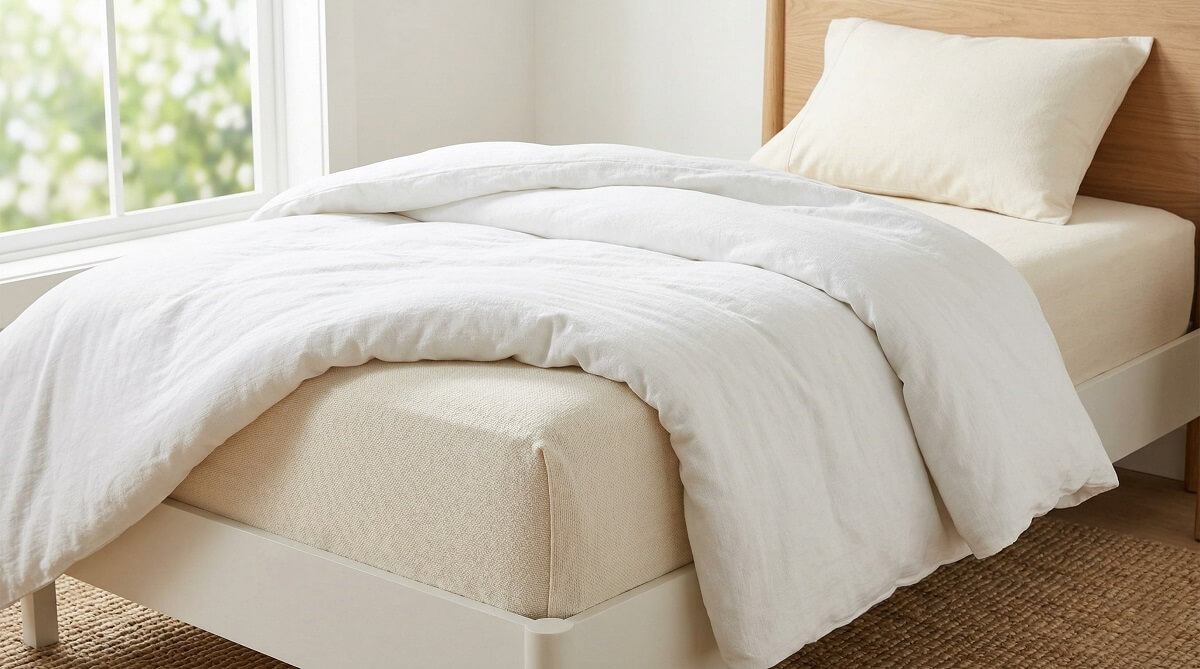
If you’re shopping for organic cotton twin sheets, one thing matters more than thread count, brand name, or price: the certification. Specifically, look for GOTS — the Global Organic Textile Standard. Without a GOTS or OEKO-TEX label, the word “organic” on a sheet package is marketing language with no regulatory teeth. Most shoppers do fine with a 300-400 thread count percale set in the $40-$80 range from a certified brand — see our bedding buying guides for a broader look at what to prioritize.
One thing that catches people off guard: Twin and Twin XL are not interchangeable. A standard twin mattress is 38 inches wide and 75 inches long. A Twin XL runs the same width but stretches to 80 inches — the size used in most college dorm beds. Buying the wrong size is one of the most common return reasons in this category, so measure your mattress before you order anything.
Quick summary: If you need sheets for a standard twin (kids’ room, guest bed), any GOTS-certified set in the $40-$60 range gets the job done. If it’s for a college dorm, you almost certainly need Twin XL. And if sensitive skin or allergies are a factor, it’s worth spending a bit more on a brand with both GOTS and MADE SAFE certifications — Avocado Green Mattress and Coyuchi are the two names that come up most consistently.
Who Should (and Shouldn’t) Buy Organic Cotton Twin Sheets
✅ Best For
- College students outfitting a dorm room (measure first — most dorms use Twin XL)
- Parents buying for a child’s bedroom, especially kids with eczema or sensitive skin
- Hot sleepers who want breathable, chemical-free bedding that won’t trap heat
- People with allergies or asthma who want to reduce their pesticide and chemical exposure
- Eco-conscious shoppers who want verified sustainable sourcing — not just marketing claims. Check our buying guides for what certifications to look for across different product categories.
❌ Skip If
- You’re working with a budget under $25 — certified organic at that price point is nearly impossible to find
- You use bleach or fabric softeners regularly (bleach degrades organic cotton fibers and undermines the chemical-free benefit)
- You want silky sateen feel at a low price — budget organic cotton bedding typically comes in percale, which feels crisp rather than smooth
Twin vs. Twin XL: Get the Size Right Before You Order
Most sheet-buying mistakes in this category come down to size, so let’s clear it up first.
Standard Twin Dimensions
A standard twin mattress is 38 inches wide and 75 inches long, according to Sleep Foundation’s mattress size guide. That’s the typical size for a child’s bed, a daybed, or a basic guest room. Sheets labeled “Twin” fit mattresses up to 75 inches long.
Twin XL Dimensions
Twin XL shares the same 38-inch width but adds 5 inches of length, reaching 80 inches total. That extra length is why most college dormitories use Twin XL beds: it fits taller students without bumping up to a full or queen, which wouldn’t suit standard dorm room layouts. When shopping for a dorm, assume Twin XL unless the school’s housing office specifies otherwise.
How to Tell Which Size You Have
Check your existing sheet label — the size is usually printed there. If you’re starting from scratch, measure the mattress itself (not the bed frame). Run a tape measure along the longest side. 75 inches or under: standard Twin. 76-80 inches: Twin XL. When in doubt, go Twin XL — a slightly longer fitted sheet won’t cause any issues, but a sheet that’s too short will pop off the corners constantly.
What “Organic Cotton” Actually Means on a Sheet Label
“Organic cotton” is regulated — but only when accompanied by a certification. Without a third-party label like GOTS, a brand can use “organic” loosely to imply eco-friendliness without meeting any specific standard.
Conventional vs. Organic: The Real Difference
Conventional cotton is one of the most pesticide-intensive crops in agriculture. Organic cotton grows without synthetic pesticides, herbicides, or fertilizers. That distinction matters for the environment and for the farmers who grow it. What it doesn’t automatically guarantee: that the finished sheet is free of chemical dyes, bleaches, or processing agents — which is exactly why the manufacturing side of the certification matters as much as the farming side.
Certifications That Actually Matter
Here’s a rundown of the labels you’ll encounter on organic cotton sheets:
- GOTS (Global Organic Textile Standard): The gold standard. It covers the entire supply chain — from the farm to the finished product. To carry the “organic” GOTS label, a sheet must contain at least 95% certified organic fibers, according to global-standard.org. Manufacturing must meet strict environmental and social standards, and annual onsite inspections are mandatory. This is the label to look for.
- OEKO-TEX STANDARD 100: Tests the finished textile for harmful substances — dyes, heavy metals, formaldehyde — but does not regulate farming practices. A sheet can carry OEKO-TEX while using conventionally grown cotton. Useful to see, but not the same as GOTS.
- MADE SAFE: Screens for more than 6,500 harmful substances, including some not covered by GOTS. Avocado Green Mattress carries this alongside GOTS, making it one of the more thoroughly verified options available.
- “Natural,” “eco-friendly,” or “clean” without any cert: No regulatory definition. Treat these as marketing language until you see a third-party label next to them.
The Thread Count Problem
Thread count measures the number of threads woven into one square inch of fabric. Higher isn’t always better — in the organic cotton category particularly, it’s often inflated. Many manufacturers use multi-ply construction, twisting threads together before weaving to artificially boost the number. A 600 thread count multi-ply sheet can feel coarser than a single-ply 300 TC sheet made from extra long staple cotton.
For organic cotton, the practical range is 200-400 thread count, single-ply. Avocado Green Mattress offers a genuine 400 TC single-ply and a 600 TC two-ply option — and is transparent about the difference. When a brand only lists thread count without clarifying construction type, that’s worth noting. Our bedding guides go deeper on this if you want the full breakdown.
Percale vs. Sateen: Which Weave Works for You?
The weave choice has a bigger impact on how sheets feel day-to-day than most buyers expect. Both options use the same cotton fiber — the difference is purely in how it’s constructed.
| Feature | Percale | Sateen |
|---|---|---|
| Feel | Crisp, cool, matte | Silky, smooth, slight sheen |
| Best for | Hot sleepers, warm climates | Year-round, cooler climates |
| Wrinkles | Wrinkles more easily | Less prone to wrinkling |
| Durability | Generally more durable long-term | Slightly less durable over time |
| Budget options | More widely available at lower prices | Often skews slightly higher in cost |
Hot sleepers almost always do better with percale. Sateen’s tighter weave feels more luxurious initially but retains more heat — an issue if you already run warm at night. Most budget organic cotton options come in percale, which is why they can feel crisp straight out of the wash. That’s not a defect; it’s the weave doing its job.
The Best Organic Cotton Twin Sheets in 2026
These brands show up consistently in independent testing and certification reviews. Prices are approximate and shift with promotions — check current listings before buying.
| Brand | Certification | Thread Count | Weave | Approx. Twin Price | Best For |
|---|---|---|---|---|---|
| Lane Linen | GOTS | 300–400 | Percale | ~$30–$50 | Budget buyers, dorm rooms |
| Whisper Organics | GOTS + Fair Trade | 300–500 | Sateen | ~$40–$65 | Budget-to-mid, sateen preference |
| Coyuchi | GOTS + Fair Trade | 300 | Percale | ~$120–$150 | Eco-purists, hot sleepers |
| Avocado Green | GOTS + MADE SAFE | 400 or 600 | Sateen | ~$130–$180 | Sensitive skin, allergy-prone |
| Brooklinen Organic | GOTS | Long-staple | Percale | ~$229 | Quality-first, 365-night trial |
| Boll & Branch | GOTS + Fair Trade + OEKO-TEX | 300 | Percale/Hemmed | ~$228–$279 | Luxury, heirloom durability |
Budget Pick: Lane Linen or Whisper Organics
For shoppers who want GOTS certification without a premium price tag, Lane Linen and Whisper Organics are the most accessible options on Amazon and Walmart. Lane Linen’s percale sets run roughly $30-50 for a twin set; Whisper Organics sateen sets land in the $40-65 range. Neither will feel like a five-star hotel, but both are GOTS certified, come in multiple colors, and hold up well through regular washing.
Best Overall: Coyuchi
Coyuchi earns the top spot from most independent reviewers — The Good Trade named it best overall, a consistent ranking across multiple years. Their 300 TC percale is GOTS and Fair Trade certified, with full supply chain traceability. Crisp, breathable, and durable. Twin XL sets are available through coyuchi.com and Amazon. Queen sets run about $198; twin pricing is typically lower — check current listings for the exact figure.
Best for Sensitive Skin: Avocado Green Mattress
Avocado holds both GOTS and MADE SAFE certifications — the MADE SAFE label screens for over 6,500 harmful substances, including pesticides and dyes that GOTS alone doesn’t cover. Their linens are pre-washed and pH-balanced, making them a strong choice for anyone dealing with eczema or chemical sensitivities. The 400 TC single-ply sateen is the one worth choosing (true thread count, not inflated). Twin pricing falls in the $130-$180 range depending on the set configuration.
Premium Pick: Boll & Branch or Brooklinen Organic
Independent testing by Sleep Foundation placed both Brooklinen Organic Core (~$229 twin) and Boll & Branch Signature Hemmed (~$228-$279 twin) at the top for feel and durability. Boll & Branch carries GOTS, Fair Trade, and OEKO-TEX — about as thoroughly certified as it gets in this category. Brooklinen’s Organic Core includes a 365-night trial, which is unusually generous. If you’re spending $200+ on a twin set, these are the two to compare. See our reviews section for more detailed testing notes.
Is Organic Cotton Worth the Extra Cost?
The honest answer depends on why you’re buying.
Where It Makes Sense
Kids’ rooms are the strongest case. Children spend proportionally more time in bed, and their skin absorbs chemical residues more readily than adult skin. A GOTS-certified set from Lane Linen at $40-50 is a practical choice that doesn’t demand a big budget stretch. For adults with allergies, asthma, or skin sensitivities, reducing the chemical load in bedding can make a real difference — especially if conventional sheets have triggered reactions before. Our how-to guides cover more on building an allergy-friendly sleep setup.
Where It’s Less Critical
A guest room set that gets used a few times a year presents a stronger environmental case than a personal health one. And if the budget genuinely won’t stretch past $25 for a full twin set, you’re better off with a well-reviewed conventional set than a suspiciously cheap “organic” label without any third-party verification behind it.
How to Care for Organic Cotton Sheets (Without Ruining Them)
Organic cotton sheets aren’t fragile, but they respond predictably to temperature and detergent choices. Follow these steps and they’ll stay soft and hold their dimensions for years.
First Wash
Always wash new sheets before use. Organic cotton is typically not pre-shrunk, so the first run through the washer gets the fabric to its final size. Adding about a cup of white vinegar on the first cycle helps set the color and flushes out any residual processing chemicals from the mill, according to Whisper Organics’ care guide.
Expected Shrinkage
Plan for 3-5% shrinkage after the first wash under normal conditions. High heat drying can push that closer to 10%, according to Sleep365’s organic cotton care guide. For a twin fitted sheet, 3-5% is usually negligible. At 10%, you may notice corner pull-off on a deep-pocket mattress.
Ongoing Care
- Wash in cold or warm water — not hot. Keep temperatures below 104°F to prevent excessive shrinkage.
- Use a mild liquid detergent. Bleach breaks down cotton fibers faster and strips the organic benefit you paid for.
- Tumble dry on low heat, or line dry. High heat is the primary cause of premature wear.
- Organic cotton sheets do get noticeably softer with each wash — this is genuine, not marketing copy. Extra long staple cotton breaks in over 3-5 cycles and improves from there.
Frequently Asked Questions
Are organic cotton sheets really worth the extra cost?
For kids’ rooms and allergy-prone sleepers, yes. For a guest room used occasionally, the environmental argument is stronger than the personal health case. The key factor is buying certified — a GOTS label on a $45 Lane Linen set gives you more real assurance than a $150 “organic” set with no third-party verification. Browse our how-to guides for more on evaluating bedding claims.
What is GOTS certification and why does it matter?
GOTS (Global Organic Textile Standard) is the most comprehensive certification for organic textiles. It covers the full supply chain — from the farm where cotton is grown to the factory where sheets are stitched. To carry the “organic” GOTS label, a product must contain at least 95% certified organic fibers, and the manufacturer must pass annual onsite audits by an independent certification body. Without GOTS, “organic” on a sheet label has no regulatory meaning.
What’s the difference between Twin and Twin XL sheets?
Standard twin sheets fit mattresses up to 75 inches long (38″ x 75″). Twin XL fits 80-inch mattresses (38″ x 80″). Most college dorm beds are Twin XL. Measure your mattress before ordering — getting the size wrong is the most common return reason for twin sheet sets.
Are organic cotton sheets good for hot sleepers?
Yes, especially in percale weave. Percale’s looser construction allows more airflow than sateen, which makes it a better pick for people who run warm at night. Organic cotton also moves moisture away from the body more effectively than most synthetic fabrics.
How do I wash organic cotton sheets without shrinking them?
Use cold or warm water (under 104°F). Tumble dry on low, or line dry. Avoid high heat settings. Expect 3-5% shrinkage on the first wash regardless — that’s standard for non-pre-shrunk cotton and typically isn’t enough to affect fit on a standard twin.
Do organic cotton sheets get softer over time?
Yes. Sheets made from extra long staple organic cotton become noticeably softer after several washes. If they feel stiff at first, run them through 3-5 cycles before forming an opinion — the improvement is real.
Are organic cotton sheets safe for babies and young children?
GOTS-certified organic cotton is widely used in nurseries and kids’ rooms. For infant beds specifically, look for sheets made for crib or toddler mattresses rather than standard twin sets — the fit requirements are much stricter for safety reasons. Brands like Makemake Organics and Natemia specialize in GOTS-certified kids’ and baby bedding.
What thread count should I look for in organic cotton sheets?
In the 200-400 range, single-ply. Higher thread counts in organic sheets are typically achieved through multi-ply construction — threads twisted together to inflate the number without improving feel. A genuine 300 TC single-ply sheet from extra long staple cotton almost always feels better than a 600 TC multi-ply sheet made from shorter fibers.
Check current prices at Amazon, or shop directly through Coyuchi, Avocado Green Mattress, and Boll & Branch for their full twin and Twin XL collections. Prices on certified organic bedding move significantly with seasonal promotions — major holidays typically bring the steepest discounts on the pricier sets.
Browse more bedding buying guides on ChubbytIps, including coverage on pillow fills, mattress protectors, and duvet options.
