


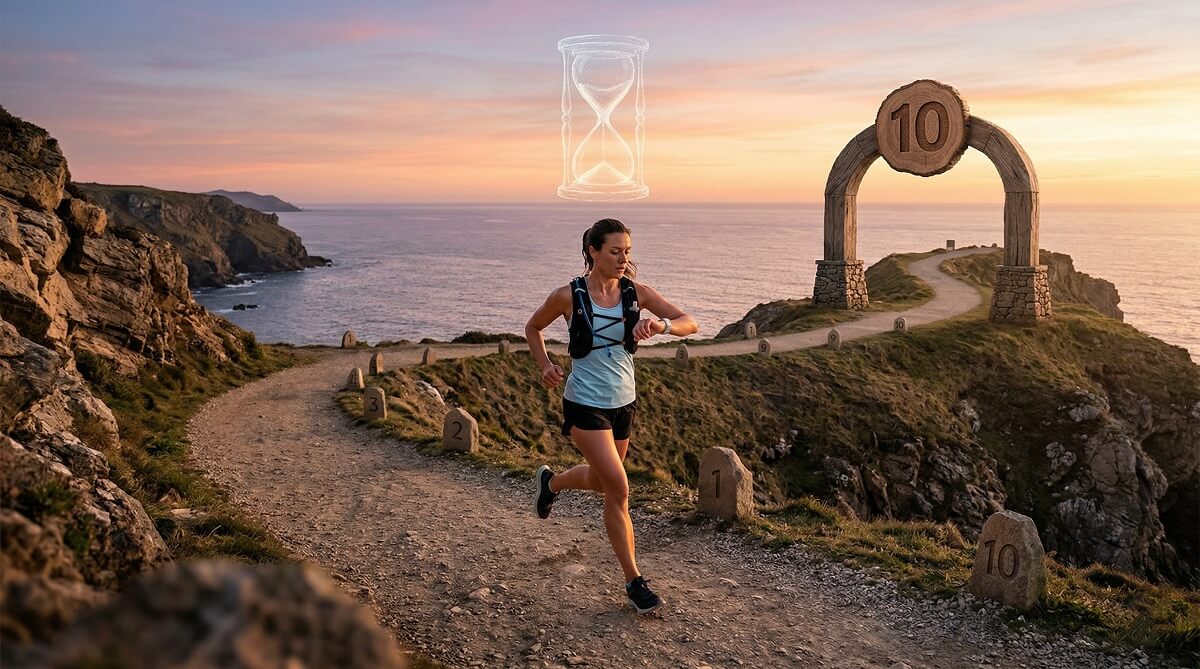
For most recreational runners, 10 miles takes somewhere between 1 hour 15 minutes and 2 hours to complete. The exact time depends heavily on your current fitness, pace, terrain, and conditions — but if you’re a typical recreational runner logging miles on Strava, you’re probably looking at close to 1 hour 38 minutes. That’s based on an average training pace of around 9:53 per mile, which Marathon Handbook cites from Strava’s aggregate data across millions of logged runs.
For context: 10 miles equals roughly 16.1 kilometers. If you ran on a standard 400-meter track, you’d complete a little over 40 laps. It’s a genuine endurance effort — longer than three 5K races back to back — and it requires consistent preparation to handle comfortably. But once you’ve built the base, it’s a deeply satisfying distance to own. For more fitness guides, browse .
Is a 10-Mile Run Right for You Right Now?
✅ Good Fit If You:
- Already run 5–6 miles comfortably without stopping
- Have been training consistently for at least 4 months
- Want a solid long-run workout or are targeting a 10-mile race
- Are building toward a half marathon
❌ Hold Off If You:
- Can’t currently cover 5 miles without stopping to walk
- Started running in the past month or two
- Don’t yet have a weekly base of at least 15 miles
How Long Does It Take to Run 10 Miles at Different Paces?
The simplest way to estimate your 10-mile time is to know your current mile pace. Take that number and multiply by 10. The table below covers the range where most runners fall — from a brisk walk-run to a strong recreational pace.
| Pace (min/mile) | Speed (mph) | 10-Mile Finish Time |
|---|---|---|
| 15:00 | 4.0 | 2:30:00 |
| 13:20 | 4.5 | 2:13:20 |
| 12:00 | 5.0 | 2:00:00 |
| 11:00 | 5.5 | 1:50:00 |
| 10:00 | 6.0 | 1:40:00 |
| 9:00 | 6.7 | 1:30:00 |
| 8:34 | 7.0 | 1:25:43 |
| 8:00 | 7.5 | 1:20:00 |
| 7:30 | 8.0 | 1:15:00 |
| 7:00 | 8.6 | 1:10:00 |
| 6:40 | 9.0 | 1:06:40 |
| 6:00 | 10.0 | 1:00:00 |
The sweet spot for most recreational runners is somewhere between 9:00 and 11:00 per mile — putting the completion time in the 1:30 to 1:50 range. If you’re not sure of your current pace, a short 1-mile time trial or a few weeks of logged outings on a GPS watch or phone app will give you a solid baseline. See also our if you’re shopping for a GPS watch.
Average 10-Mile Run Times by Ability Level
Running Level maintains a large database of race times and uses them to define ability tiers from Beginner through Elite. According to their standards, the overall average 10-mile finish time across all ages and genders is 1:22:34. Here’s how that breaks down by ability for the peak age range (20–35).
Men (Ages 20–35)
| Ability | Faster Than | Finish Time | Pace (min/mile) |
|---|---|---|---|
| Beginner | 5% of runners | ~1:48–1:50 | ~10:53–11:00 |
| Novice | 20% of runners | ~1:30–1:31 | ~9:05–9:08 |
| Intermediate | 50% of runners | 1:17:32 | 7:45 |
| Advanced | 80% of runners | 1:07:48 | 6:47 |
| Elite | 95% of runners | 1:00:39 | 6:04 |
Women (Ages 25–30)
| Ability | Faster Than | Finish Time | Pace (min/mile) |
|---|---|---|---|
| Beginner | 5% of runners | ~2:02–2:03 | ~12:15–12:16 |
| Novice | 20% of runners | ~1:44–1:44 | ~10:25 |
| Intermediate | 50% of runners | 1:30:04 | 9:00 |
| Advanced | 80% of runners | 1:19:27 | 7:57 |
| Elite | 95% of runners | 1:11:30 | 7:09 |
Data sourced from Running Level’s 10-mile standards database. Note that times slow gradually from age 35 onward, though the decline is modest until the 50s.
7 Factors That Affect How Long It Takes to Run 10 Miles
Two runners with the same age and body weight can cover 10 miles 30 minutes apart. These are the variables that matter most. For deeper guidance on conditioning and workouts, browse .
1. Your Current Fitness Base
Cardiovascular fitness — measured by VO2 max and your aerobic threshold — is the biggest lever. Runners who have trained consistently for a year or more will carry a far larger aerobic engine into a 10-miler than someone who started a few months ago. There’s no shortcut here; the base takes time to build.
2. Running Experience and Pacing Skill
Experience teaches you how to distribute effort over a longer distance. Newer runners often start too fast, pay for it in miles 6–10, and finish much slower than their early pace suggested. Runners with a few years under their belt instinctively know when to hold back in the first half.
3. Terrain — Road, Trail, and Treadmill
Road running on flat pavement is your fastest option. Trails add technical footing, roots, and hills that slow you down by 10–20% or more depending on the terrain. Treadmill running, by contrast, tends to be slightly easier than outdoor running because the belt assists foot turnover and there’s no wind resistance — most runners find they run roughly the same pace or slightly faster on a treadmill at the same perceived effort.
4. Weather and Temperature
Running performs best in cool conditions — roughly 44–59°F is considered optimal for endurance. According to research cited by Outside Online, runners slow down approximately 1.7–4.5% for every 9°F rise above 41°F. On a hot, humid 85°F day, you could easily be running 30–60 seconds per mile slower than your cool-weather pace — that adds up to 5–10 extra minutes over 10 miles.
5. Age
Peak running performance typically occurs between ages 20–35. After that, a gradual decline sets in — driven by natural decreases in muscle mass (sarcopenia) and VO2 max. The good news: the drop-off is slow. A fit 50-year-old runner’s 10-mile time is usually only 10–15 minutes slower than their 30-year-old self at comparable training levels.
6. Sex
On average, men run faster than women at every distance — a difference that typically works out to 10–15% across the ability spectrum. This reflects differences in average lean body mass and heart/lung size. At the recreational level, individual fitness and training history matter far more than sex.
7. Your Effort Level
A training run at conversational pace versus a race-effort 10-miler are entirely different experiences. Most runners can push 1–2 minutes per mile faster in a race than in daily training. If you’re estimating your 10-mile finish time for a race, subtract 60–90 seconds from your typical training pace as a starting estimate.
How Many Calories Do You Burn Running 10 Miles?
Running is one of the higher calorie-burning activities you can do. The estimates below use the standard exercise science MET formula (metabolic equivalent × body weight × duration) at a 10:00/mile pace. Faster paces burn slightly fewer calories per mile because the run takes less time, though the total is comparable.
| Body Weight | Approx. Calories Burned (10 miles) |
|---|---|
| 130 lbs (59 kg) | ~960 calories |
| 150 lbs (68 kg) | ~1,100 calories |
| 175 lbs (79 kg) | ~1,290 calories |
| 200 lbs (91 kg) | ~1,490 calories |
These are estimates based on running on flat terrain at a moderate pace. Actual burn varies with your individual metabolism, incline, and running efficiency. Use a running calorie calculator with your exact weight and pace for a more precise figure. At these mileage levels — especially anything approaching two hours — fueling with carbohydrates during the run is worth considering to maintain performance in the final miles.
Notable 10-Mile Races in the United States
Ten-mile road races are less common than 5Ks or half marathons, but a handful of prestigious events stand out on the national calendar. They’re a worthwhile goal if you want to test your 10-mile conditioning on a measured course with competition energy. For race preparation tips, check our .
Independence Blue Cross Broad Street Run — Philadelphia, PA
This is the largest 10-mile race in the United States, drawing over 40,000 participants each year. Held in early May, the course runs straight down Philadelphia’s Broad Street from north to south, finishing at the Navy Yard. According to the official race website, runners must maintain at least a 15:00/mile pace. The 2025 men’s winner, Joshua Izewski, clocked 46:13 — the 2026 race is scheduled for May 3, 2026.
Credit Union Cherry Blossom Ten Mile Run — Washington, DC
One of the most scenic spring races in the country, the Cherry Blossom Ten Mile Run is held every April at the Washington Monument Grounds. The 2026 edition is set for April 12. The race has been run since 1973 and draws competitive fields alongside thousands of recreational runners.
Bix 7 — Davenport, IA
Technically 7 miles, but worth mentioning for runners looking for a challenging mid-distance road race in the Midwest. Many regional running series also include 10-mile events — check local race calendars for events near you.
How to Build Up to Running 10 Miles
If 10 miles is further than you’ve gone before, the path there is straightforward — it just takes patience. Most runners with a consistent base can add 10 miles as a long run within 8–12 weeks of focused training.
Start With a Solid Base
You should be running at least 3–4 days per week and covering at least 15–20 miles total before you attempt 10 in a single outing. Running on tired legs teaches your body nothing except how to get injured. If your longest single run is currently 5 miles, give yourself 6–8 weeks of gradual buildup before targeting 10.
Build Your Long Run Gradually
The classic “10% rule” — don’t increase weekly mileage by more than 10% — is a useful rough guideline, though Runners Connect notes that more recent research points to single-run spikes as the bigger injury driver. Specifically, completing any run that’s more than 30% longer than your longest recent run raises injury risk significantly. Extend your long run in 1–2 mile increments each week: 6 miles → 7 → 8 → 9 → 10.
Run Your Long Run Easy
Long runs shouldn’t be hard runs. Keep your long-run pace at least 60–90 seconds per mile slower than your 10K race pace. The goal is time on feet and aerobic adaptation, not speed. You should be able to hold a full conversation throughout.
Don’t Skip Recovery
The day after a 10-mile effort, take a rest day or do an easy walk. Your body adapts during recovery, not during the run itself. Compressing hard efforts back-to-back is the fastest way to end up sidelined.
Frequently Asked Questions
How long does it take a beginner to run 10 miles?
A beginner runner can expect to take between 1:45 and 2:30 for 10 miles, typically combining jogging and walking intervals. At a 13:00/mile walk-run pace, that’s about 2 hours 10 minutes. Most beginners need 3–6 months of consistent workouts before covering 10 miles without stopping. For a structured approach, our cover beginner fitness progressions.
What is a good 10-mile time for a man?
For men aged 20–35, finishing under 1:17:32 puts you at the intermediate level — faster than roughly half of all runners in that group, according to Running Level’s standards. A solid recreational goal is anywhere in the 1:20–1:35 range.
What is a good 10-mile time for a woman?
For women aged 25–30, 1:30:04 is the intermediate benchmark (faster than 50% of runners). A respectable finish for a recreational female runner is 1:35–1:55, depending on training level.
How long does 10 miles take at a 10-minute pace?
Exactly 1 hour 40 minutes. Ten miles × 10 minutes per mile = 100 minutes.
Is 10 miles considered a long run?
For most recreational runners, yes. Runners training for a half marathon or beyond often use 10-milers as a standard weekly long run. At the elite level, 10 miles is a moderate-length training day. For someone new to distance running, it’s a significant milestone.
How many calories do you burn running 10 miles?
Roughly 960–1,490 calories depending on body weight, based on standard MET calculations. A 150-pound runner burns approximately 1,100 calories; a 200-pound runner burns closer to 1,490. These figures assume flat terrain at a moderate pace.
Can I run 10 miles without any prior training?
Technically yes, but it’s not recommended. Without a running base, expect significant muscle soreness, a high walk-to-run ratio, and a meaningful injury risk in the days that follow. Most people who “push through” a 10-miler with no base spend the next week struggling to walk down stairs.
How does 10 miles compare to a half marathon?
A half marathon is 13.1 miles — 3.1 miles more than 10. At a 10:00/mile pace, that extra distance adds about 31 minutes. Ten miles is an excellent stepping stone when training for a half marathon.
To get a precise estimate for your current fitness level, use a free pace calculator or log a few weeks of workouts with a GPS watch or running app. Your average training pace multiplied by 10 gives a realistic 10-mile projection. If you’re targeting a race like the Broad Street Run or the Cherry Blossom Ten Mile, check the event website for minimum pace requirements and entry details. Browse more on ChubbytIps.
