


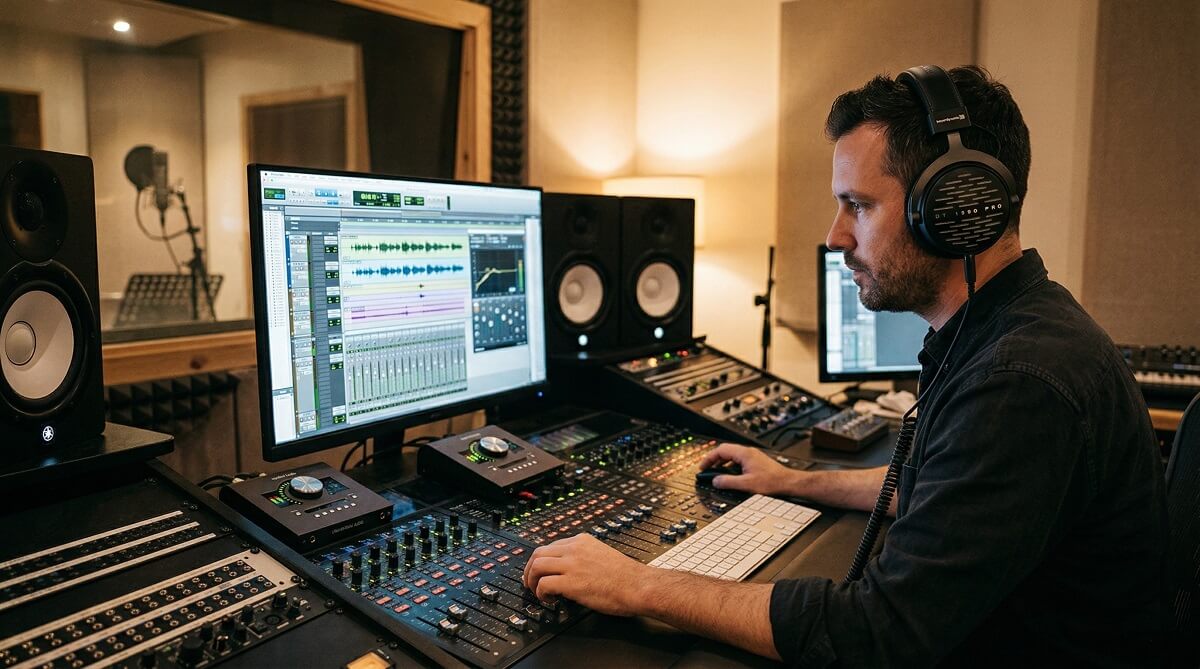
If you’re mixing music in a bedroom or home studio, a good pair of headphones will improve your mixes faster than almost any other upgrade. The reason is simple: most untreated rooms introduce enough low-end buildup, flutter echo, and comb filtering to make even expensive monitors unreliable. Headphones sidestep the room entirely. The tricky part is knowing which ones to trust.
Here are the picks that hold up in real sessions. For most producers working in the $300–$500 range, the Sennheiser HD 600 (~$299.95) or the Sony MDR-MV1 (~$400) are the two strongest options. Step up to the $400–$700 range and the Audeze MM-100 ($399) and Neumann NDH 30 (~$649) are hard to beat for neutral, trustworthy monitoring. If budget isn’t the main constraint, the Audeze MM-500 ($1,699) sits at the top of the pile for professional work.
One thing worth knowing upfront: professional mixers — including multi-platinum engineers like Manny Marroquin and Andrew Scheps — have moved toward headphone-based monitoring because the results translate. What was once considered a workaround is now a legitimate workflow. These recommendations are built around that reality.
Who Should (and Shouldn’t) Use Headphones for Mixing
✅ Best For
- Home studio producers working in untreated or semi-treated rooms
- Engineers who mix late at night or in shared living spaces
- Musicians who track and mix in the same session without switching gear
- Podcasters and voice-over artists who need clean, accurate monitoring
- Producers on a budget who can’t yet afford full acoustic treatment
❌ Skip If
- You already work in a professionally treated control room with calibrated monitors
- You need to check surround or spatial audio — headphone stereo has limits
- You’re recording live instruments and need total sound isolation (open-back headphones leak; use closed-back for tracking)
- You’re sharing a mix session live with a client in the room
Why Your Room Matters More Than Your Speakers — And How Headphones Help
Most people upgrading their studio gear focus on monitors. The room those monitors sit in gets treated as an afterthought. That’s backward. The acoustic properties of a space — standing waves, reflections, and low-end cancellation — have a bigger impact on what you hear than the speakers themselves.
Getting a home studio room to a point where monitors are genuinely useful typically costs $1,000–$3,000 in acoustic treatment, and even then you’re working against geometry that was never designed for audio. A $300–$700 pair of headphones bypasses all of that. The floor isn’t bouncing bass frequencies back at you. The corners aren’t adding resonances. What you hear is what’s in the file.
That doesn’t make headphones a perfect solution. Stereo imaging works differently on headphones than speakers, and mixes should always be checked across multiple playback systems. But as a primary reference — especially in an untreated space — a well-chosen pair of headphones is a genuinely practical tool, not a compromise.
Open-Back vs. Closed-Back: Which Works Better for Mixing?
Almost every recommendation on this list is open-back. There’s a straightforward reason for that.
Open-Back Headphones
Open-back designs allow air to pass through the ear cups, which reduces resonance and gives the sound a more natural, speaker-like quality. Stereo image is wider and more accurate. Ear fatigue sets in later during long sessions. For stationary studio mixing, these are the go-to option.
The tradeoff: they leak sound in both directions. Someone in the same room will hear what you’re monitoring, and ambient noise bleeds in. Open-backs are designed for quiet studio environments.
Closed-Back Headphones
Closed-back designs isolate you from the room, which makes them better for tracking (recording while wearing them) or working in louder environments. The enclosed design can cause bass to accumulate slightly, making them less ideal as a primary mixing reference.
Good closed-back options for mixing-adjacent tasks: the Beyerdynamic DT 1770 Pro, the Austrian Audio Hi-X60, and the Sony MDR-7506 (a tracking standard in recording studios for decades). For mixing specifically, open-back is the clearer choice.
Best Headphones for Sound Mixing — Picks by Budget
Under $350 — Sennheiser HD 600
The Sennheiser HD 600 has been a professional studio standard for decades, and the reason is simple: the midrange is exceptionally neutral and honest. You hear what’s actually there, without the hyped lows or exaggerated highs that make cheaper cans sound exciting but unreliable for critical listening.
The HD 600’s weakness is sub-bass — below around 80–100Hz, there isn’t much information. If your music is bass-heavy, you’ll want a separate reference for low-end checks (a subwoofer, a car stereo, a good portable speaker). For mids and highs, these are hard to beat at the price.
Impedance is 300Ω, which means they’re on the quieter side plugged directly into a phone or tablet. Pair them with an audio interface (which any recording setup should already have) and they’re fine. A dedicated headphone amp isn’t necessary but does help.
Current price: $299.95 at the Sennheiser US store (check current pricing — this has fluctuated).
~$400 — Sony MDR-MV1
Sony’s MDR-MV1 was designed specifically for mixing and mastering, and it shows. The frequency response runs from 5 Hz to 80,000 Hz with a 40mm driver and a relatively low 24Ω impedance — meaning it drives easily off any audio interface without a dedicated amp.
At 223g (7.87 oz) without the cable, these are the lightest open-back mixing headphones on this list by a significant margin. Engineers who mix for four-to-eight-hour stretches will notice that. The sound is engaging without being hyped: detailed highs, usable low end, and a slight openness that makes long sessions less fatiguing.
Sony also built in support for their 360VME (Virtual Mixing Environment) platform, which uses HRTF measurements to simulate studio speaker setups in headphones. This is a niche feature, but worth knowing if spatial audio is part of your workflow.
~$399 — Audeze MM-100
Planar magnetic headphones use a fundamentally different driver design than dynamic headphones, and the difference shows most clearly in low-end accuracy. The Audeze MM-100 at $399 is the most accessible entry point into planar magnetic monitoring for mixing.
Developed alongside Grammy-winning mixer Manny Marroquin, the MM-100 targets production-grade accuracy at a price that was previously impossible for planar magnetics. The low end is more defined and less resonant than most dynamic headphones at this price — useful for producers working on electronic music, hip-hop, or anything where bass translation matters.
Current price: $399 at Audeze. Check Amazon for current availability with the affiliate link: Audeze MM-100 on Amazon.
~$649 — Neumann NDH 30
Neumann makes microphones that recording engineers trust implicitly. The NDH 30 carries that same philosophy into headphone design: accuracy first, comfort second, aesthetics a distant third.
The specs reflect this. Impedance is 120Ω — manageable with most interfaces. THD is less than 0.03% at 100dB SPL. Frequency response runs from 12Hz to 34kHz. Weight is 352g, which is heavier than the Sony but distributed well enough that the fatigue is minimal during long sessions.
What makes the NDH 30 stand out in practice is the midrange. It’s detailed, forward, and unforgiving in a way that’s genuinely useful — the headphone equivalent of putting your mix through a small mono speaker to hear exactly how the important frequencies sit. If your mids are muddy or your vocals are buried, these cans will tell you immediately. That’s the point.
~$500–$550 — Beyerdynamic DT 1990 Pro
For engineers who want solid build quality, long-term comfort, and a sound that’s revealing without being clinical, the Beyerdynamic DT 1990 Pro is a strong choice. The design is built to last — replaceable ear pads, a cable that actually stays in place, and a headband that doesn’t creep down during a session.
The frequency response has a slight emphasis in the upper-mid and high frequencies, which some engineers find encouraging (it pushes you toward brighter, more forward mixes) and others find less useful (it can mask harshness in the 4–5kHz range). Whether that suits your mixing habits is personal. These are typically priced around $500–$550 — check current pricing at Amazon.
~$1,199 — Focal Clear Pro MG
The Focal Clear Pro MG earns its place on this list on two fronts: comfort and build quality. These are genuinely pleasant to wear for extended sessions in a way that heavier options like the Neumann or Audeze aren’t. The design is also notably more refined — lighter ear cups, a cleaner headband, and a finish that doesn’t look like lab equipment.
The sound is smooth and detailed, with strong low end and a slight softness around 3kHz that makes them non-fatiguing over long stretches. The tradeoff is that same softness can slightly underrepresent harshness in that region — if you tend to boost upper mids aggressively, the Clear Pro MG won’t push back on that as much as the Neumann or Audeze would. Worth knowing before buying. Typical pricing is around $1,000–$1,200; check current prices before purchasing.
$1,699 — Audeze MM-500
The MM-500 is where the tradeoffs stop. Also designed with Manny Marroquin, these planar magnetic cans deliver what reviewers consistently describe as the closest thing to sitting in front of calibrated studio monitors — specifically in the low end, where most pairs fall short.
At $1,699, they’re not for everyone. But for working engineers who spend real hours behind a DAW, the return on that investment shows up in mixes that translate consistently across different playback systems. The low-end information is accurate enough that mastering decisions made on these headphones hold up off of them.
Current price: $1,699 at Audeze · Check on Amazon.
Quick Comparison: Best Headphones for Mixing
| Model | Type | Approx. Price | Impedance | Best For |
|---|---|---|---|---|
| Sennheiser HD 600 | Open-back dynamic | $299.95 | 300Ω | Flat mids/highs reference, entry-pro |
| Sony MDR-MV1 | Open-back dynamic | ~$400 | 24Ω | Long sessions, lightweight, low-impedance |
| Audeze MM-100 | Open-back planar | $399 | 18Ω | Low-end accuracy, planar entry point |
| Neumann NDH 30 | Open-back dynamic | ~$649 | 120Ω | Flat, honest, midrange-focused reference |
| Beyerdynamic DT 1990 Pro | Open-back dynamic | ~$500–$550 | 250Ω | Build quality, comfort, long-term use |
| Focal Clear Pro MG | Open-back dynamic | ~$1,000–$1,200 | 55Ω | Comfort, style, extended sessions |
| Audeze MM-500 | Open-back planar | $1,699 | 18Ω | Pro mixing/mastering, top-tier accuracy |
Prices as of March 2026 — check current pricing before purchasing.
Do You Need a Headphone Amp?
The short answer for most home studio setups: probably not. A standard audio interface — a Focusrite Scarlett, an Apollo Solo, a Behringer UMC202 — puts out enough power to drive most of the headphones on this list at usable volumes.
Where impedance matters: the Sennheiser HD 600 at 300Ω and the Beyerdynamic DT 1990 Pro at 250Ω are the two picks that benefit most from a dedicated headphone amp. You’ll notice the difference in dynamic range and authority at the low end. They’ll still work off an interface, but a headphone amp brings out more of what they can do.
The low-impedance options — Sony MDR-MV1 at 24Ω, Audeze MM-100 at 18Ω, Audeze MM-500 at 18Ω — drive easily off almost anything, including a laptop’s headphone output in a pinch. No amp needed.
The Neumann NDH 30 at 120Ω sits in the middle — it works well off a good interface, though a headphone amp improves clarity. The Focal Clear Pro MG at 55Ω is interface-friendly as well.
Should You Use Headphone Calibration Software?
Calibration software like Sonarworks SoundID Reference measures your specific pair of headphones (or uses a pre-measured profile from their library of 500+ supported models) and applies a correction curve to make the response flatter and more predictable.
The headphones-only plan is currently priced at approximately €69–€99 depending on sales (around $75–$110 USD — check current pricing). It works as a DAW plugin or a system-wide audio processor on macOS 11+ and Windows 10/11, with a 21-day free trial available.
Whether it’s worth it depends on your headphones. Models with already flat response (the Neumann NDH 30, the Sennheiser HD 600) benefit less. Models with a distinctive sonic character (the Focal Clear Pro MG’s 3kHz dip, the Beyerdynamic’s upper-mid lift) benefit more — calibration can flatten those tendencies and make them easier to mix on confidently.
It’s not a requirement. But it’s a relatively inexpensive way to get more reliable results out of headphones you already own or are planning to buy.
Frequently Asked Questions
What’s the difference between studio headphones and regular consumer headphones?
Studio headphones are tuned for accuracy. Consumer headphones are typically tuned for enjoyment — boosted bass, hyped highs, a “fun” sound. That V-shaped EQ curve sounds good for music listening but actively misleads you when mixing. You’ll end up compensating for a sound profile that only exists in your headphones, and the mix will fall apart on other playback systems. Studio headphones aim to show you what’s actually in the recording, not what sounds exciting.
Can you actually mix professionally on headphones?
Yes — and increasingly, working professionals do. Multi-platinum mixing engineers including Manny Marroquin and Andrew Scheps have moved toward headphone-based monitoring. High-end mastering engineers like Glenn Schick work in headphones as well. The key is using headphones designed for accurate monitoring (open-back, flat response) and cross-checking mixes on multiple playback systems before finalizing. The workflow is legitimate; the key is understanding the tools.
What impedance should I look for in mixing headphones?
Low impedance (under 50Ω) means the headphones are easy to drive and work fine with any audio interface or even a phone. High impedance (150–300Ω) means the headphones need more voltage to reach full dynamic range — they’ll work off an interface but benefit from a dedicated headphone amp. For home studio use without a headphone amp, the Sony MDR-MV1 (24Ω), Audeze MM-100 (18Ω), or Focal Clear Pro MG (55Ω) are the easiest options.
Are planar magnetic headphones worth the premium for mixing?
For bass-heavy music — electronic, hip-hop, pop production — yes, often. Planar magnetic drivers handle low-frequency transients more accurately than most dynamic drivers at a given price point. The Audeze MM-100 at $399 brings planar performance to a price where it’s a real consideration, not just a high-end luxury. The MM-500 at $1,699 is the top of that ladder. If your genre doesn’t rely heavily on low-end accuracy, a flat dynamic headphone like the Neumann NDH 30 may serve you just as well at a lower price.
What software helps with headphone mixing accuracy?
Sonarworks SoundID Reference is the most widely used option. It applies a correction curve to your headphones based on measured frequency response data from their library of 500+ models (or a personal measurement of your specific pair). It works as a DAW plugin or system-wide processor. There’s a 21-day free trial. Sony’s 360VME platform offers a similar approach specifically for the MDR-MV1, using HRTF measurements to simulate studio speaker environments.
Is the Sony MDR-7506 still a good mixing headphone?
The MDR-7506 is one of the most common tracking headphones in professional studios — for wearing while recording, not for mixing. It has a hyped upper midrange and treble that makes it useful for catching unwanted noise during recording but unreliable as a primary mixing reference. Engineers who’ve mixed on them for years can learn to compensate, but there are better options for mixing starting at $300. The MDR-MV1 is Sony’s actual answer to mixing headphones.
How long can you mix in headphones before ear fatigue?
This varies by headphone and individual. Open-back headphones generally cause less ear fatigue than closed-back, because the drivers aren’t sealed against your ear creating pressure. Volume is the bigger factor — mixing at 85dB or below significantly extends how long you can work accurately. With a flat, open-back pair at moderate levels, four-to-six-hour sessions are realistic. The Sony MDR-MV1 (223g) and Focal Clear Pro MG are the most comfortable options here for extended wear.
What closed-back headphones are best if I also need to record?
If you need isolation for tracking live instruments (where open-back headphones would bleed into microphones), the Beyerdynamic DT 1770 Pro is the closed-back equivalent of the DT 1990. The Austrian Audio Hi-X60 is a compact, reliable closed-back option. The Sony MDR-7506 — while not the best choice for mixing — remains a dependable tracking pair in professional studios worldwide.
Where to Buy
All of these headphones are available at major retailers. Sweetwater is worth checking for pro-audio specific recommendations and customer service. Amazon carries all of them as well:
- Sennheiser HD 600 on Amazon
- Sony MDR-MV1 on Amazon
- Audeze MM-100 on Amazon
- Neumann NDH 30 on Amazon
- Beyerdynamic DT 1990 Pro on Amazon
- Audeze MM-500 on Amazon
