


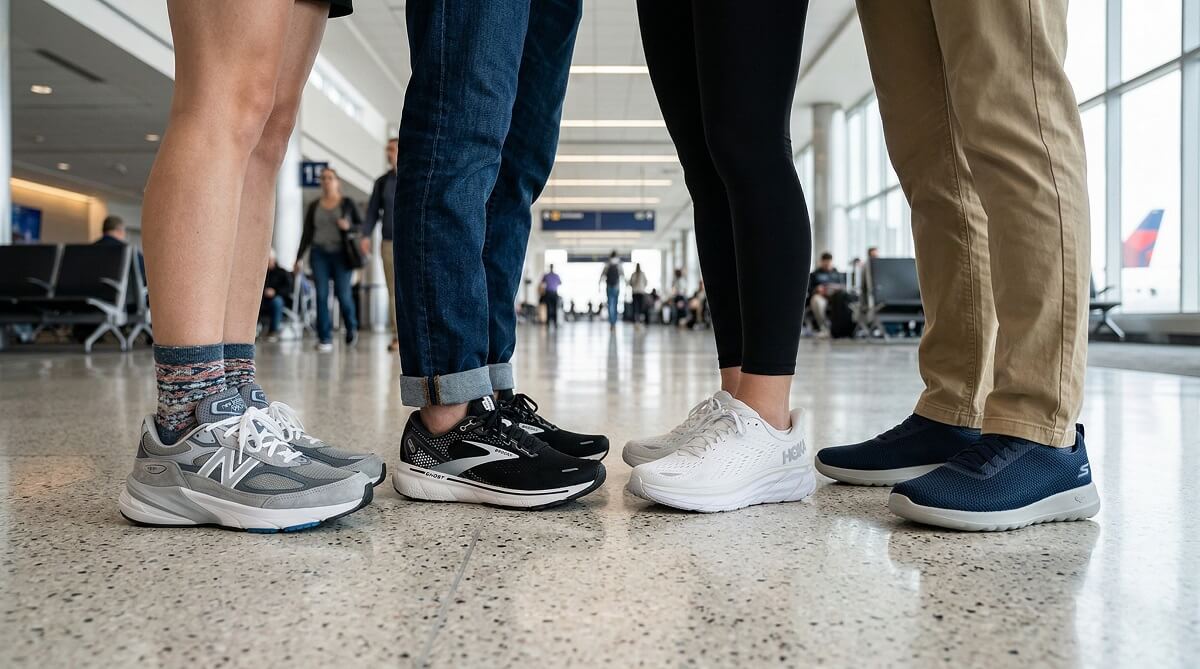
Spending eight, ten, or twelve hours on your feet isn’t just tiring — the wrong footwear can cause plantar fasciitis, metatarsalgia, and lower back pain that “may take months under a doctor’s care to resolve,” according to podiatric surgeon Timothy Oldani, DPM of Missouri Foot and Ankle. A solid pair absorbs impact without collapsing after hour six, holds your heel steady to prevent ankle fatigue, and stays breathable enough that blisters aren’t another thing to deal with at the end of the shift.
After reviewing manufacturer specs, real-world test data, and verified pricing from Zappos, Amazon, and brand sites, here are five pairs that hold up through a full shift. The Brooks Ghost 17 earns the top overall spot — $150, APMA-recognized, and offered in four widths including extra-wide. For maximum shock absorption without the midsole going mushy, the ASICS Gel-Nimbus 27 is the step-up. Workers who need certified slip resistance on kitchen or hospital floors should look at the Crocs On the Clock Work Sneaker at $69.99 MSRP — ASTM-certified, LiteRide foam footbed, and easy to wipe clean after a chaotic shift.
Prices noted are as of March 2026 — check current pricing at the retailer links before purchasing, as sales shift regularly.
Who Should (and Shouldn’t) Buy Standing Sneakers
✓ Best For
- Workers on their feet 6+ hours per shift — nurses, teachers, retail associates, kitchen staff, warehouse workers
- Travelers logging 15,000+ steps per day through airports and cities
- Anyone dealing with foot fatigue, sore knees, or lower back pain by end of shift
- People with flat feet, mild overpronation, or plantar fasciitis who need structured footwear
- Buyers who want a shoe that doubles as a casual everyday option off the clock
✗ Skip These If
- You need a steel-toe or composite-toe boot for heavy construction — this guide covers athletic-style sneakers, not safety-rated work boots
- You prefer a zero-drop minimalist shoe — zero drop is generally not recommended for prolonged static standing
- You’re buying primarily for high-intensity running — these picks optimize for standing comfort over race performance
- You need a waterproof hiking boot for rugged outdoor terrain — a different category with different requirements
What Actually Makes a Sneaker Work for Standing All Day
Most sneakers are built for dynamic forward motion — heel-to-toe transitions, propulsion, stride mechanics. Standing is a different demand. Your foot stays mostly static, pressure distributes across the full footbed rather than cycling through a gait, and the foam has to hold its shape under constant load rather than short-burst impact. Four features separate footwear that carries you through a shift from footwear that leaves you limping by lunch.
Cushioning That Holds Its Shape
Very soft foams feel great at step one but compress under sustained weight — testers describe this as a “sinking” or “muddy” feeling that sets in around hour four. RunRepeat’s lab testing uses an ASTM F1976-measured shock absorption (SA) score and found that a reading of 110 SA in the heel indicates a shoe capable of maintaining impact protection over extended standing hours. The ASICS Gel-Nimbus 27 scores strong here with its FF BLAST Plus Eco foam and PureGEL heel insert — high cushion that stays structured. The Brooks Ghost 17’s DNA LOFT v3 foam hits a balanced middle ground, softer than a stability shoe but firm enough to support a full kitchen shift without degrading.
Heel Counter and Structural Rigidity
Hold any shoe by the heel and toe and try folding it in half. A shoe that folds completely lacks the midsole rigidity to prevent your ankle from rolling inward under fatigue — the condition called overpronation that puts cumulative stress on your knees and lower back. Podiatric surgeon Priya Parthasarathy, DPM of Foot Ankle Specialists of the Mid-Atlantic says lace-up shoes offer better support for standing all day compared to slip-ons, because laces let you adjust fit as your foot swells through the shift. A stiff heel counter locks the rear foot steady, reducing the micro-movements at the ankle that pile up into fatigue over long hours.
Heel Drop: The 6–10mm Range
Heel drop is the difference in height between the heel and forefoot. Zero-drop shoes work for certain runners but place the Achilles tendon under sustained stretch during static standing — not a comfortable situation for long hours. A modest lift in the 6–10mm range reduces strain on the Achilles and plantar fascia, which is why Dr. Parthasarathy recommends “a slight 0.5-inch heel” for workers who stand all day. Every pick in this guide falls in that range: Brooks Ghost 17 at 10mm, ASICS Gel-Nimbus 27 at 8mm, On Cloudtilt at 7mm.
Fit, Width, and Toe Box Space
Feet swell over the course of a shift — sometimes by a half-size or more. A pair that fits cleanly at 8 a.m. may pinch by 3 p.m. Look for a roomy toe box that lets your toes spread naturally, and consider sizing up a half size if you’re between fits. For wide feet, brands like Brooks, ASICS, and New Balance offer documented width options — the Ghost 17 goes all the way to extra-wide (4E).
Top 5 Sneakers for Standing All Day (2026)
The five pairs below were selected against podiatrist-recognized criteria: structured cushioning, heel counter rigidity, real-world test records, and verified specs from manufacturer sources. Honest downsides included — no pick is right for every situation.
1. Brooks Ghost 17 — Best Overall
Price: $150 at Brooks / $149.95 at Zappos (March 2026) | Heel drop: 10mm | Weight: 10.1 oz (men’s) | Widths: Narrow, Medium, Wide, Extra Wide
The Ghost 17 is the most consistently recommended pair across podiatric and real-world standing assessments. Brooks’ Ghost line carries the APMA Seal of Acceptance, confirming it promotes proper foot health per the American Podiatric Medical Association’s standards. The nitrogen-infused DNA LOFT v3 midsole was updated from the previous model with 1mm more cushion in the heel and 3mm more in the forefoot, and the heel-to-toe drop was trimmed from 12mm to 10mm for a smoother transition. Business Insider’s chef tester wore these through over a dozen 10-hour kitchen shifts and described “an outstanding balance of comfort and support” for his knees and lower back.
The double jacquard air mesh upper is breathable without being flimsy. The insole is removable, so you can swap in custom orthotics if your foot condition calls for it. Four widths — including narrow and extra-wide — means this fits more foot shapes than most.
Best for: Nurses, teachers, retail workers, restaurant staff, travelers
Honest downside: The Ghost 17 is not the maximum-cushion option. If joint sensitivity is high and you want the most protective ride possible, step up to the Gel-Nimbus 27.
Check current price on Amazon | See all sizes and colors at Zappos
2. ASICS Gel-Nimbus 27 — Best for Maximum Cushioning
Price: $165 MSRP / $124.95 on sale at Zappos (check current pricing) | Heel drop: 8mm | Weight: 10.7 oz (men’s) | Stack height: 43.5mm heel / 35.5mm forefoot
Think of the Ghost 17 as the daily driver and the ASICS Gel-Nimbus 27 as what you reach for when your knees genuinely need more forgiveness. The full-length FF BLAST Plus Eco midsole with PureGEL heel insert delivers substantial cushioning that doesn’t go soft — Business Insider’s tester confirmed after 100+ cumulative hours across international travel days that the shoe “maintains its structure” rather than compressing into mush. The 43.5mm heel stack places this firmly in the max-cushion tier, and it still tips in at 8mm drop.
The jacquard mesh upper is roomy and highly breathable — a real advantage in warm work environments. The OrthoLite X-55 sockliner feels soft around the ankle. The upper uses at least 75% recycled content according to ASICS. One practical note: at $165 MSRP, watch for Zappos sales that have brought this down to $124.95.
Best for: Workers with knee or joint sensitivity, those wanting maximum impact absorption, warmer work environments
Honest downside: Heavier than the Ghost 17 at 10.7 oz. Not the right pick if you’re active and moving at pace all day — the extra weight adds up over a long shift.
Check current price on Amazon | See current price at Zappos
3. ASICS GT-1000 14 — Best Budget Stability Pick
Price: ~$110 MSRP | Heel drop: 8mm (measured 9.6mm) | Stack height: 35.4mm heel / 25.8mm forefoot
The GT-1000 14 is the practical pick for workers who need stability on a tighter budget. The average stability shoe runs around $142 — according to RunRepeat’s data — and this one comes in at $110 while including ASICS’ 3D Guidance System: high midsole walls and a broad heel base that guide foot alignment without restricting forward movement. FF BLAST cushioning and Rearfoot GEL technology provide reasonable impact absorption for the price tier. Wide options are available.
Best for: Budget-conscious buyers, mild overpronators, warehouse and delivery workers, anyone who replaces shoes frequently
Honest downside: Breathability scores low in lab testing. Poor airflow in hot environments makes this a poor fit for kitchen workers or anyone in warm, humid workspaces.
4. Crocs On the Clock Work Sneaker — Best Non-Slip for Kitchen and Hospital
Price: $69.99 MSRP (frequently discounted to $49.99–$52.49) | Slip resistance: ASTM F2913-24 + ASTM F3445-24 certified | Widths: Available in wide
For anyone who needs verified slip resistance — kitchen staff, nurses, hospital techs, food service workers — the Crocs On the Clock Work Sneaker is the most practical option under $75. The Crocs Lock outsole meets ASTM F2913-24 and F3445-24 certification standards, not just a marketing claim. The synthetic Nubuck overlay resists spills and wipes clean easily — a real-world advantage for anyone working around food, liquids, or cleaning agents.
The premium LiteRide foam footbed delivers genuine cushioning rather than the firm EVA common in work shoes at this price point. Business Insider’s chef tester wore these through multiple 10-hour standing kitchen shifts and reported well-supported feet with no aches. The lace-up design — rather than Crocs’ traditional clog format — provides ankle security for workers who pivot during busy service.
Best for: Cooks, restaurant staff, nurses, food service workers, hospital environments
Honest downside: Less total cushioning than the Ghost 17 or Gel-Nimbus 27. Not the right choice if maximum shock absorption is the priority.
Check men’s price on Amazon | Check women’s price on Amazon
5. On Cloudtilt — Best for Travel and All-Day Walking
Price: $170 at Zappos / On.com | Heel drop: 7mm | Weight: 8 oz (women’s) / 10.6 oz (men’s)
Built around On’s CloudTec Phase technology, the Cloudtilt uses firm foam pods arranged to compress sequentially underfoot, spreading impact across the stride rather than concentrating it at one point. RunRepeat’s energy return test scored the Cloudtilt at 58.1% in the heel — 13.9% above average — giving the shoe a light, springy character that reduces leg fatigue over hours of active movement. The knit upper from 100% recycled polyester is sock-like and breathable, accommodating foot swelling without heat buildup. The bungee lace system lets you slip the shoe on and off without untying.
This is the pick for travelers, city walkers, and anyone whose day involves continuous movement rather than stationary standing in one spot.
Best for: Travelers, city walking, mixed standing-and-walking days, casual daily wear
Honest downside: No wide-width option. The sock-like upper reduces lateral stability — not suited for kitchen or pivot-heavy jobs. Not a slip-resistant work shoe.
Quick Comparison: Five Picks at a Glance
| Model | Best For | Price (MSRP) | Heel Drop | Weight (Men’s) | Slip-Resistant | Wide Width |
|---|---|---|---|---|---|---|
| Brooks Ghost 17 | Overall / Nurses / Retail | $150 | 10mm | 10.1 oz | No | Yes (up to 4E) |
| ASICS Gel-Nimbus 27 | Max cushion / Joint relief | $165 | 8mm | 10.7 oz | No | Yes |
| ASICS GT-1000 14 | Budget / Stability | ~$110 | 8mm | ~9.5 oz | No | Yes |
| Crocs On the Clock | Kitchen / Hospital | $69.99 | ~6mm | ~10 oz | Yes (ASTM certified) | Yes |
| On Cloudtilt | Travel / Walking | $170 | 7mm | 10.6 oz | No | No |
Prices as of March 2026. Verify current pricing at retailer links before buying — sales are common, especially at Zappos.
Recommended Sneaker by Occupation
| Occupation | Top Pick | Key Reason |
|---|---|---|
| Nurses / Healthcare | Brooks Ghost 17 or Crocs On the Clock | Ghost for cushion and support; Crocs for ASTM-certified slip resistance on hospital floors |
| Kitchen / Restaurant | Crocs On the Clock Work Sneaker | Certified slip resistance, spill-resistant overlay, easy to clean |
| Retail / Sales Floor | Brooks Ghost 17 | Versatile appearance, reliable support for mixed standing and walking |
| Warehouse / Delivery | ASICS GT-1000 14 | Stability and durability at a lower cost — sensible when shoes take a beating |
| Teachers | Brooks Ghost 17 | Comfortable for classroom standing, light enough for hallway movement |
| Travelers | On Cloudtilt | Springy feel, adapts to foot swelling, clean look from plane to street |
Signs Your Standing Shoes Have Worn Out
Midsole foam degrades faster than the rubber outsole — a pair can look perfectly intact on the outside while the cushioning inside has already lost most of its shock-absorbing capacity. RunRepeat estimates the replacement window at 300–500 miles. For a shift worker wearing the same pair five days a week on an 8-hour shift, that works out to roughly 6–12 months depending on how active the role is.
Watch for these signals before the miles add up: new pain in areas that didn’t bother you before (commonly the arch or ball of foot), visible compression lines in the midsole foam, or a flattened insole where the heel cup no longer holds depth. If your old pair produces discomfort that a fresh version of the same shoe doesn’t reproduce — the foam is spent.
RunRepeat also points to shoe rotation as a practical plantar fasciitis prevention strategy for workplace use: alternating between two pairs gives the foam time to rebound between shifts.
Frequently Asked Questions
What are the best sneakers for standing all day?
The Brooks Ghost 17 is the standout overall pick for most workers — it delivers structured cushioning, heel stability, and breathability, and holds the APMA Seal of Acceptance. For maximum impact absorption, the ASICS Gel-Nimbus 27 is worth the step-up in price. For kitchen or hospital environments where certified slip resistance matters, the Crocs On the Clock Work Sneaker at $69.99 MSRP is the reliable, affordable choice.
Are HOKAs good for standing all day?
Some models work well, others don’t. Business Insider’s testers found that several HOKA styles — including the Gaviota — are too flexible to offset their high cushioning, producing an unstable feel after a few hours of standing. Within the HOKA lineup, the Bondi SR (designed for shift workers) and the Clifton 10 are stronger choices for standing-heavy use.
Are flat shoes (zero drop) okay for standing all day?
Podiatrists generally caution against them. A modest heel lift — around 6–10mm — reduces strain on the Achilles tendon and plantar fascia. Zero-drop footwear places these structures under sustained stretch during static standing, which can trigger or worsen plantar fasciitis over time. Dr. Parthasarathy specifically recommends “a slight 0.5-inch heel” for standing-heavy work environments.
What features should I look for in a shoe for all-day standing?
Five things matter most: cushioning that maintains structure under sustained load (not just soft, but stable); heel counter rigidity (the shoe should not fold in half lengthwise); heel drop in the 6–10mm range; a roomy toe box that accommodates swelling; and a lace-up closure for an adjustable fit. Add certified slip resistance for kitchen or clinical environments, and prioritize breathability for warm or humid workspaces.
How is a standing shoe different from a running shoe?
Running shoes are optimized for dynamic forward motion. Standing distributes consistent pressure across the entire foot for extended periods — a different mechanical situation. Standing-focused footwear tends to use firmer, more even cushioning throughout the sole rather than heel-and-forefoot cushioning tuned for stride mechanics. Many daily training shoes from ASICS, Brooks, and HOKA do cross over well for standing when they meet the structural rigidity and heel drop requirements above.
What should I do if my feet still hurt after getting new shoes?
Dr. Parthasarathy recommends rotating footwear throughout the week for varied cushion and support levels, stretching during and after your shift (calf stretches, toe flexes), and icing to manage inflammation at end of day. Compression socks help with circulation during long hours on your feet. If pain persists past a few weeks, a podiatrist visit is worth it — persistent pain may point to plantar fasciitis or another condition that needs direct treatment.
Do I need wide-width shoes for standing all day?
Not automatically, but feet can swell by a half-size or more over a long shift. If you’re between sizes or have wider-than-average feet, sizing up or selecting a wide option is worth considering. The Brooks Ghost 17 and ASICS GT-1000 14 both carry wide and extra-wide options. The On Cloudtilt does not — a real limitation for wider-footed buyers. New Balance and Skechers both have strong wide-width rosters if none of the five picks here match your foot shape.
How long do standing shoes last?
Plan for 300–500 miles before cushioning degrades meaningfully — roughly 6–12 months for a full-time shift worker, depending on activity level. The foam compresses well before the rubber outsole shows wear, so a pair that looks fine externally may already be providing poor protection. Replace when new pain patterns appear, midsole compression lines become visible, or the insole heel cup has flattened out.
Your feet will give you honest feedback within a shift or two. Check current prices for the Brooks Ghost 17 on Amazon or Zappos, or use the comparison table above to match any of the five picks to your specific work environment.
