


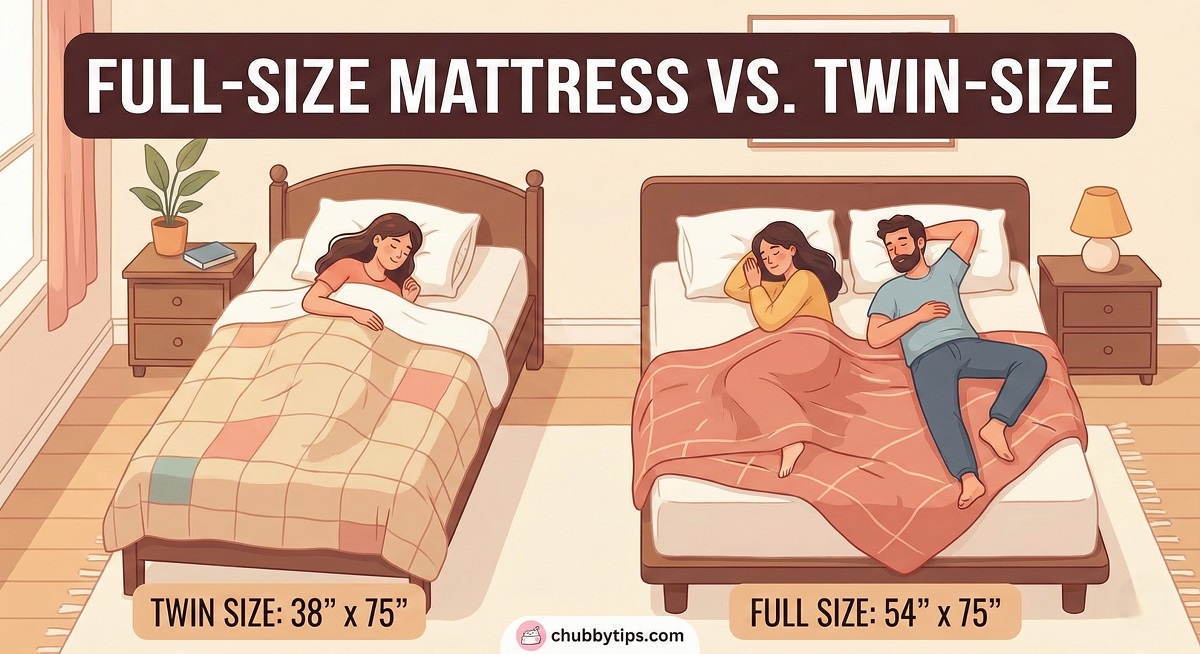
A full mattress (54″ x 75″) is 16 inches wider than a twin (38″ x 75″), giving you 42% more sleeping surface. Both share the same 75-inch length, so if you’re over 6 feet tall, neither size offers extra legroom. If you’re also considering larger options, our covers queen and king sizes.
The quick answer: Choose a twin for kids, tight budgets, or rooms under 100 square feet. Choose a full for single adults who want room to spread out, guest rooms that need to accommodate various visitors, or teens who’ve outgrown their childhood bed. Neither is ideal for couples sleeping together regularly.
Expect to pay $150-$400 for a quality twin mattress and $250-$600 for a comparable full. Bedding costs scale accordingly, with full-size sheets typically costing $10-$20 more per set than twin.
Who Should Buy a Twin vs Full Mattress?
Choose a Twin If:
- You’re buying for a child or young teen
- Your room is under 100 sq ft (smaller than 10×10 feet)
- Your total budget is under $400 including bedding
- The bed will be part of a bunk bed or trundle setup
- You need to move the mattress frequently
Choose a Full If:
- You’re a single adult wanting room to stretch out
- You’re setting up a guest room for various visitors
- You have a teen who’s outgrown their twin but doesn’t need a queen
- Your room is at least 10×10 feet with space for other furniture
- You occasionally share the bed with a child or pet
Skip Both and Consider a Queen If:
- Two adults will share the bed regularly
- The sleeper is over 6’3″ tall
- You want maximum long-term value and flexibility
Twin vs Full Mattress Dimensions at a Glance
According to Sleep Foundation’s sizing standards, these are the official dimensions for each mattress size:
| Specification | Twin | Full |
|---|---|---|
| Width | 38 inches | 54 inches |
| Length | 75 inches | 75 inches |
| Surface Area | 2,850 sq in | 4,050 sq in |
| Typical Weight | 40-45 lbs | 50-60 lbs |
| Minimum Room Size | 7×10 ft (70 sq ft) | 10×10 ft (100 sq ft) |
| Width Per Person (shared) | N/A | 27 inches each |
The Key Numbers
- Full is 16 inches wider than twin (42% more width)
- Full has 42% more sleeping surface overall
- Both are 75 inches long (about 6 feet 3 inches)
- Full weighs roughly 10-15 pounds more than a comparable twin, according to mattress weight data from eachnight.com
Who Should Buy a Twin Mattress?
Twin mattresses are the smallest standard bed size at 38 inches wide by 75 inches long. They’re the go-to choice when space or budget is tight, and they work well for and dorm situations.
Best Uses for Twin Beds
- Children ages 3-12 transitioning from a crib or toddler bed
- Bunk beds and loft beds where two beds share vertical space
- Small rooms and dorms where floor space is at a premium
- Guest rooms with limited space for occasional use
- Day beds that double as seating during the day
Twin Mattress Advantages
- Most affordable standard mattress size (budget options start around $150)
- Lightest weight at 40-45 pounds, making them easiest to move
- Fits through doorways and up narrow staircases without hassle
- Bedding is widely available and less expensive
- Leaves more floor space for furniture in small rooms
Twin Mattress Drawbacks
- Too narrow for most adults who move around while sleeping
- Same 75-inch length as full, so no advantage for tall sleepers
- Children may outgrow it faster than expected
- No room for pets or occasional bed-sharing
Who Should Buy a Full Mattress?
A full mattress (also called a double bed) measures 54 inches wide by 75 inches long according to Sleep Foundation’s full bed dimensions guide. That extra 16 inches of width compared to a twin makes a real difference for adult sleepers who want space to spread out.
Best Uses for Full Beds
- Single adults who want room to stretch out at night
- Teenagers who’ve outgrown their childhood twin
- Guest rooms that need to accommodate visitors of various sizes
- Studio apartments where you want comfort without overwhelming the space
- Budget-conscious couples (though a queen is recommended for regular sharing)
Full Mattress Advantages
- 16 extra inches of width provides real sleeping comfort for adults
- Good balance between sleeping space and room footprint
- Comfortably fits one adult plus occasional guest (child or pet)
- More affordable than queen while offering substantial space
- Works well in bedrooms around 10×10 feet with furniture
Full Mattress Drawbacks
- Still too narrow for two adults sleeping together regularly (only 27 inches per person)
- Same 75-inch length as twin offers no extra legroom for tall sleepers
- Bedding costs more than twin sizes
- Heavier (50-60 lbs) and harder to maneuver than twin
Room Size Requirements
Before buying either size, measure your room. A mattress that “fits” but leaves no walking space creates daily frustration.
Twin Bed Room Planning
- Minimum room size: 7 x 10 feet (70 sq ft)
- Comfortable room size: 9 x 10 feet (90 sq ft) with dresser space
- Clearance needed: At least 24 inches on one accessible side, 36 inches at foot
- Best for: Kids’ rooms, narrow guest rooms, dorm rooms
Full Bed Room Planning
- Minimum room size: 10 x 10 feet (100 sq ft)
- Comfortable room size: 10 x 12 feet (120 sq ft) with furniture
- Clearance needed: 24 inches on both sides ideal, 36 inches at foot
- Best for: Primary bedrooms, spacious guest rooms, studio apartments
Pro tip: Use painter’s tape to outline the mattress dimensions on your floor before purchasing. Add 24-36 inches on the sides you need to access, and make sure doors and closets can still open freely.
Price Comparison: What You’ll Actually Pay in 2026
Mattress prices vary widely based on materials, brand, and where you buy. According to Tom’s Guide’s Amazon mattress reviews, here’s what to expect for each size category.
Twin Mattress Pricing
| Category | Price Range | Examples |
|---|---|---|
| Budget | $100-$250 | Amazon Basics, Linenspa |
| Mid-range | $250-$500 | Zinus Green Tea (~$200-$300), Nectar |
| Premium | $500-$1,000+ | DreamCloud ($419), Awara ($649) |
Full Mattress Pricing
| Category | Price Range | Examples |
|---|---|---|
| Budget | $150-$350 | Amazon Basics, Linenspa |
| Mid-range | $350-$700 | Zinus, Nectar, Brooklyn Bedding |
| Premium | $700-$1,500+ | DreamCloud, Saatva, Awara |
Don’t Forget Bedding Costs
The mattress is just the start. You’ll also need sheets, a mattress protector, and likely a new bed frame. Sheet prices scale with size:
- Twin sheet sets: $10-$50 (budget to quality cotton)
- Full sheet sets: $20-$65 (budget to quality cotton)
Expect full-size bedding to cost roughly 30-50% more than twin across all accessories. Check our for bedding recommendations.
Special Situations: When to Consider Alternatives
When to Consider Twin XL Instead
Twin XL mattresses measure 38 inches by 80 inches, providing 5 extra inches of length while keeping the narrow width. They’re the standard in college dorms and a smart choice for:
- Taller teens and adults who need length but not width
- Small rooms where a full won’t fit but standard twin is too short
- Creating a split king (two Twin XL mattresses side by side equal a king)
When to Consider Full XL Instead
Full XL mattresses measure 54 inches by 80 inches. They’re less common but offer the full’s width with 5 extra inches of length. Good for tall single adults who want width and length but don’t need a queen.
Note: Full XL bedding can be harder to find and may cost more than standard sizes.
When to Skip Both and Get a Queen
Sometimes neither twin nor full is the right answer. Consider upgrading to a queen (60″ x 80″) if:
- Two adults will share the bed regularly (queen gives 30 inches per person vs 27 on full)
- The sleeper is over 6’3″ tall (queen is 80 inches long vs 75 for twin/full)
- You’re making a long-term investment and want better resale value
Making Your Final Decision: 5-Minute Framework
Step 1: Measure Your Room
- Under 100 sq ft: Twin is your best fit
- 100-120 sq ft: Either works; full if buying for a single adult
- Over 120 sq ft: Full recommended for adults
Step 2: Count the Sleepers
- One child: Twin
- One adult: Full preferred; twin if budget is tight
- Adult + pet/child occasionally: Full
- Two adults: Skip both, get a queen
Step 3: Check Your Budget
- Under $300 total (mattress + bedding): Twin
- $300-$600 total: Full is within reach
- Over $600: Consider queen for better long-term value
Step 4: Consider the Future
- Child will outgrow bed in 2-3 years? Twin for now, upgrade later
- Teen or adult using for 5+ years? Full (or queen) makes more sense
- Guest room for various visitors? Full accommodates more body types
Frequently Asked Questions
What’s the actual difference between twin and full size?
Width. A full mattress is 16 inches wider than a twin (54 inches vs 38 inches). Both are 75 inches long.
Can two adults sleep on a full mattress?
Technically yes, but it’s cramped. Each person gets only 27 inches of width, which is less than a crib mattress. For regular couple sleeping, a queen (60 inches wide) is the minimum most sleep experts recommend.
Is a twin bed big enough for an adult?
For smaller adults who sleep relatively still, yes. Most adults prefer at least a full for comfort. If you’re over 6 feet tall, consider a Twin XL or full for the extra 5 inches of length.
Do two twin mattresses make a king?
Two Twin XL mattresses (38″ x 80″ each) placed side by side equal a king (76″ x 80″). Two standard twins would be the right width but 5 inches shorter than a standard king.
What room size do I need for each?
Twin: minimum 7×10 feet (70 sq ft). Full: minimum 10×10 feet (100 sq ft). Add 20+ square feet if you want a dresser or desk in the room.
Which size has better resale value?
Full and queen sizes typically sell more easily secondhand because they accommodate more sleepers and situations than twins.
Is a full the same as a double?
Yes. “Full” and “double” refer to the exact same mattress size: 54 inches wide by 75 inches long. “Double” is the older term that’s less commonly used today.
How much heavier is a full mattress than a twin?
A full mattress typically weighs 50-60 pounds compared to 40-45 pounds for a twin. That’s roughly 10-15 pounds more, which matters if you need to move the mattress frequently or carry it up stairs.
Ready to Shop?
Now that you know which size fits your needs, compare current prices and reviews at major retailers before making your final decision. Look for mattresses with at least a 100-night sleep trial and 10-year warranty for the best protection on your purchase. Browse more on ChubbytIps.
