


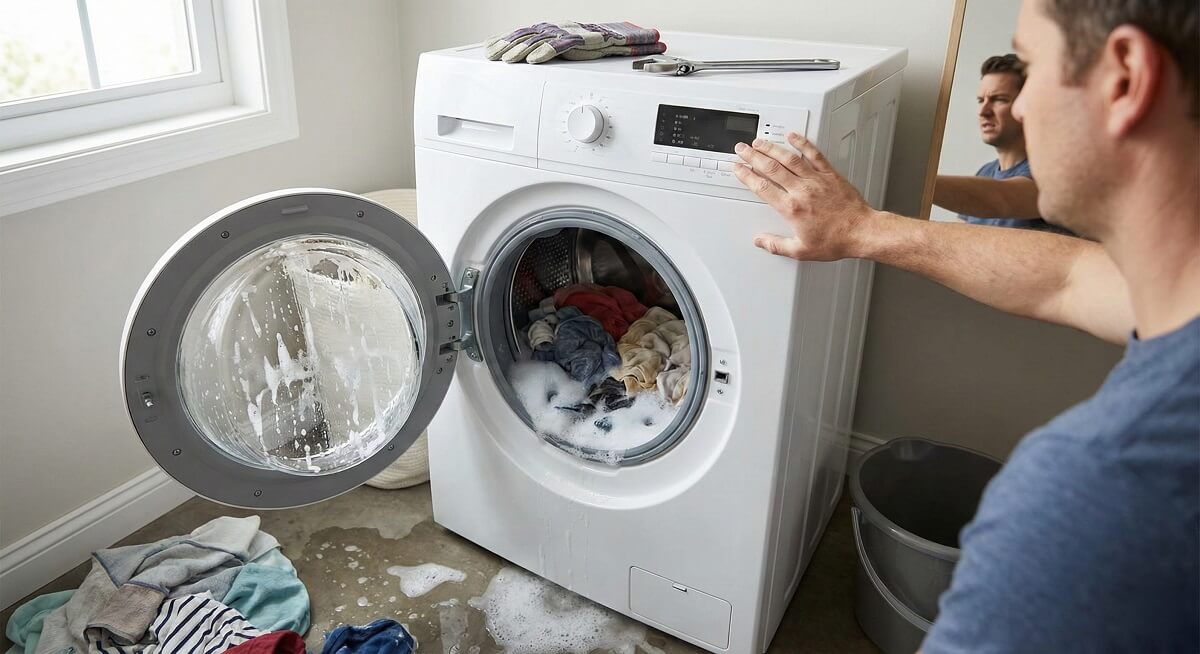
If your washing machine won’t spin or drain, you’re dealing with one of three common culprits: a faulty lid switch, a clogged drain pump, or a broken motor coupling. Here’s the good news—80% of these problems are DIY-fixable with basic tools and about an hour of your time. You’ll spend $15-$150 on parts doing it yourself versus $180-$350 hiring a professional (as of February 2026). The average homeowner pays around $220 for a service call, according to national repair cost data.
In this guide, I’ll walk you through exactly how to diagnose which part is failing—no guesswork required. You’ll learn step-by-step fixes for each common cause, when DIY makes sense versus calling a technician, and what tools and parts you’ll actually need. doesn’t have to be expensive or complicated. I’m not going to tell you to replace things randomly or throw money at the problem. We’ll use a logical troubleshooting process to identify the exact issue first.
Most repairs take 30 to 90 minutes, depending on which component failed. You’ll need basic skills—if you can use a screwdriver and multimeter, you can handle these repairs. I’ll cover when to disconnect power and water for safety, and more importantly, when to stop and call a pro instead of continuing on your own.
Quick Diagnostic Flowchart
Before you start taking things apart, let’s figure out what’s actually broken. Run through this decision tree:
Does the machine agitate or wash normally?
- YES → Likely a lid switch or drain pump issue
- Does water drain at all?
- NO → Start with clogged drain pump or hose (Section: Cause #1)
- YES but won’t spin → Check the lid switch assembly (Section: Cause #2)
- Does water drain at all?
- NO → Likely motor coupling or drive belt
- Check for broken coupling or loose belt (Sections: Cause #3 and #4)
Special case: Does it work on the “Drain & Spin” cycle but not during a normal wash? That points to a shift actuator or control board problem (Section: Cause #5).
Tools You’ll Need
- Multimeter ($20-$50) — Essential for testing electrical components. Models like the AstroAI 6000 or Kaiweets HT118A work great for appliance repair.
- Basic socket set or wrench set ($20-$50)
- Screwdrivers (Phillips and flathead) ($10-$25 for a set)
- Bucket and towels (for water spillage)
- Flashlight ($10-$30)
- Channel locks or pliers ($15-$30) — Optional but helpful
Safety First (Before You Start)
I can’t stress this enough—follow these steps before you touch anything:
- Unplug the washing machine from the wall outlet. Don’t just turn it off—actually unplug it.
- Turn off water supply valves (both hot and cold lines at the wall).
- Place towels around the base of the machine. You will get water spillage.
- Have a bucket ready to catch remaining water in hoses and the pump.
- Never bypass safety switches permanently. They exist for a reason—to keep the drum from spinning with the lid open.
When to STOP and Call a Professional
- Gas or burning smell coming from the machine
- Visible sparking or scorched wiring
- Cracked tub or major water leak from the cabinet
- You’re uncomfortable testing electrical components
- Machine is still under manufacturer warranty (DIY repairs may void it)
Most Common Causes (Ranked by Frequency)
Cause #1: Clogged Drain Pump or Hose (40% of Cases)
Symptoms:
- Water stays in the tub after the cycle ends
- Machine makes a humming noise but doesn’t drain
- Water drains very slowly or not at all
How to Diagnose:
- Visual check: Look at the drain hose for obvious kinks or bends.
- Listen: A humming sound during the drain cycle means the pump motor is trying to work—it’s likely clogged, not dead.
- Hose test: Disconnect the drain hose from the standpipe or laundry sink and check for clogs inside the hose itself.
How to Fix:
- Locate the drain pump. It’s usually at the bottom front or rear of the machine. You may need to remove a front access panel or tip the washer back slightly.
- Remove the access panel. Most panels snap off or require removing a few screws.
- Disconnect the hoses. Have your bucket ready—water will come out. Check each hose for socks, coins, hair ties, or other debris.
- Remove the pump. It’s typically held by 2-4 screws or a quarter-turn mounting bracket. Inspect the impeller (the spinning part inside). Sometimes small items jam it.
- Clean and reassemble. If the impeller spins freely and there’s no damage, you probably just had a clog. If it’s cracked or won’t spin, you need a new pump.
Parts Needed:
- Replacement drain pump (if damaged): $20-$100, depending on brand and model (as of February 2026). Most fall in the $25-$60 range. Available from Amazon, RepairClinic, or manufacturer parts sites.
- Hose clamps (if needed): $5-$10
Time required: 30-45 minutes
Skill level: Basic to intermediate
can prevent future issues.
Cause #2: Faulty Lid Switch Assembly (30% of Cases)
Symptoms:
- Washer fills with water but won’t agitate or spin
- Lid lock light may flash or stay on
- Works fine until it reaches the spin cycle, then stops
- No clicking sound when you close the lid
How to Diagnose:
- Visual test: Press the lid switch manually and listen for a click. No click usually means it’s dead.
- Multimeter test: Set your multimeter to continuity mode (the symbol that looks like sound waves). With the lid open, the switch should show “OL” or infinite resistance. With the lid closed (or switch pressed), it should beep or show near-zero resistance, indicating continuity.
The lid switch is a safety feature. The machine thinks the lid is open even when it’s closed, so it refuses to spin. That’s why you might hear it try to start the spin cycle and then immediately quit.
How to Fix:
- Locate the lid switch. It’s either under the top panel near the lid or built into the lid assembly itself, depending on your model.
- Remove the control panel or top cover. Usually held by clips or a few screws. Lift it carefully—there are wires attached.
- Disconnect the wire harness. It should have a clip or tab release. Take a photo before disconnecting so you remember which wires go where.
- Test the old switch with your multimeter to confirm it’s faulty.
- Install the new switch and reconnect the wires. Make sure it clicks into place properly.
Parts Needed:
- Lid switch assembly: $20-$50 for most brands (as of February 2026). OEM parts from manufacturers like Whirlpool, Maytag, and Kenmore fall in this range. Aftermarket versions may be $15-$30.
Time required: 20-40 minutes
Skill level: Basic
Important note: Some people bypass the lid switch by jumping the wires together. DO NOT do this. It’s a safety hazard. The switch prevents the drum from spinning at high speed with the lid open, which could seriously injure someone (especially kids or pets).
Cause #3: Broken Motor Coupling (15% of Cases)
Symptoms:
- Motor runs but the drum doesn’t move at all
- May agitate weakly or not at all
- Common after overloading the washer with heavy items like comforters
How to Diagnose:
- Remove the access panel and inspect the motor coupling visually.
- Look for broken rubber or plastic pieces in the bottom of the cabinet.
- Check if the motor shaft and transmission shaft are disconnected or spinning independently.
The motor coupling is a small rubber and plastic connector between the motor and the transmission. It’s designed to fail before more expensive components get damaged—kind of like a sacrificial part. If you’ve been overloading your washer, this is usually what gives out first.
How to Fix:
- Unplug the machine and remove the front or rear panel. Access varies by brand. Whirlpool/Maytag direct-drive models typically require removing the cabinet.
- Locate the motor coupling between the motor and transmission. It sits right where the two shafts meet.
- Remove the old coupling. You may need to remove the motor itself (usually 2-4 bolts) to access it.
- Install the new coupling. It should slide onto both shafts. Make sure it’s seated fully.
- Reassemble and test with a small load first.
Parts Needed:
- Motor coupling: $10-$25 (as of February 2026). It’s a simple part, so aftermarket versions work fine.
Time required: 45-60 minutes
Skill level: Intermediate (requires removing the motor or cabinet)
Cause #4: Worn or Broken Drive Belt (10% of Cases)
Symptoms:
- Motor runs but there’s no spinning or agitating
- May see the belt lying on the floor of the cabinet
- Smell of burning rubber if the belt is slipping
How to Diagnose:
- Remove the panel and visually inspect the belt around the motor and drum pulleys.
- Check for cracks, fraying, or a complete break.
- Test the tension—it should be firm, not loose or saggy.
Drive belts are more common in older top-load washers and most front-load models. Newer direct-drive top-loaders don’t have belts—they use the motor coupling instead.
How to Fix:
- Access the motor and pulley area. You’ll likely need to remove the rear panel or front panel depending on the model.
- Remove the old belt from the motor pulley and drum pulley. If it broke, there may be pieces to clean up.
- Install the new belt. Start by looping it around the motor pulley, then stretch it over the drum pulley. This can take some effort—it’s supposed to be tight.
- Check alignment. The belt should sit centered on both pulleys, not riding to one side.
Parts Needed:
- Drive belt: $15-$35, depending on brand (as of February 2026). Make sure you get the right belt for your model—they’re not universal.
Time required: 30-50 minutes
Skill level: Intermediate
Cause #5: Faulty Shift Actuator (5% of Cases, Brand-Specific)
Symptoms:
- Works on the “Drain & Spin” cycle but not during a regular wash
- Spins on low speed but won’t shift to high speed
- Lid lock light flashes during spin attempts
- Very common on Whirlpool Cabrio and Maytag Centennial models
How to Diagnose:
- Run the diagnostic test mode (check your manual for the specific button sequence—it varies by model).
- Check for error codes. Common codes: F7 or E1 on Whirlpool models.
- The shift actuator houses a speed sensor. If it fails, the machine refuses to spin fast as a safety feature.
This is a known problem on certain Whirlpool and Maytag models from around 2010-2020. The plastic shift arm loses resistance and becomes loose under heavy loads. Whirlpool has issued multiple service bulletins and part redesigns to address it.
How to Fix:
- Locate the shift actuator. On Cabrio and Centennial models, it’s underneath the washer. You’ll need to tip the machine back or lay it on its front.
- Disconnect the wire harness and remove the mounting bolts (usually 3-4 bolts).
- Remove the old actuator. It may be tight—wiggle it gently.
- Install the new actuator and reconnect the wiring.
- Test all cycles—run a full wash to make sure it shifts properly through all speeds.
Parts Needed:
- Shift actuator: $80-$150 (as of February 2026). For this part, I recommend OEM (original manufacturer) over aftermarket. The redesigned OEM parts have stronger construction.
Time required: 30-45 minutes
Skill level: Intermediate
Models affected: Whirlpool Cabrio (WTW model numbers), Maytag Centennial (MVW model numbers), and related brands like Kenmore Elite, Roper, and Estate.
Brand-Specific Issues to Know
Whirlpool and Maytag Top-Loaders
Shift actuator failures are extremely common after 4-6 years of use, especially on Cabrio and Centennial models. If you have a model number starting with WTW or MVW and your washer won’t spin at high speed, check the shift actuator first. There’s also a related component called the “splutch” (shift clutch) that can wear out on these models.
LG Front-Loaders
LG washers have a small drain pump filter that clogs frequently, especially if you wash items with lint or pet hair. The “OE” error code means the machine can’t drain water. According to LG’s official support documentation, you should clean the drain pump filter (located at the bottom front behind a small door) every month or two. Common causes: kinked drain hose, clogged filter, or excessive suds from using too much detergent.
Samsung Washers
Samsung front-loaders often throw a “5E” or “SE” error code when they can’t drain. Like LG, check the drain filter first—it’s the easiest fix. Samsung also has issues with door lock failures on front-load models. If the door won’t lock, the washer won’t start at all.
GE Top-Loaders
Older GE models (pre-2015) commonly fail at the motor coupling, especially if you overload them. Newer GE direct-drive models have fewer moving parts and are generally more reliable. If you have an older GE that won’t agitate or spin, check the motor coupling first.
Cost Analysis: Should You Repair or Replace?
When to Repair
Repairing makes sense if:
- Your machine is less than 7 years old
- Repair cost is less than 50% of replacement cost
- It’s a single component failure, not multiple issues stacking up
- You have a high-quality brand (Whirlpool, Maytag, LG, Samsung, Speed Queen)
Typical Repair Costs (As of February 2026)
| Repair Type | DIY Parts Cost | Professional Service Cost |
|---|---|---|
| Lid switch replacement | $20-$50 | $150-$250 |
| Drain pump replacement | $20-$100 | $150-$350 |
| Motor coupling replacement | $10-$25 | $180-$300 |
| Drive belt replacement | $15-$35 | $150-$250 |
| Shift actuator replacement | $80-$150 | $250-$400 |
| Control board replacement | $150-$350 | $350-$600 |
According to national repair cost data from Angi and HomeGuide (February 2026), the average washing machine repair runs about $220, with most repairs falling between $180 and $250. Service calls include a diagnostic fee of $75-$100 (usually credited toward the repair) plus labor at $50-$150 per hour, plus parts. If you’re in a high-cost area like New York City, expect to pay $315-$328 on average.
When to Replace
Consider replacing your washer if:
- The machine is 8+ years old
- You’re facing multiple component failures
- Repair cost exceeds $400
- There’s tub damage, frame damage, or structural issues
- You’ve had frequent breakdowns (more than one major repair per year)
- Newer models would save significant energy and water costs
New Washer Costs (As of February 2026)
If you decide replacement makes more sense, here’s what you’re looking at:
- Budget top-loader: $300-$600 (basic features, smaller capacity)
- Mid-range top-loader: $600-$900 (larger capacity, more cycles, better efficiency)
- Budget front-loader: $700-$1,000
- Mid-range front-loader: $900-$1,400
Most quality washers fall in the $500-$1,500 range at retailers like Best Buy and Home Depot. The sweet spot for value is around $600-$800, especially during sales. Major sale periods: Presidents’ Day, Memorial Day, Labor Day, and Black Friday (expect 30-45% off in late November 2026).
Energy Savings Consideration
New ENERGY STAR certified washers use 20-25% less energy and 30-33% less water compared to standard washers, according to official ENERGY STAR program data. Over the lifetime of the appliance, that’s approximately $530 in energy cost savings and over 2,000 gallons of water saved annually. If you’re replacing an old top-load agitator washer with a new ENERGY STAR front-loader, the savings jump to 45% less energy and 50% less water. pays for itself over time.
How to Find the Right Replacement Parts
Getting Your Model Number
You need the exact model number to order the right parts. Here’s where to find it:
- Inside the door rim (most common location)
- On the back panel of the machine
- Under the lid on top-loaders
- On a sticker or metal plate
Model numbers look something like this: WTW4816FW2 (Whirlpool), MVW6230HW (Maytag), WM3900HWA (LG). Take a photo of the model and serial number plate so you have it when shopping online.
OEM vs. Aftermarket Parts
OEM (Original Equipment Manufacturer)
Pros:
- Exact fit guaranteed
- Maintains warranty protection (if still under warranty)
- Quality is assured—same part that came with the machine
Cons:
- More expensive—typically 20-40% higher than aftermarket
Best for: Control boards, shift actuators, complex assemblies
Aftermarket
Pros:
- Lower cost
- Often the same quality as OEM (many are made in the same factories)
Cons:
- Fit may vary slightly
- Shorter warranty (typically 90 days vs. 1 year for OEM)
Best for: Lid switches, hoses, drive belts, simple components
For example, a lid switch assembly from RepairClinic runs $20-$50 for OEM parts (as of February 2026), while aftermarket versions might be $15-$30. For that small price difference, I usually go OEM on electrical parts. But for a drain hose or belt? Aftermarket is fine.
Where to Buy Parts
- Amazon: Fastest shipping (often same-day or next-day with Prime), easy returns, competitive pricing. Good for common parts.
- RepairClinic.com: Model-specific guarantees (“Guaranteed to fit your [model]”), free repair videos for many parts, same-day shipping if ordered by 9 PM ET, 365-day return policy.
- AppliancePartsPros.com: Expert phone support, detailed diagrams, good for hard-to-find parts.
- Local appliance parts stores: Same-day availability if you need a part immediately. Call ahead to check stock.
Shipping times vary, but most online retailers deliver standard parts in 2-5 business days. If you need the part faster, check local stores or pay for expedited shipping.
Preventive Maintenance (Stop Future Problems)
Monthly Tasks
- Clean the drain pump filter (front-loaders only). It’s behind a small access door at the bottom front. Pull out the filter, rinse it, and put it back.
- Inspect hoses for wear, cracks, or bulging. Replace any hose that looks questionable—a burst hose can flood your laundry room.
- Wipe the door seal on front-loaders to prevent mold and mildew buildup.
Quarterly Tasks
- Run a cleaning cycle with a washer cleaner tablet or a cup of white vinegar. This removes detergent buildup and keeps the tub fresh. this natural approach prevents mold and odors.
- Check that the machine is level. An unbalanced washer causes excessive vibration, which wears out bearings and other components faster. Use a level and adjust the feet if needed.
- Inspect the drain hose for kinks or clogs where it connects to the standpipe or sink.
Best Practices
- Don’t overload the washer. Clothes should move freely during the wash cycle. Overloading strains the motor coupling, transmission, and bearings.
- Use HE (high-efficiency) detergent in HE washers. Regular detergent creates too many suds, which can prevent proper draining and rinsing.
- Leave the door or lid open between washes. This allows air circulation and prevents mildew growth.
- Remove wet clothes promptly. Leaving wet clothes in the washer breeds bacteria and mold.
Average Component Lifespans
Here’s how long you can expect major components to last under normal use:
- Lid switch: 5-7 years (mechanical wear from repeated cycles)
- Drain pump: 4-6 years (affected by water quality, debris, and usage frequency)
- Motor coupling: 6-10 years (fails sooner if you frequently overload)
- Drive belt: 7-10 years (rubber degrades over time)
- Control board: 8-12 years (electronic components generally last longer)
The overall lifespan of a washing machine is typically 10-14 years. Regular maintenance can push that closer to the upper end.
Frequently Asked Questions
Why does my washer drain but not spin?
Most likely a faulty lid switch. The machine detects the lid as open (even if it’s closed) and refuses to spin for safety. Test the lid switch with a multimeter or listen for the click when closing the lid. If there’s no click or the multimeter shows no continuity, swap out the switch.
Can I still use my washer if it won’t spin?
Not recommended. Standing water in the tub breeds bacteria and mold. You can manually drain it and wring clothes out by hand, but address the issue soon to avoid mildew and odor problems. Plus, wringing out heavy wet clothes is exhausting.
How much does a repair technician charge?
As of February 2026, typical service charges include a $75-$100 service call or diagnostic fee, plus $50-$150 per hour for labor, plus the cost of parts. For a simple repair like a lid switch or drain pump, expect a total bill of $180-$350. More complex repairs (shift actuator, control board) can run $250-$600. The national average repair cost is around $220.
Is it worth fixing a 10-year-old washing machine?
Probably not, unless it’s a high-end commercial-grade model and the repair is under $150. New washers are significantly more energy-efficient, and a 10-year-old machine is likely to have additional failures coming soon. Use the 50% rule: if the repair costs more than 50% of a new machine AND the washer is more than 50% through its expected lifespan (10-14 years), replace it.
What’s the clicking sound during the spin cycle?
Usually the lid switch or a failing shift actuator. The clicking is the machine trying to engage the spin mechanism but failing the safety checks. It’s essentially saying, “I want to spin, but something is telling me not to.” Check the lid switch first—it’s the easiest and cheapest fix.
Can I bypass the lid switch temporarily?
Technically yes—you could jump the wires together. But DON’T. The lid switch prevents the drum from spinning at high speed with the lid open. Bypassing it is dangerous, especially if you have kids or pets around. The drum spins at 600-1200 RPM. That’s fast enough to cause serious injury. Just replace the $20-$50 switch.
Why does the “Drain & Spin” cycle work but not the regular cycle?
This points to a shift actuator or control board issue. The separate “Drain & Spin” cycle works because it doesn’t require the same sensor validation that a full wash cycle does. It’s a simpler sequence. When the main cycle fails but the spin-only cycle works, the problem is usually with how the machine shifts between speeds or validates that shift—hence the shift actuator.
How do I know if the problem is the pump or just a clog?
Listen during the drain cycle. If you hear humming, the pump motor is working—it’s likely clogged. If it’s completely silent when it should be draining, the pump may be dead. Always check for clogs first because that’s free and takes 15 minutes. Removing socks and coins from the pump is way better than buying a new pump.
What causes drain pumps to fail?
Small items like coins, socks, hair ties, and bobby pins are the number one cause. Detergent buildup, hard water deposits, and normal wear after 4-6 years also contribute. Always check pockets before washing. I learned this the hard way after destroying a pump with a handful of change and a wire twist-tie.
Should I use OEM or aftermarket replacement parts?
For simple components (lid switches, hoses, belts), aftermarket is fine and saves you money. For complex assemblies (control boards, shift actuators), OEM is safer to ensure proper fit and compatibility. I’ve had good luck with aftermarket lid switches and drain pumps, but I wouldn’t trust an aftermarket control board.
Conclusion and Next Steps
Four out of five “won’t spin or drain” problems are fixable at home with basic tools and an hour or two of your time. Start with the simplest diagnosis: check for clogs in the drain pump and hose, then test the lid switch. Those two issues account for 70% of all cases and are the easiest to resolve.
Budget $15-$150 for parts if you do it yourself, versus $180-$350 for a professional repair. The savings are significant, especially for straightforward repairs like lid switches and clogged pumps. can save you hundreds on service calls. If your machine is older than 8 years or facing multiple component failures, replacement may make more financial sense than repair.
Your Action Plan
- Use the diagnostic flowchart at the top of this article to identify your specific issue.
- Gather your tools: multimeter, basic hand tools, bucket, and towels.
- Find your model number and order the correct part for your machine.
- Follow the step-by-step repair instructions for your specific problem.
- Test all cycles after the repair to confirm everything works.
When in doubt, call a professional. If you’re uncomfortable testing electrical components or doing major disassembly, there’s no shame in hiring a technician. Safety comes first. But for most people, these repairs are straightforward and manageable—I’ve walked dozens of friends and family members through resolving these exact issues over the phone.
Good luck with your repair! Check pockets, don’t overload, and your washer should give you many more years of service. for other common household issues.
